The Sky Is a Map

Celestial Geometry, Seasons,
and Angular Size

Dr. Anna Rosen

January 26, 2026

Join iClicker

iClicker QR code for joining ASTR 101, with join link join.iclicker.com/ASES.
Credit: iClicker

If you can’t scan: open the link and enter the course code ASES.
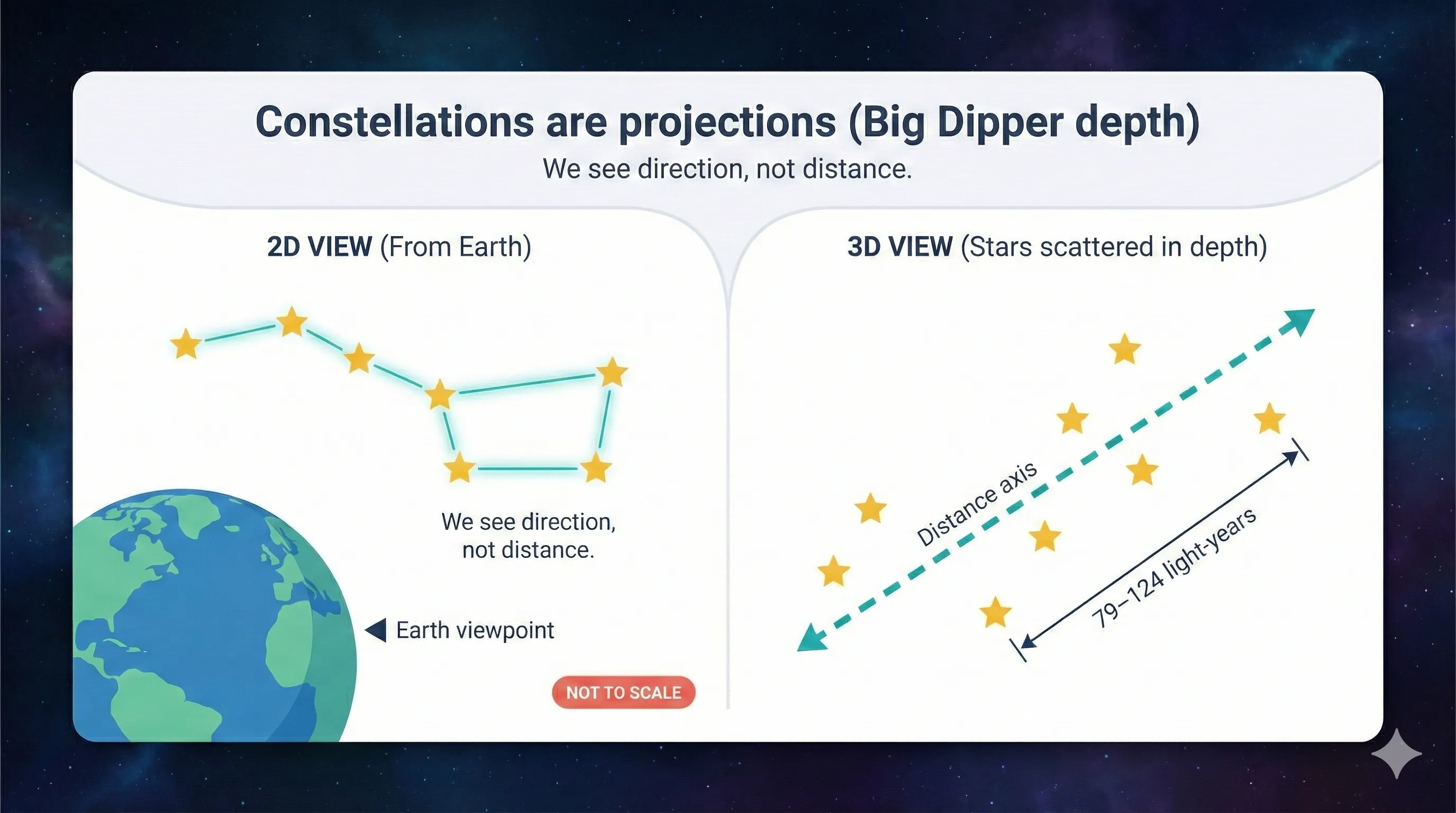
Illustration showing constellation lines drawn on stars, emphasizing that the pattern is a projection on the sky rather than a physical cluster.
Credit: (A. Rosen/Gemini)

The Big Dipper looks like a family.

But these stars aren’t neighbors in space.

They range from 79 to 124 light-years away.

The pattern exists only because they lie along similar directions from Earth.

Today’s Learning Objectives

By the end of today, you’ll be able to:

  • Explain why the sky is a map of directions, not distances
  • Use the celestial sphere to locate objects: horizon, zenith, poles, equator, ecliptic
  • Explain seasons as axial tilt (sun angle + day length), not changing distance
  • Interpret solstices and equinoxes geometrically
  • Use angular size reasoning to compare sizes and distances

The Celestial Sphere

A Map of Directions

The Problem: No Depth Perception

Look up at the night sky. You see points of light scattered across a dark dome.

Here’s the fundamental problem:

Your eyes can’t tell you whether a star is
close and dim or far and luminous.

The sky gives us directions by default.
Measuring distances requires extra work.

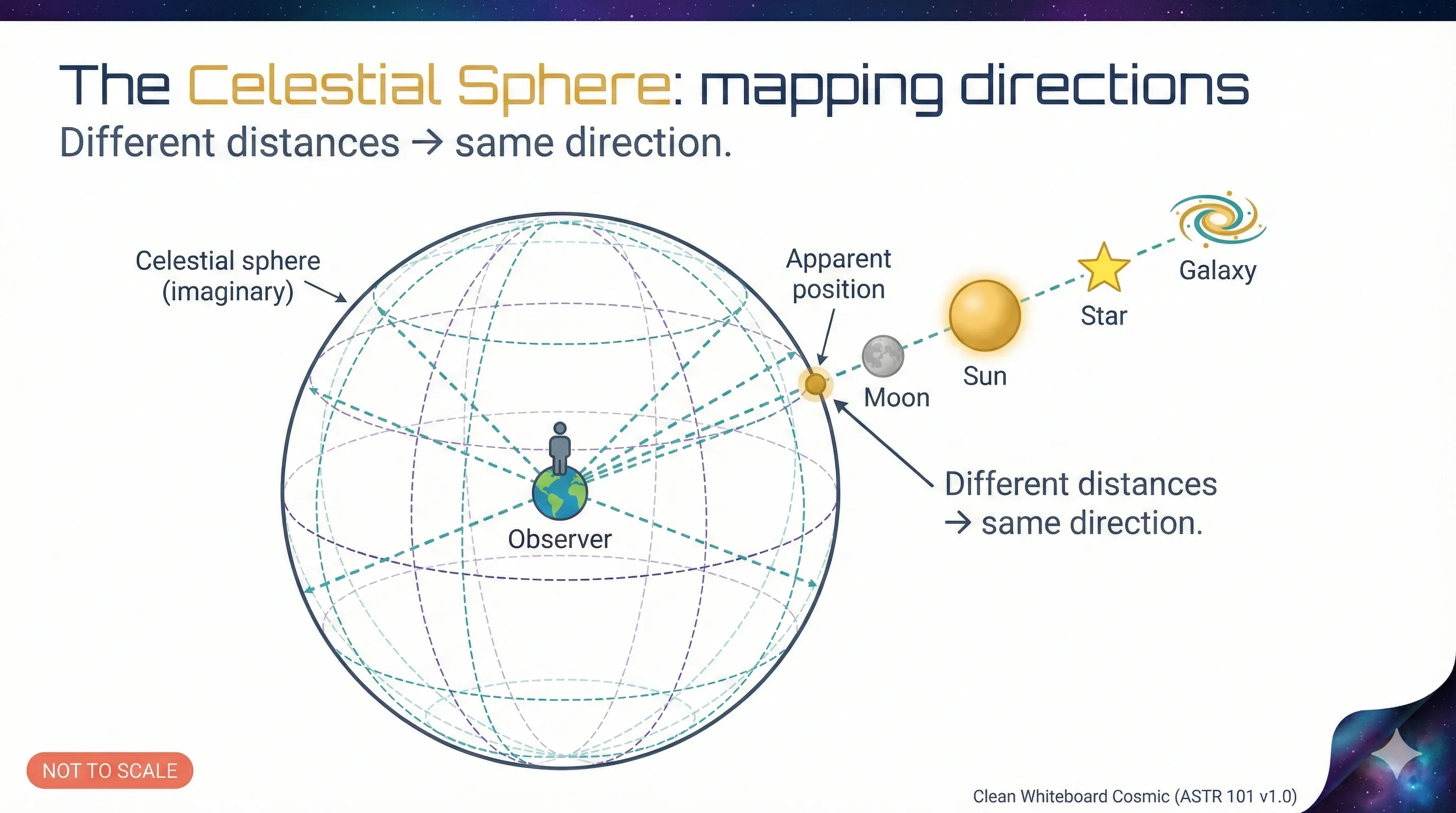
The Celestial Sphere

Diagram of the celestial sphere showing cardinal directions and the observer’s horizon-based coordinate system.
Credit: (A. Rosen/Gemini)

Imagine standing at the center of a vast, transparent globe.

Every star, planet, and galaxy can be located by pointing in some direction.

Key insight: The celestial sphere doesn’t represent where things are — it represents where to look.

Reference Points on the Sky
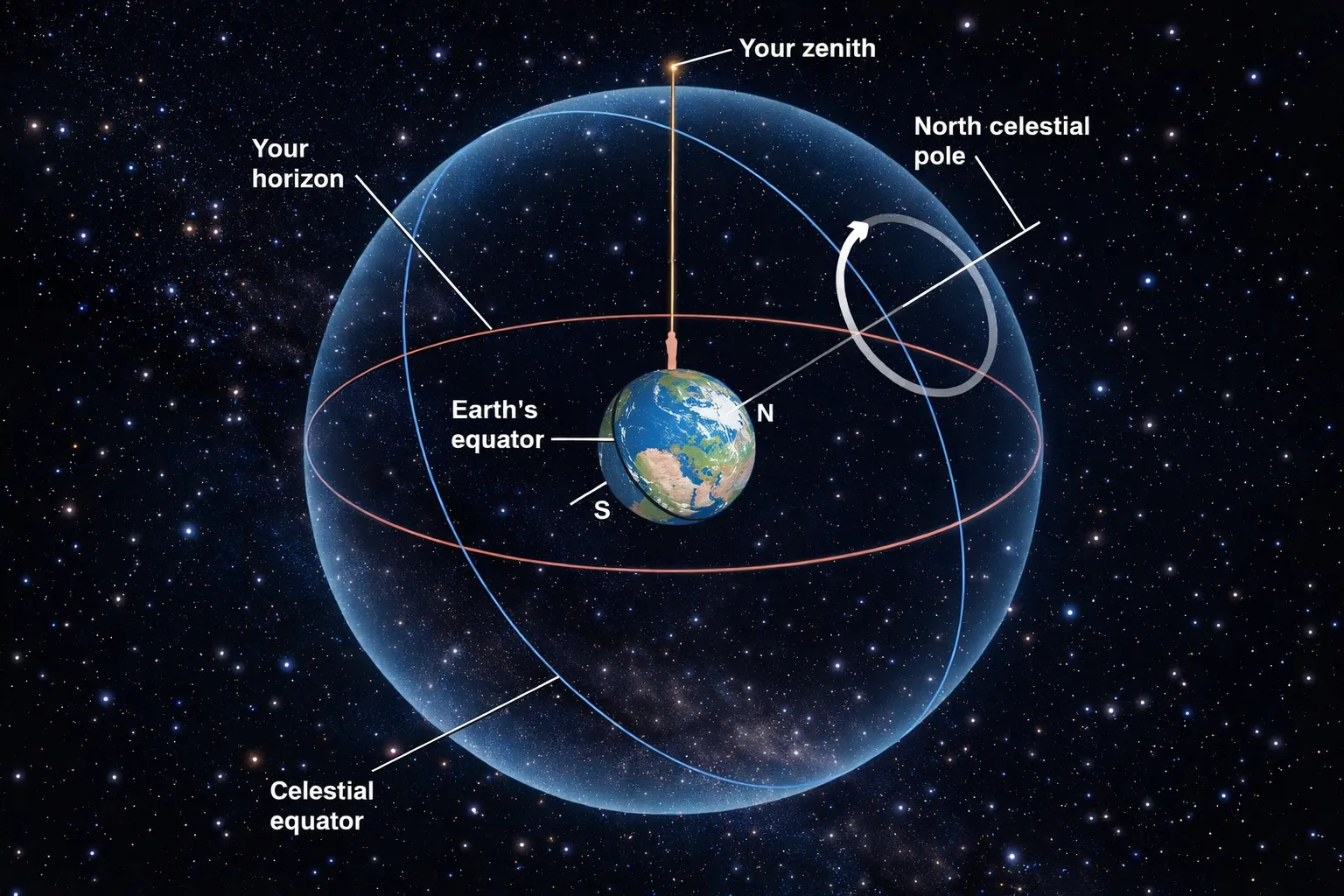
Diagram illustrating great circles and reference points on the celestial sphere used for defining coordinates.
Credit: (A. Rosen/ChatGPT)
Point What It Is
Zenith Straight up from where you stand
Celestial poles Earth’s rotation axis extended to the sky

Zenith is your local “up.”

North is a compass direction along the horizon — not the same as zenith!

Reference Circles on the Sky

Circle Definition What It Corresponds To
Celestial equator Earth’s equator projected onto the sky Divides N/S celestial hemispheres
Horizon Where sky meets ground Your local view (depends on location)
Ecliptic Sun’s yearly path across the sky Earth’s orbital plane projected onto sky

All three are great circles — they divide the celestial sphere into equal halves.

Celestial Coordinates

Coordinate Meaning Earth Analog
Declination (Dec) Angle N/S of celestial equator (−90° to +90°) Latitude
Right Ascension (RA) Position along equator (0–24h) Longitude

Why hours for RA?

24 hours = 360°, so 1 hour = 15°.

The sky appears to rotate once per day — hours match the clock.

Observable: Position on the sky (RA, Dec)

Model: Celestial sphere geometry

Inference: Where to point the telescope tonight

Two Circles That Matter

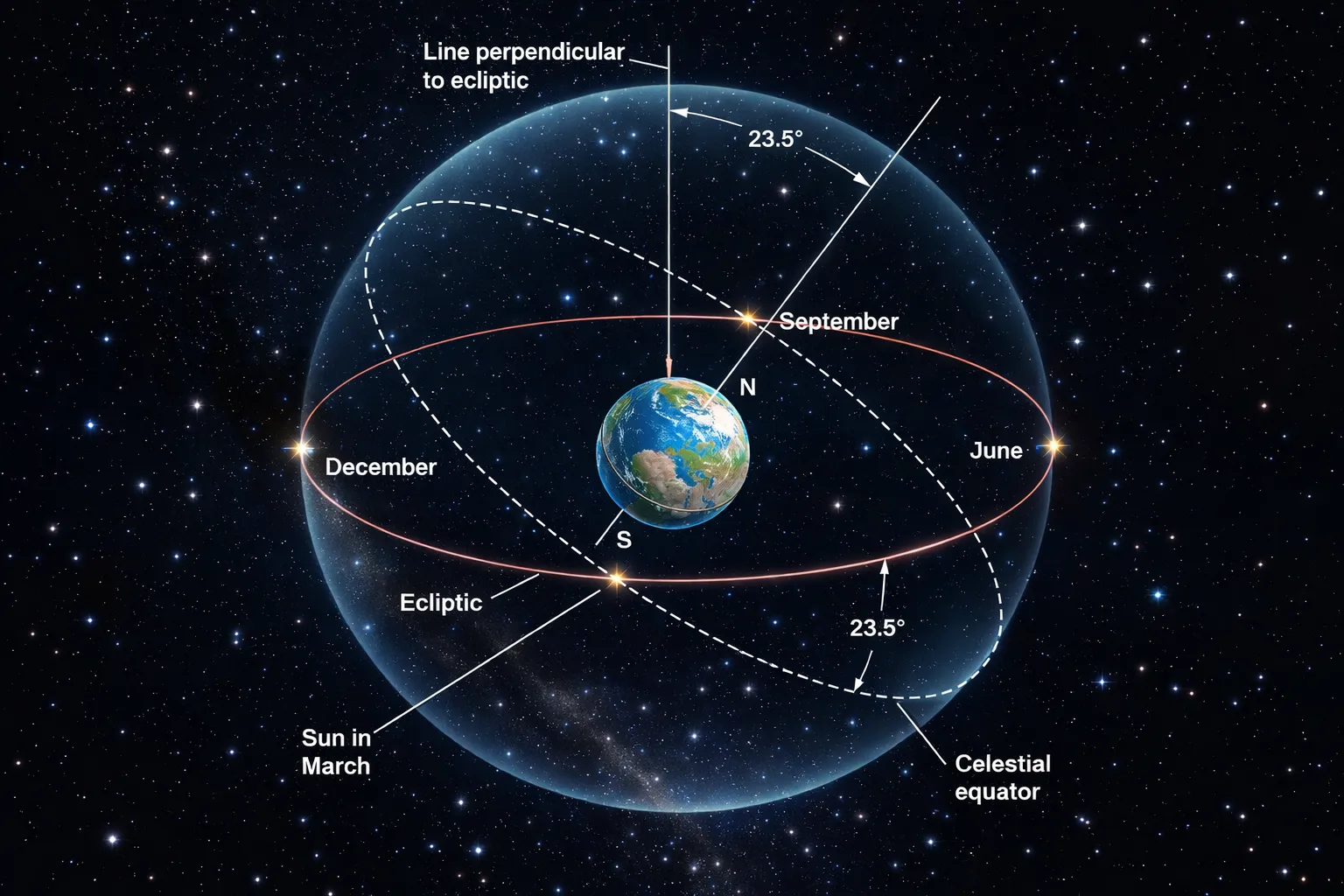
Diagram of the celestial sphere showing the ecliptic path relative to the celestial equator.
Credit: (A. Rosen/ChatGPT)

Celestial Equator: Defined by Earth’s rotation — perpendicular to the spin axis.

Ecliptic: Defined by Earth’s orbit — the Sun’s apparent yearly path.

The crucial point: These circles are tilted 23.5° relative to each other.

This tilt is why we have seasons.

Two Motions, Two Time Scales

Motion Cause Time Scale What You See
Daily arc Earth’s rotation 24 hours Sun rises east, sets west
Yearly drift Earth’s orbit 365 days Sun slides eastward along ecliptic

The daily arc is why the Sun is up during the day.

The yearly drift is why the Sun’s noon altitude changes with the seasons.

Quick Check: The Ecliptic

The ecliptic is:

Seasons: Tilt, Not Distance

The Misconception That Won’t Die

The Common Misconception

Diagram contrasting the incorrect distance-based seasons idea with the tilt-based explanation involving sunlight angle and day length.
Credit: (A. Rosen/Gemini)

“Earth is closer to the Sun in summer.”

This is wrong — but it’s a reasonable first guess.

Surveys show many college students and adults believe this.

The Proof: Opposite Hemispheres

If distance caused seasons:

Both hemispheres would have summer at the same time — when Earth is closest to the Sun.

What we observe:

When it’s summer in the Northern Hemisphere, it’s winter in the Southern Hemisphere.

The hemispheres have opposite seasons.

Conclusion: Distance cannot be the cause.

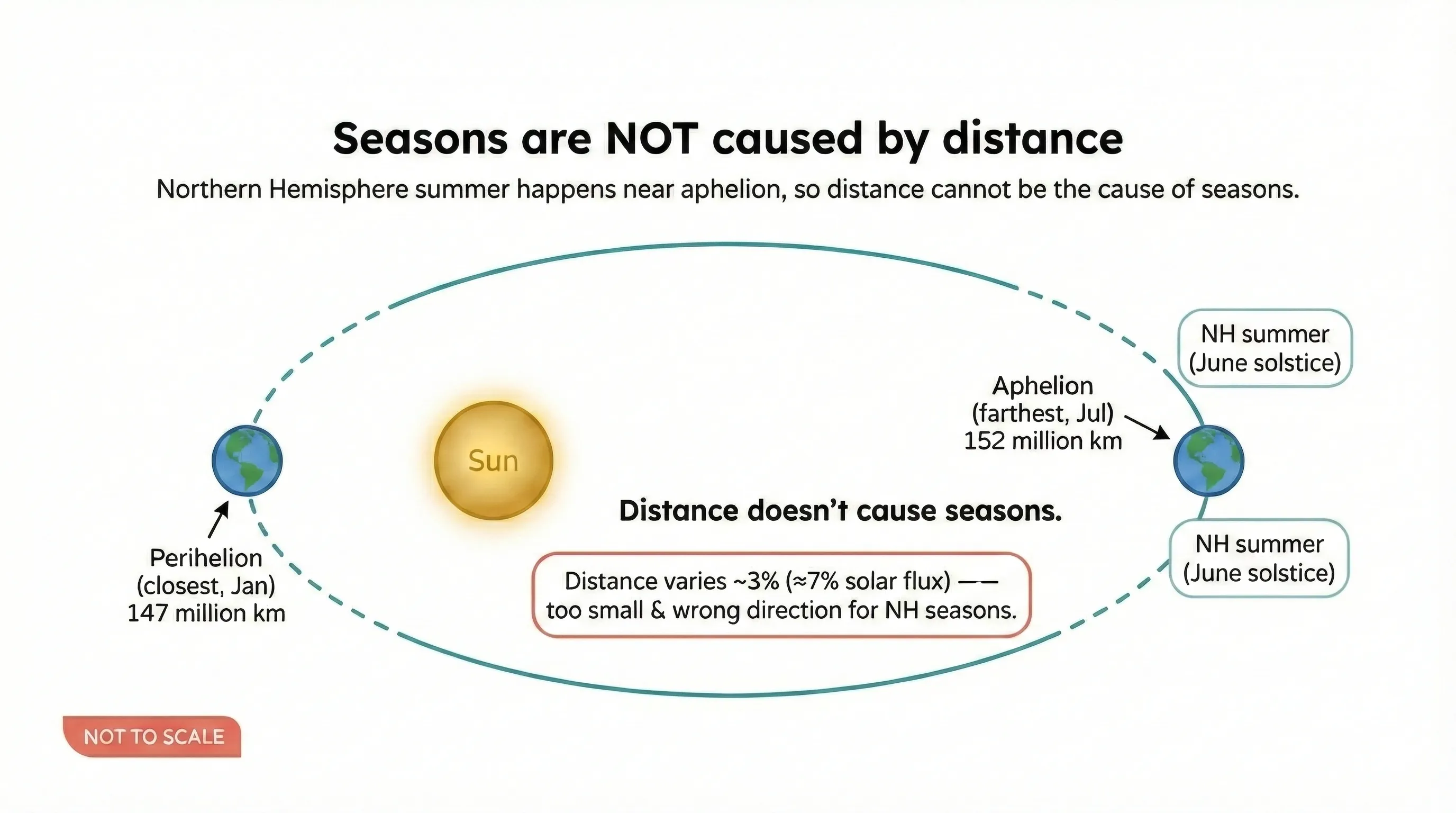
The Numbers Don’t Work Either

  • Earth’s distance from the Sun varies by only ~3% over the year
  • Perihelion (closest): 147 million km — in January
  • Aphelion (farthest): 152 million km — in July
  • This 3% distance change affects solar flux by only ~7%

The irony: Earth is farthest from the Sun during Northern Hemisphere summer!

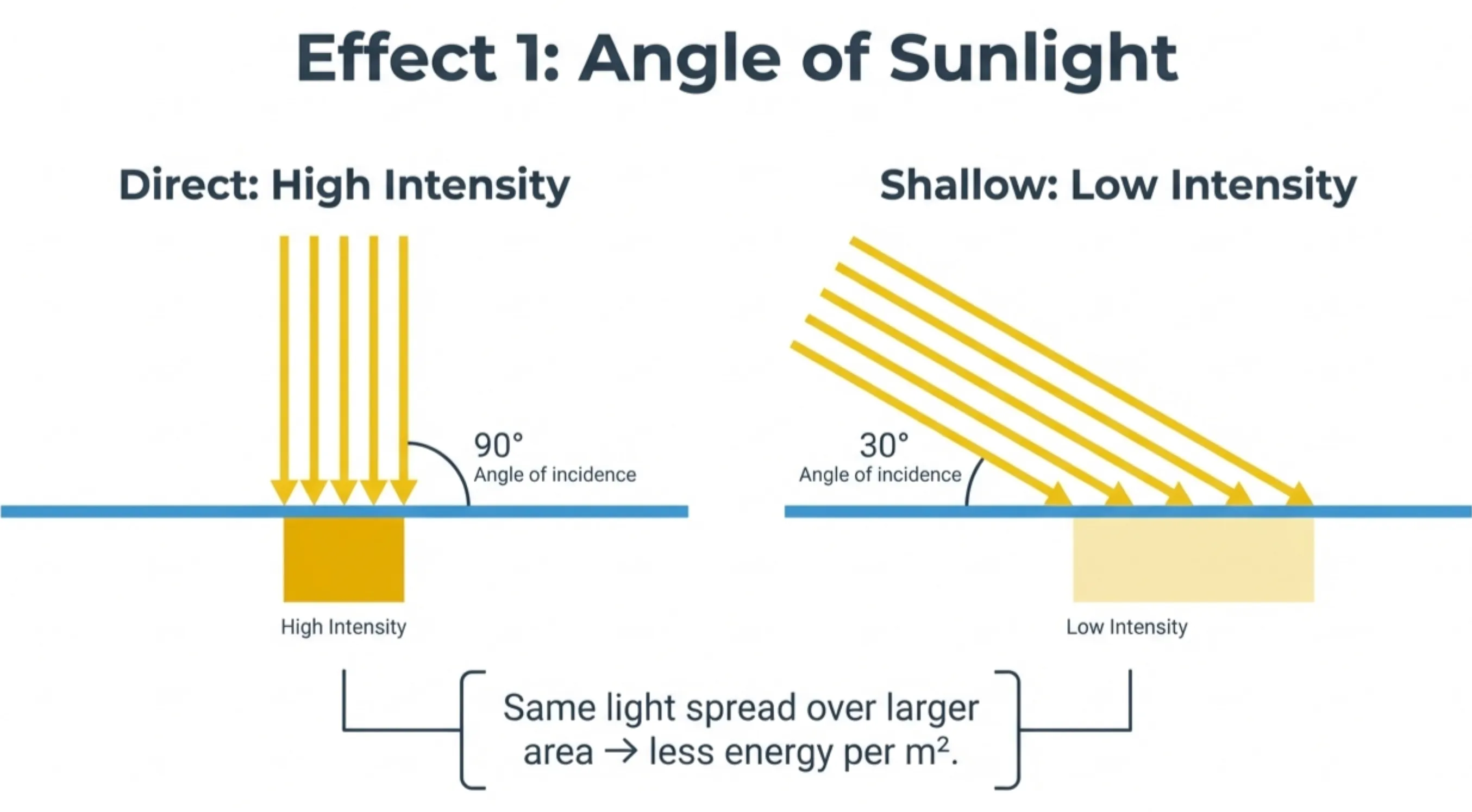
The Real Mechanism: Effect 1

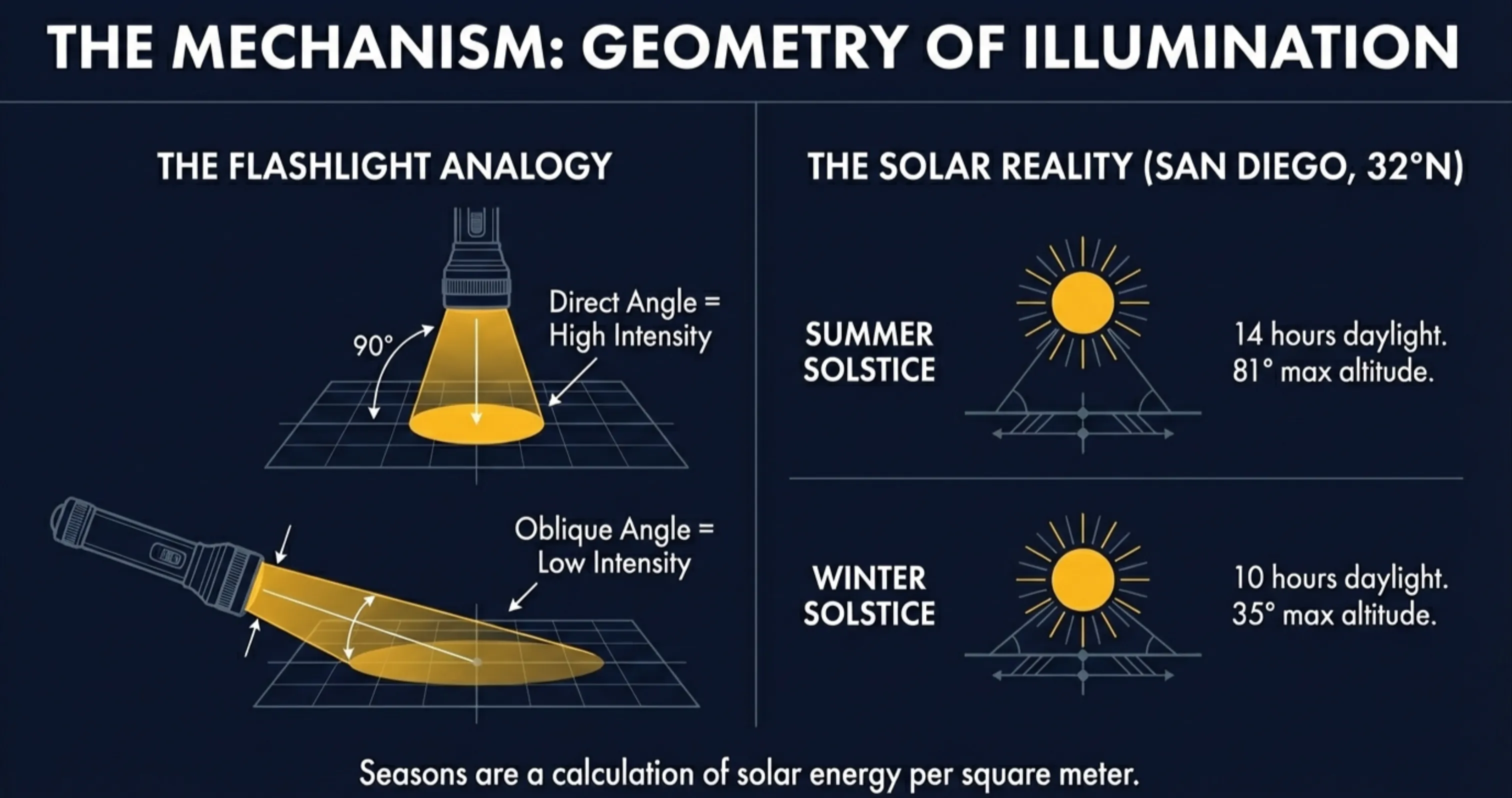
Diagram showing sunlight hitting at a steep angle versus a shallow angle, spreading the same energy over a larger area at shallow incidence.
Credit: (A. Rosen/NotebookLM)

Sunlight Angle

When the Sun is higher in the sky, its rays hit the ground more directly.

Flashlight analogy:

  • Straight down → bright circle
  • Tilted → same light spreads over larger area
  • Less energy per square meter

The Real Mechanism: Effect 2
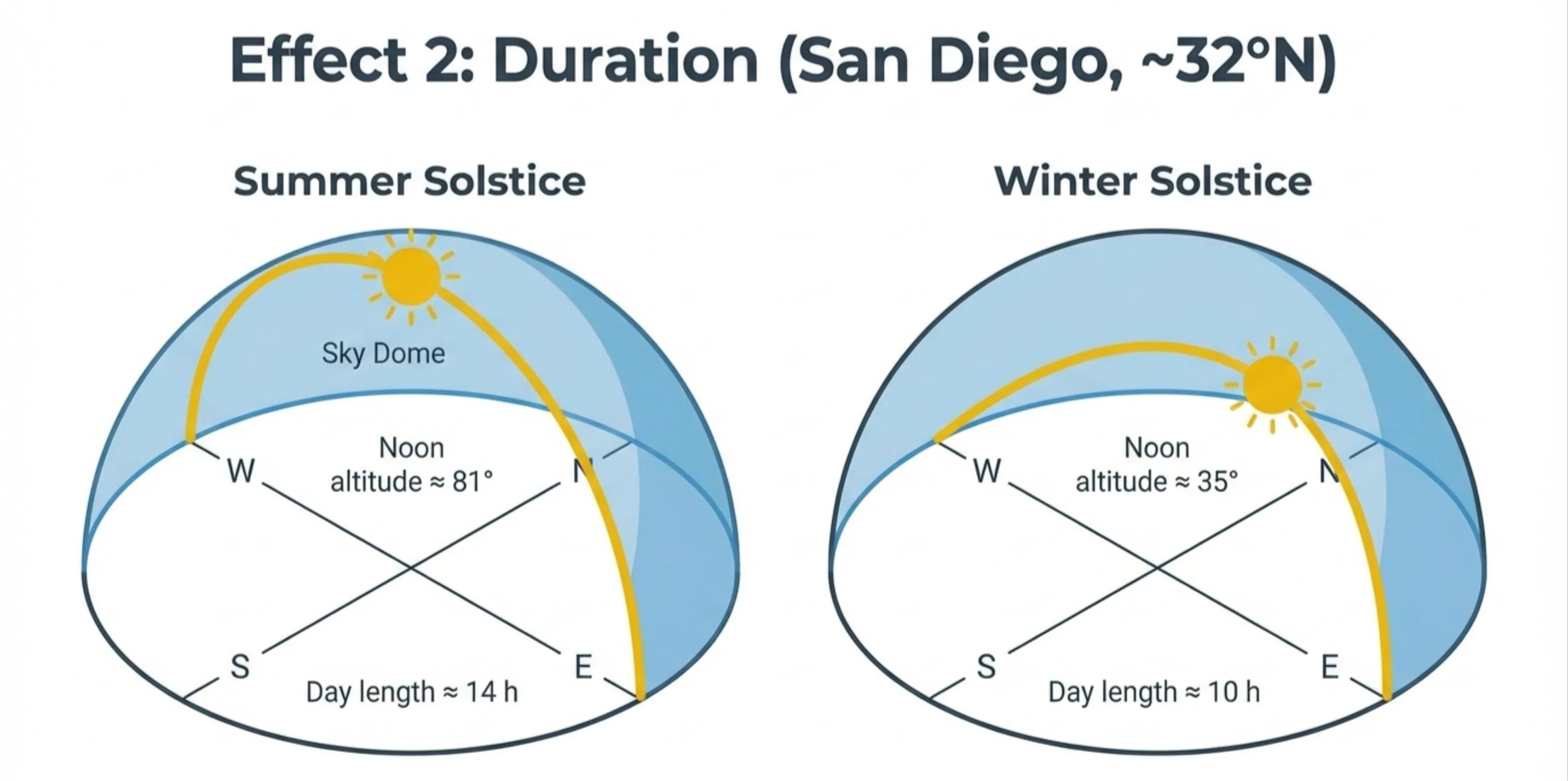
Diagram showing longer versus shorter daylight duration and differing Sun paths across the sky in different seasons.
Credit: (A. Rosen/NotebookLM)

Day Length

When your hemisphere tilts toward the Sun, the Sun takes a longer path across your sky.


San Diego (~32°N):

Season Day Length Noon Altitude
Summer solstice ~14 hours ~81°
Winter solstice ~10 hours ~35°

The Bottom Line

Earth–Sun geometry diagram showing axial tilt and how it changes which hemisphere is tilted toward the Sun.
Credit: (A. Rosen/NotebookLM)

Observable: Sun’s noon altitude and day length change through the year

Model: Earth’s 23.5° axial tilt

Inference: Seasons are about solar energy per square meter per day

Tilt changes this through:

  1. Sun angle (how concentrated)
  2. Day length (how many hours)

Quick Check: Summer Sun Path

During summer in your hemisphere, the Sun:

Solstices and Equinoxes

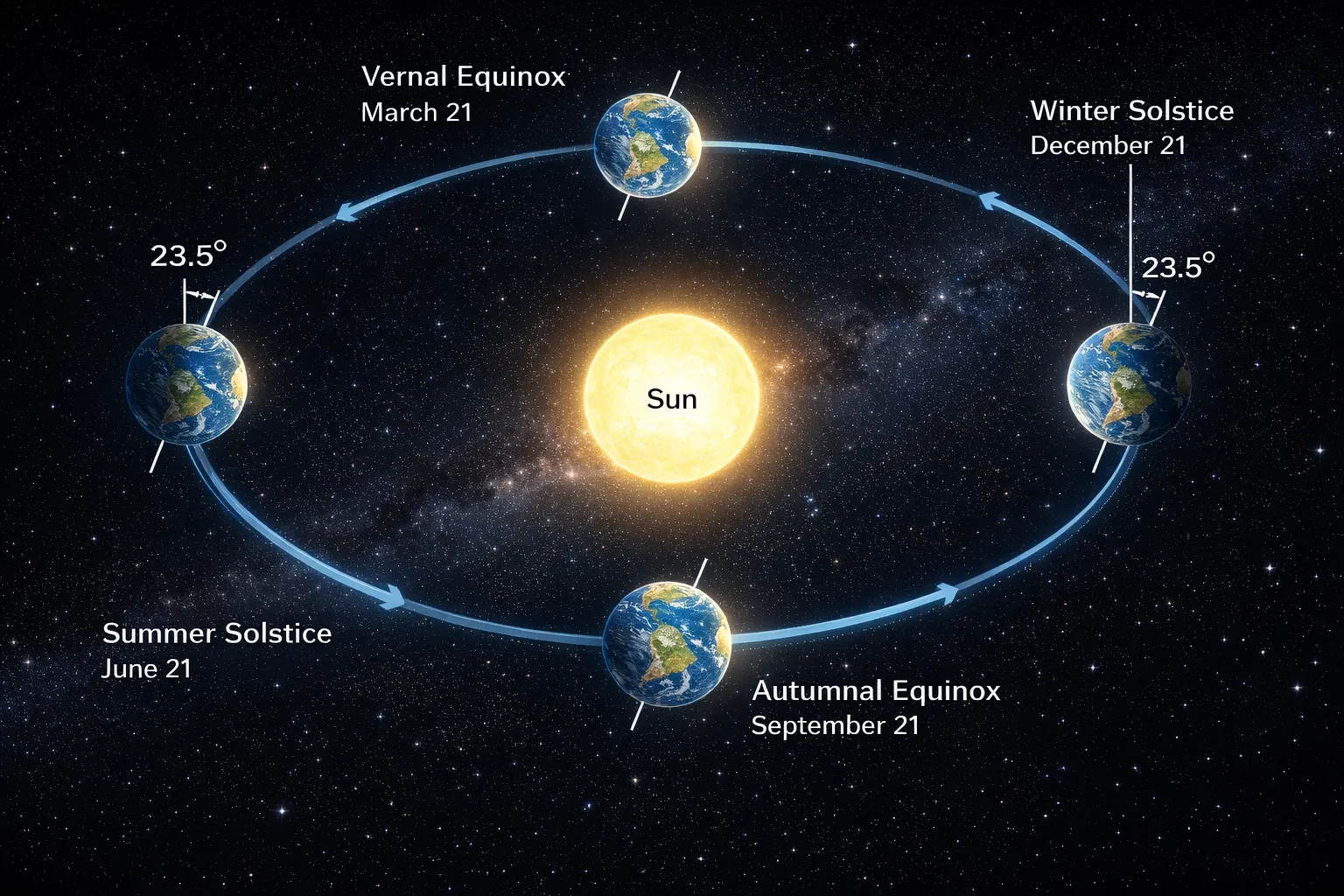
Diagram of Earth’s orbit showing axial tilt maintained in space and indicating seasonal orientation.
Credit: (A. Rosen/ChatGPT)

Equinox = day ≈ night everywhere

Solstice = Sun “stands still” at extreme

Event Date What Happens
March Equinox ~Mar 20 Sun crosses equator going north
June Solstice ~Jun 21 Sun farthest north; longest NH day
Sept Equinox ~Sep 22 Sun crosses equator going south
Dec Solstice ~Dec 21 Sun farthest south; shortest NH day

Demo: Seasons Explorer

Demo Mission 1: Test the Distance Hypothesis

  • Click through the 4 season presets
  • Record the Earth-Sun Distance for each
  • Is Earth closer during NH summer or winter?

(You should find Earth is farthest from the Sun in July — the opposite of what distance hypothesis predicts!)

Demo Mission 2: The Real Mechanism

With display overlays on:

  • Go to June Solstice vs December Solstice
  • Record Day Length and Sun Altitude for both
Season Day Length Sun Altitude
June Solstice _____ _____
December Solstice _____ _____

Key question: What changes between June and December that explains the temperature difference?

Angular Size

How Big Things Look

The Fundamental Insight

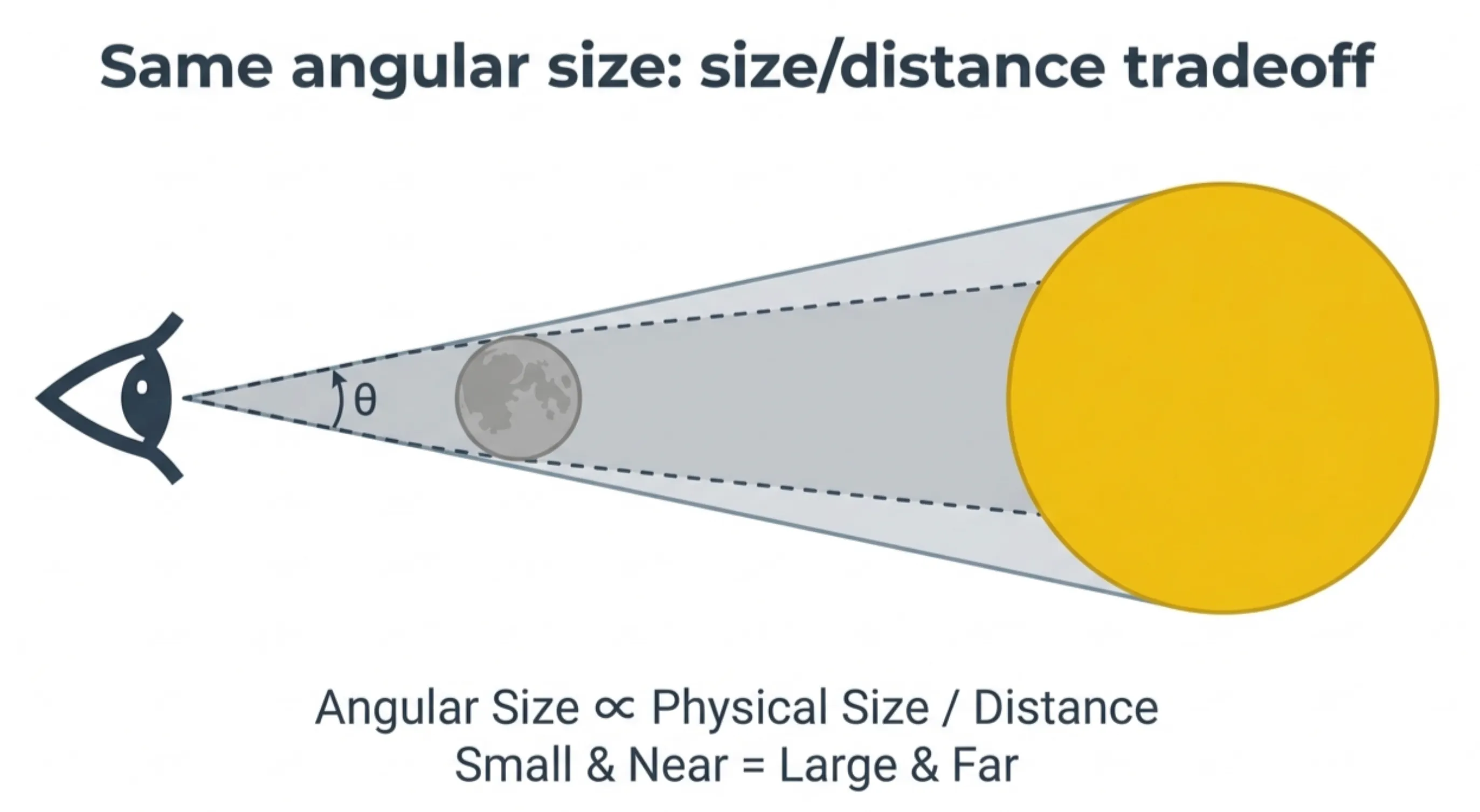
Diagram illustrating that the same angular size can result from a small nearby object or a large distant object.
Credit: (A. Rosen/NotebookLM)

How big is the Moon?

In kilometers: 3,474 km diameter.

But that’s not what you see.

What you see is how much of your field of view it occupies — its angular size.

The Moon’s angular size: ~0.5°

Angular Units

Unit Relation Example
1 degree (°) Base unit Thumb width at arm’s length ≈ 2°
1 arcminute (’) 1° = 60’ Human eye resolution ≈ 1’
1 arcsecond (“) 1’ = 60” Telescope territory

Useful conversion:

0.5° = 30’ = 1800”

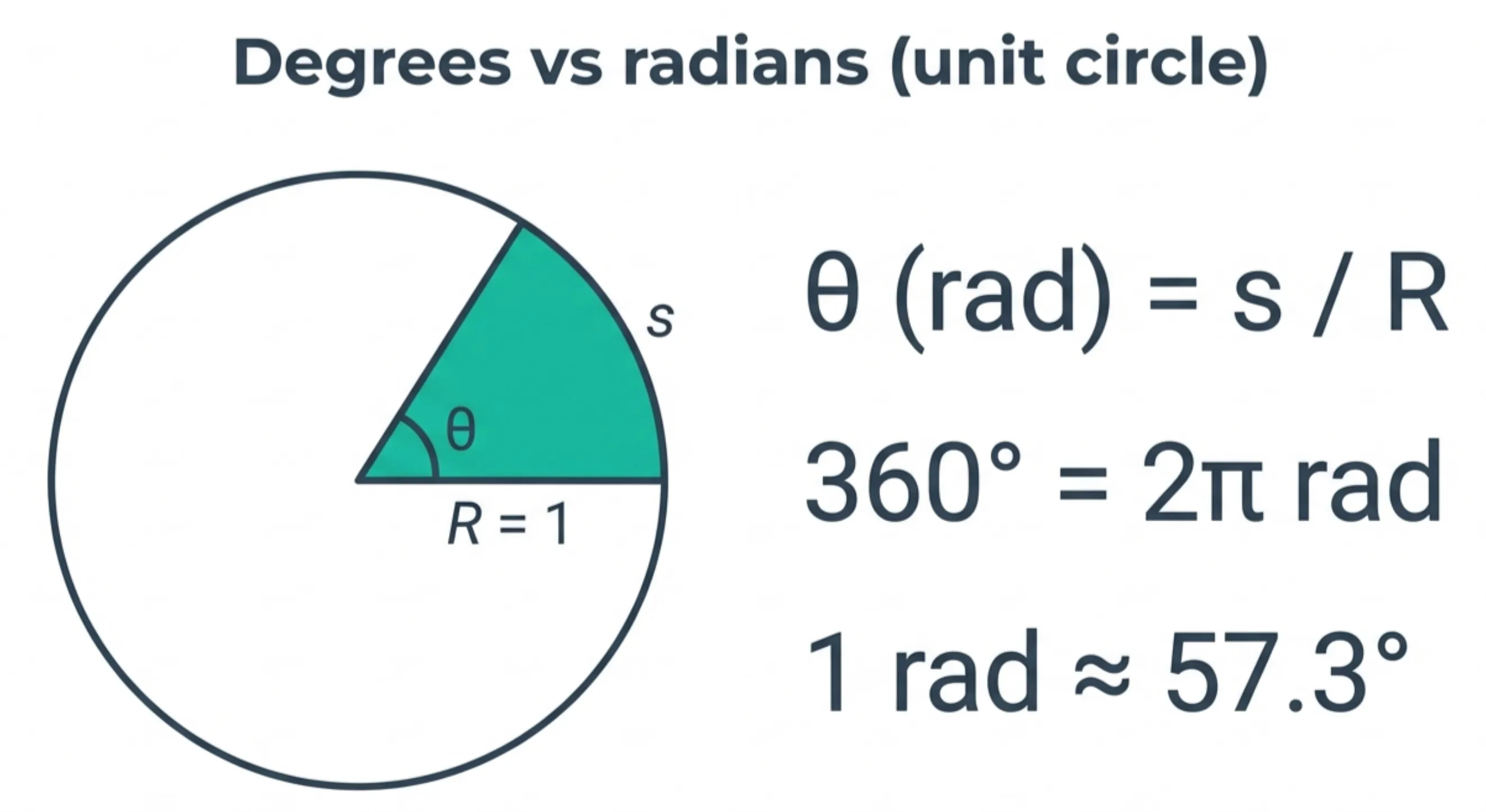
Unit circle diagram comparing degree measures to radian measures and emphasizing arc length definition of radians.
Credit: (A. Rosen/NotebookLM)

A radian is defined by \(θ =\) arc/radius.

1 radian ≈ 57.3°

The Small-Angle Formula

For small angles (less than a few degrees):

\[\boxed{\theta = \frac{D}{d} \quad \text{(radians)}}\]

To convert to degrees:

\[\boxed{\theta_{\text{degrees}} = 57.3° \times \frac{D}{d}}\]

where \(D\) = physical diameter, \(d\) = distance

Key insight: Angular size depends on both physical size and distance.

A large object far away can look the same as a small object nearby.

Worked Example: The Moon

  • Moon’s diameter: \(D = 3474\) km
  • Moon’s distance: \(d = 384{,}000\) km
  • Angular size: \(\theta = 57.3° \times \frac{3474 \text{ km}}{384{,}000 \text{ km}} = 57.3° \times 0.00905\)
  • Result: θ ≈ 0.52° (about half a degree)

That’s roughly half the width of your pinky finger at arm’s length.

The Sun-Moon Coincidence

The Sun:

  • Diameter: ~1,400,000 km
  • Distance: ~150,000,000 km
  • Angular size: ~0.53°

The Moon:

  • Diameter: ~3,474 km
  • Distance: ~384,000 km
  • Angular size: ~0.52°

The Sun is 400× larger but also 400× farther.

The factors cancel — they appear almost exactly the same size!

Why This Matters

Because of this coincidence, the Moon can just barely cover the Sun completely.

Total solar eclipses are possible.

We see the Sun’s corona — its outer atmosphere — only during these moments.

Quick Check: Same Angular Size

Two planets have the same angular size as seen from Earth. This means:

Demo: Angular Size Explorer

Explore:

  • Double the distance → what happens to angular size?
  • Double the physical size → what happens to angular size?
  • Compare Sun vs Moon (Today) presets
  • Watch the unit label (° / ′ / ″) when angles are tiny

You should find: distance ×2 → angular size ÷2 (inverse relationship)

A Cosmic Privilege

  • The Moon is drifting away from Earth at 3.8 cm per year
  • We measure this with laser retroreflectors left by Apollo astronauts
  • Billions of years ago, the Moon appeared much larger
  • In ~600 million years, the Moon will appear too small to fully cover the Sun

We live in a privileged cosmic moment: the only era when total solar eclipses are possible.

Connecting the Concepts

The Through-Line: Geometry

  • Celestial sphere: The geometry of directions in the sky
  • Seasons: The geometry of illumination from Earth’s tilt
  • Angular size: The geometry of apparent size from distance

Observable: Positions, angles, apparent sizes

Model: 3D geometry of Earth, Sun, Moon, stars

Inference: Real physical properties and motions

Looking Ahead: Lecture 4

Next time: Moon Phases and Eclipses

We’ll apply angular size to understand:

  • Why the Moon appears to change shape each month
  • Why eclipses don’t happen every month
  • The difference between total, annular, and partial eclipses

Preview: Moon phases are NOT caused by Earth’s shadow. (The geometry will prove it.)

Takeaways

What to recognize:

  1. The sky is a map of directions, not distances — that’s the celestial sphere
  2. Seasons are caused by axial tilt (sun angle + day length), not distance
  3. Angular size depends on both physical size AND distance
  4. The Sun-Moon angular size match is a coincidence that enables total eclipses

Recognition, not retention — you should be able to identify these ideas when they return.

Reading & Practice

Before next class:

  • Complete the Lecture 3 Reading (includes demo explorations)
  • Work through the Check Yourself questions (some will be assigned for homework)
  • Try at least 3 Practice Problems
  • Read or skim the Lecture 4 Reading

Questions?