Phases, Eclipses, and
Why Shadows Rarely Matter
January 28, 2026
If you can’t scan: open the link and enter the course code ASES.
Two questions that secretly have the same answer:
Why does the Moon change shape?
Why don’t we get eclipses every month?
Geometry. (Not vibes.)
By the end of today, you’ll be able to:
Open NotebookLM: notebooklm.google.com
Make your notebook (now):
Example source URL to add: https://astrobytes-edu.github.io/astr101-sp26/modules/module-01/readings/lecture-04-moon-geometry-reading.html
Why NotebookLM:
Caveats: Study tool only. Don’t use it to generate graded solutions. If it doesn’t cite the reading, treat it as untrusted and go back to the source.
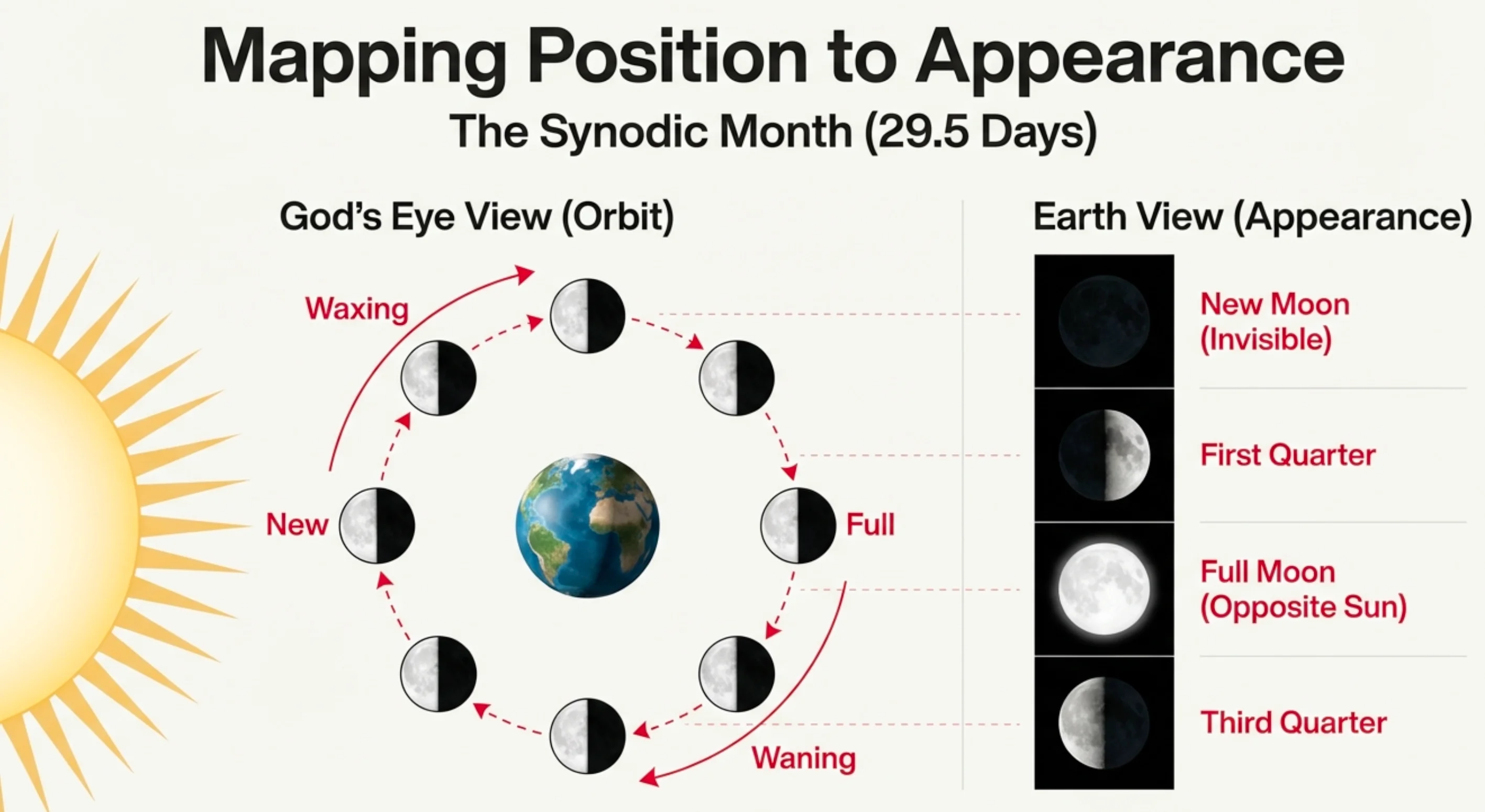
Moon phases are caused by:
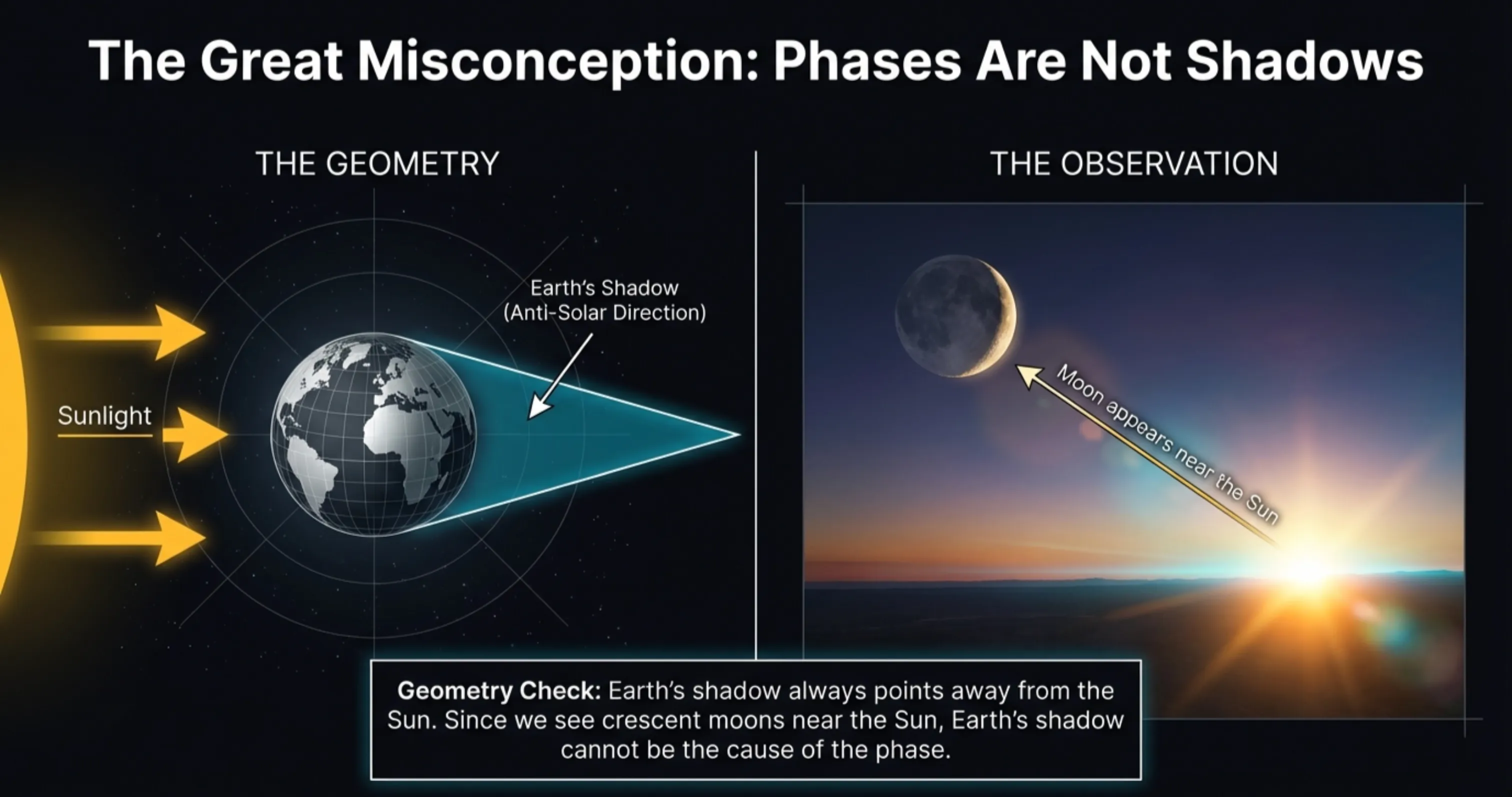
Phases are not Earth’s shadow.
If phases were Earth’s shadow, we’d have an “almost-eclipse” basically every night.
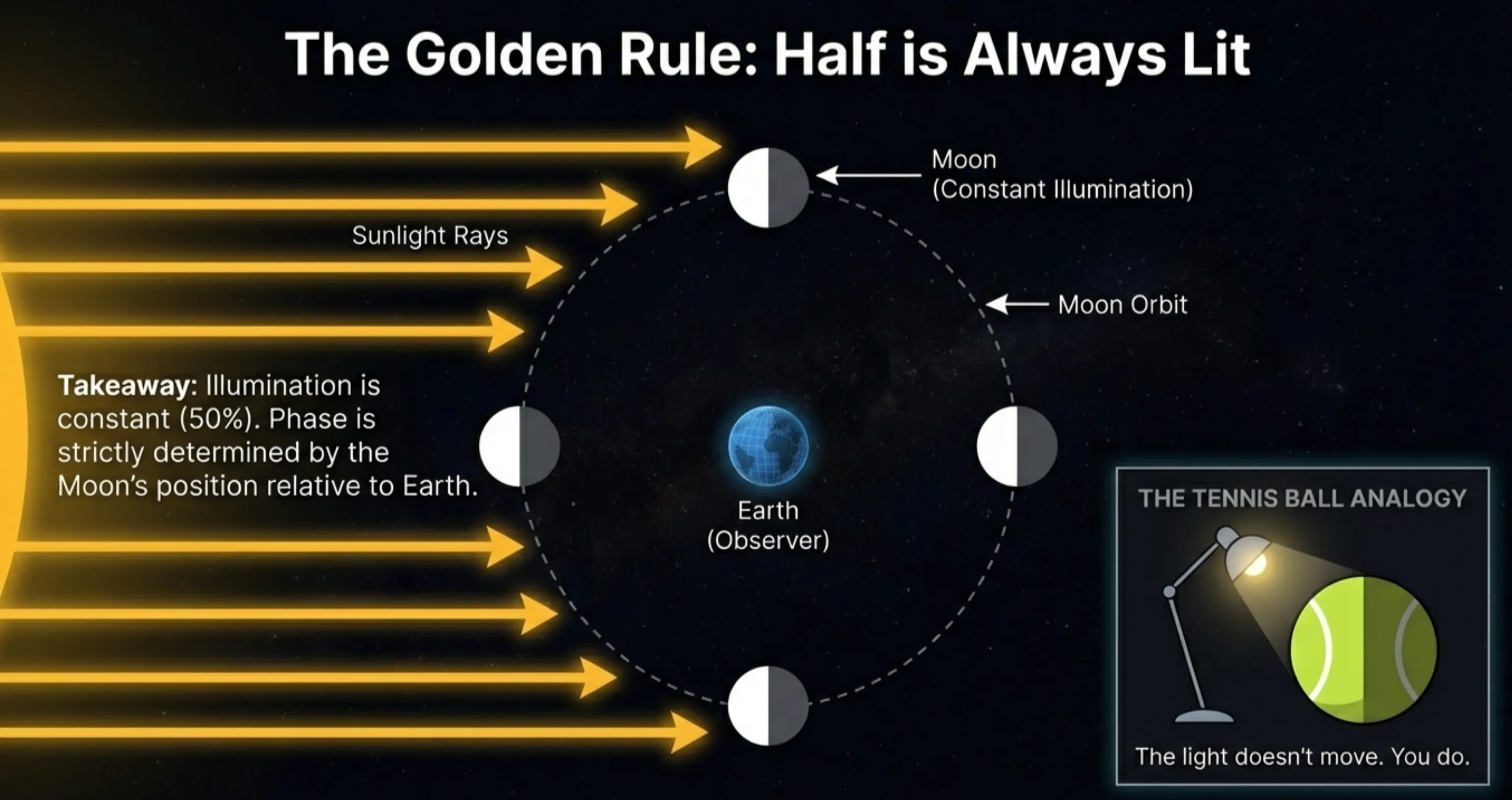
The Sun illuminates half of the Moon at all times.
The phase is: how much of that lit half you can see from Earth.
Imagine a tennis ball under one lamp:
Moon phases are this exact demo — just with the Sun as the lamp and Earth as your viewpoint.
Sidereal month ≈ 27.3 days (relative to the stars)
Synodic month ≈ 29.5 days (new → new)
Earth moves around the Sun, so the Sun-direction shifts during one Moon orbit.
The Moon must catch up to re-align → about 2 extra days.
Main takeaway: phases track the Sun-direction, not the background stars.
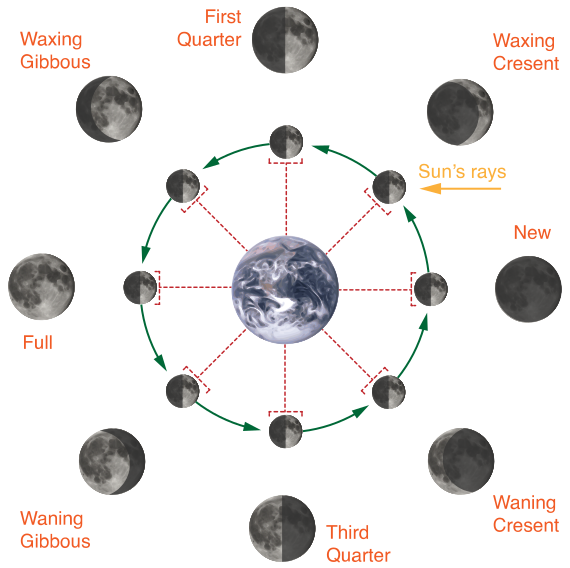
At first quarter, the Moon is:
Waxing = getting brighter each night
Waning = getting dimmer each night
Growing/waning is about time direction, not left vs right on the Moon.
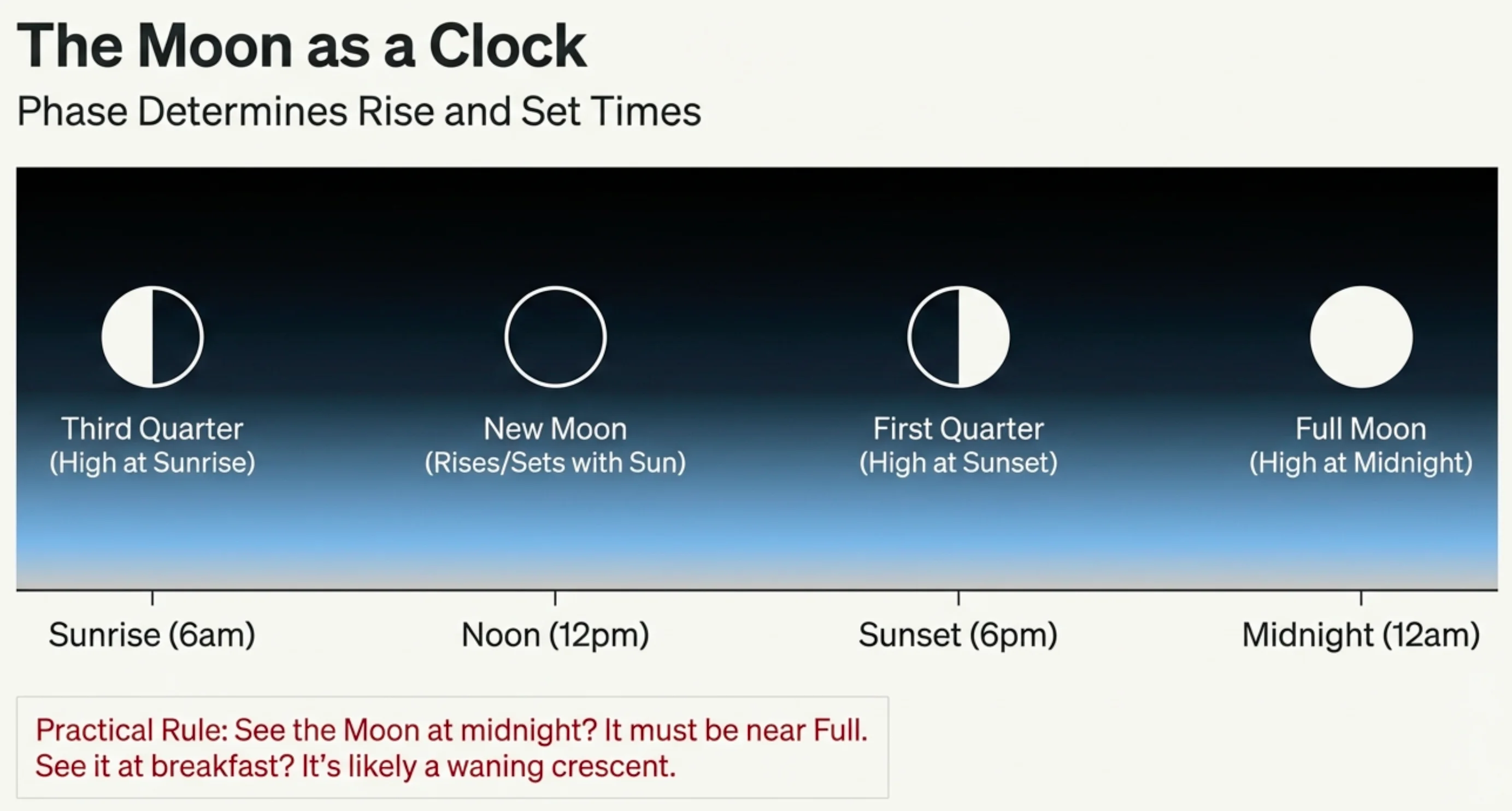
If you know the time and you can estimate the phase, you can usually predict where to look.
You see a crescent Moon low in the western sky just after sunset. Is it waxing or waning?
It’s midnight, and the Moon is highest in the sky. What phase is it?
✏️ 60-second sketch
Draw sunlight coming from the left, Earth in the middle, and the Moon in four positions: new, first quarter, full, third quarter.
Then: for each Moon, shade the half away from the Sun and ask: what fraction of the lit half can Earth see?
When you’re done: compare with a neighbor. If your sketches disagree, decide which one has the lit half always facing the Sun.
Open the Moon Phases demo:
Do three quick checkpoints:
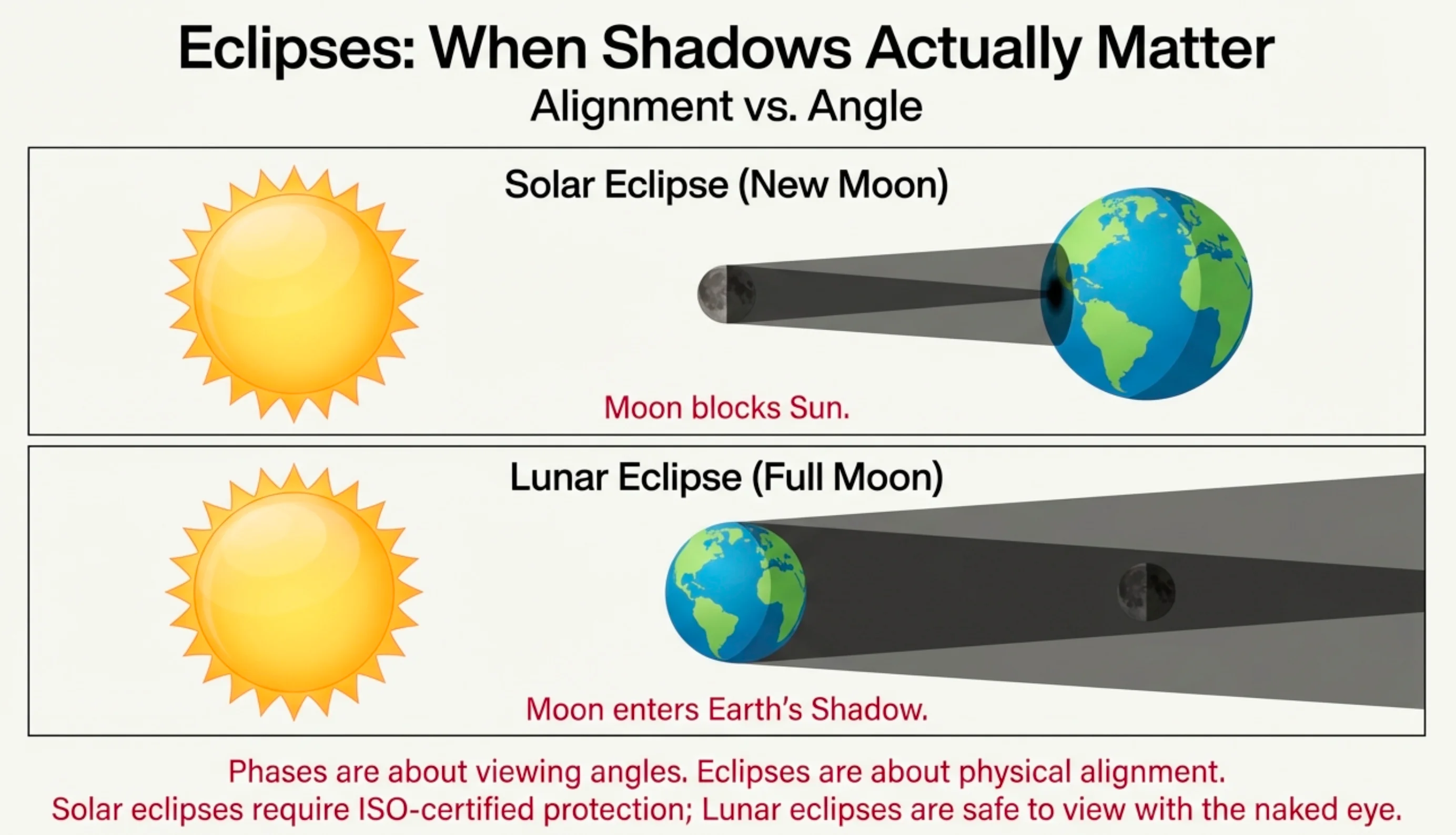
Eclipses: when shadows actually matter
During a solar eclipse, the Moon must be at:
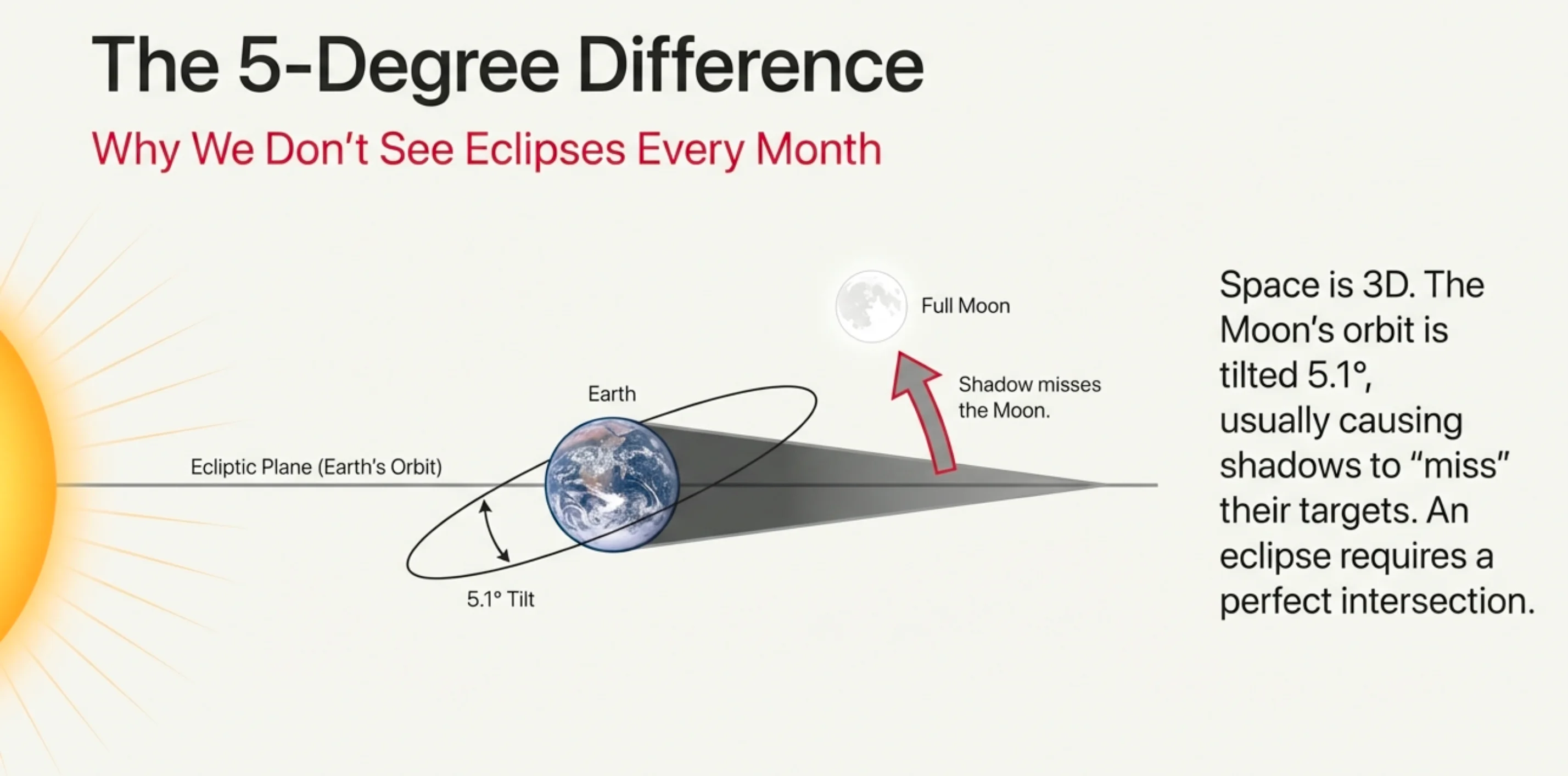
If eclipses happen at new and full moon…
…why don’t we get two eclipses every month?
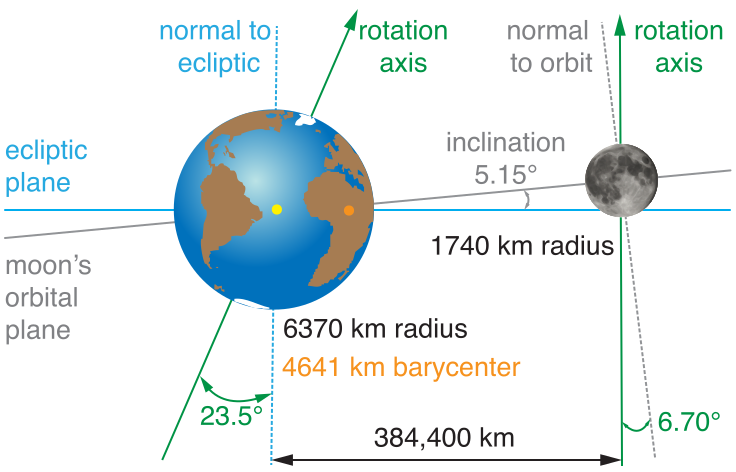
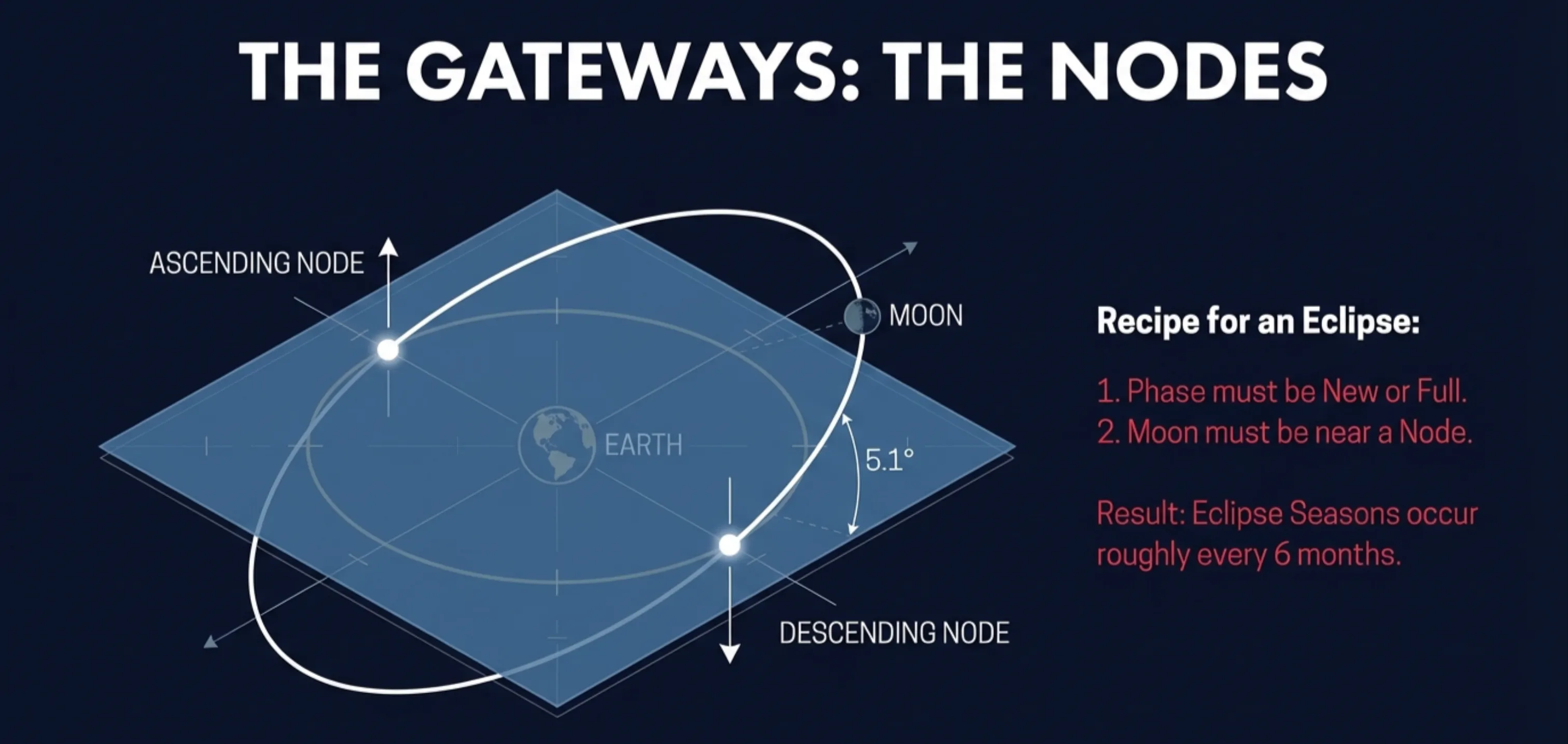
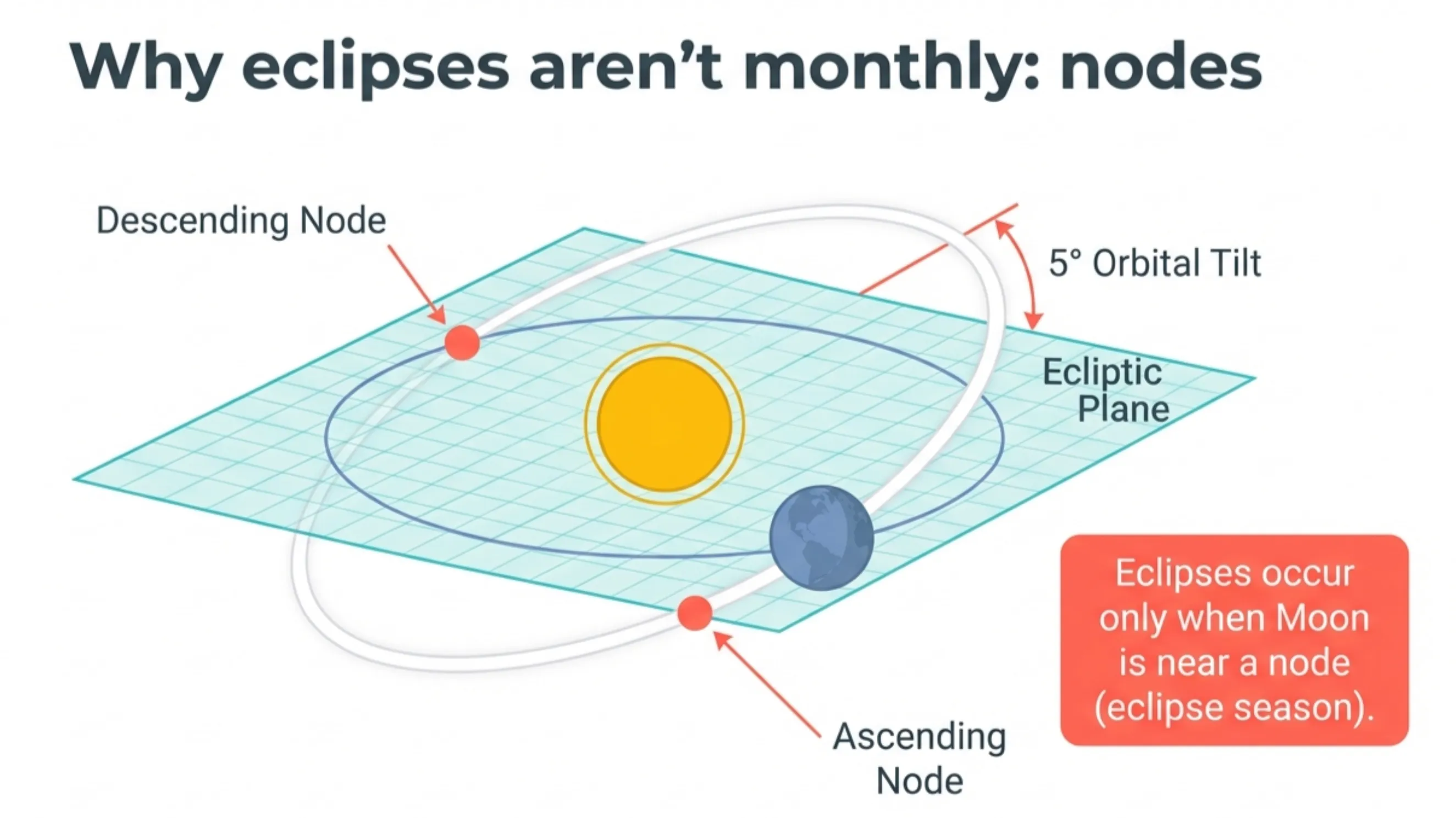
Because the Moon’s orbit is tilted by about 5° relative to the ecliptic.
Most months, the Moon passes a few degrees above or below the Sun (new moon) or Earth’s shadow (full moon).
Eclipses are only possible when the Moon is near a node (where its orbit crosses the ecliptic).
Open the Eclipse Geometry demo:
Two fast tests:
Eclipses don’t occur every month because:
✏️ 90-second sketch
Draw the ecliptic as a straight line. Draw the Moon’s orbit as a tilted loop crossing the ecliptic at two nodes.
Mark new moon and full moon positions both near a node and far from a node.
Circle the cases where an eclipse is possible.
When you’re done: hold up your paper (or show your neighbor) so we can check the logic quickly.
When the Sun is lined up near a node direction, eclipses become possible for a short window: an eclipse season.
Helpful reference numbers (global):
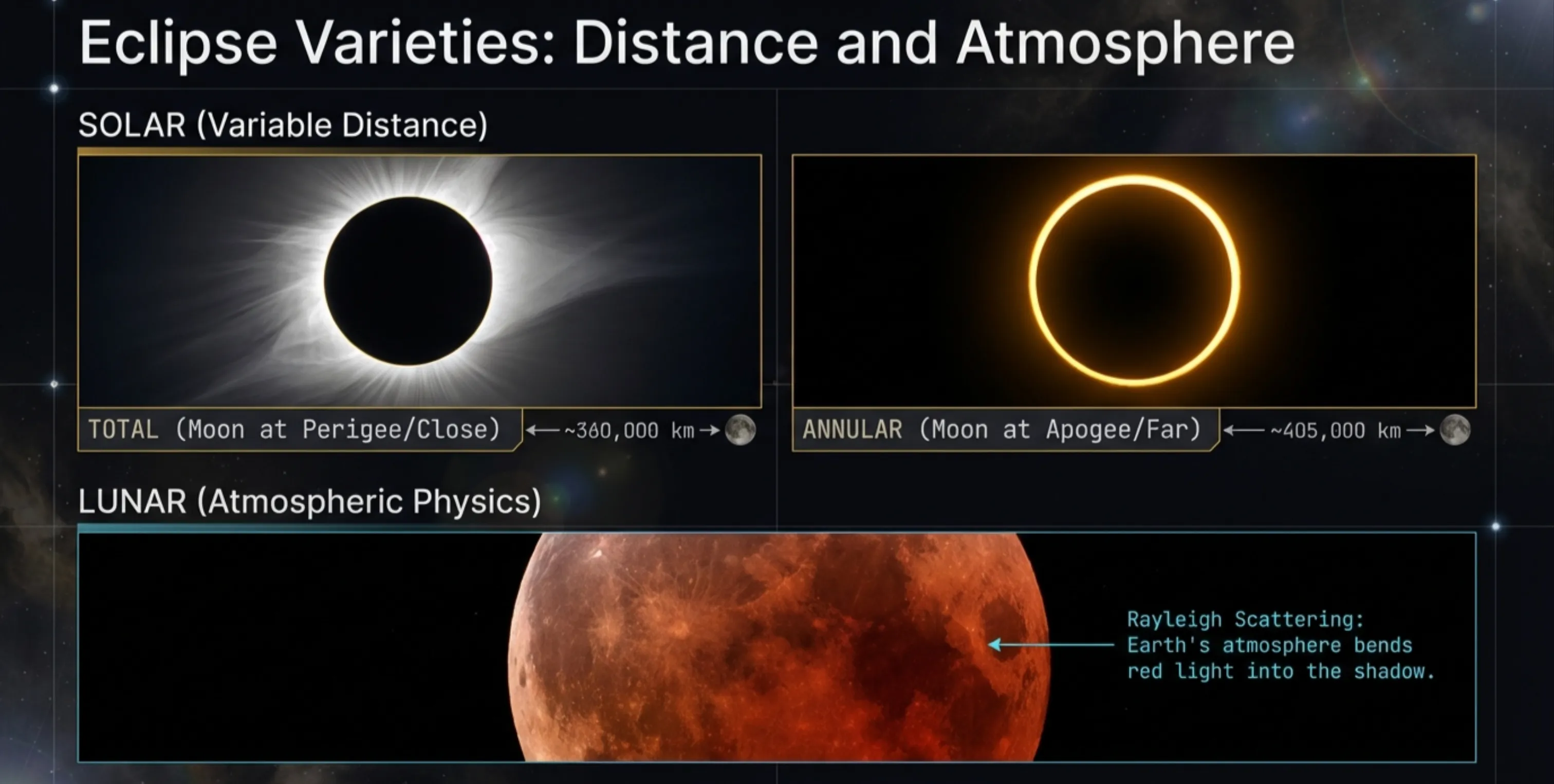
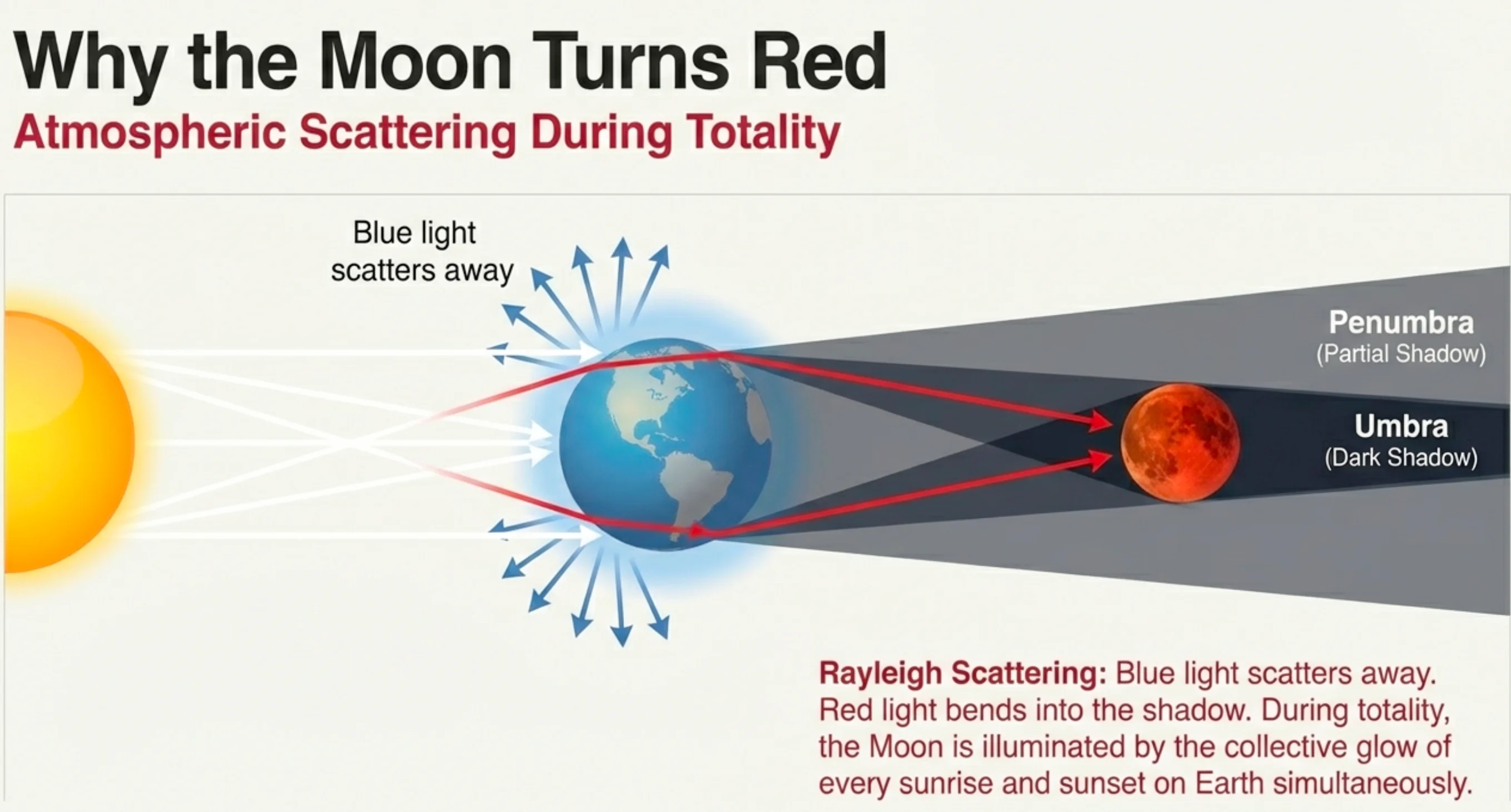
During a total lunar eclipse, the Moon is lit by sunlight filtered through Earth’s atmosphere.
Recall (Lecture 3): Sun and Moon are both about 0.5° across in our sky.
But the Moon’s distance changes — so its angular size changes.
If the Moon looks bigger than the Sun → total eclipse possible.
If the Moon looks smaller than the Sun → annular eclipse (ring).
If the Moon were 20% farther from Earth than it is now, solar eclipses would be:
Total solar eclipses are temporary.
The Moon is slowly receding from Earth (about 3.8 cm/year).
Far in the future, the Moon will look too small to fully cover the Sun.
Phases: not shadows → changing viewing angle of the Moon’s sunlit half.
Eclipses: shadows → rare alignment + near a node.
Total vs annular: angular size (Moon distance) decides whether the Sun can be fully covered.
✏️ 60 seconds: draw + explain
Draw the geometry for a lunar eclipse.
In one sentence: Why must it be full moon?

ASTR 101 • Lecture 4 • Dr. Anna Rosen