Newton’s Revolution
From Patterns to Physics
February 4, 2026
The Apple and the Moon
Does the force that pulls an apple to the ground…
also reach up to the Moon?
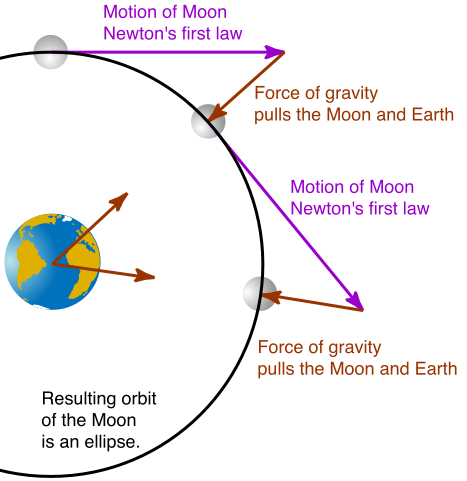
The Moon Is Falling
The Moon IS falling toward Earth.
Right now. Continuously. Every second.
But it’s moving sideways so fast that it keeps missing.
That combination of falling + moving sideways is what we call an orbit.
The Moon’s Orbit: Velocity + Inward Force
Two ideas at once:
- Sideways velocity carries the Moon forward
- Gravity pulls inward
The path curves because both happen continuously.
Newton’s Cannon
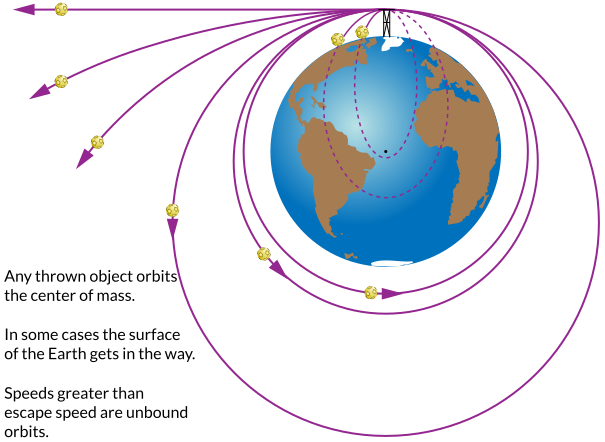
Fire fast enough to fall around Earth instead of hitting it.
Today’s Learning Objectives
By the end of today, you can:
- State Newton’s three laws and use \(F = ma\)
- Explain why circular motion needs centripetal acceleration
- State universal gravitation and the inverse-square rule
Today’s Learning Objectives (continued)
By the end of today, you can:
- Distinguish mass from weight
- Explain why astronauts float (free fall, not zero gravity)
- Connect Newton’s gravity to Kepler’s three laws
- Use orbital motion to infer mass of a central object
Where We Left Off (Lecture 5)
Kepler discovered three empirical laws:
- Orbits are ellipses with the Sun at one focus
- Planets sweep equal areas in equal times
- \(P^2 \propto a^3\) (period-distance relation)
These describe what planets do.
But Kepler couldn’t explain why.
Part 1: The Rules of Motion
Newton’s Three Laws
Newton’s First Law: Inertia
An object at rest stays at rest. An object in motion stays in motion — unless acted upon by a net force.
Key insight: Things don’t change their motion on their own.
If something speeds up, slows down, or changes direction — a net force caused it.
First Law Example: Deep Space
A spacecraft in deep space fires its engines briefly, then shuts them off. What happens next?
- It gradually slows down and stops
- It continues at constant velocity indefinitely
- It starts drifting toward the nearest star
- It needs to keep firing to maintain speed
Newton’s Second Law: F = ma
\[\vec{F}_{net} = m\vec{a}\]
Net force tells matter how to accelerate.
Mass tells matter how much to resist.
A vector has magnitude and direction. The arrows show direction.
Units: force in N, mass in kg, acceleration in \(\mathrm{m/s^2}\).
More net force, more acceleration.
More mass, less acceleration.
Quick Check: F = ma
The same force is applied to a bowling ball and a tennis ball. Which experiences greater acceleration?
- The bowling ball (more mass)
- The tennis ball (less mass)
- Both experience the same acceleration
- Neither accelerates
Critical Insight: Direction Changes = Acceleration
Constant speed ≠ constant velocity
Acceleration happens when either changes:
- Speeding up
- Slowing down
- Changing direction at constant speed
A planet moving in a circle at constant speed is accelerating because its direction constantly changes!
Quick Check: Circular Motion
A car drives around a circular track at a constant speedometer reading of 60 mph. Is the car accelerating?
- No — the speed is constant
- Yes — the direction is constantly changing
- Only if the driver presses the gas pedal
- Only if there’s friction
Centripetal Acceleration
For circular motion at speed \(v\) and radius \(r\):
\[a_c = \frac{v^2}{r}\]
This acceleration points toward the center.
The force required:
\[F_c = ma_c = \frac{mv^2}{r}\]
What Provides the Centripetal Force?
Centripetal force is not a new type of force.
It’s whatever force happens to be pulling the object toward the center:
- For planets: gravity
- For a ball on a string: tension
- For a car turning: friction between tires and road
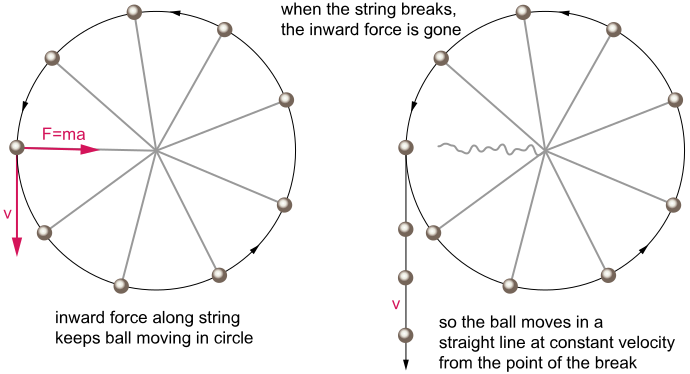
Circular Motion Needs an Inward Force
If the inward force vanishes, the object keeps moving straight.
That is Newton’s First Law in action.
Quick Check: Centripetal Force
A planet orbits the Sun in a nearly circular orbit. What force provides the centripetal acceleration?
- The planet’s inertia
- The planet’s momentum
- Gravity from the Sun
- The planet’s rotational spin
Newton’s Third Law: Action-Reaction
For every force, there is an equal and opposite reaction force.
Examples:
- You push on the ground; the ground pushes back on you
- Earth pulls on the Moon; the Moon pulls on Earth
- The Sun pulls on Jupiter; Jupiter pulls on the Sun
The Astronomical Payoff
Jupiter pulls on the Sun with the same force the Sun pulls on Jupiter.
But the Sun is about 1000 times more massive, so it accelerates about 1000 times less.
The Sun wobbles — just barely.
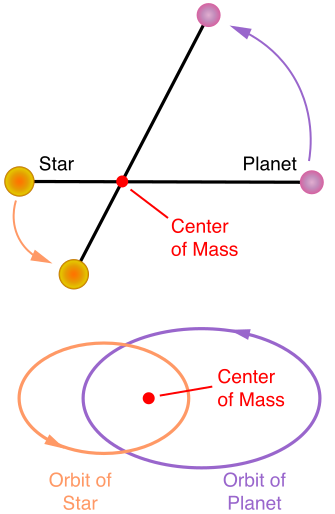
This tiny stellar wobble is one major way we detect exoplanets!
Center of Mass: The Real Pivot Point
The center of mass is the balance point of a system. If you could put your finger exactly there, the system would not tip.
For a star–planet pair, both objects orbit this point, not each other. The more massive object sits closer to it, so its orbit is smaller — that is the wobble we detect.
Quick Check: Third Law
Earth exerts a gravitational force on the Moon. The Moon exerts a force on Earth that is:
- Much weaker, because the Moon is smaller
- Much stronger, because Earth is closer
- Exactly equal in magnitude, opposite in direction
- Zero, because the Moon is in space
Part 2: Universal Gravitation
One equation rules all
Predict First!
If you double your distance from Earth’s center, gravity becomes…
- 1/2 as strong
- 1/4 as strong
- 1/8 as strong
Newton’s Law of Universal Gravitation
\[F_g = \frac{Gm_1m_2}{r^2}\]
| Part | Meaning |
|---|---|
| \(G\) | Universal constant (\(6.674 \times 10^{-11}\ \mathrm{N\,m^2/kg^2}\)) |
| \(m_1 m_2\) | Force depends on both masses |
| \(r^2\) | Force weakens with distance squared |
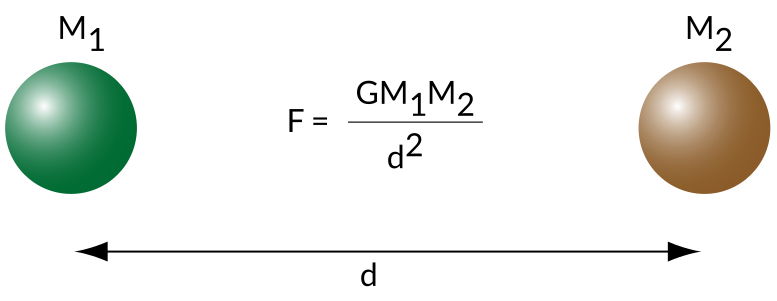
The Gravity Equation in Pictures
Gravity depends on:
- Both masses (\(m_1, m_2\))
- Distance squared (\(r^2\))
Closer or more massive means stronger force.
The Inverse-Square Law
“\(r^2\) in the denominator” is profound:
| Distance change | Force change |
|---|---|
| Double the distance | Force drops to 1/4 |
| Triple the distance | Force drops to 1/9 |
| \(10\times\) the distance | Force drops to 1/100 |
Why Inverse-Square?
As distance grows, the same influence spreads over a larger sphere.
Area grows like \(r^2\), so strength drops like \(1/r^2\).
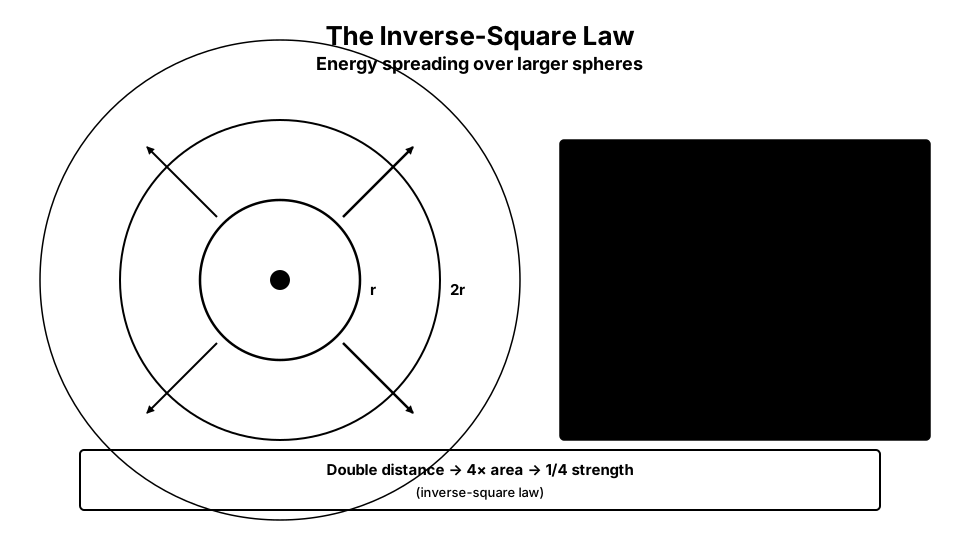
What to notice: inverse-square comes from spreading over spherical area — double distance means 4× the area and 1/4 the per-area strength. (Credit: Illustration: A. Rosen (SVG))
Quick Check: Inverse-Square
The Moon is about 60 Earth radii from Earth’s center. The Moon experiences gravitational acceleration that is:
- 60 times weaker
- 360 times weaker
- 3,600 times weaker
- The same strength
Mass vs. Weight
A critical distinction
The Distinction
| Quantity | What it measures | Changes with location? |
|---|---|---|
| Mass (\(m\)) | Resistance to acceleration (inertia) | No — same everywhere |
| Gravitational force (\(F_g\)) | Force from gravity | Yes — depends on local \(g\) |
| Apparent weight | What you feel (scale reading) | Yes — depends on gravity AND motion |
Quick Check: Mass vs. Weight
An astronaut has mass 70 kg on Earth. On the Moon (about \(1/6\) of Earth’s \(g\)), their:
- Mass decreases to about 12 kg
- Weight is about 1/6, but mass stays 70 kg
- Both mass and scale reading stay the same
- Mass increases because there’s less gravity
Why Astronauts Float
Fixing the biggest misconception
The Wrong Answer
Misconception: “Astronauts float because there’s no gravity in space.”
At ISS altitude (~400 km), Earth’s gravity is still ~90% as strong as at the surface!
The Right Answer
Astronauts float because they’re in free fall.
The ISS and everyone inside are falling toward Earth together.
But moving sideways so fast they keep missing.
Everything falls together at the same rate, so nothing pushes back on you.
That means no sensation of weight.
Free Fall Feels Weightless
You feel weight when a surface pushes back on you.
In orbit, everything falls together, so there is no push.
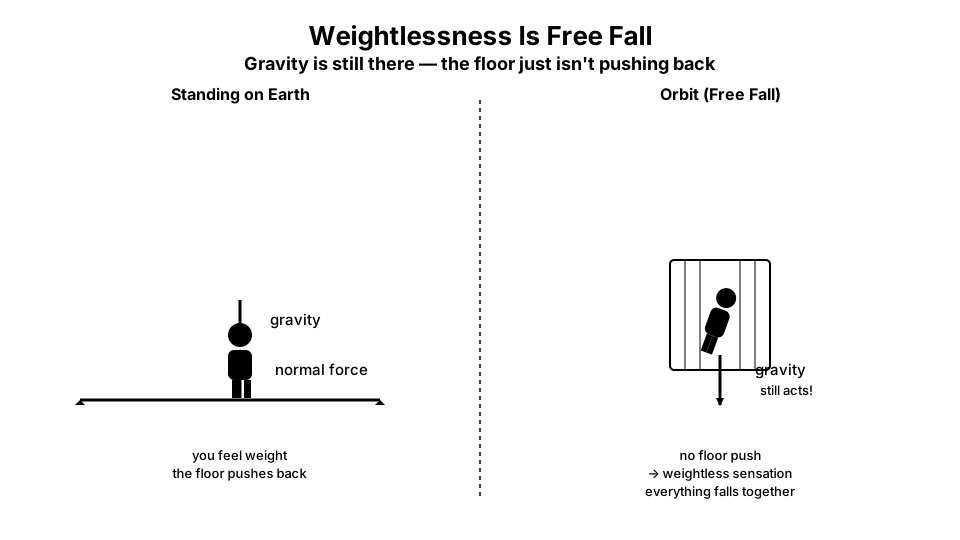
What to notice: weight is the floor’s push (normal force) — in free fall there is gravity but no supporting push, so you feel weightless. (Credit: Illustration: A. Rosen (SVG))
Free fall = apparent weightlessness
Not because gravity is gone — because everything is falling together.
Quick Check: Weightlessness
An astronaut floats inside the ISS, 400 km above Earth. Earth’s gravitational pull on the astronaut is:
- Zero — that’s why they float
- About 90% of what it would be on Earth’s surface
- Exactly the same as on Earth’s surface
- Much stronger than on Earth’s surface
Part 3: Newton Explains Kepler
From patterns to physics
The Big Picture
| Kepler’s Law | Newton’s Explanation |
|---|---|
| Orbits are ellipses | Inverse-square force implies conic sections |
| Equal areas in equal times | Central force implies angular momentum conservation |
| \(P^2 \propto a^3\) | Inverse-square gives this exact exponent |
Kepler said “here’s what happens.”
Newton said “here’s why it must happen.”
Explaining Kepler I: Ellipses
Question: Why are orbits ellipses?
Newton’s Answer:
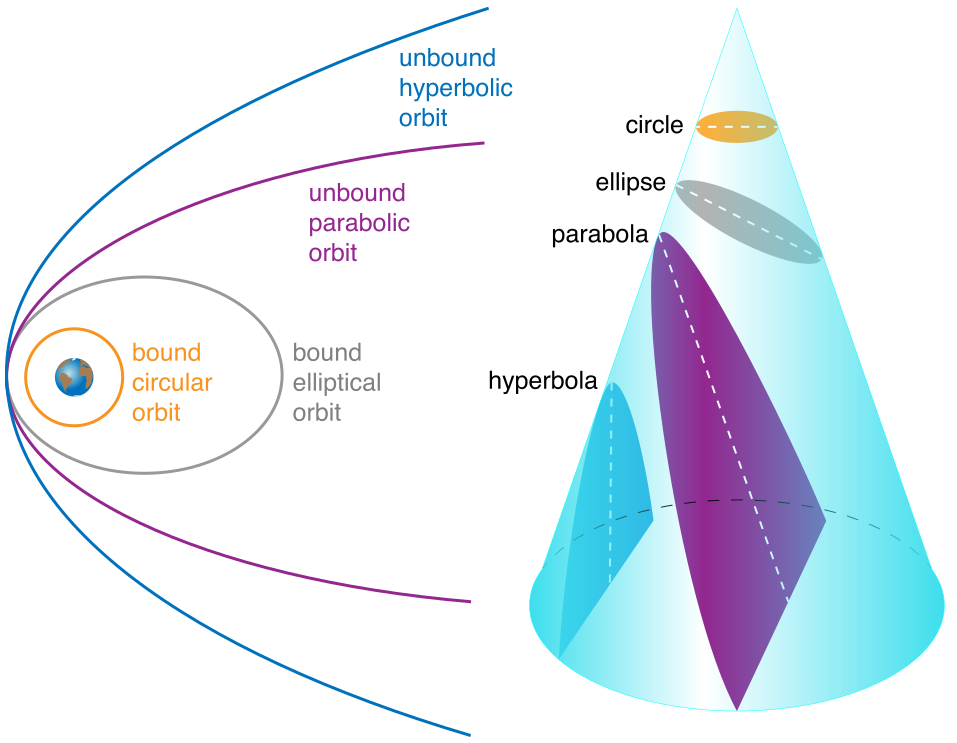
Any object moving under an inverse-square central force traces a conic section.
- Not enough energy to escape: ellipse
- Just enough energy to escape: parabola
- More than escape energy: hyperbola
Orbits Are Conic Sections
Energy decides the shape:
- Ellipse: bound
- Parabola: just escapes
- Hyperbola: unbound
Quick Check: First Law Explained
Newton explained that planetary orbits are ellipses because:
- Planets were created in elliptical paths
- Inverse-square gravity mathematically produces conic sections
- Ellipses are the simplest possible curves
- The Sun’s rotation shapes the orbits
Explaining Kepler II: Equal Areas
Question: Why do planets sweep equal areas in equal times?
Newton’s Answer:
Gravity is a central force — always pointing toward the Sun.
Central forces conserve angular momentum.
If \(L\) is constant and you get closer (\(r\) smaller), you must move faster (\(v\) larger).
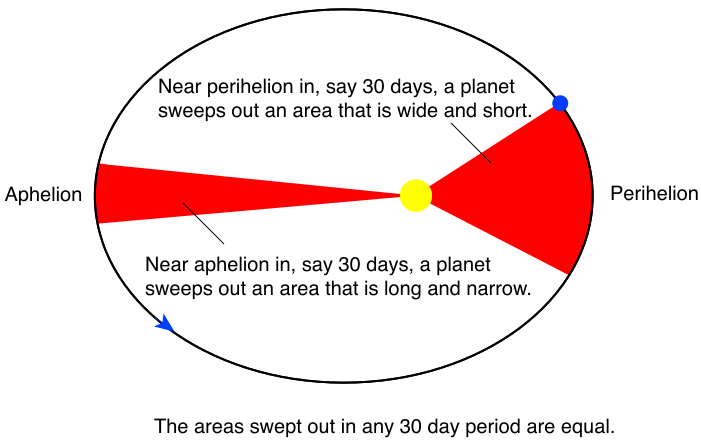
Equal Areas = Variable Speed
In the same time interval:
- Near perihelion: fast, short arc
- Near aphelion: slow, long arc
Areas match because speed changes.
The Ice Skater (Again)
Arms in: spins faster
(smaller \(r\))
Arms out: spins slower
(larger \(r\))
Conservation of angular momentum.
Same physics for planets: closer is faster, farther is slower.
Quick Check: Second Law Explained
Newton explained Kepler’s Second Law (equal areas) as a consequence of:
- The inverse-square nature of gravity
- Conservation of angular momentum because gravity is a central force
- The fact that planets have elliptical orbits
- Energy conservation
Explaining Kepler III: \(P^2 \propto a^3\)
Question: Why this exact relationship?
Newton’s Answer:
For a force \(F \propto 1/r^n\), the period-distance relationship is:
\[P^2 \propto a^{n+1}\]
- If \(n = 2\) (inverse-square): \(P^2 \propto a^3\) (matches Kepler)
- If \(n = 1\): \(P^2 \propto a^2\) (does not match)
- If \(n = 3\): \(P^2 \propto a^4\) (does not match)
Newton’s Improved Version
\[P^2 = \frac{4\pi^2}{G(M + m)} a^3\]
What’s new compared to Kepler:
- The constant includes \(G\) and the total mass
- Works for any gravitational system, not just our Solar System
- We can solve for mass!
Motion Reveals Mass
Rearranging Newton’s version:
\[M \approx \frac{4\pi^2 a^3}{G P^2}\]
Measure orbital period and distance. Calculate central mass.
This is how we “weigh” the Sun, black holes, and galaxies.
We never touch them — we just watch how things move around them.
Quick Check: Weighing the Sun
How do astronomers determine the mass of the Sun?
- By measuring how bright it is
- By measuring Earth’s orbital period and distance
- By sending a spacecraft to collect a sample
- By measuring the Sun’s size
Quick Check: Different Stars
Two planets orbit at the same distance. Star A: \(2M_\odot\). Star B: \(0.5M_\odot\). Which planet has the shorter orbital period?
- Planet A
- Planet B
- Both have the same period
- Cannot tell without planet masses
Part 4: Synthesis
From empirical to physical
From Kepler to Newton
| Kepler (Empirical) | Newton (Physical) |
|---|---|
| Describes what planets do | Explains why they do it |
| Patterns from data | Mechanisms from principles |
| Limited to observed systems | Universal — applies everywhere |
| Can predict within Solar System | Can predict anywhere gravity acts |
One Equation Rules All
\[F = \frac{Gm_1m_2}{r^2}\]
With this single equation, Newton explained:
- Why apples fall
- Why the Moon orbits Earth
- Why planets orbit the Sun
- Why all three of Kepler’s laws hold
- How to weigh objects we’ll never touch
Key Takeaways (1/2)
Newton’s Three Laws: (1) Inertia, (2) \(F = ma\), (3) Action-Reaction
Circular motion = acceleration (direction changes), requiring centripetal force
Universal Gravitation: \(F = GMm/r^2\) — inverse-square law
Mass vs. Weight: Mass is intrinsic; weight depends on local gravity
Key Takeaways (2/2)
Astronauts float because of free fall, not because gravity is absent.
Newton explains Kepler:
- Ellipses: inverse-square force implies conic sections
- Equal areas: central force implies angular momentum conservation
- \(P^2 \propto a^3\): inverse-square gives the exponent
Motion reveals mass: \(M \approx 4\pi^2 a^3/(G P^2)\)
The Course Connection
Motion reveals mass — the foundation for nearly everything else:
- Stars: Binary star orbits, stellar masses
- Galaxies: Rotation curves, dark matter
- Black holes: Orbiting stars, invisible mass
- Exoplanets: Stellar wobbles, planet detection
Coming Up: Light as Information
Next lecture: Light is our only messenger from the cosmos.
We’ll learn to decode what light tells us:
- How fast is it moving? (wavelength)
- How hot is it? (spectrum)
- What is it made of? (spectral lines)
Next Steps
Reading: Lecture 7 Reading Companion
Demo: Binary Orbits (motion reveals mass)
Questions?
Kepler gave us the patterns.
Newton gave us the physics.
Next: Light gives us the information.
Appendix: Optional Numericals
Use as backup or post-lecture reference.
Numerical Verification
Newton’s claim: the Moon is falling
The Moon IS Falling: Calculation
Newton’s claim: The same gravity that pulls apples pulls the Moon.
Test: Calculate the Moon’s centripetal acceleration and compare to surface gravity.
Given data:
- Earth-Moon distance: \(r = 384,400\) km \(= 3.844 \times 10^8\) m
- Moon’s orbital period: \(P = 27.3\) days
- Earth’s radius: \(R_E = 6,371\) km
- Surface gravity: \(g = 9.81\ \mathrm{m/s^2}\)
Step 1: Find the Moon’s Orbital Speed
The Moon travels a circular path of circumference \(2\pi r\) in time \(P\).
Convert period to seconds:
\[P = 27.3 \text{ days} \times \frac{24 \text{ hr}}{1 \text{ day}} \times \frac{3600 \text{ s}}{1 \text{ hr}} = 2.36 \times 10^6 \text{ s}\]
Calculate orbital speed:
\[v = \frac{2\pi r}{P} = \frac{2\pi \times 3.844 \times 10^8 \text{ m}}{2.36 \times 10^6 \text{ s}}\]
\[v = \frac{2.415 \times 10^9 \text{ m}}{2.36 \times 10^6 \text{ s}} = 1,023 \text{ m/s} \approx 1.0 \text{ km/s}\]
Step 2: Calculate Centripetal Acceleration
\[a_c = \frac{v^2}{r} = \frac{(1,023 \text{ m/s})^2}{3.844 \times 10^8 \text{ m}}\]
\[a_c = \frac{1.047 \times 10^6 \text{ m}^2/\text{s}^2}{3.844 \times 10^8 \text{ m}} = 2.72 \times 10^{-3} \text{ m/s}^2\]
Unit check: \(\frac{\text{m}^2/\text{s}^2}{\text{m}} = \frac{\text{m}}{\text{s}^2}\) (acceleration)
The Moon’s acceleration toward Earth is \(a_c = 0.00272\ \mathrm{m/s^2}\).
Compare to surface gravity: \(g = 9.81\ \mathrm{m/s^2}\).
Step 3: Test the Inverse-Square Law
If gravity follows \(1/r^2\), then at the Moon’s distance:
\[\frac{a_{\text{Moon}}}{g_{\text{surface}}} = \frac{1}{(\text{distance ratio})^2}\]
Calculate distance ratio:
\[\frac{r_{\text{Moon}}}{R_E} = \frac{3.844 \times 10^8 \text{ m}}{6.371 \times 10^6 \text{ m}} = 60.3\]
The Moon is 60.3 Earth radii away.
Predicted acceleration ratio:
\[\frac{a_{\text{Moon}}}{g} = \frac{1}{(60.3)^2} = \frac{1}{3636} = 2.75 \times 10^{-4}\]
Step 4: Compare Prediction to Measurement
Predicted (from inverse-square):
\[a_{\text{predicted}} = \frac{g}{3636} = \frac{9.81}{3636} = 2.70 \times 10^{-3} \text{ m/s}^2\]
Measured (from orbital motion):
\[a_{\text{measured}} = 2.72 \times 10^{-3} \text{ m/s}^2\]
Match! Difference < 1%
The same gravity that pulls apples pulls the Moon.
This was Newton’s triumph: unifying terrestrial and celestial physics.
Verifying ISS “Weightlessness”
Claim: At ISS altitude (400 km), gravity is still ~90% of surface value.
Calculate:
\[r_{\text{ISS}} = R_E + h = 6,371 + 400 = 6,771 \text{ km}\]
\[\frac{g_{\text{ISS}}}{g_{\text{surface}}} = \left(\frac{R_E}{r_{\text{ISS}}}\right)^2 = \left(\frac{6,371}{6,771}\right)^2\]
\[= (0.941)^2 = 0.885 = 88.5\%\]
Gravity at ISS altitude is 88.5% of surface gravity!
Astronauts float because they’re falling, not because gravity is gone.
Weighing the Sun: Full Calculation
Given:
- Earth’s orbital period: \(P = 365.25\) days \(= 3.156 \times 10^7\) s
- Earth’s orbital radius: \(a = 1.496 \times 10^{11}\) m (1 AU)
- \(G = 6.674 \times 10^{-11}\ \mathrm{N\,m^2/kg^2}\)
From Newton’s form of Kepler III:
\[M_\odot = \frac{4\pi^2 a^3}{G P^2}\]
\[M_\odot = \frac{4\pi^2 (1.496 \times 10^{11})^3}{(6.674 \times 10^{-11})(3.156 \times 10^7)^2}\]
Weighing the Sun: Unit Analysis
\[M_\odot = \frac{4\pi^2 a^3}{G P^2}\]
Numerator units:
\[[\text{m}^3] \quad \text{(since } a^3 \text{ is in meters cubed)}\]
Denominator units:
\[\left[\frac{\text{N} \cdot \text{m}^2}{\text{kg}^2}\right] \times [\text{s}^2] = \left[\frac{\text{kg} \cdot \text{m/s}^2 \cdot \text{m}^2}{\text{kg}^2}\right] \times [\text{s}^2] = \frac{\text{m}^3}{\text{kg}}\]
Result units:
\[\frac{\text{m}^3}{\text{m}^3/\text{kg}} = \text{kg}\]
Weighing the Sun: Result
Calculating numerator:
\[4\pi^2 (1.496 \times 10^{11})^3 = 4\pi^2 \times 3.348 \times 10^{33} = 1.322 \times 10^{35} \text{ m}^3\]
Calculating denominator:
\[(6.674 \times 10^{-11})(3.156 \times 10^7)^2 = 6.674 \times 10^{-11} \times 9.96 \times 10^{14}\] \[= 6.65 \times 10^{4} \text{ m}^3/\text{kg}\]
Final result:
\[M_\odot = \frac{1.322 \times 10^{35}}{6.65 \times 10^{4}} = 1.99 \times 10^{30} \text{ kg}\]
The Sun’s mass is \(2 \times 10^{30}\) kg — determined just by watching Earth orbit!
Deeper Dive
Escape velocity and orbital energy
Escape Velocity
Question: How fast must you launch an object so it never falls back?
Energy conservation:
\[\frac{1}{2}mv^2 - \frac{GMm}{r} = 0\]
(Kinetic energy at launch = gravitational potential energy to escape)
Solving for escape velocity:
\[v_{\text{escape}} = \sqrt{\frac{2GM}{r}}\]
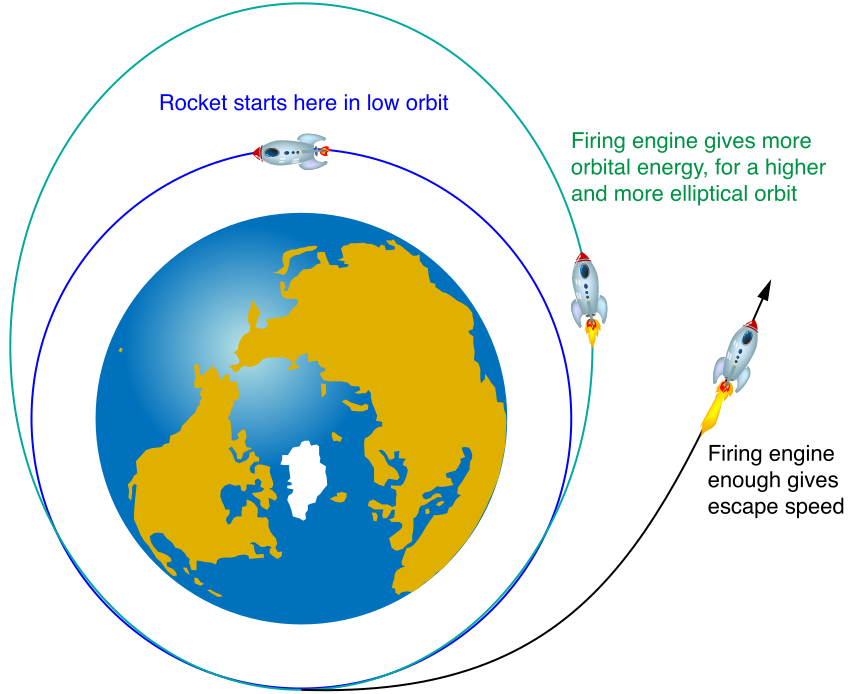
Escape Velocity in One Picture
Add energy and the orbit stretches.
Add enough and the path becomes unbound.
Earth’s Escape Velocity: Calculation
\[v_{\text{escape}} = \sqrt{\frac{2GM_E}{R_E}}\]
Given:
- \(G = 6.674 \times 10^{-11}\ \mathrm{N\,m^2/kg^2}\)
- \(M_E = 5.97 \times 10^{24}\) kg
- \(R_E = 6.371 \times 10^6\) m
\[v_{\text{escape}} = \sqrt{\frac{2 \times 6.674 \times 10^{-11} \times 5.97 \times 10^{24}}{6.371 \times 10^6}}\]
\[= \sqrt{\frac{7.97 \times 10^{14}}{6.371 \times 10^6}} = \sqrt{1.25 \times 10^8} \text{ m}^2/\text{s}^2\]
\[v_{\text{escape}} = 11,200 \text{ m/s} = \boxed{11.2 \text{ km/s}}\]
Escape Velocities Across the Solar System
| Object | Mass (Earth = 1) | Radius (Earth = 1) | \(v_{\text{escape}}\) |
|---|---|---|---|
| Moon | 0.012 | 0.27 | 2.4 km/s |
| Earth | 1 | 1 | 11.2 km/s |
| Jupiter | 318 | 11.2 | 59.5 km/s |
| Sun | 333,000 | 109 | 618 km/s |
Circular Orbital Velocity
For a circular orbit, set gravitational force = centripetal force:
\[\frac{GMm}{r^2} = \frac{mv^2}{r}\]
Solving for orbital velocity:
\[v_{\text{circular}} = \sqrt{\frac{GM}{r}}\]
Key relationship:
\[v_{\text{escape}} = \sqrt{2} \times v_{\text{circular}}\]
To escape, you need only 41% more speed than circular orbit speed!
ASTR 101 • Lecture 6 • Dr. Anna Rosen