Lecture 3:
Gravity and Orbits
From Patterns to Physics
Learning Objectives
By the end of this lecture, you will be able to:
- Distinguish between empirical laws (patterns) and physical laws (mechanisms)
- Describe how Newton derived the inverse-square law from Kepler’s observations
- Apply Newton’s laws of motion to orbital problems using force balance
- Calculate orbital velocity and escape velocity, and explain what each represents
- Use energy and angular momentum conservation to predict orbital behavior
- Explain the virial theorem for bound systems at equilibrium or time-averaged
Read these aloud. Emphasize the through-line: Kepler → Newton → conservation laws. Timing: ~2 min.
Kepler told us what.
Newton told us why.
Hook: Let this sit for 5 seconds. The through-line for today is the transition from pattern-finding to mechanism-explaining.
Part 1: Patterns Without Explanation
Kepler’s Empirical Laws
The Scene: 1600s
Imagine spending twenty years recording planet positions…
. . .
You discover three remarkable patterns:
- Orbits are ellipses, not circles
- Planets speed up near the Sun
- Farther planets take longer to orbit
. . .
But you have no idea why.
3–4 min. Set up Kepler’s achievement and its limitations. This is pattern recognition without mechanism.
Kepler’s First Law: Orbits Are Ellipses
Planets move in ellipses with the Sun at one focus.
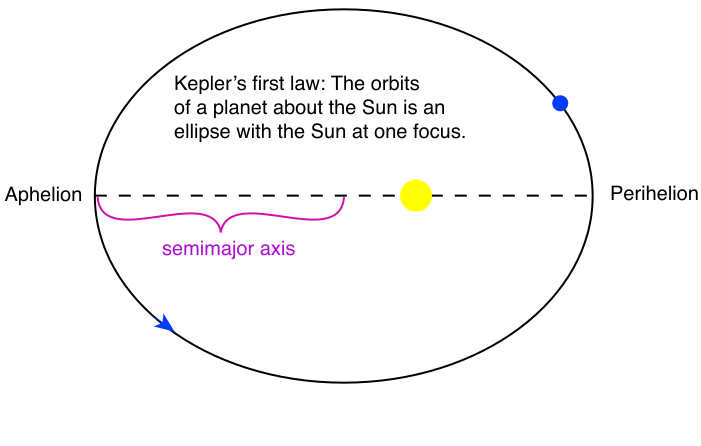
Key terms:
- Semi-major axis \(a\):
average distance - Eccentricity \(0 \ge e < 1\):
how “squashed”
(0 = circle, 1 = line)
Point to the figure. Emphasize: nature doesn’t care about “perfect” circles.
Kepler’s Second Law: Equal Areas
A line from planet to Sun sweeps equal areas in equal times.
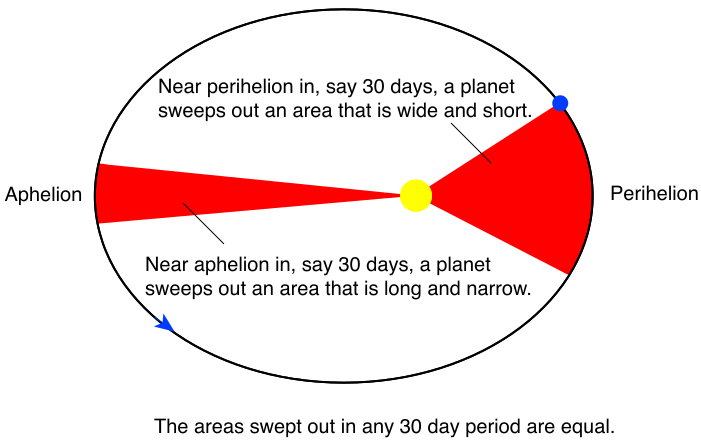
Translation: Planets move faster near the Sun.
Press R to animate underline. Foreshadow: this hints at angular momentum conservation.
Kepler’s Third Law: The Scaling Relation
For orbits around a central mass: \(P^2 \propto a^3\)
What this means:
- Move 2× farther → period increases by \(2^{3/2} \approx 2.83\)
- It’s a proportionality, not an equality
- The constant depends on the central mass
Emphasize: this is empirical—extracted from data. No explanation of why.
Kepler III: Ratio Method
- Start with Kepler III, take square root
\[P^2 \propto a^3 \;\Rightarrow\; P \propto a^{3/2}\]
- Write as equality (same central mass = same \(C\))
\[P = C \cdot a^{3/2}\]
- For two objects, divide to cancel \(C\)
\[\frac{P_2}{P_1} = \frac{\cancel{C} \cdot a_2^{3/2}}{\cancel{C} \cdot a_1^{3/2}} = \left(\frac{a_2}{a_1}\right)^{3/2}\]
Key: Proportionality hides an unknown constant. Dividing cancels it → true equality.
Walk through every step. Students struggle with proportionality → equality → ratio. The ratio method turns “\(\propto\)” into “\(=\)” by canceling what we don’t know.
Kepler III: Ratio Formula
From the previous slide: \[\frac{P_2}{P_1} = \left(\frac{a_2}{a_1}\right)^{3/2}\]
. . .
Solve for \(P_2\): \[P_2 = P_1 \times \left(\frac{a_2}{a_1}\right)^{3/2}\]
. . .
This is the ratio method. If you know \(P_1\), \(a_1\), and \(a_2\), you can find \(P_2\) without knowing \(G\) or the central mass.
Box this formula. They’ll use it repeatedly.
Kepler III: Mars Example
Given: \(a_\text{Mars} = 1.52\,\text{AU}\), \(a_\text{Earth} = 1\,\text{AU}\), \(P_\text{Earth} = 1\,\text{yr}\). Find: \(P_\text{Mars}\)
Start: \(P^2 \propto a^3\) → \(P \propto a^{3/2}\)
Ratio formula: \[P_2 = P_1 \times \left(\dfrac{a_2}{a_1}\right)^{3/2}\]
Let: 1 = Earth, 2 = Mars
Substitute with units: \[P_\text{Mars} = 1\,\text{yr} \times \left(\dfrac{1.52\,\cancel{\text{AU}}}{1\,\cancel{\text{AU}}}\right)^{3/2}\]
Calculate: \(1\,\text{yr} \times (1.52)^{3/2} = 1\,\text{yr} \times 1.87\)
\[\boxed{P_\text{Mars} = 1.87\,\text{yr}}\]
Show every unit. Show the cancellation. Students need to see AU/AU = 1.
Common Notation Trap
Avoid “\(P^2 = a^3\)” — this hides units and mass dependence!
. . .
The full physical law (Newton’s version):
\[P^2 = \frac{4\pi^2}{G(M+m)} a^3\]
. . .
The “shortcut” only works for Solar System orbits with \(m \ll M\) measured in years and AU around a ~\(1\,M_\odot\) star.
Students see \(P^2 = a^3\) in intro courses. Explain why it’s misleading for real astrophysics.
Prediction Question 📊 Poll
If you move a planet to twice its orbital distance, by what factor does its period increase?
A. 2× (linear)
B. 4× (squared)
C. 2.83× (\(2^{3/2}\))
D. 8× (cubed)
Give 30 seconds for think-pair-share. Then advance to reveal answer.
Prediction Question — Answer
If you move a planet to twice its orbital distance, by what factor does its period increase?
From \(P^2 \propto a^3\): if \(a\) doubles, \(P^2 \to 2^3 = 8\), so \(P \to \sqrt{8} \approx 2.83\).
What Kepler Couldn’t Explain
- Why ellipses and not some other shape?
- What causes planets to speed up near the Sun?
- Why exactly \(P^2 \propto a^3\)?
- Does this work beyond our solar system?
. . .
Empirical laws summarize data. They don’t explain physics.
This sets up the need for Newton’s contribution.
Part 2: The Physics of Motion
Newton’s Laws + Circular Motion
Newton’s Three Laws (Quick Review)
First Law: Objects in motion stay in motion (unless acted on by a force)
. . .
Second Law: \(\vec{F} = m\vec{a}\)
- Force tells matter how to accelerate
- Mass tells matter how to resist
. . .
Third Law: Every action has an equal and opposite reaction
Brief review—students saw this in physics. Emphasize F = ma is the workhorse.
Vectors: Direction Matters
\(\vec{F}\), \(\vec{v}\), \(\vec{a}\) have arrows because they’re vectors.
. . .
Speed: how fast
“30 km/s”
Velocity: how fast and which way
“30 km/s heading east”
. . .
Critical for understanding circular motion. Many students miss this.
The Key Insight: Circular Motion
An object moving in a circle at constant speed is accelerating.
. . .
Intuition: Faster motion → direction changes more rapidly. Tighter curve → direction changes more sharply. Both increase acceleration.
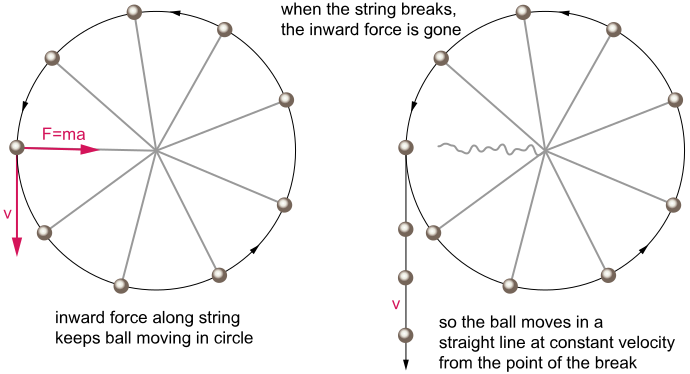
Centripetal acceleration: \[\boxed{a_c = \dfrac{v^2}{r}}\] (points toward center)
Build intuition BEFORE showing formula. Draw attention to the direction changing even as speed stays constant.
Concept Check 📊 Poll
A car drives around a circular track at constant speedometer reading. Is the car accelerating?
A. Yes — direction is changing, so velocity is changing
B. No — speed is constant, so no acceleration
C. Only when the car speeds up or slows down
D. Only at certain points on the track
Give 30 seconds for think-pair-share. Then advance to reveal answer.
Concept Check — Answer
A car drives around a circular track at constant speedometer reading. Is the car accelerating?
Common misconception: confusing speed with velocity.
Centripetal Force
By \(F = ma\), if there’s acceleration, there must be a force:
\[F_c = ma_c = \frac{mv^2}{r}\]
. . .
This connects circular motion physics to gravity.
Part 3: Newton’s Law of Gravitation
From Patterns to Mechanism
The Universal Law of Gravity
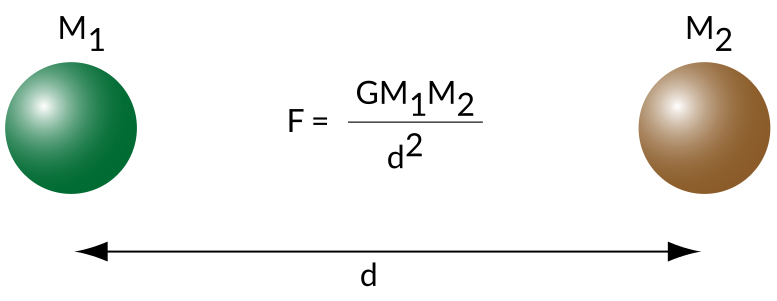
\[F_g = \frac{Gm_1 m_2}{r^2}\]
- \(F_g\) — gravitational force (dynes)
- \(G = 6.67 \times 10^{-8}\,\mathrm{cm^3\,g^{-1}\,s^{-2}}\)
- \(m_1, m_2\) — the two masses (g)
- \(r\) — distance between centers (cm)
“Every particle of matter in the universe attracts every other particle with a force that is proportional to the product of their masses and inversely proportional to the square of the distance between their centres.” — Newton, Principia (1687)
Newton’s big insight: one law explains both falling apples and orbiting planets. Walk through each term.
Physical Interpretation
\(Gm_1 m_2\) (numerator)
More mass → more pull
Product of masses (Newton III)
\(r^2\) (denominator)
Inverse-square law
Double distance → 1/4 the force
. . .
\(G\) is the same everywhere in the universe — on Earth, on Mars, in distant galaxies.
Prediction Question 📊 Poll
Using \(F_g = \dfrac{Gm_1 m_2}{r^2}\):
If you double the distance between two masses, by what factor does the force change?
A. Halves (1/2)
B. Quarters (1/4)
C. Doubles (2×)
D. Unchanged
Give 30 seconds for think-pair-share. Then advance to reveal answer.
Prediction Question — Answer
If you double the distance between two masses, by what factor does the force change?
Inverse-square: \((2r)^2 = 4r^2\), so force is 1/4.
How Did Newton Know It’s Inverse-Square?
He didn’t guess — he derived it from Kepler III.
. . .
The logic:
- Assume \(F \propto 1/r^n\) for unknown \(n\)
- Apply circular motion: gravity = centripetal force
- Connect to Kepler: \(P^2 \propto r^3\)
- Solve for \(n\)
This is the beautiful synthesis: empirical → physical.
The Derivation (Setup)
For circular orbit, gravity provides centripetal force:
\[k\frac{Mm}{r^n} = \frac{mv^2}{r}\]
. . .
Planet mass \(m\) cancels (same orbit speed regardless of mass!):
\[\frac{kM}{r^n} = \frac{v^2}{r}\]
Point out that m canceling explains why all objects fall at the same rate.
The Derivation (Key Step)
Using \(v = \dfrac{2\pi r}{P}\) (circumference/period):
\[P^2 = \frac{4\pi^2}{kM} r^{n+1}\]
. . .
Compare to Kepler III: \(P^2 \propto r^3\)
. . .
\[n + 1 = 3 \quad \Rightarrow \quad \boxed{n = 2}\]
. . .
The inverse-square law is required by Kepler’s Third Law!
This is the punchline. Newton didn’t assume inverse-square—he proved it.
The Simplification We Made
Our derivation assumed the Sun stays fixed while the planet orbits.
. . .
Is that true?
Newton’s Third Law says no. If the Sun pulls the planet, the planet pulls the Sun.
Both bodies must move.
Pause here. Let them feel the tension. We derived n=2, but we cheated by ignoring the Sun’s motion. Now we fix that.
Two-Body Reality: Center of Mass
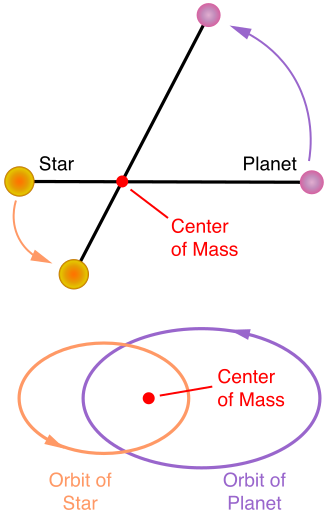
Both bodies orbit their common center of mass (barycenter).
Balance condition: \[m_1 \, r_1 = m_2 \, r_2\]
The more massive body orbits closer to the center of mass.
When \(M \gg m\): barycenter ≈ center of \(M\)
(Kepler’s approximation)
Point to figure. Emphasize: THIS is why Kepler’s “Sun at one focus” works—the Sun barely moves because it’s so massive. But it does move.
Deriving \((M+m)\): Setup
From center of mass:
\[m_1 r_1 = m_2 r_2\]
Total separation:
\[r = r_1 + r_2\]
Solve for each distance:
\[r_1 = \frac{m_2}{m_1 + m_2}\, r\]
\[r_2 = \frac{m_1}{m_1 + m_2}\, r\]
Each body’s orbital radius depends on both masses through the total \((m_1 + m_2)\).
Walk through algebra: from \(m_1 r_1 = m_2 r_2\) and \(r = r_1 + r_2\), solve for \(r_2\). Key: each body’s distance from center of mass involves the sum.
Deriving \((M+m)\): The Math
Gravity on body 2: \[F = \frac{Gm_1 m_2}{r^2}\]
Centripetal force for body 2: \[F = \frac{4\pi^2 m_2 r_2}{P^2}\]
Substitute \(r_2 = \dfrac{m_1 r}{m_1 + m_2}\):
\[\frac{Gm_1 m_2}{r^2} = \frac{4\pi^2 m_2}{P^2} \cdot \frac{m_1 r}{m_1 + m_2}\]
Cancel \(m_1 m_2\), solve for \(P^2\):
\[\boxed{P^2 = \frac{4\pi^2}{G(m_1 + m_2)} r^3}\]
\((m_1 + m_2)\) emerges because each body’s orbital radius depends on how mass is distributed.
This is the punchline. The \((M+m)\) isn’t arbitrary — it emerges from the geometry of two bodies orbiting their common center of mass. Connection: This is exactly how we detect exoplanets—we measure the star’s wobble.
Newton’s Version of Kepler III
Accounting for both bodies’ motion, Newton derived:
\[P^2 = \frac{4\pi^2}{G(M + m)} a^3\]
. . .
What’s new compared to Kepler?
- The “constant” varies by system (depends on total mass \((M+m)^{-1}\))
- A planet at 1 AU around a \(2\,M_\odot\) star orbits faster than Earth (shorter \(P\))
- We can solve for mass: \(M + m = \dfrac{4\pi^2 a^3}{G P^2}\)
. . .
Kepler didn’t notice because all his data came from one system — our Solar System.
This is how we “weigh” stars in binaries, black holes from orbiting stars, galaxies from rotation curves. Emphasize: the “constant” is only constant within a single system. Compare two stars of different mass to drive this home.
Part 4: Orbital and Escape Velocity
How fast must you go?
Orbital Velocity
For a circular orbit at radius \(r\) around mass \(M\):
\[\frac{GMm}{r^2} = \frac{mv_{orb}^2}{r}\]
. . .
Mass \(m\) cancels (a feather and bowling ball orbit at the same speed!):
. . .
\[\boxed{v_{orb} = \sqrt{\frac{GM}{r}}}\]
Derive step by step. Emphasize the mass independence.
Orbital Velocity: Physical Interpretation
\[v_{orb} = \sqrt{\frac{GM}{r}}\]
- Larger \(M\) → stronger gravity → must orbit faster
- Larger \(r\) → weaker gravity → can orbit slower
- Orbiting mass doesn’t matter!
. . .
Earth’s orbital velocity: \(v_{orb} \approx 30\) km/s
Earth travels 108,000 km/hr just to stay in orbit!
Worked Example: Earth’s Orbit
Given: \(M_\odot = 2 \times 10^{33}\,\text{g}\), \(r = 1.5 \times 10^{13}\,\text{cm}\), \(G = 6.67 \times 10^{-8}\,\frac{\text{cm}^3}{\text{g}\cdot\text{s}^2}\)
. . .
\[v_{orb} = \sqrt{\frac{GM_\odot}{r}} = \sqrt{\frac{(6.67 \times 10^{-8}\,\frac{\text{cm}^3}{\text{g}\cdot\text{s}^2})(2 \times 10^{33}\,\text{g})}{1.5 \times 10^{13}\,\text{cm}}}\]
. . .
Units: \(\sqrt{\dfrac{\text{cm}^3 \cdot \cancel{\text{g}}}{\cancel{\text{g}} \cdot \text{s}^2 \cdot \text{cm}}} = \sqrt{\dfrac{\text{cm}^{\cancel{3}2}}{\text{s}^2}} = \dfrac{\text{cm}}{\text{s}}\) ✓
. . .
Numbers: \(\sqrt{\frac{(6.67)(2)}{1.5} \times 10^{-8+33-13}} = \sqrt{8.9 \times 10^{12}} \approx 3 \times 10^6\,\frac{\text{cm}}{\text{s}} = 30\,\frac{\text{km}}{\text{s}}\)
Show units FIRST, then numbers. Students need to see cancellation.
Energy in Mechanics
Mechanics studies motion and the forces that cause it. Energy is the capacity to do work — to move things.
. . .
Kinetic Energy: energy of motion
\[K = \frac{1}{2}mv^2\]
Faster or more massive → more kinetic energy
Gravitational Potential Energy: energy of position in a gravitational field
\[U = -\frac{GMm}{r}\]
Closer to mass → more negative (deeper in the “well”)
Brief intro. Most students have seen KE before. PE being negative may be new—address next slide.
Why Is Potential Energy Negative?
. . .
As you fall toward a mass:
- Gravity speeds you up (gives kinetic energy)
- You’re dropping below zero in potential energy
- Negative U = you’re in debt — you “owe” energy to escape
. . .
The deeper in the well (smaller \(r\)) → the more negative \(U\) → the more you need to climb out.
The debt metaphor helps. Relate to escape: if your KE savings can’t pay off your PE debt, you’re trapped.
Escape Velocity
To escape to infinity, you need enough kinetic energy to overcome gravity:
\[\frac{1}{2}mv_{esc}^2 = \frac{GMm}{r}\]
. . .
Solving (mass cancels again!):
\[\boxed{v_{esc} = \sqrt{\frac{2GM}{r}} = \sqrt{2} \cdot v_{orb}}\]
Key relationship: escape is √2 times orbital velocity.
Escape Velocity: What It Means
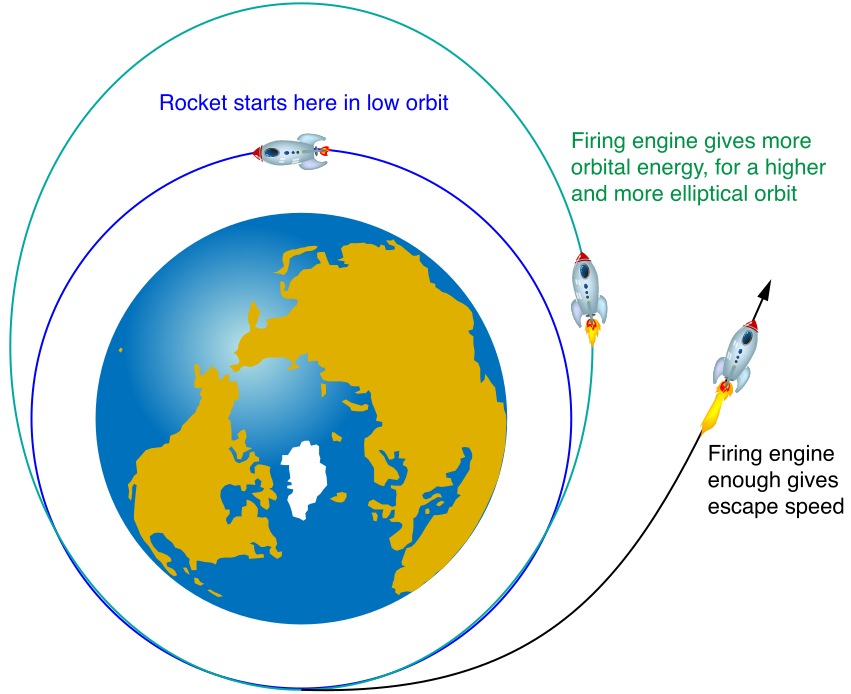
| Location | \(v_{orb}\) | \(v_{esc}\) |
|---|---|---|
| Earth surface | 7.9 km/s | 11.2 km/s |
| Moon surface | 1.7 km/s | 2.4 km/s |
| Sun surface | 434 km/s | 618 km/s |
Apollo needed smaller rockets to leave the Moon!
Concept Check 📊 Poll
Jupiter orbits at 5 AU from the Sun. Earth orbits at 1 AU. How does Jupiter’s orbital velocity compare to Earth’s?
- A. Jupiter is faster (farther out, longer path)
- B. Earth is faster by factor ~2.2 (\(\sqrt{5}\))
- C. They’re the same (same Sun)
- D. Jupiter is faster by factor 5
Give 30 seconds for think-pair-share. Then advance to reveal answer.
Concept Check — Answer
Jupiter orbits at 5 AU from the Sun. Earth orbits at 1 AU. How does Jupiter’s orbital velocity compare to Earth’s?
From \(v_{orb} \propto 1/\sqrt{r}\): Earth is \(\sqrt{5} \approx 2.2\) times faster.
Part 5: Conservation Laws
Energy and Angular Momentum
Energy in Orbits
Recall: \(K = \frac{1}{2}mv^2\) (positive) and \(U = -\frac{GMm}{r}\) (negative).
. . .
Total mechanical energy:
\[E = K + U = \frac{1}{2}mv^2 - \frac{GMm}{r}\]
. . .
The sign of \(E\) determines the orbit’s fate — we’ll see how next.
Brief recall, then introduce total E as the key quantity. Sign of E determines bound vs. unbound.
Energy Determines Orbit Type
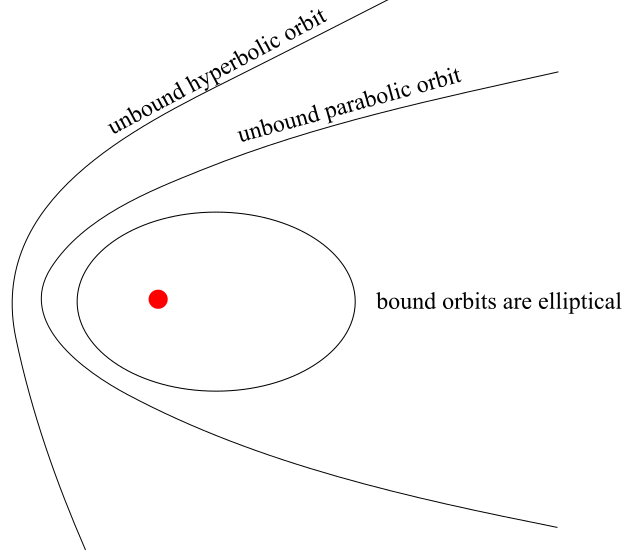
| Total Energy | Orbit Type |
|---|---|
| \(E < 0\) | Bound (ellipse/circle) |
| \(E = 0\) | Parabolic (just escapes) |
| \(E > 0\) | Hyperbolic (escapes with speed to spare) |
Key insight: the sign of E tells you the orbital fate.
Energy Conservation in Orbits
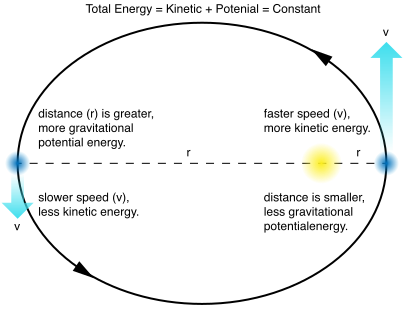
At perihelion: High \(K\), low \(U\) (fast, close)
At aphelion: Low \(K\), high \(U\) (slow, far)
Total \(E\): Always constant!
K and U trade off, but E stays fixed.
Angular Momentum Conservation
For orbital motion:
\[L = mvr = mr^2\dot{\phi} = \text{constant}\]
\(\dot{\phi}\) (“phi-dot”) = angular velocity = how fast the angle changes (rad/s). The dot means “per unit time.”
Two equivalent forms:
\(v = r\dot{\phi}\) (arc length per time), so both give the same \(L\).
Why conserved? Gravity is a central force—it exerts no torque (twisting force).
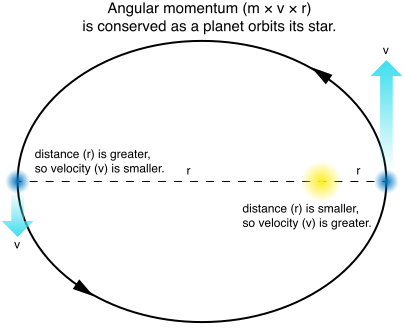
Torque = what makes things spin faster/slower. Central force → no torque → L conserved. Explain dot notation: it’s just shorthand for “rate of change” — no calculus needed to use it.
Kepler II Explained!
Areal velocity (rate of sweeping area):
\[\frac{dA}{dt} = \frac{L}{2m} = \text{constant}\]
. . .
. . .
When \(r\) decreases, \(v\) must increase to keep \(L = mvr\) constant.
This is the deep connection Kepler couldn’t see.
Prediction Question 📊 Poll
A planet has perihelion at 1 AU and aphelion at 4 AU. Using \(L = mvr = \text{const}\):
By what factor is the linear speed larger at perihelion?
A. 2× (ratio of distances)
B. 4× (ratio of distances)
C. 16× (ratio squared)
D. 8× (ratio cubed)
Give 30 seconds for think-pair-share. Then advance to reveal answer.
Prediction Question — Answer
A planet has perihelion at 1 AU and aphelion at 4 AU. By what factor is the linear speed larger at perihelion?
From \(v_p r_p = v_a r_a\): \(v_p/v_a = r_a/r_p = 4/1 = 4\).
The Virial Theorem
For bound systems, the virial theorem applies in two situations:
- Truly static systems: A star in hydrostatic equilibrium
- Periodic systems: Time-averaged over complete orbits
. . .
\[\langle K \rangle = -\frac{1}{2}\langle U \rangle\]
. . .
For circular orbit (instant = average):
\[K = \dfrac{GMm}{2r},~U = -\dfrac{GMm}{r} → K = -\frac{1}{2}U~✓\]
Distinguish equilibrium vs. time-averaged. The angle brackets mean “average.”
Virial Theorem: Why It Matters
Where we use it:
- Stars (thermal vs. gravity)
- Galaxies (dark matter!)
- Gas clouds (collapse criteria)
The virial theorem is a workhorse for the rest of the course.
Part 6: The Big Picture
From Newton to Einstein
What Newton Achieved
Before Newton: celestial physics ≠ terrestrial physics
. . .
After Newton: One physics, everywhere
. . .
| Kepler’s Laws | Newton’s Explanation |
|---|---|
| Ellipses | Solution under inverse-square gravity |
| Equal areas | Angular momentum conservation |
| \(P^2 \propto a^3\) | Requires inverse-square; constant = \(G\) × mass |
This unification is one of the greatest achievements in physics history.
Forward Connections
The physics of gravity connects to everything this semester:
| Topic | Connection |
|---|---|
| Binary Stars | Masses from orbits |
| Exoplanets | Transit timing, radial velocity |
| Stellar Structure | Virial theorem |
| Black Holes | Escape velocity → event horizon |
| Galaxies | Rotation curves → dark matter |
Every time we infer mass from motion, we’re using Newton.
Beyond Newton: A Glimpse of Einstein
Newton’s framework is excellent… but not the final word.
. . .
| Newton’s View | Einstein’s View |
|---|---|
| Gravity is a force | Gravity is curved spacetime |
| Space/time are fixed | Space/time are dynamic |
| Objects feel a pull | Objects follow geodesics |
Tease General Relativity without going deep.
Curved Spacetime
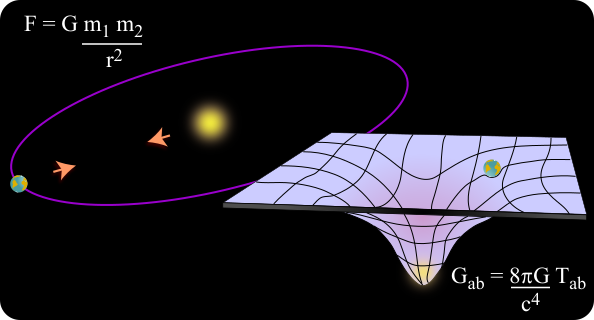
Einstein: “Mass tells spacetime how to curve; spacetime tells mass how to move.”
Beautiful diagram. Don’t belabor—this is a teaser.
Summary: The Machine
- Inverse-square gravity → conic-section orbits
- Central force → angular momentum conserved → Kepler II
- Force balance → \(v_{orb} = \sqrt{\frac{GM}{r}}\)
- Energy conservation → \(v_{esc} = \sqrt{\frac{2GM}{r}}\)
\(E\) determines bound vs. unbound - Equilibrium → virial theorem: \(\langle K \rangle = -\frac{1}{2}\langle U \rangle\)
This is the conceptual machinery for gravitational systems.
The Takeaway
If you forget everything else from today, remember this:
Patterns become physics
Kepler found the what. Newton explained the why.
This transition — from empirical to physical — is how science works.
Core message. Let this land.
Key Equations
| Quantity | Equation |
|---|---|
| Grav. Force | \(F_g = \dfrac{Gm_1m_2}{r^2}\) |
| Orbital Velocity | \(v_{orb} = \sqrt{\dfrac{GM}{r}}\) |
| Escape Velocity | \(v_{esc} = \sqrt{2}\,v_{orb}\) |
| Kepler III | \(P^2 = \dfrac{4\pi^2}{G(M+m)}a^3\) |
| Quantity | Equation |
|---|---|
| Kinetic Energy | \(K = \frac{1}{2}mv^2\) |
| Potential Energy | \(U = -\dfrac{GMm}{r}\) |
| Total Energy | \(E = K + U\) |
| Angular Momentum | \(L = mvr\) |
| Virial Equilibrium | \(\langle K \rangle = -\frac{1}{2}\langle U \rangle\) |
Questions?
Common questions at this point:
- “Why is potential energy negative?”
- “What’s the difference between orbital and escape velocity?”
- “When does the virial theorem apply?”
Address these directly if time permits.
Looking Ahead
Next time: Light as information — blackbody radiation and stellar spectra
Before then:
- Read: Lecture 3 reading (gravity and orbits) — especially the worked examples
- Review: Unit analysis and how \(v_{orb}\), \(v_{esc}\), and energy tell you about orbital fate
Next lecture begins Module 1’s transition to light and stellar properties.