Lecture 2: The Balancing Act — Hydrostatic Equilibrium
What holds a star up against its own gravity?
Without support, the Sun should collapse in about 50 minutes.
So what has kept it stable for 4.6 billion years?
0-2 min. Direct callback to Lecture 1. The hook is the short dynamical timescale.
Pressure Is Not Enough
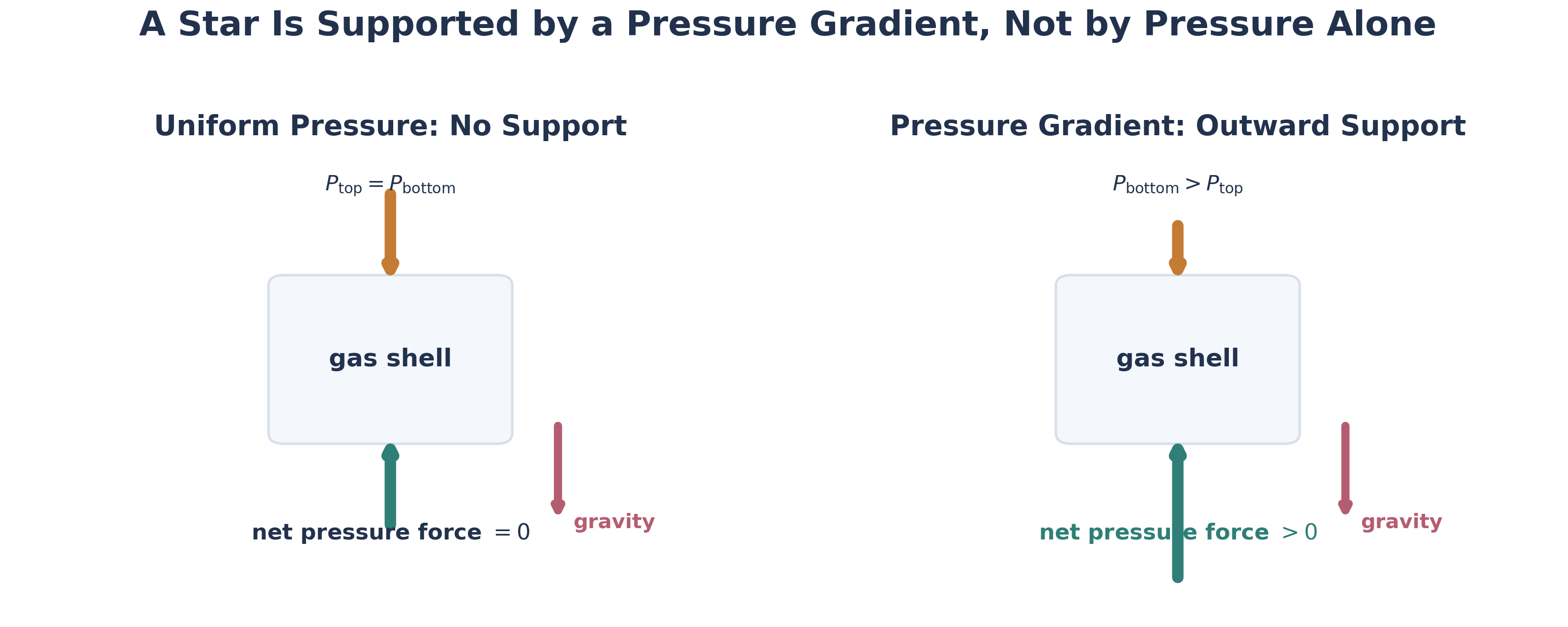
The outward force comes from a pressure gradient: the gas below a layer must push harder than the gas above it.
2-4 min. This is the locked second slide. Say it explicitly: equal pressure on both sides gives no net support.
Today’s Targets
By the end of class, you should be able to:
- explain why a star needs a pressure gradient, not just pressure
- interpret the equation of hydrostatic equilibrium
- estimate how central pressure scales with \(M\) and \(R\)
- use the virial theorem to connect gravity and thermal energy
- explain why losing energy can make a star get hotter
4-5 min. Keep the emphasis on physical meaning first, equations second.
Today’s Roadmap
- The support problem — why equal pressure does not help
- The shell argument — force balance inside a star
- The master equation — hydrostatic equilibrium
- How much pressure? — estimating the solar core
- Why contraction heats — virial theorem and core temperature
5-6 min. This lets students know we are moving from intuition to equation to consequences.
The Swimming Pool Analogy
- water pressure is larger at the bottom than at the top
- why? each deeper layer supports more overlying weight
- a star works the same way: deeper layers must support more stellar mass
Support comes from a difference across a layer, not from an absolute number.
6-8 min. Use this to get buy-in before the shell derivation.
Visual Intuition: The Stellar Tug-of-War
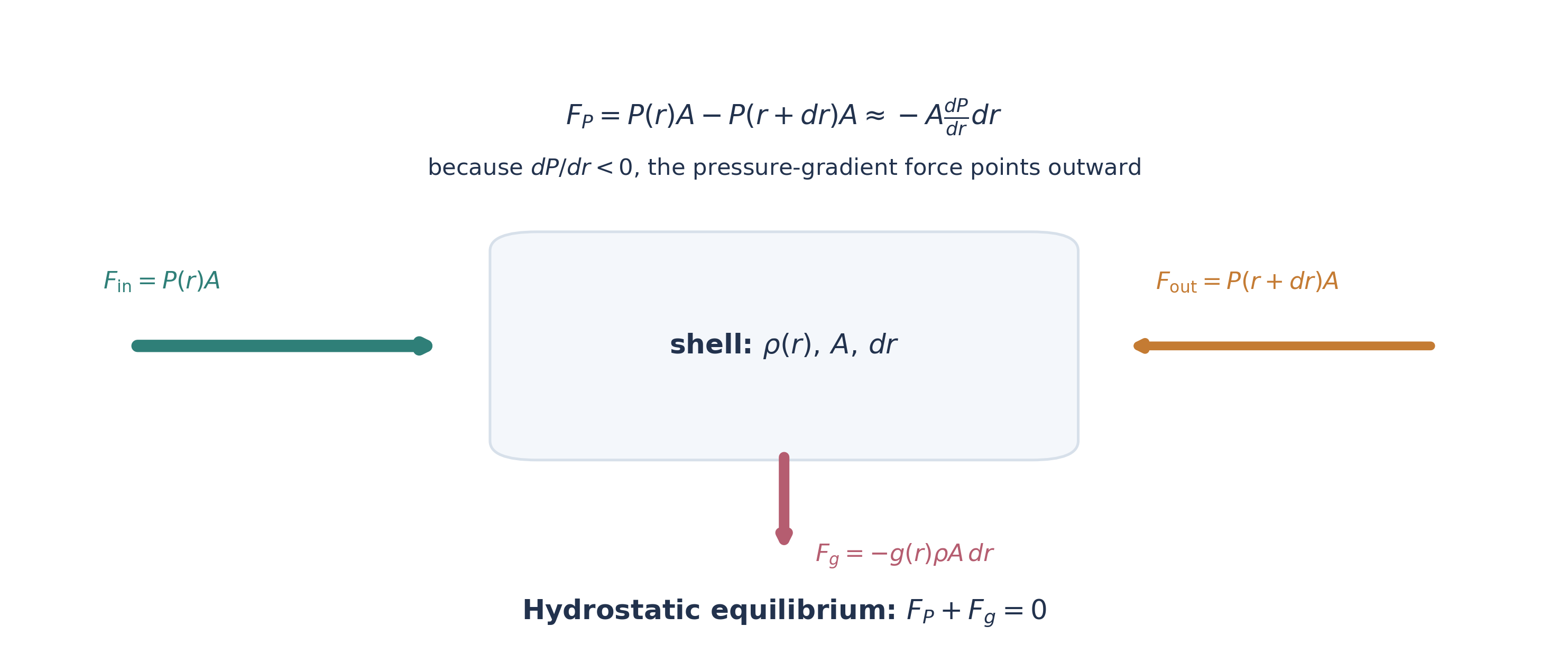
8-9 min. Use this as the bridge from the pool analogy to the shell argument. Stress that hydrostatic equilibrium is local and layer-by-layer, not a single force acting only at the surface.
Build the Force Balance
Consider a thin shell at radius \(r\) with thickness \(dr\).
Gravity
- pulls inward
- depends on enclosed mass \(M(r)\)
- acts on shell mass \(\rho A\,dr\)
Pressure difference
- bottom face pushes out
- top face pushes in
- net force is outward only if pressure decreases with radius
8-10 min. This slide is the verbal setup for the equation. Keep the symbols tied to the picture.
The Master Balance Law
\[ \frac{dP}{dr} = -\frac{G\,M(r)\,\rho(r)}{r^2} \tag{1}\]
Read it like a sentence
- \(P\) is pressure and \(\rho\) is density
- \(M(r)\) is the mass enclosed inside radius \(r\)
- left side: how pressure changes outward
- right side: the local weight per unit volume
- negative sign: pressure must fall as radius increases
10-14 min. Read it in plain English: pressure must drop outward at exactly the rate needed to support the overlying weight. Assumptions: spherical symmetry and no strong acceleration.
Quick Check: What If the Gradient Were Wrong?
If \(dP/dr = 0\) everywhere inside a star, the star would:
- expand rapidly
- collapse on the dynamical timescale
- remain stable because pressure is still present
- become cooler but keep the same size
14-15 min. This separates “pressure exists” from “pressure supports.”
How Much Pressure Does the Core Need?
\[ P_c \sim \frac{GM^2}{R^4} \tag{2}\]
Scaling story
- \(P_c\) is central pressure
- \(M\) is stellar mass and \(R\) is stellar radius
- more mass means more weight to support
- smaller radius means much stronger compression
- this is an order-of-magnitude estimate, not a full stellar model
15-19 min. This is the first big payoff from hydrostatic equilibrium.
Solar Core Pressure: Order of Magnitude
\(P_c \sim \frac{GM_\odot^2}{R_\odot^4} \approx 10^{16}~\text{dyn}/\text{cm}^2\)
- about 10 billion atmospheres
- high enough that ordinary everyday intuition stops helping
- still only an estimate; real solar models give an even larger central pressure
19-21 min. The number matters less than the scale and the dependence on compactness.
Gravity and Thermal Energy Are Linked
\[ 2 K_\text{th} + U_\text{grav} = 0 \tag{3}\]
What makes this deep
- \(K_\text{th}\) is total thermal energy
- \(U_\text{grav}\) is gravitational potential energy
- gravity binds the star, so \(U_\text{grav}<0\)
- thermal motion resists collapse
- the theorem links the energy budget to the force balance
21-25 min. This is the conceptual bridge from force balance to energy balance.
The Strange Result: Negative Heat Capacity
- a star radiates energy away
- gravity makes it contract a little
- contraction increases particle speeds
- the core temperature rises even while the star is losing energy
Self-gravitating systems do the opposite of a coffee cup on your desk.
25-28 min. This is the conceptual payoff of the lecture. Pause here and let it feel weird.
Energy Ledger for a Self-Gravitating Star
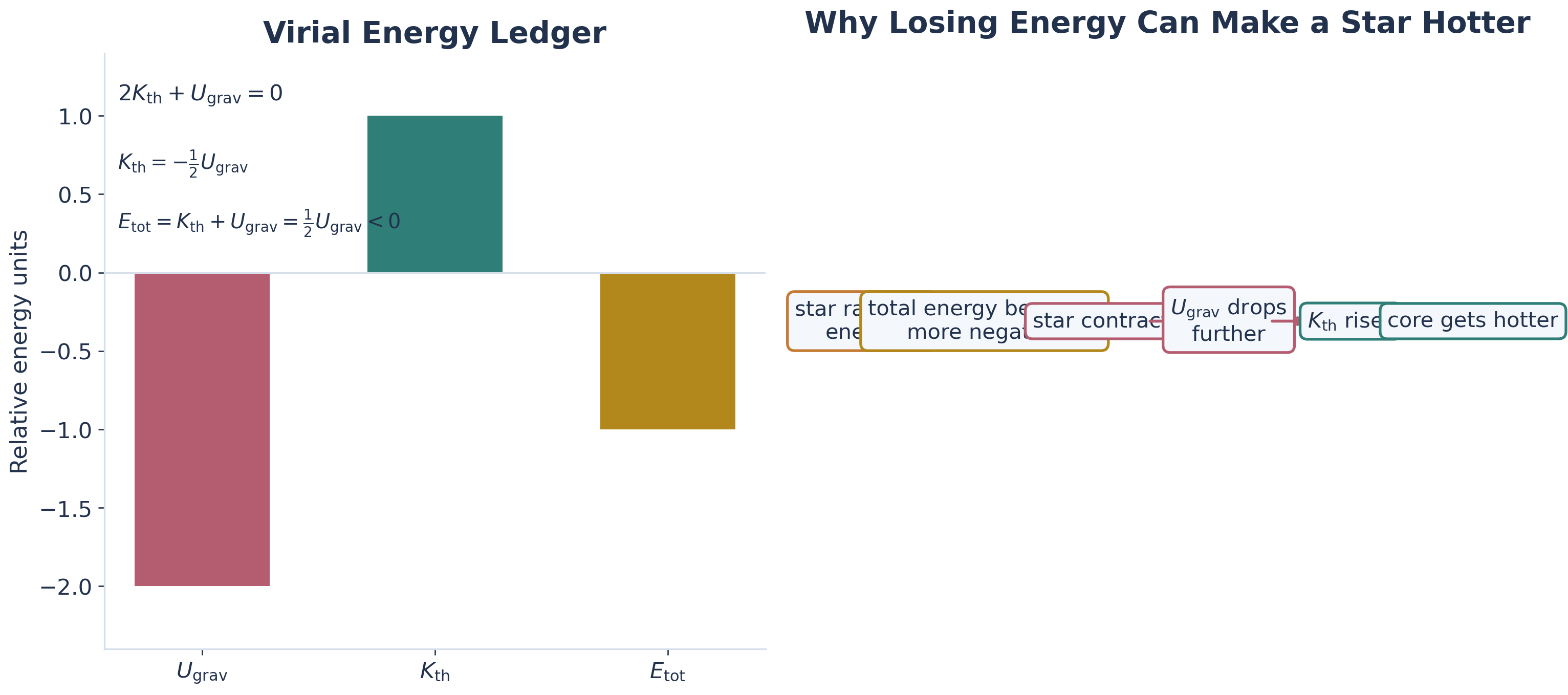
Use the left panel to lock the factor-of-two bookkeeping, then walk the right panel as the causal chain.
From Gravity to Core Temperature
\[ T_c \sim \frac{\mu G M m_p}{k_B R} \tag{4}\]
Why this matters
- \(\mu\) is mean molecular weight
- \(m_p\) is the proton mass and \(k_B\) is Boltzmann’s constant
- depends on mass, radius, and composition
- gives the Sun a core temperature of order \(10^7~\text{K}\)
- shows that gravity alone can prepare the conditions for fusion
28-31 min. This is the “we can estimate the solar core without going inside” moment.
Core Temperature Changes Surprisingly Slowly with Mass
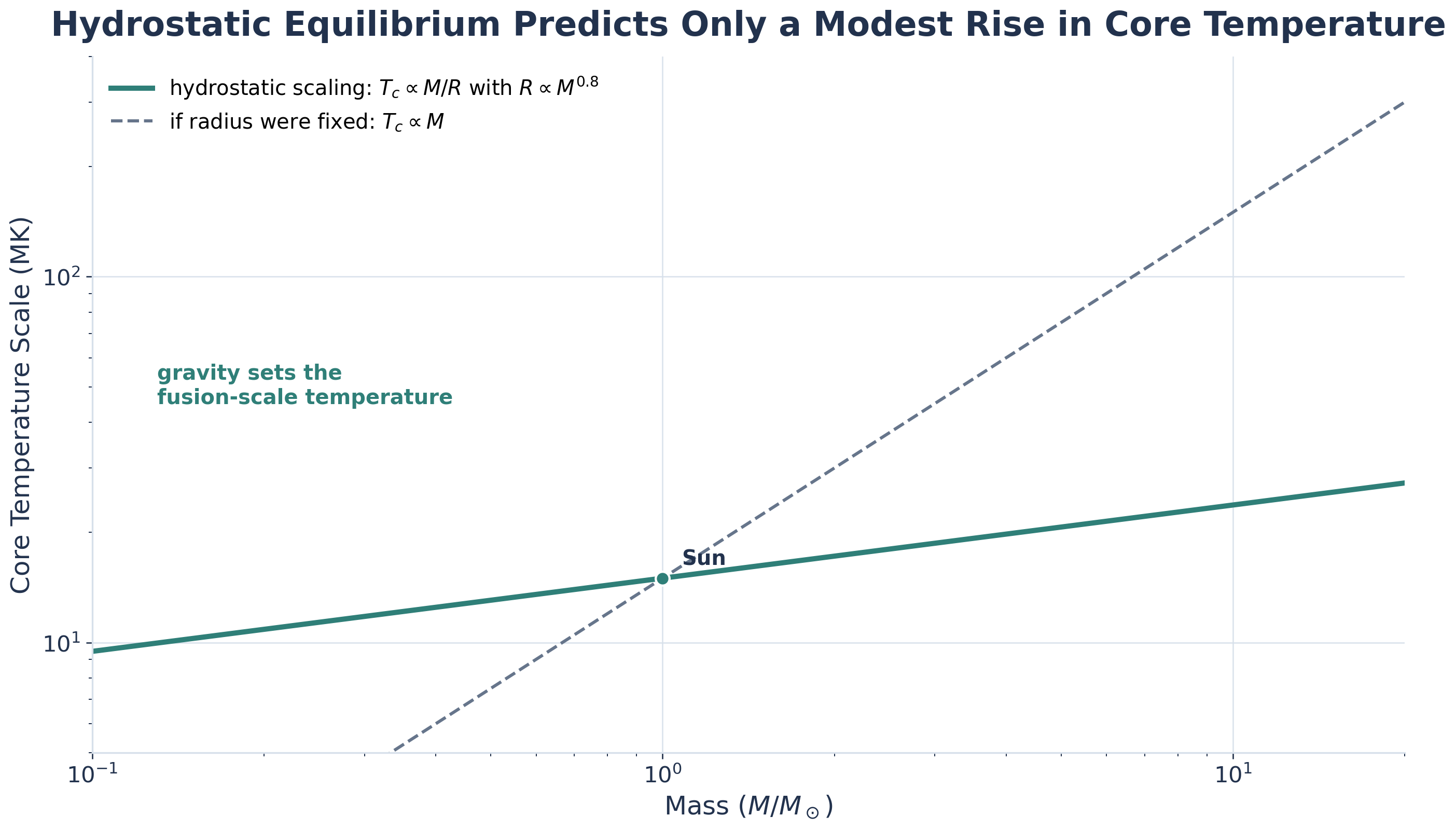
More massive stars are hotter inside, but not by orders of magnitude.
Why 15 Million K Matters
What we used
- gravity
- pressure balance
- thermal motion
What we have not used yet
- nuclear reaction details
- tunneling
- the proton-proton chain
That is the setup for the next lecture: once the core is hot enough, how does fusion actually happen?
31-33 min. Make the transition explicit. Students should feel that hydrostatic equilibrium prepares the ground for fusion.
Where in the Sun Is the Engine?
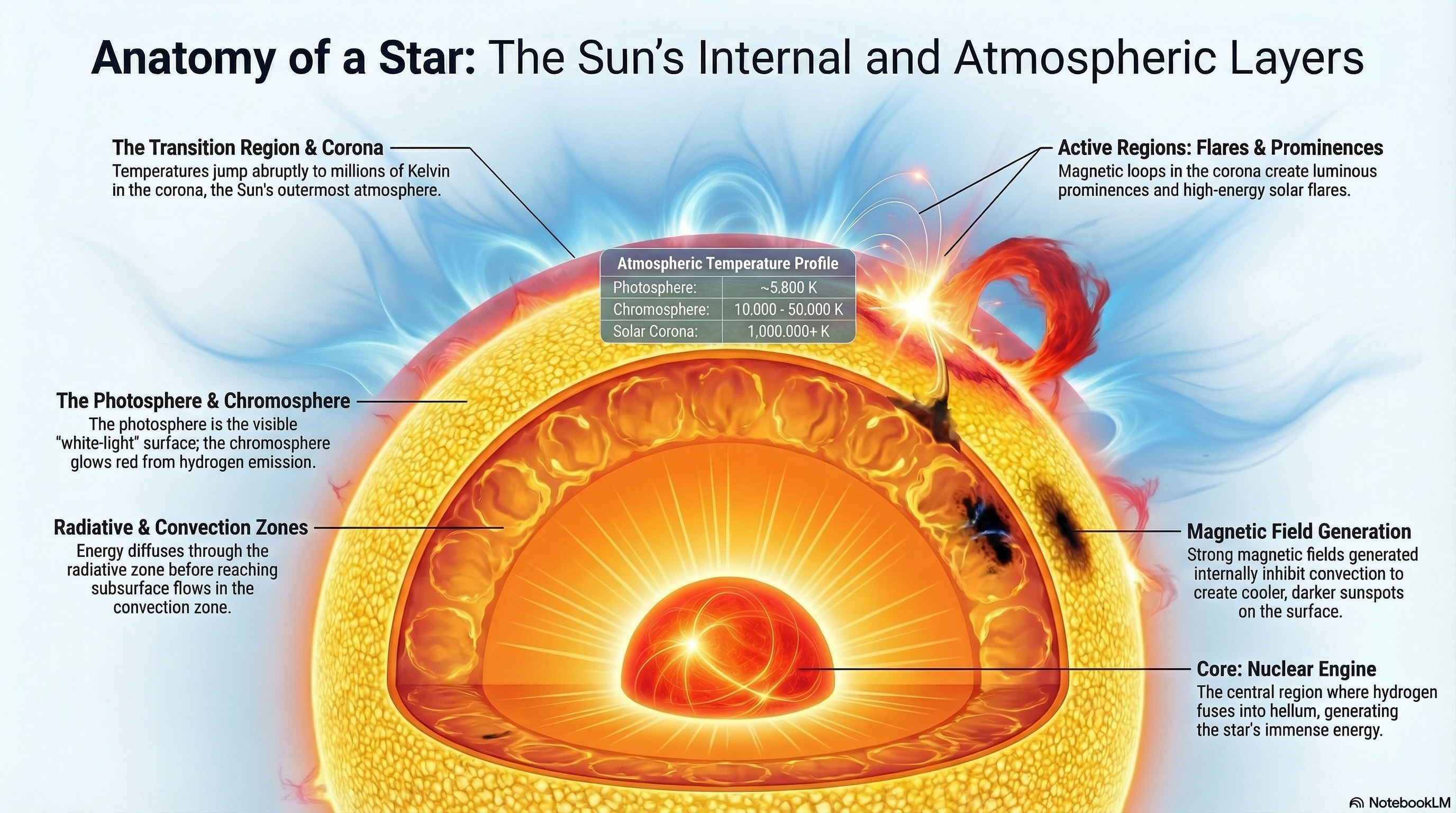
33-34 min. Point out how small the core is compared with the whole star. This helps students separate the fusion engine from the layers that transport and emit the energy.
Observable -> Model -> Inference
| Step | This lecture |
|---|---|
| Observable | A star stays roughly steady for billions of years |
| Model | Pressure gradient balances gravity |
| Inference | The core must be dense, high-pressure, and hot |
We never “see” the solar core directly.
We infer it from the physics required to keep the Sun standing.
33-35 min. Bring the course throughline back to the surface.
Summary: What Hydrostatic Equilibrium Gives Us
- Stars need a pressure gradient — equal pressure on both sides does nothing
- Hydrostatic equilibrium is the master balance law for stellar structure
- Central pressure scales with compactness — same mass, smaller radius means larger \(P_c\)
- Virial balance links gravity and heat — contraction raises temperature
- The solar core must be hot — enough to set up nuclear fusion
38-40 min. This is the clean stopping point for the shorter version.
Looking Ahead
Gravity can make the core hot enough.
Next question: how do protons actually fuse when they repel each other?
40-41 min. Hand off to Lecture 3: nuclear fusion.
Preview: Hydrostatic Balance Is Not the Whole Story
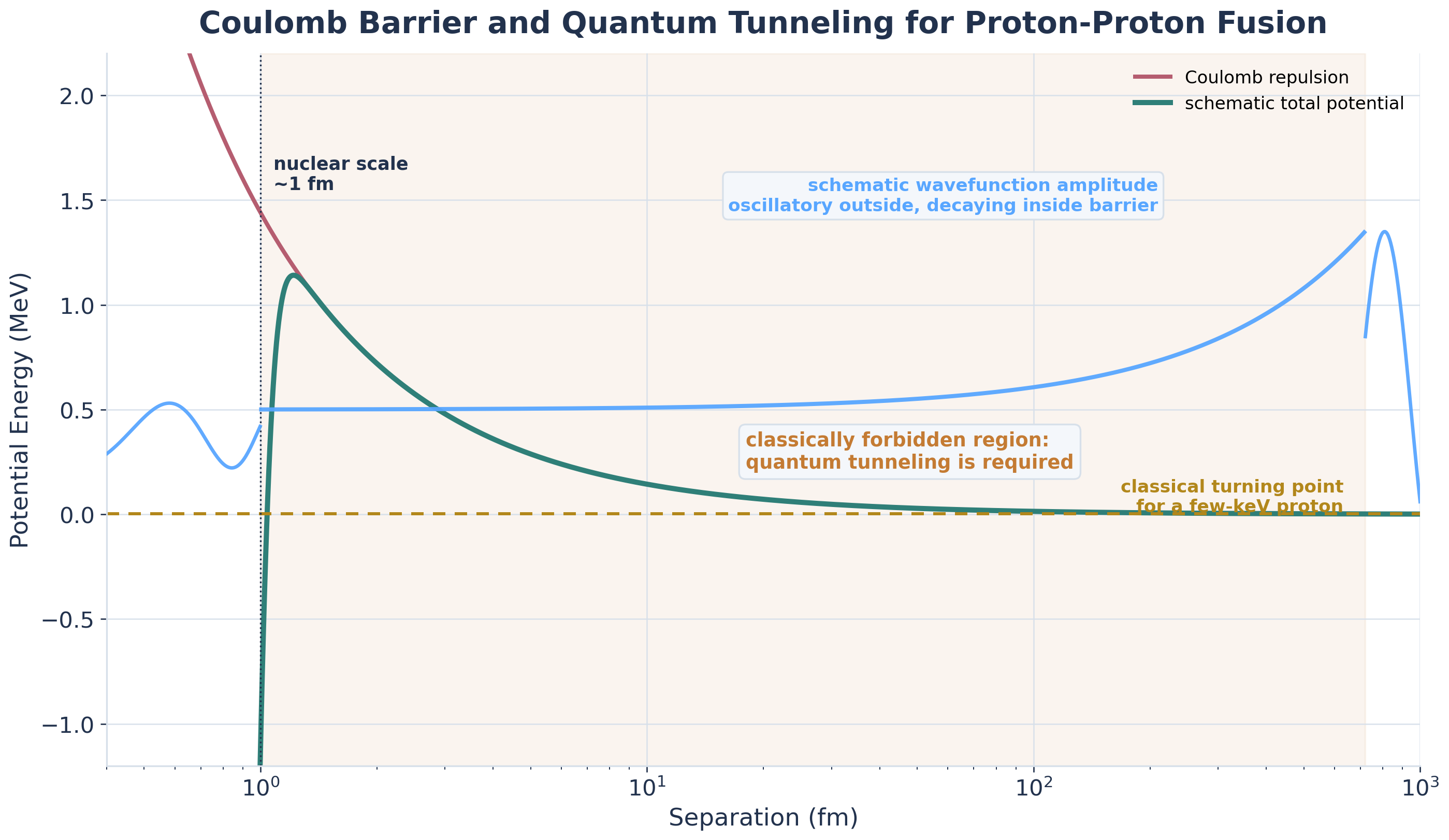
Preview slide. The left side connects directly to today’s lecture; the right side previews why classical physics fails and quantum tunneling is required.
Optional Expansion
Use these if we want the slower derivation or a fuller pressure story.
Optional: Shell Derivation in One More Step
For a shell of area \(A\) and thickness \(dr\):
\[ F_\text{pressure} = [P(r) - P(r+dr)]A \approx -\frac{dP}{dr}A\,dr \]
\[ F_\text{grav} = -\frac{G M(r)\rho A\,dr}{r^2} \]
Set \(F_\text{pressure} + F_\text{grav} = 0\) to recover hydrostatic equilibrium.
Optional derivation slide for a class that wants the force balance written out explicitly.
Optional: Why White Dwarfs Need Enormous Support
Keep the same mass, shrink the radius by a huge factor, and the required central pressure skyrockets.
That is why later in Module 3 ordinary gas pressure stops being enough, and degeneracy pressure has to take over.
Optional forward-looking bridge to the stellar remnants lectures.
Optional: The Stellar Thermostat
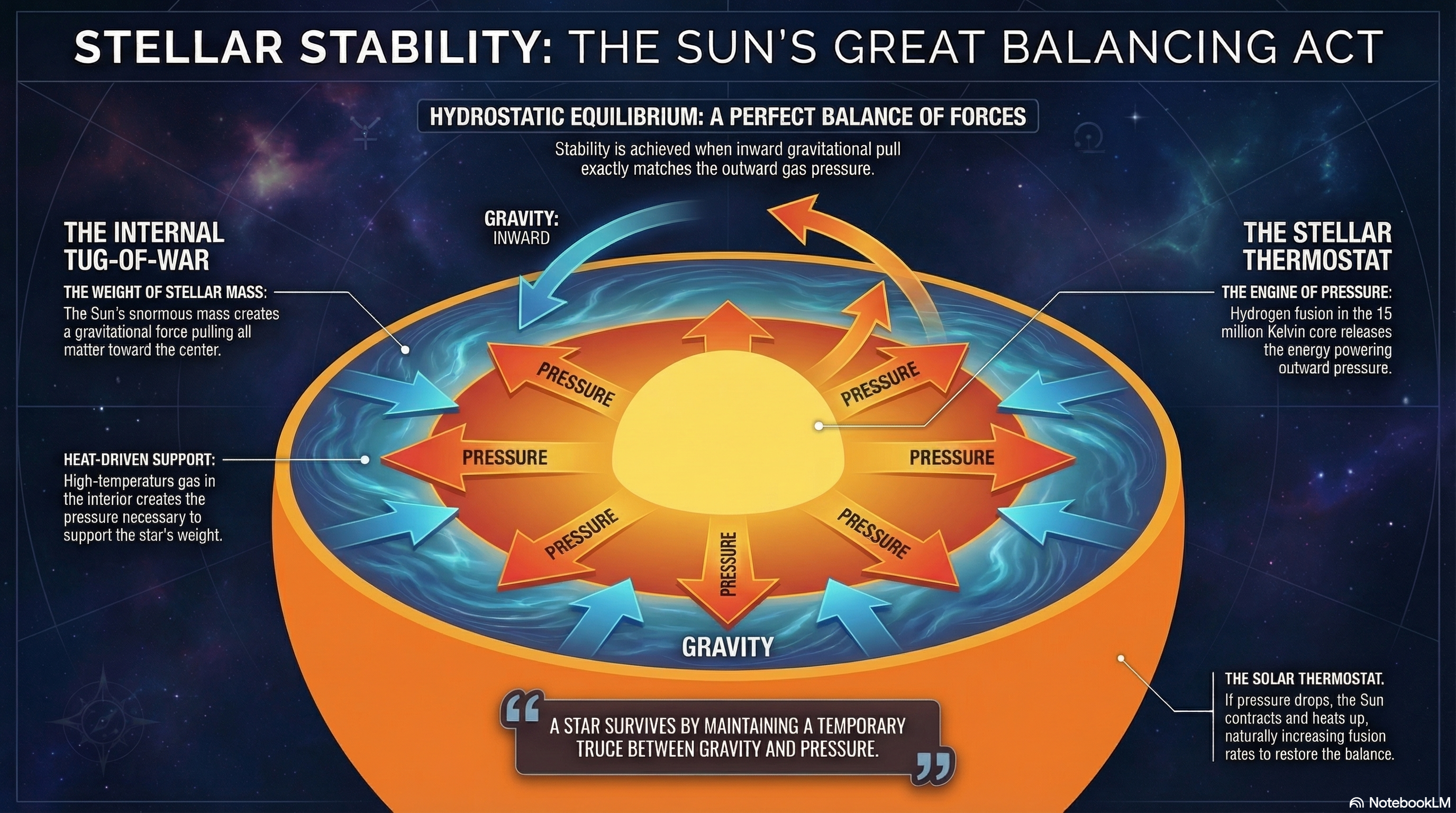
Optional visual summary of the thermostat idea: contraction raises temperature and fusion rate, which helps restore pressure support.