Module in brief
Galaxies & Cosmology
From galaxies to the evolving universe.
Zooming out from individual stars to the systems and spacetime that contain them. Galaxies are evolving ecosystems of gas, stars, and feedback; dynamics weighs what light cannot show and reveals dark matter; and the expansion of spacetime — Hubble's law, redshift, the cosmic microwave background, and the Big Bang — sets the stage on which all of it plays out.
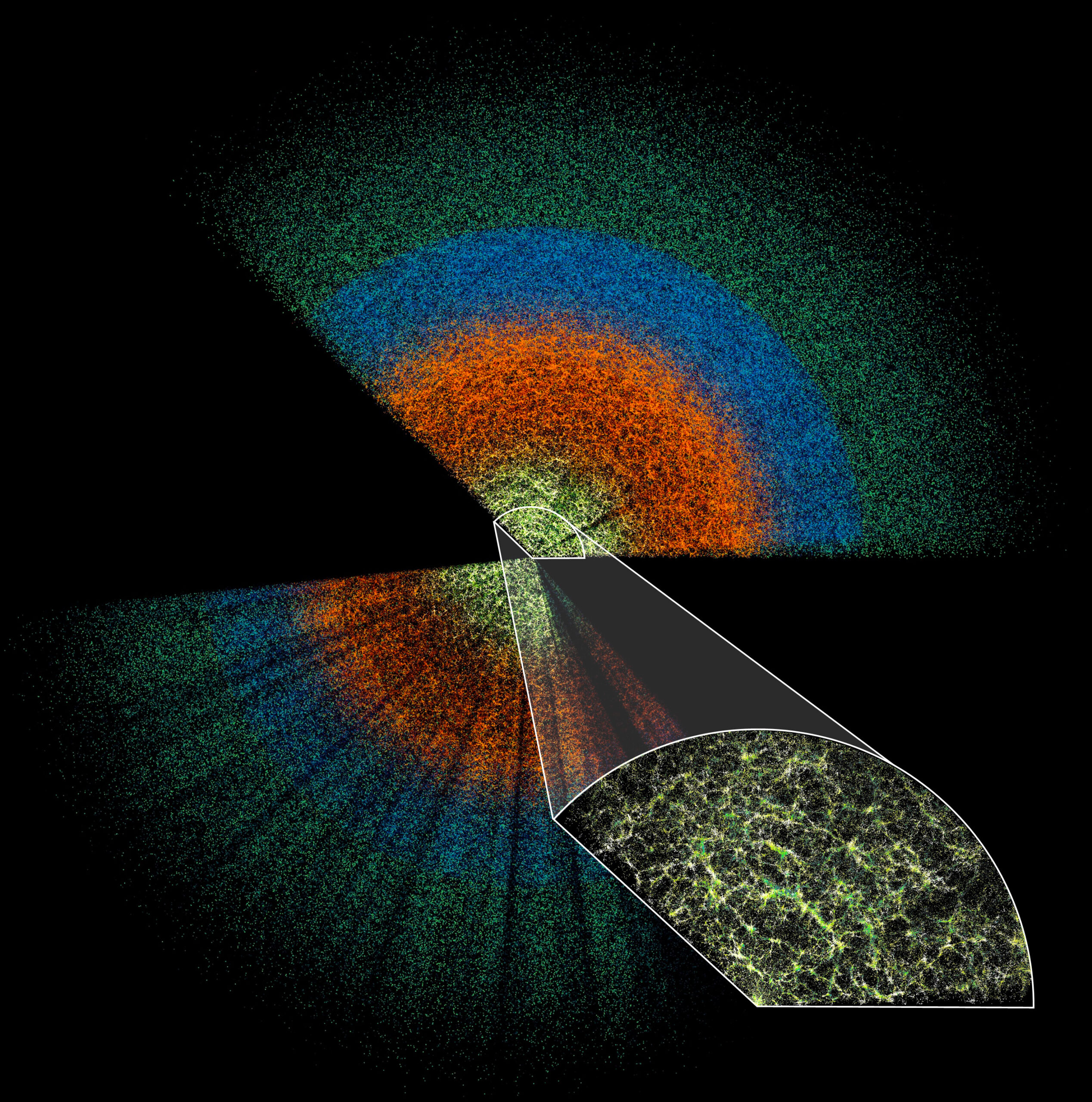
Module Overview
Follow the evidence chain from galaxy ecosystems and gravitating mass to cosmic expansion and history.
Lessons
Galaxies as Ecosystems
A galaxy is not a container of stars but an evolving ecosystem: gas falls in, cools, forms stars, is heated and enriched by feedback, and sometimes expelled. Multiwavelength observations reveal different components — stars, dust, neutral and molecular gas, hot plasma — and the baryon cycle connects stellar evolution to galaxy evolution. The reading opens Module 5 by extending the observe-model-infer method from single stars to the systems that make them.
Weighing the Invisible
Gravity turns motion into mass. From the single circular-orbit relation M(<r) = rv^2/G, this reading weighs the Milky Way's central black hole from S-star orbits, reads flat galaxy rotation curves as evidence for extended dark-matter halos, and quantifies the luminous-versus-dynamical ledger: across galaxies and clusters the gravitating mass outweighs the baryons several-fold. Dark matter emerges as a convergent inference and sets the stage for the cosmic matter budget.
The Expanding Universe
How we measure the expanding universe. The distance ladder is completed — parallax, standard candles, and the Hubble flow — and Hubble's law v = H0 d turns distance into recession speed and 1/H0 into a first age of ~14 Gyr. Cosmological redshift records the changing scale factor, and recession faster than light is allowed because space itself expands (the simple v = H0 d is a low-redshift law). Deep fields turn distance into lookback time. The capstone bookend to Module 2's first question: how far away is that object?
What the Universe Is Made Of
Read the Friedmann equation to find out what the universe is made of, what shape it has, and what its fate will be. Dividing by the expansion rate gives the cosmic budget 1 = Omega_r + Omega_m + Omega_Lambda, measured against the critical density of about five hydrogen atoms per cubic meter. The universe is ~5% ordinary matter, ~26% dark matter, ~69% dark energy, and spatially flat; matter once decelerated the expansion and dark energy now accelerates it. The cosmic microwave background supplies the evidence, and the Reading the Math thread from Module 3 lands on the equation for the whole universe.
The First Three Minutes
The course finale. Wind the expansion backward and the universe grows hot and dense, until in the first three minutes it is a nuclear furnace. Inflation stretches quantum fluctuations into the seeds of structure; the hot Big Bang reheats into a radiation plasma; Big Bang nucleosynthesis forges the primordial hydrogen, helium, and lithium in a brief freeze-out window; and the cosmic timeline unfolds from radiation to matter to dark-energy domination. The origin-of-elements arc closes — BBN plus stellar fusion plus supernovae build the periodic table — and the course's observe-model-infer method is traced from a parallax angle to the Big Bang.
Module Synthesis
Reconstruct an evolving universe by connecting galaxy-scale evidence with expansion, composition, and the early universe.