The First Three Minutes
Section 1 of 6
Concept Throughline
By the end of this reading, you will be able to:
Concept Throughline
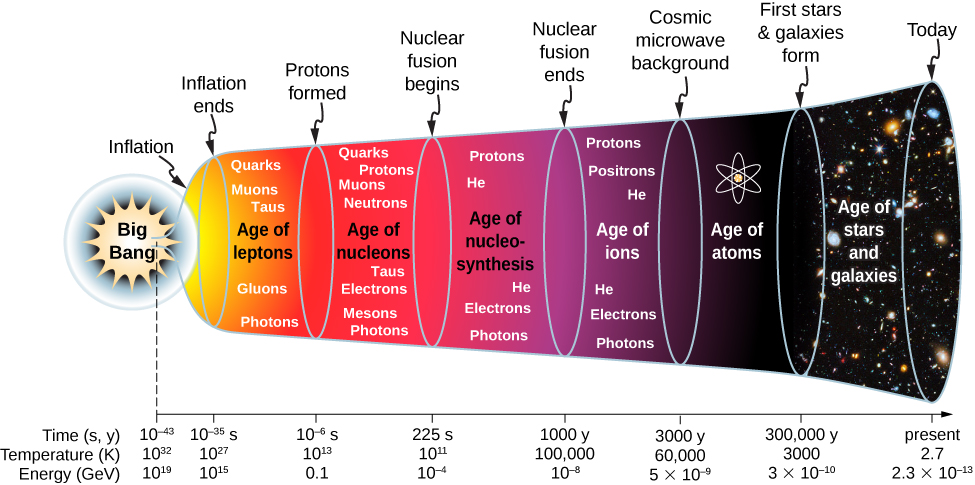
Run the expansion backward. Space contracts, the scale factor shrinks, and everything grows hotter and denser — until, in the first three minutes, the whole universe is a nuclear furnace. The atoms in your body remember it.
The last reading read the Friedmann equation forward, to the universe’s fate. Now we read it backward. If space has been expanding and cooling, then earlier it was smaller, denser, and hotter. Wind the clock back far enough and the universe becomes hot enough to fuse nuclei — a furnace that ran for about three minutes and left a fingerprint we still measure today: the cosmic ratio of hydrogen to helium.
This is the finale, and it closes the oldest thread in the course. The hydrogen in the water you drank this morning is not from any star. It is a relic of the first three minutes — older than the Sun, older than the Galaxy, nearly as old as time.
The cosmic helium fraction and the microwave glow
About a quarter of the ordinary matter in the universe, by mass, is helium — everywhere, even in gas that no star has touched — and the sky glows with relic light.
A hot, dense, expanding early universe
Run the expansion backward: at one second the universe was a plasma of protons, neutrons, electrons, and radiation at ten billion kelvin. Nuclear reactions built light nuclei until expansion cooled and thinned the furnace shut.
The first three minutes, reconstructed
The measured helium fraction matches what those reactions predict, confirming a hot dense origin we can never visit — inference at the farthest possible reach.