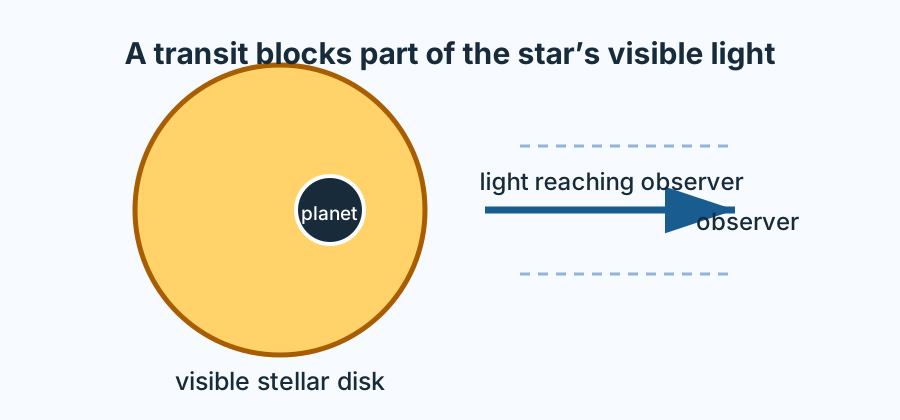
A transit occurs when an orbiting planet passes between its star and an observer. From the observer’s viewpoint, the planet covers a small part of the star’s visible disk, so the received starlight decreases.
What is—and is not—seen
For most transit systems, the star and planet are not separately resolved in the image. The detector records their combined light. During a transit, we do not watch a dark planet move across a detailed stellar photograph; we infer its effect from a very small change in the star’s measured brightness.
A transit has stages
As the planet moves across the apparent stellar disk, the amount of blocked light changes.
Out of transit: the planet does not overlap the visible stellar disk.
Ingress: overlap begins and grows.
Interior transit: the planet is in front of the stellar disk; complete overlap is possible for some geometries.
Egress: overlap shrinks to zero.
The course’s first calculation intentionally starts with the simplest interior case. Project 1 later adds the geometry needed to describe the changing overlap through ingress and egress.
Next connection
Read Light curves and normalized flux for the actual data record, or The uniform-source transit model for the first geometric approximation.