Module in brief
Foundations
From photons to physical claims.
The shared toolkit and vocabulary every later module assumes — what astronomers measure, the reasoning tools that turn those measurements into physical claims, and the habits (units, ratios, estimation) that keep the physics honest.
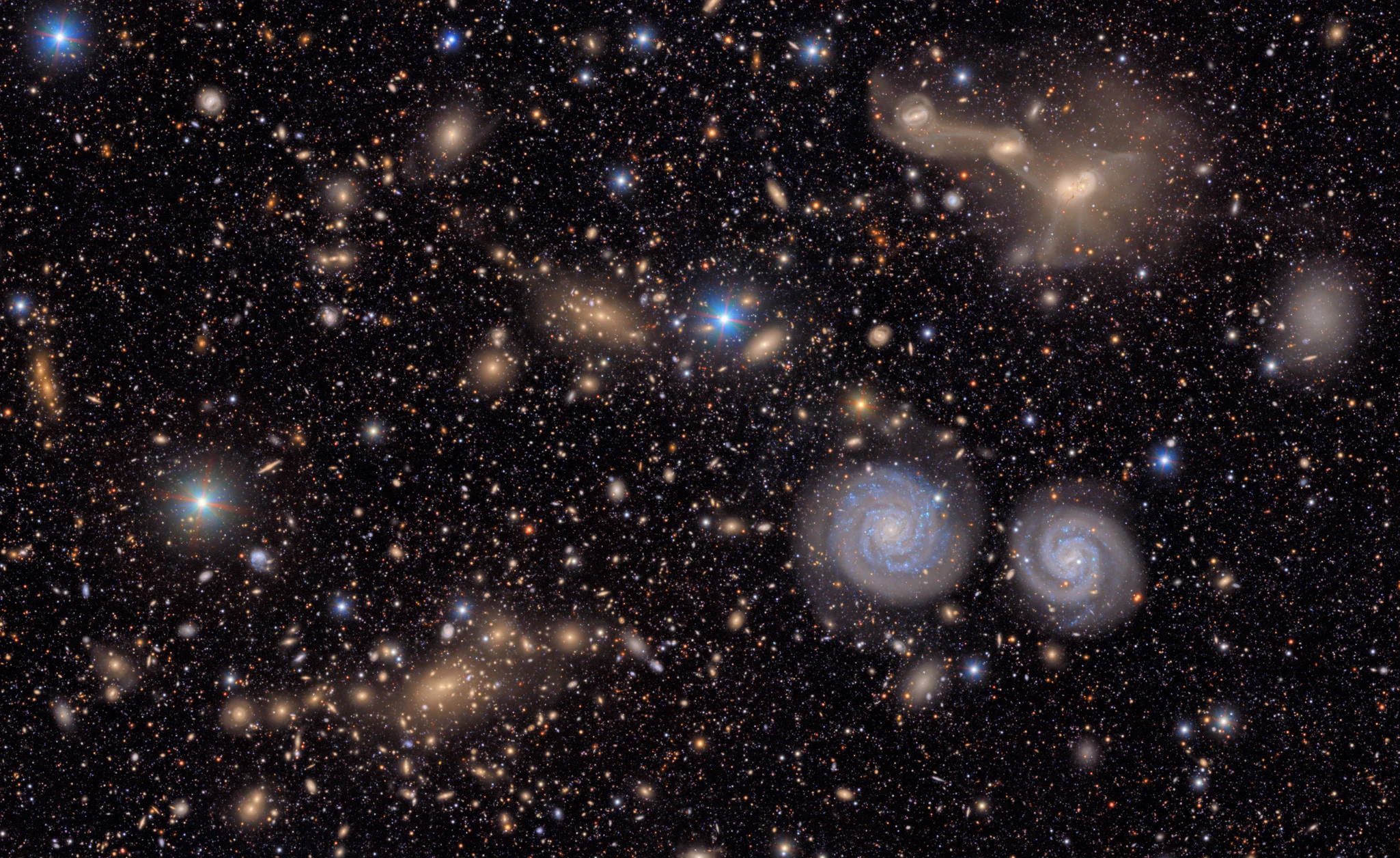
Module Overview
Follow the reasoning chain that turns limited astronomical measurements into testable physical claims.
Lessons
Spoiler Alerts
A trailer for the semester: how astronomers turn photons into physical claims, and how we stay honest about the assumptions behind every inference. The course's foundational Observable→Model→Inference chapter (framing: OMI).
Tools of the Trade
Four problem-solving tools — dimensional analysis, the ratio method, unit conversions, and order-of-magnitude estimation — that turn points of light into physical understanding. (Non-OMI: a toolkit lecture, so no framing declared.)
Gravity and Orbits
Kepler's empirical laws become Newton's gravity: circular motion, orbital and escape speed, and how energy, angular momentum, and the virial theorem predict orbital behavior. (Non-OMI: a derivation/mechanism lecture, so no framing declared.)
Light as Information
Everything we know about the cosmos comes from light. How light is emitted, absorbed, scattered, and collected by telescopes lets us infer temperature (Planck/Wien), composition (Kirchhoff/Bohr), and motion (Doppler) without ever touching a star. Closes Module 1 with an Observable→Model→Inference synthesis.
Module Synthesis
Use measurement, modeling, and quantitative checks together before carrying the method into stellar astrophysics.