Gravity and Orbits
Section 1 of 6
From Empirical Laws to Mechanism
After completing this reading, you will be able to:
Part 1: The Scientific Revolution in Miniature
Why This Matters
Imagine you’ve spent twenty years meticulously recording the positions of planets. You’ve filled notebooks with data, tracking Mars against the background stars night after night. Eventually, patterns emerge. You discover three remarkable regularities — but you have no idea why they’re true. You can predict where Mars will be next year, but you can’t explain what makes it move.
This was Johannes Kepler’s situation in the early 1600s. His three laws of planetary motion were extraordinary achievements: precise, quantitative rules extracted directly from observational data. But they raised as many questions as they answered. Why ellipses and not circles? Why do planets speed up near the Sun? What physical mechanism connects a planet’s distance to its orbital period?
These questions would haunt astronomy for nearly a century — until Isaac Newton showed that all three of Kepler’s laws were consequences of a single, deeper truth: the law of universal gravitation.
Empirical law
A pattern extracted from data that describes what happens without explaining the underlying mechanism. Reliable within the range of the data, but silent on why.
Physical law
A statement of mechanism, derived from first principles, that explains why a pattern holds — and predicts new situations beyond the original data.
This story illustrates something profound about how science works. An
Kepler’s Empirical Laws: Patterns Without Explanation
Before we can appreciate what Newton accomplished, we need to understand what Kepler discovered. His three laws of planetary motion, distilled from decades of observation by Tycho Brahe, are:
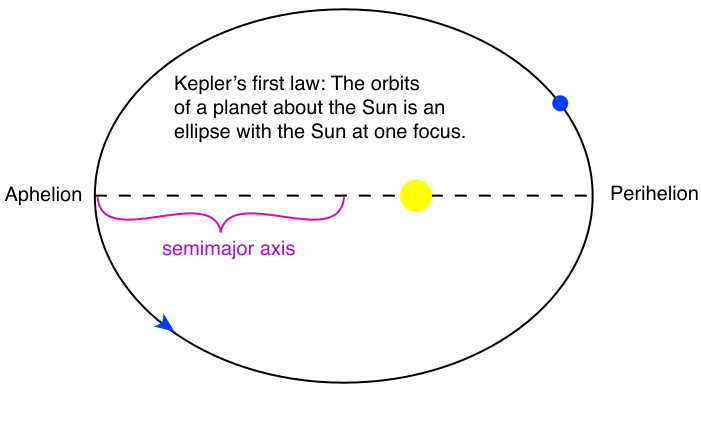
Kepler’s First Law (Law of Orbits):
Planets move in ellipses, with the Sun at one focus.
This was revolutionary. The ancient Greeks — and nearly everyone since — had assumed celestial motion must be circular, because circles were “perfect.” Kepler showed that nature doesn’t care about geometric aesthetics. Real orbits are ellipses, which means a planet’s distance from the Sun changes continuously throughout its orbit.
Eccentricity
A number measuring how “squashed” an ellipse is. is a circle; as the ellipse becomes more elongated. Earth’s is about 0.017 — nearly circular.
The
Semi-major axis
Half the longest diameter of an ellipse — the average distance from the orbiting body to its host. We reserve the symbol for it throughout.
Key orbital terms:
Semi-major axis Perihelion Aphelion - Instantaneous separation (): the current distance between the two bodies, varying between and .
Perihelion
The point of closest approach to the Sun, at distance .
Aphelion
The farthest point from the Sun, at distance .
Kepler’s Second Law (Law of Areas):
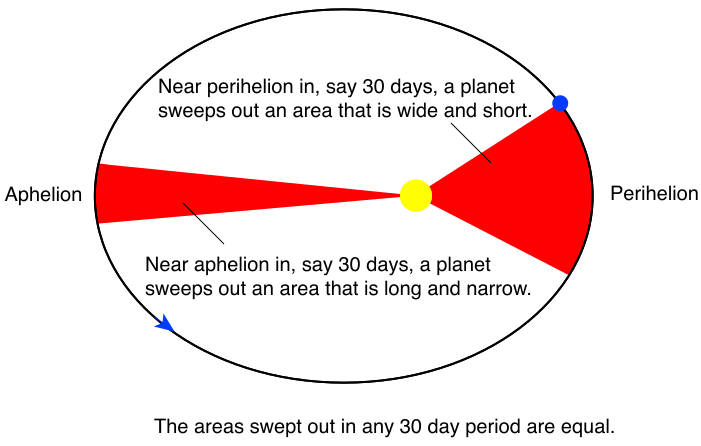
A line connecting a planet to the Sun sweeps out equal areas in equal times.
This law encodes a surprising fact: planets move faster when they’re closer to the Sun and slower when they’re farther away. The “equal areas” rule quantifies exactly how the speed changes — but it doesn’t explain why speed and distance are connected this way.
Central force
A force directed along the line connecting two bodies (toward a center). Gravity is central — and any central force conserves angular momentum, which is why Kepler’s Second Law holds.
Foreshadowing: the equal-area law hints at something deep — it suggests the force on the planet points directly toward the Sun (a
Kepler’s Third Law (Law of Periods):
For orbits around a given central mass, .
This is a scaling relation — it tells us how one quantity changes when we change another. If you move a planet farther from the Sun, its orbital period increases, but not linearly: doubling the distance increases the period by a factor of . Written as a proportionality:
where is the orbital period and is the semi-major axis. Notice this is a proportionality, not an equality — the constant of proportionality depends on the central mass, as Newton would later show.
Pause & Predict #1
Commit to an answer before reading on.
Check your reasoning against the answers below.
Problem
Check the two predictions above. (a) If you double a planet’s orbital distance, by what factor does its period change? (b) Does Kepler II’s “faster near the Sun” mean planets are accelerating?
- If distance doubles, increases by , so increases by .
- Yes — planets accelerate continuously (their velocity direction always changes). The “speeding up” near perihelion is the linear speed increasing; the acceleration always points toward the Sun.
The Limits of Empirical Laws
Kepler’s laws are powerful predictive tools. Given a planet’s orbital parameters, you can calculate where it will be at any future time. But notice what they don’t tell you: why orbits are ellipses, what causes the speed-up near the Sun, why the period depends on distance with exactly this power, or whether the same rules apply beyond our solar system. Empirical laws summarize observations but don’t explain the underlying physics. This is precisely where Newton’s contribution transformed astronomy into physics.