Tools of the Trade
Section 1 of 5
Dimensional Analysis
By the end of this reading, you will be able to:
Why This Matters: The Challenge of Points of Light
Stars appear as mere points of light. Is that faint red glow a tiny nearby dwarf or a massive distant supergiant? We can’t visit them. We can’t weigh them directly. We can’t send a probe to measure their temperature.
So how do we know anything about them?
We need a toolkit that extracts physics from limited data. That is what this lecture provides: four methods that turn “points of light” into physical understanding.
2.1 Tool 1: Dimensional Analysis
The Smoke Detector for Physics
Here is a student’s attempt to calculate Mars’s orbital period:
Their calculator returns — of something.
Can you tell this equation is wrong without doing any calculation? Yes — and the method is called dimensional analysis.
Dimension
The physical nature of a quantity — what kind of thing it is (length, mass, time, …). Dimensions are invariant; units are conventions.
Units vs. Dimensions
Every physical quantity has two aspects. Units are human conventions: meters versus centimeters, grams versus kilograms. Dimensions are physical invariants: a length is a length, no matter what unit you measure it in.
![Split diagram contrasting UNITS (The Map) showing ruler, stopwatch, and weights labeled as 'human inventions, fungible, arbitrary' versus DIMENSIONS (The Territory) showing [L], [T], [M] symbols labeled as 'physical realities, invariant, fundamental'. Footer states physical laws must hold regardless of units used.](/astr201/figures/units-vs-dimensions-nblm.png)
We denote
| Dimension | Symbol | Examples of Units |
|---|---|---|
| Length | cm, m, AU, pc, ly | |
| Mass | g, kg, | |
| Time | s, yr, Myr |
Derived Quantities
Here is how common quantities build from the fundamental three:
![Visual equation builder showing how Mass [M], Length [L], and Time [T] combine like building blocks: Velocity = L/T → [L][T]^-1, Acceleration = velocity/time → [L][T]^-2, Force = mass × acceleration → [M][L][T]^-2, Energy = force × distance → [M][L]²[T]^-2. Includes sanity check: if your energy calculation has dimensions [M][L][T]^-1, you missed a velocity term.](/astr201/figures/fundamental-dims-nblm.png)
| Quantity | Dimensions | CGS Unit |
|---|---|---|
| Velocity | cm/s | |
| Acceleration | cm/s² | |
| Force | dyne (g cm/s²) | |
| Energy | erg (g cm²/s²) | |
| Pressure | dyne/cm² |
What are the dimensions of momentum, ?
Momentum is mass times velocity: .
The Smoke Detector Test
Here is the key idea: both sides of any valid physics equation must have the same dimensions. If you calculate a star’s mass and the answer has dimensions of time, the physics is wrong — you do not need a calculator to know something is broken.
To apply this to the student’s equation, the left side should be a period, . The right side has divided by — so first we need the dimensions of .
What Are the Dimensions of G?
Newton’s law of gravity gives us a handle on :
Let’s name every piece:
- : the gravitational force between the two bodies
- : the gravitational constant — how strong gravity is
- : the mass of the central object (e.g. a star)
- : the mass of the orbiting object (e.g. a planet)
- : the distance between the two masses
This is the equation we invert to weigh the cosmos: we never measure a gravitational force on a star directly, but its consequences — orbits, accelerations — let us solve for the masses involved. First, though, we use it for a humbler purpose: to read off the dimensions of .
We know force has dimensions . Solving Newton’s law for :
![Diagram explaining that constants like G and c are not just numbers but conversion factors. Shows c (speed of light) with dimensions [L][T]^-1 as the universal speed limit, and G (gravitational constant) derived from Newton's law with dimensions [M]^-1[L]^3[T]^-2. Highlights the inverse mass term that allows gravity to cancel mass.](/astr201/figures/physical-constants-nblm.png)
Back to the Student’s Error
Now we can check :
So the student’s equation gives
That is “time squared per length” — physically meaningless. The equation is guaranteed wrong, and we knew it before touching a calculator.
A classmate claims orbital period scales as . Could this one be right? Check its dimensions.
, and the square root gives — a time. This one survives the smoke-detector test, so it could be correct.
The Dimensional Analysis Protocol
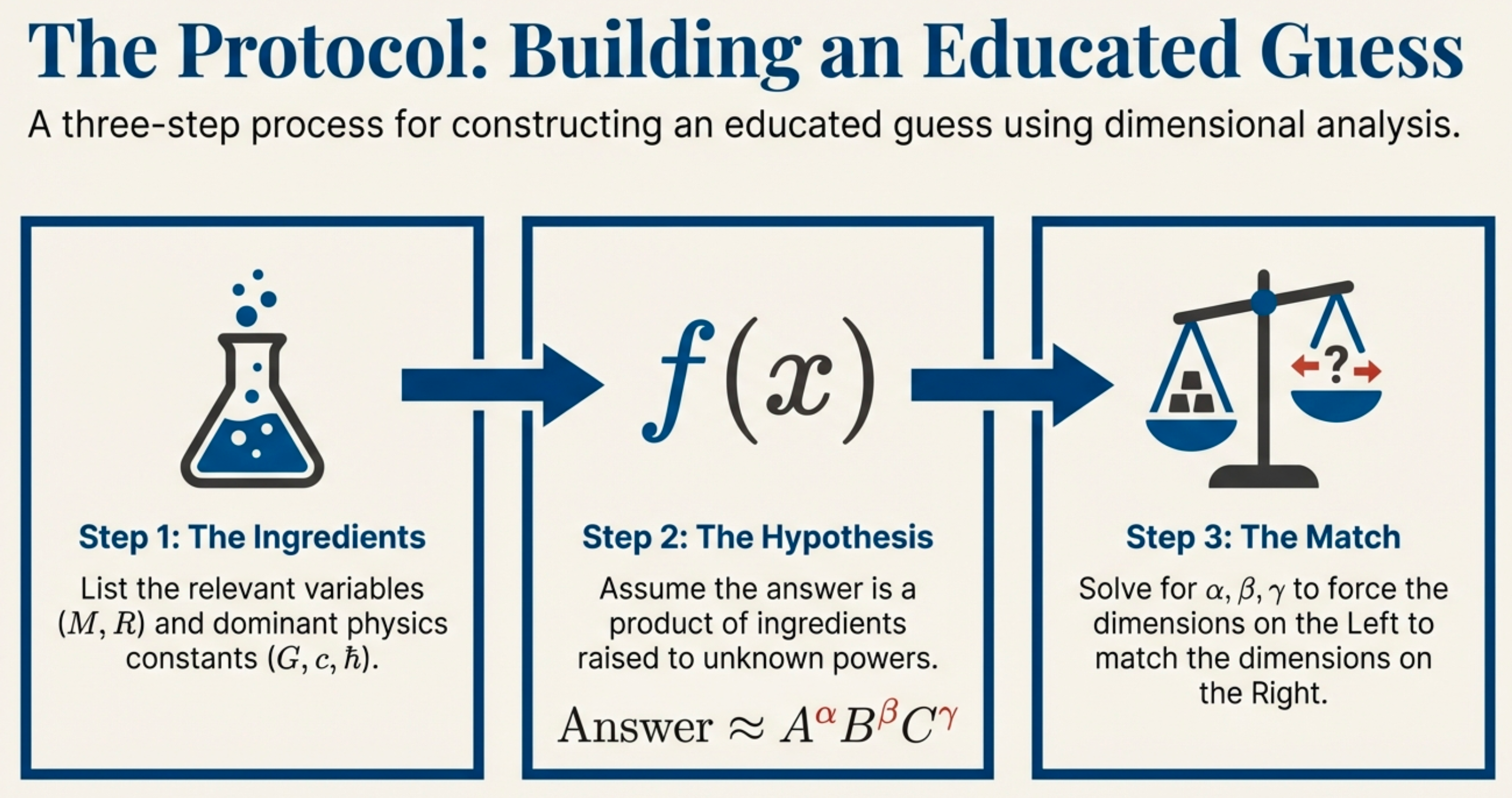
The systematic approach has five steps:
- Identify the target. What are you solving for, and what dimensions should it have?
- List the ingredients. Which quantities could the answer depend on, and what are their dimensions?
- Build a combination. Assume the answer is a product of powers:
- Match exponents. Require the dimensions to agree on both sides.
- Solve for the exponents
Worked Example: Deriving Kepler’s Third Law
Let’s derive how orbital period scales with orbital radius and central mass . The ingredients — and the target — are the dimensions we just collected:
![Diagram showing planetary orbit with star mass M and orbital radius r. Lists ingredients: Distance r with dimension [L], Star Mass M with dimension [M], Gravity G with dimension [M]^-1[L]^3[T]^-2. Target dimension: Time [T].](/astr201/figures/case-A-planetary-orbits-dimensional-analysis-1.png)
| Quantity | Dimensions |
|---|---|
| (orbital radius) | |
| (central mass) | |
| (gravitational constant) |
Problem
Find how the orbital period scales with orbital radius and central mass . The target is a time, .
StepAssume a power law
Suppose . Substituting dimensions and collecting exponents:
StepMatch exponents
Require each fundamental dimension to balance:
- Time:
- Mass:
- Length:
Dimensional check
With these exponents . Check the radicand: , so ✓ — a time, exactly as the target demands.
Result
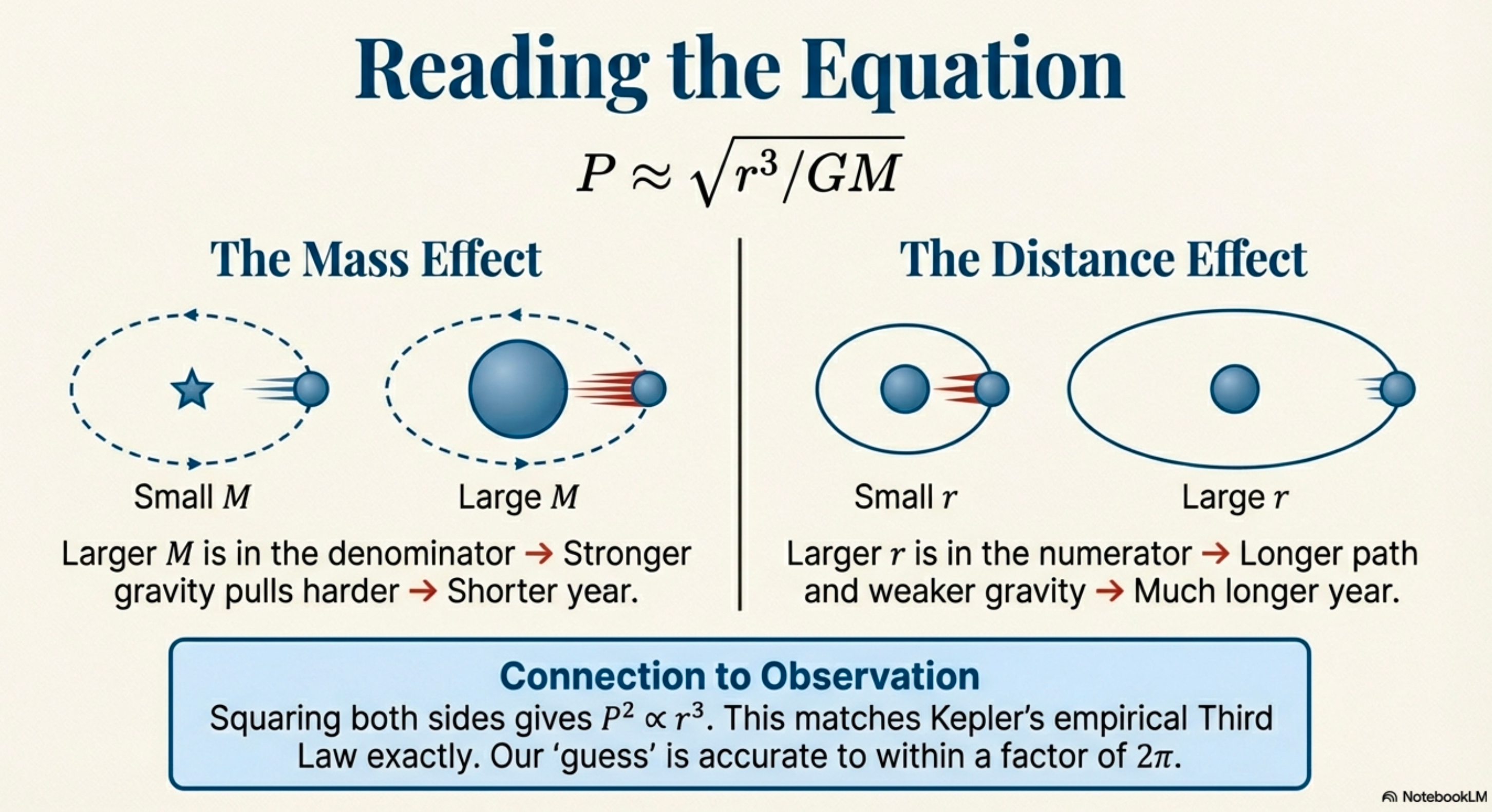
. Dimensional analysis fixes the scaling exactly but cannot supply the pure number out front; the full force-balance derivation gives .
![Three-step derivation: Step A (Kill Mass) - multiply G×M to get [L]^3[T]^-2, Step B (Kill Length) - divide by r^3 to get [T]^-2, Step C (Isolate Time) - invert and square root to get P ≈ √(r^3/GM). Result achieved with zero calculus.](/astr201/figures/case-A-planetary-orbits-dimensional-analysis-2.png)
We just derived this scaling from dimensions alone — no calculus, no orbit-solving. The registry card below records what the relationship assumes and when it breaks; the squared form makes Kepler’s empirical jump out directly.
Another Example: The Black Hole Event Horizon
What sets the “point of no return” around a black hole? We want a length scale at which gravity wins against light itself.
Event horizon
The boundary beyond which nothing — not even light — can escape a black hole’s gravitational pull. Its radius is the Schwarzschild radius.
![Diagram with black hole illustration showing curved spacetime. Goal: Find Schwarzschild radius R_sch. Ingredients: Mass M [M], Gravity G [M]^-1[L]^3[T]^-2, Speed of Light c [L][T]^-1. Target dimension: Length [L].](/astr201/figures/case-B-black-hole-dimensional-analysis-nblm-1.png)
The
| Quantity | Dimensions |
|---|---|
| (black hole mass) | |
| (gravity) | |
| (speed of light) |
Problem
Find the length scale — the horizon radius — built from , , and . The target is a length, .
StepAssume a power law
Suppose . Substituting dimensions:
StepMatch exponents
- Time:
- Mass:
- Length: , hence ,
Dimensional check
With , the combination is . Check: ✓ — a length, as required.
Result
. Dimensional analysis nails the scaling; the pure number in front needs more physics.
![Solution logic: (1) Eliminate Mass: G×M → [L]^3[T]^-2, (2) Eliminate Time: divide by c² → [L], (3) Result: R_sch ≈ GM/c². Image of accretion disk around black hole. Note: General Relativity yields exactly this scaling factor.](/astr201/figures/case-B-black-hole-dimensional-analysis-nblm-2.png)
Solving Einstein’s equations supplies the one thing dimensional analysis could not — a factor of — giving . We captured the essential physics without any of that machinery.
Using , what happens to the event horizon if you double the black hole’s mass?
Since linearly, doubling the mass doubles the horizon radius.