COMP 536 | Numerical Methods
2026-04-22
By the end of this lecture, you will be able to:
In Project 1, you modeled stellar populations — where stars land on the HR diagram:
But real stars move. They orbit, interact, and evolve dynamically. That’s Project 2.
In Project 2, you’ll simulate gravitational dynamics — stars moving under each other’s gravity:
To make this work, we need to solve ordinary differential equations numerically. That’s today’s lecture.
Every one of these has the form:
\[\frac{d\mathbf{y}}{dt} = \mathbf{f}(t, \mathbf{y})\]
Ordinary Differential Equations (ODEs) are the language of change.
The Initial Value Problem (IVP)
Given a rate of change and a starting point, predict the future:
\[\frac{d\mathbf{y}}{dt} = \mathbf{f}(t, \mathbf{y}), \qquad \mathbf{y}(t_0) = \mathbf{y}_0\]
Mathematics gives us the recipe for change. Computers can only do arithmetic.
How do we bridge the gap?
A state vector captures everything about the system right now.
For a mass on a spring: \(\;\mathbf{y} = [x,\, v]^T\) — position and velocity. That’s it.
Physics tells us how the state changes:
\[\frac{d}{dt}\begin{bmatrix} x \\ v \end{bmatrix} = \begin{bmatrix} v \\ -\omega^2 x \end{bmatrix}\]
Physics gives us a 2nd-order equation: \(\;\ddot{x} = -\omega^2 x\)
Computers need 1st-order systems: \(\;\dot{\mathbf{y}} = \mathbf{f}(\mathbf{y})\)
The recipe (you will use this for every project):
Tip
For Project 2: Newton’s law \(m\ddot{\vec{r}} = \vec{F}\) converts the same way. Your state vector will be \([\vec{r}_1, \vec{r}_2, \ldots, \vec{v}_1, \vec{v}_2, \ldots]\) with \(6N\) components for \(N\) particles.
The derivative is defined as a limit:
\[\frac{dy}{dt} = \lim_{h \to 0} \frac{y(t+h) - y(t)}{h}\]
Computers cannot take limits. So we drop the limit and use finite \(h\):
\[\frac{y(t+h) - y(t)}{h} \approx f(t, y)\]
Rearrange to get a recipe for the future:
\[\boxed{y_{n+1} = y_n + h \cdot f(t_n, y_n)}\]
We just derived Euler’s method.
How large should \(h\) be? Dimensional analysis gives us a rule of thumb:
Tip
For today’s SHO (\(\omega = 1\), period \(T = 2\pi\)): \(h = 0.1\) gives about 63 points per period. Good enough to see the methods’ behavior clearly.
For Project 2 (Earth orbit, period \(T = 1\) yr): start with \(h = 0.01\) yr.
\[\frac{dy}{dt} = -y, \quad y(0) = 1\]
Exact: \(y(t) = e^{-t}\)
Simple, monotonic, forgiving.
Good for building intuition.
\[\ddot{x} = -\omega^2 x\]
State: \(\mathbf{y} = [x, v]^T\)
Exact: \(x(t) = \cos(\omega t)\)
Oscillatory, energy-conserving, punishing.
Reveals fundamental flaws.
Tip
We choose these because they have exact analytical solutions. If the method fails here, it will fail on harder problems.
The simplest idea. The most spectacular failure.
Taylor-expand \(y(t + h)\) around \(t\):
\[y(t+h) = y(t) + h\,y'(t) + \frac{h^2}{2}\,y''(t) + \cdots\]
Since \(y'(t) = f(t, y)\), truncate after the first derivative:
\[\boxed{y_{n+1} = y_n + h \cdot f(t_n, y_n)}\]
Error analysis:
The order of a method tells you how fast the error shrinks when you reduce \(h\):
If you halve \(h\), the global error drops by a factor of \(2^p\):
| Method | Order \(p\) | Halve \(h\) → |
|---|---|---|
| Euler | 1 | \(2\times\) less error |
| RK2 | 2 | \(4\times\) less error |
| RK4 | 4 | \(16\times\) less error |
To get \(10\times\) more accuracy:
Higher order = much more accuracy per unit of work.
Tip
Where does the order come from? Taylor series. Euler keeps one term (\(h\)). RK4 matches four terms (\(h, h^2, h^3, h^4\)). More terms → error starts at a higher power of \(h\).
That is literally all of Euler’s method. Three lines.
The rest is choosing \(f\) and \(h\).
Exponential decay: \(\;\dfrac{dy}{dt} = -y, \quad y(0) = 1 \quad \Longrightarrow \quad y(t) = e^{-t}\)
t_exact = np.linspace(0, t_end, 200)
fig, ax = plt.subplots(figsize=(9, 3))
ax.plot(t_exact, np.exp(-t_exact), 'k-', lw=2, label='Exact: $e^{-t}$')
ax.plot(t_vals, y_vals, 'ro-', label=f'Euler ($h = {h}$)', markersize=8)
ax.set(xlabel='Time', ylabel='$y(t)$',
title='Exponential Decay: Euler Works... Okay')
ax.legend(fontsize=12)
plt.tight_layout()
plt.show()
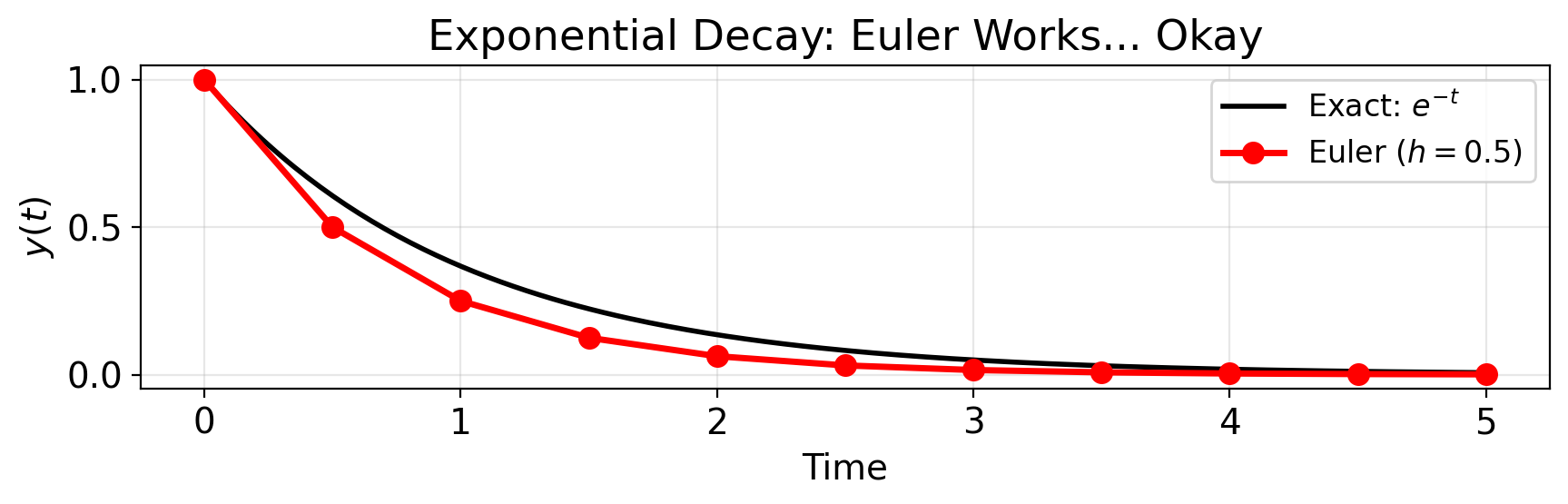
Exponential decay is forgiving — the solution shrinks, so errors shrink too.
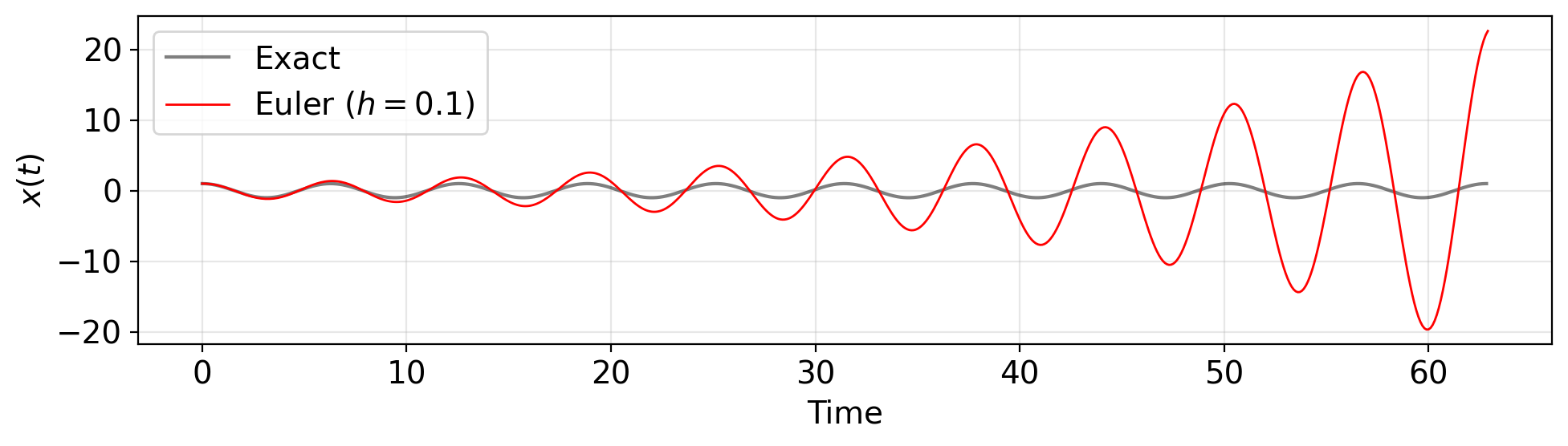
What happens when the solution oscillates and energy should be conserved?
def f_sho(t, y):
"""Harmonic oscillator: y = [x, v], dy/dt = [v, -omega^2 * x]."""
x, v = y[0], y[1]
omega_sq = 1.0 # omega = 1
return np.array([v, -omega_sq * x])
def euler_integrate(f, y0, t_span, h):
"""Euler integration returning arrays of (t, y)."""
t_vals = [t_span[0]]
y_vals = [np.array(y0, dtype=float)]
while t_vals[-1] < t_span[1] - 1e-12:
t, y = t_vals[-1], y_vals[-1]
y_new = y + h * f(t, y)
t_vals.append(t + h)
y_vals.append(y_new)
return np.array(t_vals), np.array(y_vals)
y0_sho = [1.0, 0.0] # x(0) = 1, v(0) = 0\[x(0) = 1, \quad v(0) = 0 \quad \Longrightarrow \quad x(t) = \cos(t), \quad v(t) = -\sin(t)\]
Our diagnostic — total energy should be constant:
\[E = \underbrace{\tfrac{1}{2}v^2}_{\text{kinetic}} + \underbrace{\tfrac{1}{2}\omega^2 x^2}_{\text{potential}} = \tfrac{1}{2}(v^2 + x^2) = 0.5 \quad \text{(for our ICs with } \omega = 1\text{)}\]
If \(E\) changes → the method is injecting or removing energy.
h = 0.1; t_end = 20 * np.pi # 10 periods
t_euler, y_euler = euler_integrate(f_sho, y0_sho, [0, t_end], h)
fig, ax = plt.subplots(figsize=(10, 3))
ax.plot(np.linspace(0, t_end, 2000), np.cos(np.linspace(0, t_end, 2000)),
'k-', alpha=0.5, lw=1.5, label='Exact')
ax.plot(t_euler, y_euler[:, 0], 'r-', lw=1, label=f'Euler ($h={h}$)')
ax.set(xlabel='Time', ylabel='$x(t)$')
ax.legend()
plt.tight_layout()
plt.show()
fig, ax = plt.subplots(figsize=(5, 4))
theta = np.linspace(0, 2 * np.pi, 200)
ax.plot(np.cos(theta), -np.sin(theta), 'k--', lw=2, label='Exact (circle)')
ax.plot(y_euler[:, 0], y_euler[:, 1], 'r-', lw=0.5, alpha=0.7,
label='Euler (spiral)')
ax.set(xlabel='Position $x$', ylabel='Velocity $v$',
title='Phase Space: Euler Spirals Outward')
ax.set_aspect('equal')
ax.legend()
plt.tight_layout()
plt.show()
# Total energy: E = (1/2)(v^2 + omega^2 * x^2). For omega=1: E = (x^2 + v^2)/2
E_euler = 0.5 * (y_euler[:, 0]**2 + y_euler[:, 1]**2)
fig, ax = plt.subplots(figsize=(9, 3))
ax.plot(t_euler, E_euler, 'r-', lw=2, label='Euler')
ax.axhline(0.5, color='k', ls='--', lw=1.5, label='Exact ($E = 0.5$)')
ax.set(xlabel='Time', ylabel='Total Energy $E$',
title='Energy Conservation: Euler FAILS')
ax.legend()
ax.set_ylim(0, min(E_euler[-1] * 1.1, E_euler[-1] + 50))
plt.tight_layout()
plt.show()
print(f"Energy at start: {E_euler[0]:.4f}")
print(f"Energy at end: {E_euler[-1]:.1f}")
print(f"Energy grew by: {(E_euler[-1] / E_euler[0] - 1) * 100:.0f}%")
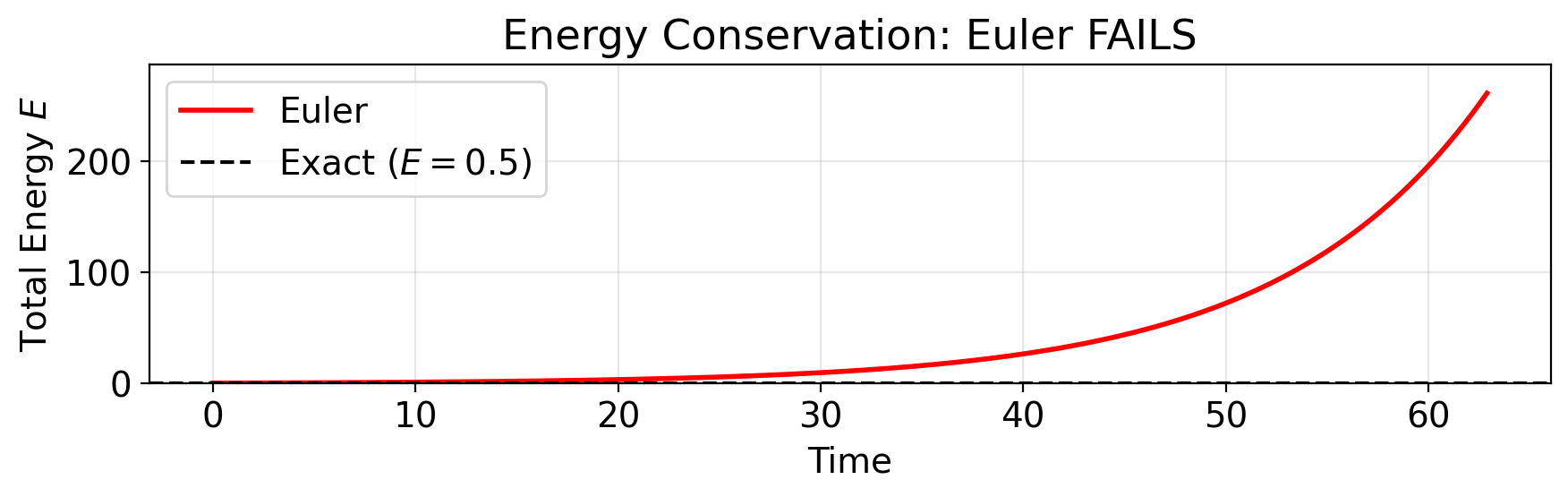
Energy at start: 0.5000
Energy at end: 261.3
Energy grew by: 52157%
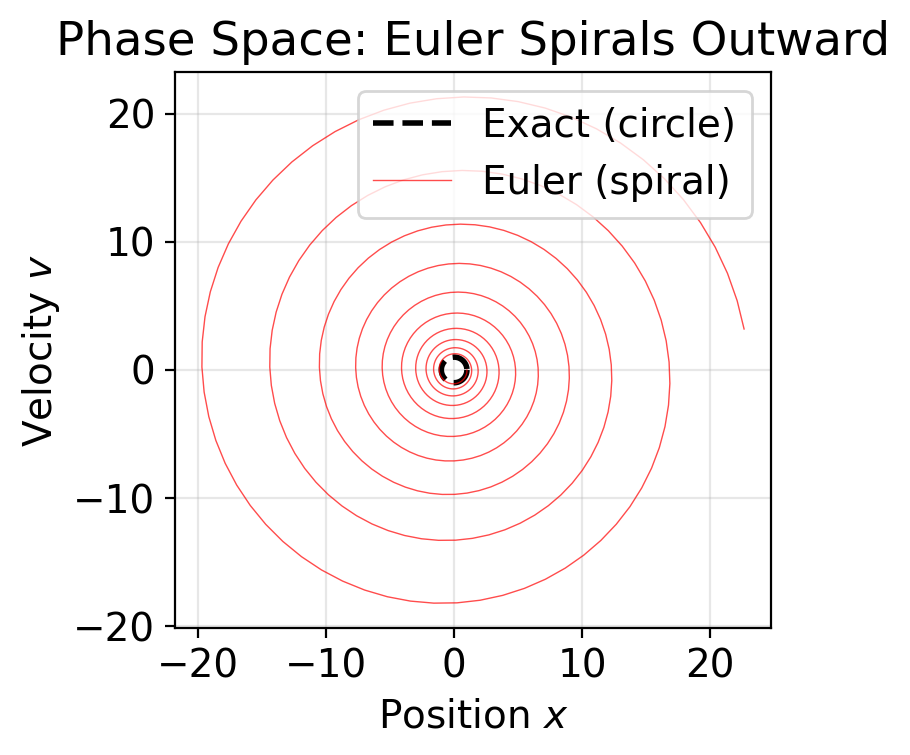
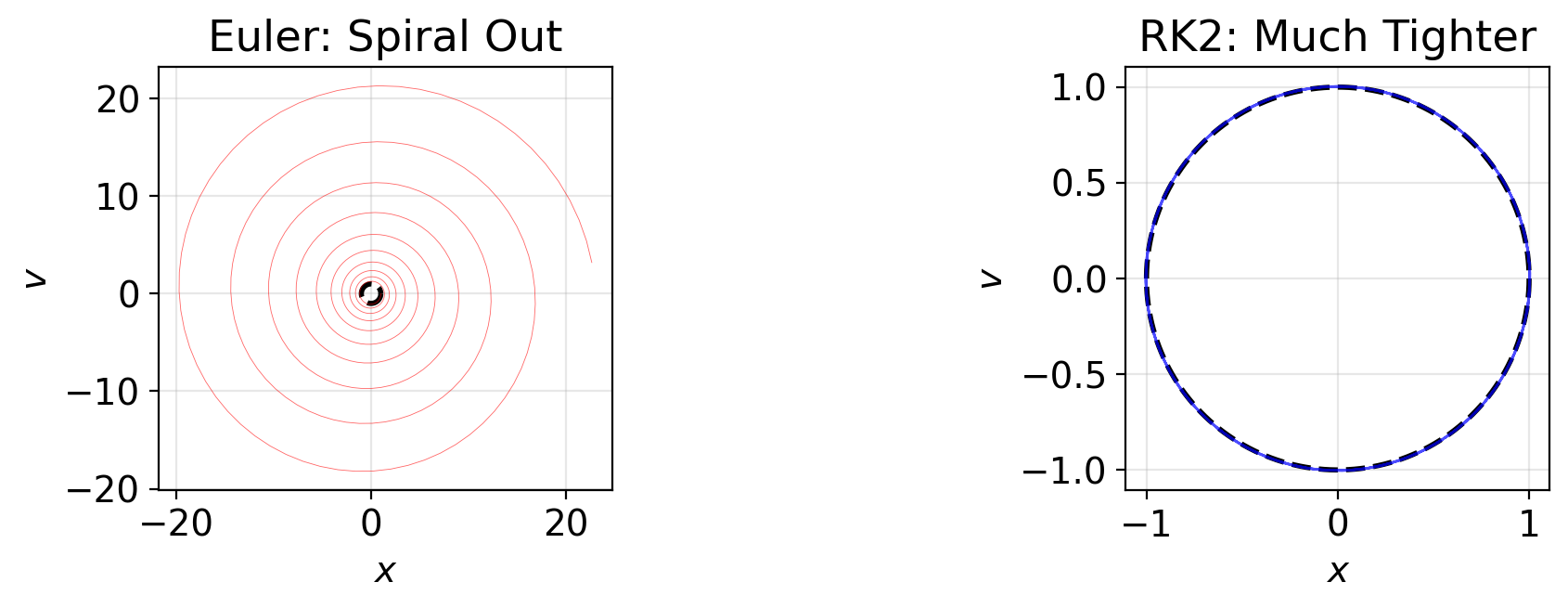
Euler follows the tangent line at each point. For the oscillator, the true orbit curves inward (it’s a circle). The tangent is always outside the circle.
Important
Making \(h\) smaller slows the growth but never stops it. Euler’s method on conservative systems is fundamentally broken.
(Euler is fine for non-oscillatory problems like exponential decay, and useful for first-pass debugging. The failure is specific to energy-conserving systems — which is exactly what Project 2 is.)
The real skill: translating math into programs.
Euler uses the slope at the start of the interval and assumes it’s constant:
\[y_{n+1} = y_n + h \cdot f(t_n, y_n)\]
But the slope changes across the interval!
What if we could peek ahead to the middle and use a better slope estimate?
Step 1: Use Euler to estimate the state at the midpoint:
\[k_1 = f(t_n, y_n)\]
Step 2: Evaluate the slope at the midpoint:
\[k_2 = f\!\left(t_n + \frac{h}{2},\; y_n + \frac{h}{2}\,k_1\right)\]
Step 3: Use the midpoint slope for the full step:
\[\boxed{y_{n+1} = y_n + h \cdot k_2}\]
Local error: \(O(h^3)\). Global error: \(O(h^2)\). Second-order method. Cost: 2 evaluations per step.
The equations:
| Math | Code |
|---|---|
| \(k_1 = f(t_n, y_n)\) | k1 = f(t, y) |
| \(k_2 = f(t_n + h/2,\; y_n + (h/2)\,k_1)\) | k2 = f(t + h/2, y + h/2 * k1) |
| \(y_{n+1} = y_n + h\,k_2\) | return y + h * k2 |
Every symbol in the math has a one-to-one correspondence in the code.
This is the skill. RK4 and Leapfrog follow the exact same translation process.
def rk2_integrate(f, y0, t_span, h):
"""RK2 integration — same structure as euler_integrate."""
t_vals = [t_span[0]]
y_vals = [np.array(y0, dtype=float)]
while t_vals[-1] < t_span[1] - 1e-12:
t, y = t_vals[-1], y_vals[-1]
y_new = rk2_step(f, t, y, h) # <-- only this line changes!
t_vals.append(t + h)
y_vals.append(y_new)
return np.array(t_vals), np.array(y_vals)Compare with euler_integrate — the only difference is calling rk2_step instead of computing y + h * f(t, y) directly.
The integration loop is method-agnostic. Swap the step function, get a different method.
Recall the Taylor series: \(\;y(t+h) = y + hy' + \frac{h^2}{2}y'' + \frac{h^3}{6}y''' + \cdots\)
Tip
The recipe for accuracy: Sample the slope at more points → match more Taylor terms → push the error to a higher power of \(h\). That’s the entire Runge-Kutta idea.
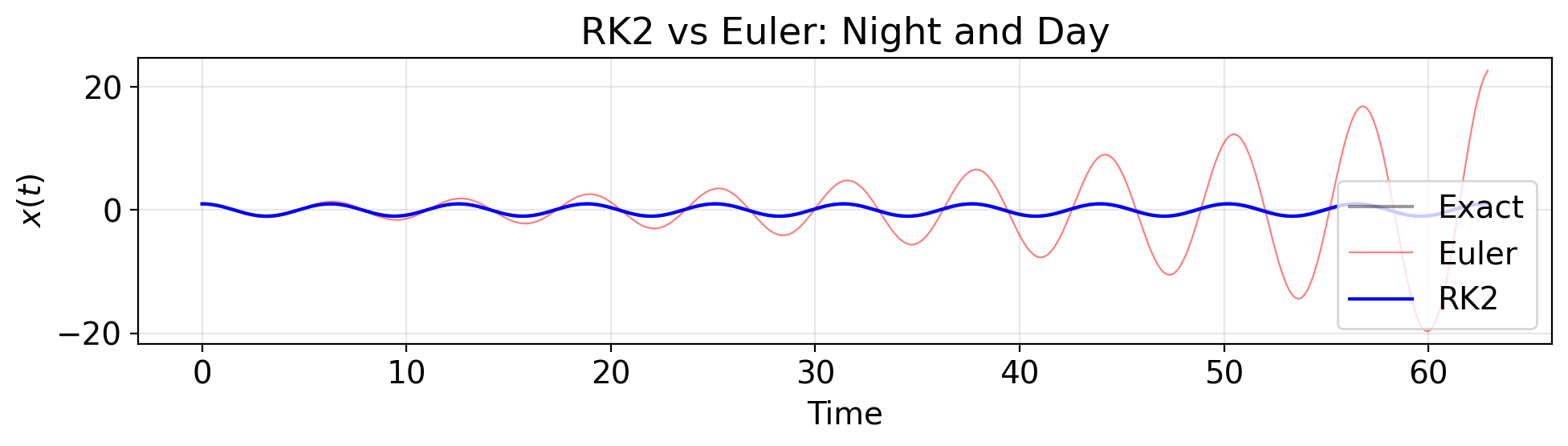
Let’s verify this prediction…
t_rk2, y_rk2 = rk2_integrate(f_sho, y0_sho, [0, t_end], h)
fig, ax = plt.subplots(figsize=(10, 3))
ax.plot(t_exact, np.cos(t_exact), 'k-', alpha=0.4, lw=1.5, label='Exact')
ax.plot(t_euler, y_euler[:, 0], 'r-', lw=0.8, alpha=0.5, label='Euler')
ax.plot(t_rk2, y_rk2[:, 0], 'b-', lw=1.5, label='RK2')
ax.set(xlabel='Time', ylabel='$x(t)$',
title='RK2 vs Euler: Night and Day')
ax.legend()
plt.tight_layout()
plt.show()
fig, (ax1, ax2) = plt.subplots(1, 2, figsize=(11, 3.5))
theta = np.linspace(0, 2 * np.pi, 200)
ax1.plot(np.cos(theta), -np.sin(theta), 'k--', lw=2)
ax1.plot(y_euler[:, 0], y_euler[:, 1], 'r-', lw=0.3, alpha=0.6)
ax1.set(title='Euler: Spiral Out', xlabel='$x$', ylabel='$v$')
ax1.set_aspect('equal')
ax2.plot(np.cos(theta), -np.sin(theta), 'k--', lw=2)
ax2.plot(y_rk2[:, 0], y_rk2[:, 1], 'b-', lw=0.5, alpha=0.7)
ax2.set(title='RK2: Much Tighter', xlabel='$x$', ylabel='$v$')
ax2.set_aspect('equal')
plt.tight_layout()
plt.show()
E_rk2 = 0.5 * (y_rk2[:, 0]**2 + y_rk2[:, 1]**2)
fig, (ax1, ax2) = plt.subplots(1, 2, figsize=(12, 3))
# Left: both on same scale
ax1.plot(t_euler, E_euler, 'r-', lw=1.5, label='Euler')
ax1.plot(t_rk2, E_rk2, 'b-', lw=1.5, label='RK2')
ax1.axhline(0.5, color='k', ls='--', lw=1)
ax1.set(xlabel='Time', ylabel='Energy $E$', title='Full Scale')
ax1.legend()
# Right: zoom on RK2
ax2.plot(t_rk2, E_rk2 - 0.5, 'b-', lw=1.5)
ax2.axhline(0, color='k', ls='--', lw=1)
ax2.set(xlabel='Time', ylabel='$E - E_0$', title='RK2 Energy Error (Zoomed)')
plt.tight_layout()
plt.show()
print(f"Euler final energy error: {abs(E_euler[-1] - 0.5):.1f}")
print(f"RK2 final energy error: {abs(E_rk2[-1] - 0.5):.2e}")
print(f"RK2 is {abs(E_euler[-1] - 0.5) / abs(E_rk2[-1] - 0.5):.0f}x better")
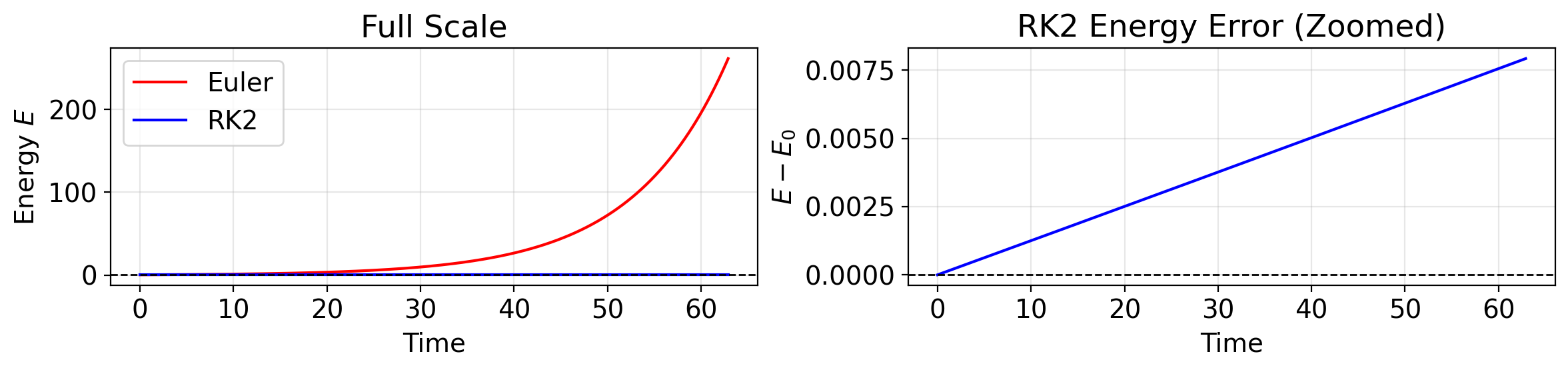
Euler final energy error: 260.8
RK2 final energy error: 7.92e-03
RK2 is 32908x better
RK2 is vastly better. But it still drifts. Over millions of timesteps — the kind you’ll run for Project 2 — that drift adds up. Is there something better?

Now you have the skill. Apply it.
\[k_1 = f(t_n,\, y_n)\] \[k_2 = f\!\left(t_n + \tfrac{h}{2},\; y_n + \tfrac{h}{2}\,k_1\right)\] \[k_3 = f\!\left(t_n + \tfrac{h}{2},\; y_n + \tfrac{h}{2}\,k_2\right)\] \[k_4 = f(t_n + h,\; y_n + h\,k_3)\]
\[\boxed{y_{n+1} = y_n + \frac{h}{6}\left(k_1 + 2k_2 + 2k_3 + k_4\right)}\]
Matches Taylor series through \(h^4\) — error starts at \(h^5\).
| Halve \(h\) | Error drops by |
|---|---|
| Euler (\(p=1\)) | \(2\times\) |
| RK2 (\(p=2\)) | \(4\times\) |
| RK4 (\(p=4\)) | \(16\times\) |
Same pattern as RK2 — each \(k\) formula becomes one line of code.
Weights \(\frac{1}{6}, \frac{2}{6}, \frac{2}{6}, \frac{1}{6}\) are Simpson’s rule!
RK2, RK4, even RK8 — they all share a fundamental flaw:
Warning
No amount of accuracy fixes a structural violation. We need a method that respects the geometry of physics.
A fundamentally different idea: update position and velocity alternately, not simultaneously.
Kick-Drift-Kick:
\[\vec{v}_{n+1/2} = \vec{v}_n + \frac{h}{2}\,\vec{a}(\vec{r}_n) \qquad \text{(half kick)}\]
\[\vec{r}_{n+1} = \vec{r}_n + h\,\vec{v}_{n+1/2} \qquad \text{(full drift)}\]
\[\vec{v}_{n+1} = \vec{v}_{n+1/2} + \frac{h}{2}\,\vec{a}(\vec{r}_{n+1}) \qquad \text{(half kick)}\]
Each sub-step is a shear — stretches phase space in one direction but preserves total area:
Result: Leapfrog conserves a slightly modified energy \(\tilde{E} = E + O(h^2)\).
| Property | RK4 | Leapfrog |
|---|---|---|
| Order | 4th | 2nd |
| After \(10^6\) steps | Drifts by \(\sim 0.1\%\) | Oscillates within \(\sim 0.01\%\) |
| After \(10^9\) steps | Drifts by \(\sim 100\%\) | Still within \(\sim 0.01\%\) |
Important
Only 2nd order — but energy is conserved to machine precision. Structure preservation beats raw accuracy.
\[k_1 = f(t_n, y_n)\] \[k_2 = f(t_n + \tfrac{h}{2}, y_n + \tfrac{h}{2}k_1)\] \[k_3 = f(t_n + \tfrac{h}{2}, y_n + \tfrac{h}{2}k_2)\] \[k_4 = f(t_n + h, y_n + hk_3)\] \[y_{n+1} = y_n + \tfrac{h}{6}(k_1 + 2k_2 + 2k_3 + k_4)\]
\[v_{n+1/2} = v_n + \tfrac{h}{2}\,a(x_n)\] \[x_{n+1} = x_n + h\,v_{n+1/2}\] \[v_{n+1} = v_{n+1/2} + \tfrac{h}{2}\,a(x_{n+1})\]
where \(a(x) = -\omega^2 x\) (or \(= F/m\) for gravity)
Notice: Leapfrog takes \((x, v)\) separately — not a single state vector.
This structural difference is why it preserves energy.
| Method | Order | Energy Behavior | Symplectic? | Evals/Step | Best For |
|---|---|---|---|---|---|
| Euler | 1st | Exponential growth | No | 1 | Learning |
| RK2 | 2nd | Moderate drift | No | 2 | Quick tests |
| RK4 | 4th | Slow drift | No | 4 | Short-time accuracy |
| Leapfrog | 2nd | Bounded oscillation | Yes | 1* | Long-time dynamics |
* Leapfrog reuses the last acceleration, so effectively 1 new evaluation per step.
For Project 2, you’ll implement three of these (Euler, RK4, Leapfrog) and discover these differences yourself.
Build a gravitational N-body simulator from scratch.
| Phase | What You Build | What You Validate |
|---|---|---|
| 1 | Euler pipeline (\(N=2\), \(N=3\)) | Force calc, energy diagnostics, plotting |
| 2 | Add RK4 + Leapfrog | Integrator comparison on same \(N=2\) problem |
| 3 | Plummer sphere ICs (\(N=10\)–\(100\)) | Virial equilibrium, cluster dynamics |
| 4 | Vectorized forces (\(N=1000+\)) | Performance scaling, loop vs. NumPy |
Tip
Each phase adds one new idea on top of a validated foundation. Phase 1 is the hardest — once your pipeline works end-to-end, everything else is incremental.
Today’s harmonic oscillator = tomorrow’s gravitational orbit:
The physics is different (gravity vs. spring), but the numerical behavior is identical.
“Today’s spring = tomorrow’s gravity.”
Before next class, read these from the course website:
Structure > Accuracy
![]()