Part 1: The Failure of Naive Integration
ODE Methods & Conservation | Numerical Methods Module 3 | COMP 536
Learning Objectives
By the end of this section, you will be able to:
From Continuous to Discrete
The fundamental ODE initial value problem asks us to find a function \(x(t)\) given its rate of change:
\[\frac{dx}{dt} = f(x, t), \quad x(t_0) = x_0\]
This has the formal integral solution:
\[x(t) = x_0 + \int_{t_0}^t f(x(s), s) ds\]
Initial Value Problem (IVP): Finding a function given its derivative and starting value — the fundamental problem of dynamics.
But this Initial Value Problem contains a circular dependency: to find \(x(t)\), we need to integrate \(f(x(s), s)\), but \(f\) depends on the unknown solution \(x(s)\) itself!
Numerical methods break this circular dependency by making assumptions about how \(f\) behaves over small time intervals:
- Constant derivative assumption (Euler): Assume \(f\) stays constant over \([t_n, t_{n+1}]\)
- Linear variation assumption (Trapezoidal): Assume \(f\) varies linearly between endpoints
- Polynomial approximation (Runge-Kutta): Assume \(f\) follows a polynomial of degree \(p\)
Each assumption leads to a different family of methods with different error behaviors, stability properties, and conservation characteristics.
The Dimensional Analysis of Timesteps
Before diving into specific methods, let’s understand what constrains our choice of timestep \(h\) from pure dimensional analysis.
For any oscillatory system with characteristic frequency \(\omega\):
- Nyquist requirement: \(h < \pi/\omega\) (must sample twice per oscillation)
- Accuracy requirement: \(h < 0.1 \times 2\pi/\omega\) (need ~60 points per period)
- Typical choice: \(h \sim 0.01 \times 2\pi/\omega\) (600 points per period)
For gravitational N-body systems, multiple timescales compete:
- Orbital period: \(t_\text{orb} = 2\pi\sqrt{a^{3}/(GM)}\) (for semi-major axis \(a\))
- Close encounter: \(t_\text{coll} = R/v_\text{rel}\) (where \(v_\text{rel}\) is relative velocity)
- Shortest scale: \(t_\text{min} = \min(\text{all pairwise encounter times})\)
- Required timestep: \(h < 0.01 \times t_\text{min}\)
Example — Earth-Sun system:
- Period: \(t_\text{orb} = 365.25 \text{ days} = 3.156 \times 10^{7}\) s
- Typical timestep: \(h \sim 1 \text{ day} = 8.64 \times 10^{4}\) s
- High accuracy: \(h \sim 0.1 \text{ day} = 8.64 \times 10^{3}\) s
Euler’s Method - The Simplest Approach
Mathematical Formulation
Euler’s method: The simplest ODE integration scheme, using a constant derivative over each timestep.
Euler’s method is the most straightforward discretization possible. Given the ODE
\[\frac{dx}{dt} = f(x,t),\] at time \(t_n\) with solution \(x_n\), and a timestep \(h\), we approximate:
\[\boxed{x_{n+1} = x_n + h f(x_n, t_n)}\]
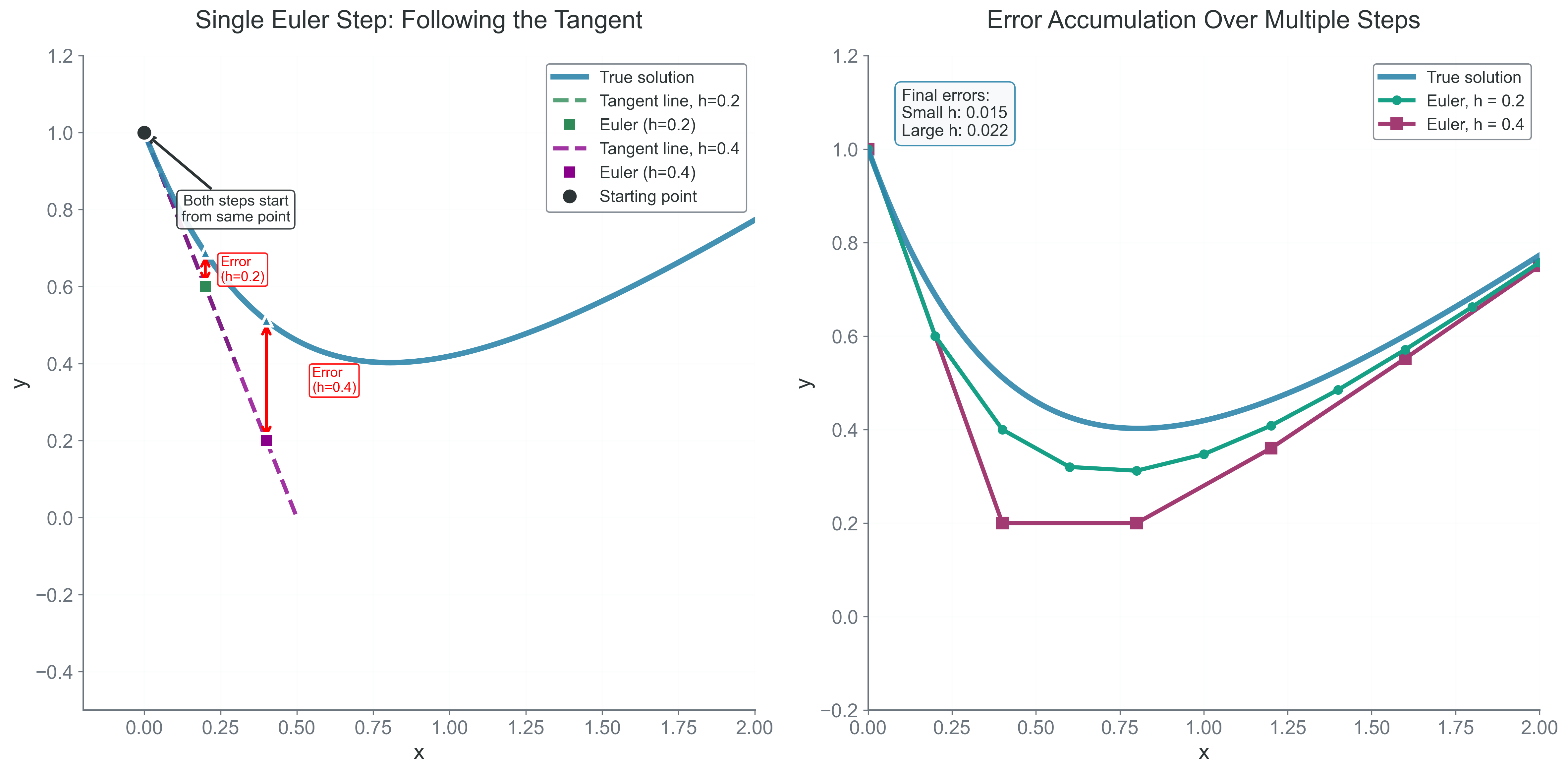
This assumes the derivative \(f\) remains constant over the entire interval \([t_n, t_{n+1}]\) — essentially extending the tangent line at \(t_n\) forward by distance \(h\).
Taylor Series Analysis of Error
Local truncation error: Error introduced in a single step, assuming perfect starting values.
Global error: Total accumulated error over the entire integration interval.
To understand Euler’s error precisely, we need the Taylor series. The true solution at \(t_{n+1} = t_n + h\) is: \[x(t_n + h) = x(t_n) + h x'(t_n) + \frac{h^2}{2}x''(t_n) + \frac{h^3}{6}x'''(t_n) + O(h^4)\] Since \(x'(t_n) = f(x(t_n), t_n)\) by definition of our ODE, Euler’s method gives:
\[\boxed{x_{n+1} = x_n + h f(x_n, t_n)}\]
The local truncation error — the error in one step — is:
\[\tau_n = x(t_{n+1}) - x_{n+1} = \frac{h^2}{2}x''(t_n) + O(h^3)\]
The leading error term is \(O(h^2)\), making Euler locally second-order accurate. But errors accumulate! Over \(N = t_\text{final}/h\) steps to reach final time \(t_\text{final}\), the global error becomes:
\[E_\text{global} = \sum_{i=0}^{N-1} \tau_i \approx N \cdot \frac{h^2}{2}x''(\xi) = \frac{t_\text{final}}{h} \cdot \frac{h^2}{2}x''(\xi) = \frac{t_\text{final} h}{2}x''(\xi) = O(h)\]
Euler is globally first-order: halving the timestep only halves the total error.
The Energy Drift Catastrophe
Let’s see Euler fail catastrophically on the harmonic oscillator:
\[\ddot{x} = -\omega^2 x\]
Converting to first-order system: \[\frac{d}{dt}\begin{pmatrix} x \\ v \end{pmatrix} = \begin{pmatrix} v \\ -\omega^2 x \end{pmatrix}\] The true solution has constant energy \(E = \frac{1}{2}(v^2 + \omega^2 x^2).\)
Implementation and Analysis
import numpy as np

def euler_harmonic(x0, v0, omega, h, n_steps):
    """Integrate harmonic oscillator with Euler's method"""
    x, v = x0, v0
    E0 = 0.5 * (v0**2 + omega**2 * x0**2)

    energies = [E0]
    for i in range(n_steps):
        # Euler update
        a = -omega**2 * x
        x = x + h * v
        v = v + h * a

        # Energy (should be constant, but...)
        E = 0.5 * (v**2 + omega**2 * x**2)
        energies.append(E)

    return energies
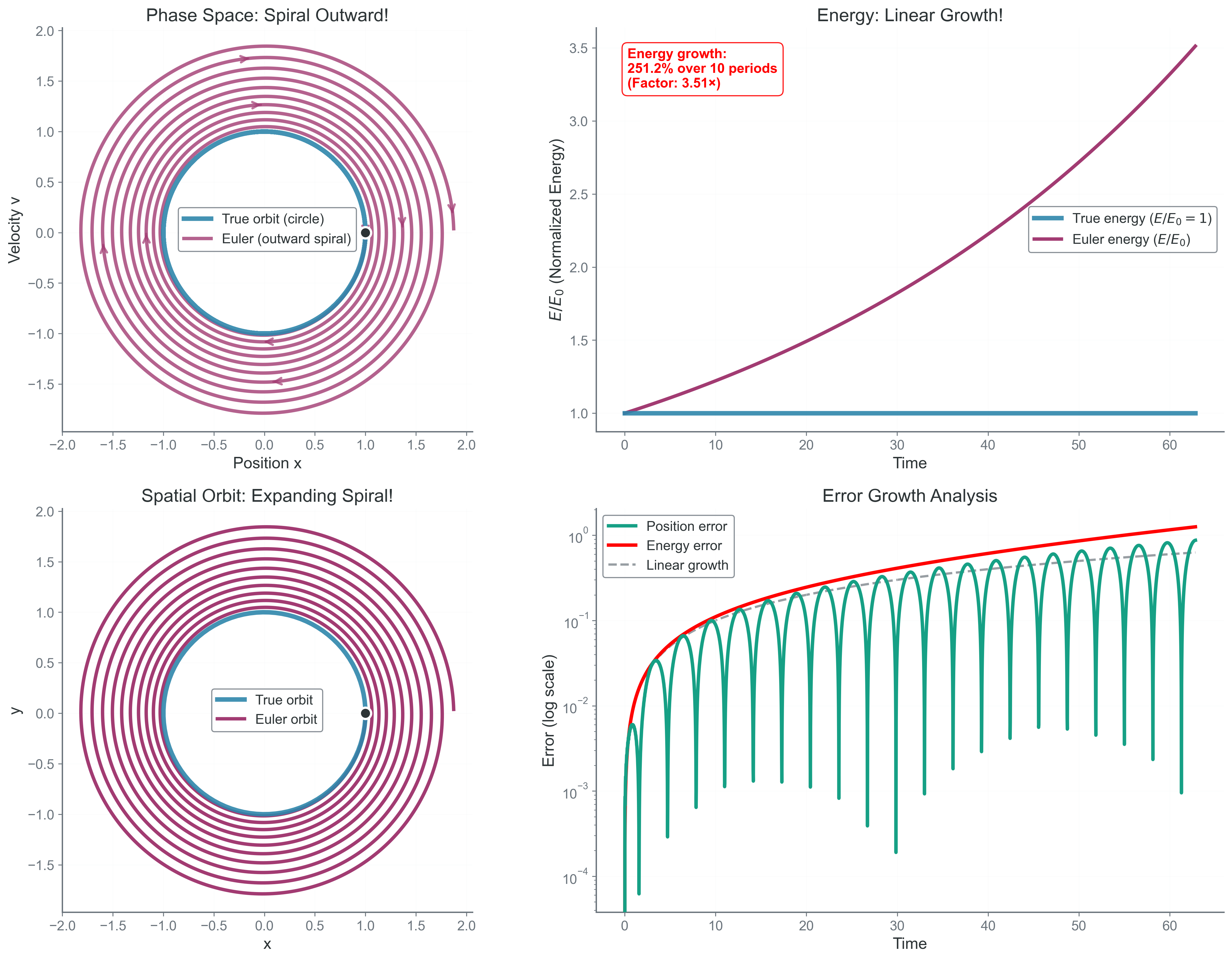
The shocking result: energy grows approximately linearly with time! After 1000 orbital periods, energy has typically increased by 10%. The orbit spirals outward, violating conservation of energy.
Mathematical Analysis of Energy Growth
For the harmonic oscillator with Euler’s method, we can derive the exact energy growth rate. Starting with position \(x_n\) and velocity \(v_n\):
\[x_{n+1} = x_n + hv_n\] \[v_{n+1} = v_n - h\omega^2x_n\]
The energy after one step: \[E_{n+1} = \frac{1}{2}(v_{n+1}^2 + \omega^2 x_{n+1}^2)\]
Substituting the updates: \[E_{n+1} = \frac{1}{2}[(v_n - h\omega^2x_n)^2 + \omega^2(x_n + hv_n)^2]\]
Expanding: \[E_{n+1} = \frac{1}{2}[v_n^2 - 2h\omega^2x_nv_n + h^2\omega^4x_n^2 + \omega^2x_n^2 + 2h\omega^2x_nv_n + h^2\omega^2v_n^2]\]
\[E_{n+1} = \frac{1}{2}[v_n^2 + \omega^2x_n^2] + \frac{h^2\omega^2}{2}[v_n^2 + \omega^2x_n^2]\]
Therefore: \[\boxed{E_{n+1} = E_n(1 + h^2\omega^2)}\]
The amplification factor \((1 + h^2\omega^2) > 1\) means energy grows exponentially! After \(N\) steps:
\[E_N \approx E_0(1 + h^2\omega^2)^N \approx E_0 e^{Nh^2\omega^2} = E_0 e^{t_\text{final}h\omega^2}\]
For Earth’s orbit with \(h = 1\) day and \(t_\text{final} = 1000\) years: \[\frac{E_{final}}{E_0} \approx e^{0.1} \approx 1.1\]
A 10% energy increase means that Earth would drift into a higher orbit!
Why Euler Fails: The Geometric View
Phase space: The space of all possible states, with position and momentum coordinates. Trajectories follow energy contours.
Liouville’s theorem: Phase space volume must be preserved in Hamiltonian systems
In phase space (position-velocity space), the harmonic oscillator traces a circle. Each Euler step moves along the tangent to the circle, placing the new point slightly outside. The phase space area increases, violating Liouville’s theorem that phase space volume must be preserved in Hamiltonian systems.
The Phase Error Problem
Even if we could tolerate energy drift, Euler has another fatal flaw: phase error. The frequency of oscillation is wrong:
\[\omega_{numerical} = \omega_{true}(1 + O(h^2))\]
After \(N = t_\text{final}/h\) oscillations, the phase error is: \[\Delta\phi = N \cdot O(h^2) = \frac{T}{h} \cdot O(h^2) = O(h)\]
This means that even with small timesteps, the phase error accumulates linearly with time.
When Does Euler Work?
Despite these failures, Euler has legitimate uses:
- Very short integrations where \(N h^2 \ll 1\)
- Highly dissipative systems where energy should decay
- Quick explorations before using better methods
- Teaching why better methods are needed!
The Fundamental Lesson
Euler’s method reveals a profound truth about numerical integration:
Local accuracy does not guarantee global stability
Euler is locally second-order accurate (\(O(h^2)\) per step), yet it systematically violates conservation laws. This isn’t a bug — it’s a fundamental property of the discretization.
The tangent line approximation, while locally accurate, doesn’t respect the curved geometry of phase space. Each step compounds this geometric error until the qualitative behavior is wrong.
- Why does Euler’s method have \(O(h^2)\) local but \(O(h)\) global error?
- If we used Euler backwards in time, would orbits spiral in or out?
- For a circular orbit, by what factor does the radius grow per orbit?
- Could we fix Euler by just using a tiny timestep?
- What is the phase space volume change per step for Euler’s method?
Bridge to Part 2: The Quest for Better Methods
Euler’s catastrophic failure motivates our search for better integration methods. The failure isn’t just about accuracy — it’s about systematic bias. Every Euler step pushes slightly outward from the true trajectory. This accumulation of geometric errors destroys the physics we’re trying to simulate.
What we need are methods that:
- Sample the derivative at multiple points to cancel biases
- Achieve higher-order accuracy to reduce error accumulation
- Maintain stability over long integration times
- Preserve conservation laws or at least bound their violation
In Part 2, we’ll explore the Runge-Kutta family — methods that evaluate the derivative at carefully chosen intermediate points to achieve higher accuracy. By sampling the “curvature” of the solution, these methods can follow the true trajectory more faithfully. But as we’ll discover, even fourth-order accuracy isn’t enough to preserve energy over cosmic timescales.
The journey from Euler to modern integration methods is a journey from naive approximation to deep understanding of geometric structure. Each method we develop addresses specific failures of its predecessors, leading ultimately to symplectic integrators that preserve the fundamental geometry of physics.
Next: Part 2 - Building Better Methods