Module in brief
How Stars Live and Die
Mass writes a star's life story.
How stars live and die. The mass limits that bound stardom, the journey off the main sequence, the quantum degeneracy that sets the Chandrasekhar limit, the deaths of giants in supernovae, and the compact remnants where gravity finally wins — white dwarfs, neutron stars, and black holes.
Module Overview
Follow mass from the limits of hydrogen burning through post-main-sequence evolution to white dwarfs, supernovae, neutron stars, and black holes.
Lessons
The Boundaries of Stardom
Stars cannot be arbitrarily small or arbitrarily large. Quantum mechanics sets the floor: below ~0.08 solar masses, electron degeneracy halts contraction before the core reaches fusion temperatures. Radiation sets the ceiling: above ~100-150 solar masses, radiation pressure and mass loss push stars toward the Eddington limit. The reading introduces the Heisenberg uncertainty principle and shows how fundamental constants fix the stellar mass range.
After the Main Sequence
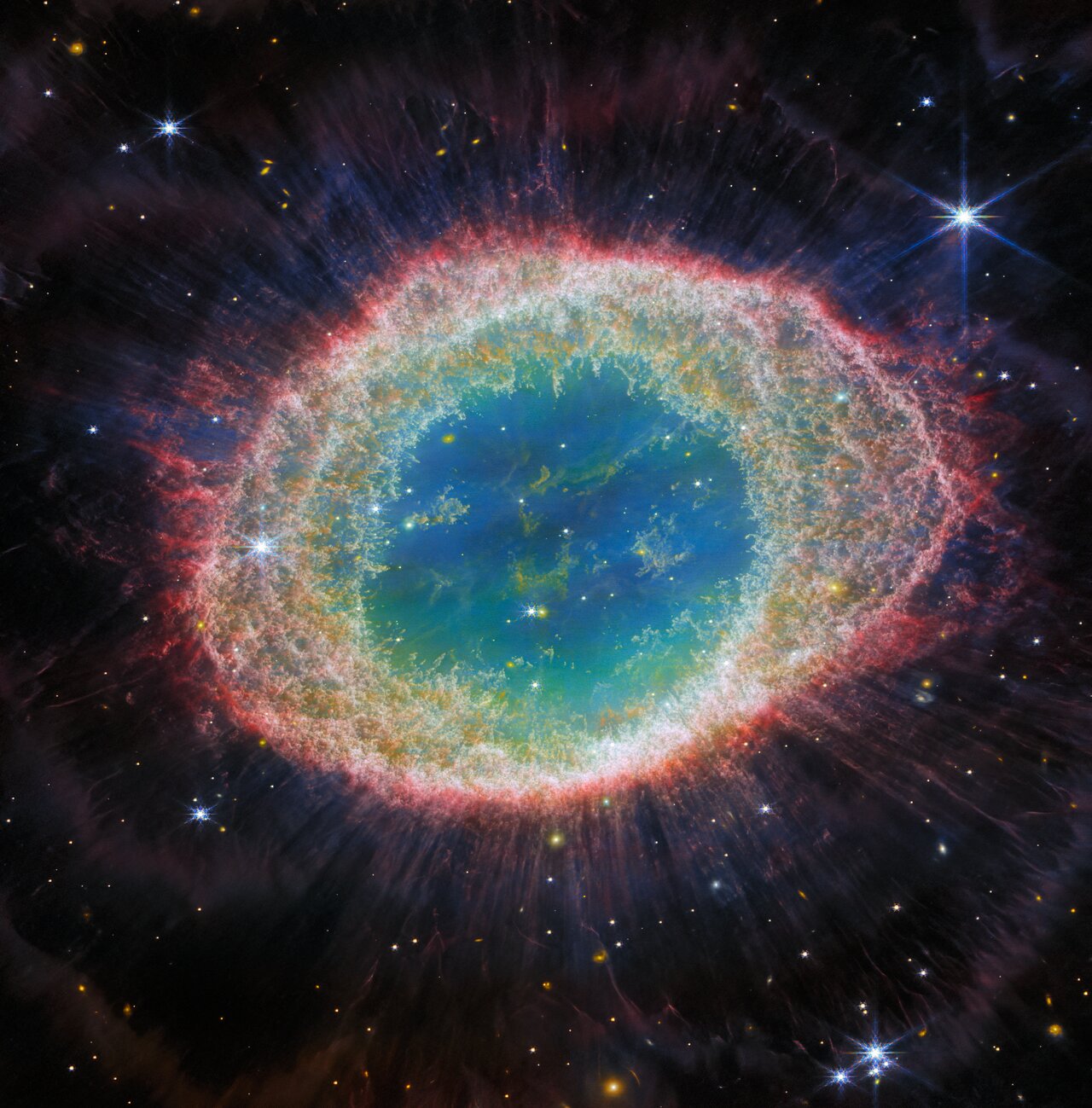
Low-mass stars do not simply fade when core hydrogen is exhausted. The virial theorem forces an inert core to contract and heat, hydrogen shell burning inflates a red giant, the triple-alpha process ignites helium (a runaway flash in a degenerate core), the AGB sheds its envelope as a planetary nebula, and a degenerate white dwarf remains. The reading reads each phase off the cluster HR diagram and builds the interior model behind it.
The Quantum Limit
White dwarfs are held up by electron degeneracy pressure, a purely quantum force. This reading completes the QM toolkit with the Pauli exclusion principle, derives degeneracy pressure from the uncertainty principle, and shows that relativistic electrons impose a maximum white-dwarf mass: the Chandrasekhar limit of about 1.4 solar masses, set by the fundamental constants hbar, c, G, and m_p (with the exact value fixed by composition through the electron fraction).
The Death of Giants
Massive stars race through successive nuclear burning stages on an accelerating timescale, building an onion-shell structure around a degenerate iron-group core. Once that core reaches an effective Chandrasekhar mass, pressure support fails, the core collapses in under a second, and a supernova ejects the outer layers while neutrinos carry away ~99% of the energy. The reading completes the nucleosynthesis story: later stars and planets inherit stellar ash.
The Final States
When electron degeneracy fails, dense neutron-rich matter forms the densest objects in the universe that still have surfaces; when even that fails, collapse passes inside an event horizon. This reading introduces neutron-star physics, pulsars, the Tolman-Oppenheimer-Volkoff limit, compactness, the Schwarzschild radius, the event horizon, and the observational evidence (pulsars, X-ray binaries, gravitational waves, the EHT) that makes neutron stars and black holes required by the data.
Module Synthesis
Use the hierarchy of pressure-support limits to connect stellar lifetimes, element production, and the compact remnant a star can leave behind.