The Final States
Section 1 of 6
Neutron Stars
By the end of this reading, you will be able to:
Guiding question: when even neutron-star matter cannot resist gravity, what is left — and how do we know it is there?
We have followed gravity through every stage of stellar evolution. First it was opposed by thermal pressure; then nuclear fusion replaced lost thermal energy; in massive stars radiation pressure mattered; after fusion ended, electron degeneracy supported white dwarfs below the Chandrasekhar limit. Now we reach the final two possibilities. If collapse reaches nuclear density and the remnant mass is not too large, neutron-rich matter forms a neutron star — roughly a solar mass in a city-sized object. If even that support fails, collapse forms a black hole — not a solid object, not a surface, but a region of spacetime bounded by an event horizon. The main skill here is not memorizing object names; it is reasoning from observed behavior to a compact-object model to a physical inference.
Part 1: Neutron Stars — Nuclear-Density Objects
Neutron star
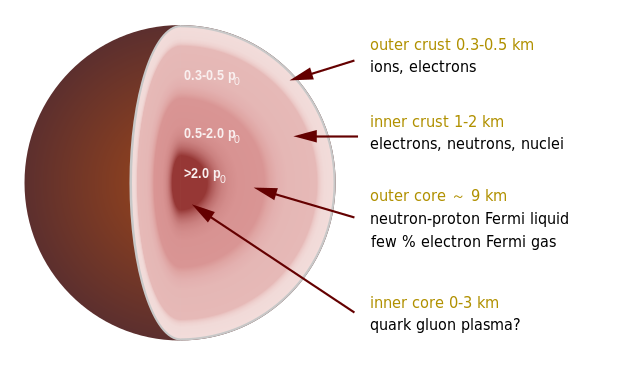
A compact remnant with roughly a solar mass compressed into a radius of order , supported by dense nuclear matter (neutron degeneracy pressure plus nuclear interactions). Densities reach –, comparable to an atomic nucleus.
Pulses, massive X-ray accretors, and dense-object mergers
Pulsars pulse with periods from milliseconds to seconds; some X-ray binaries hold compact accretors near or above a solar mass; gravitational-wave events show mergers of extremely dense objects.
A compact remnant of city scale
A normal star cannot rotate hundreds of times per second without tearing apart, but a remnant of radius can.
Stellar remnants far denser than white dwarfs
Neutron stars are the model that explains compactness, rapid rotation, strong magnetic fields, and nuclear-density matter.
Formation
During core collapse in a massive star: (1) the iron core grows past the effective Chandrasekhar mass; (2) electron degeneracy pressure can no longer support it; (3) electrons are captured by protons, ; (4) the core becomes neutron-rich and collapses toward nuclear density, ; (5) the collapse halts only if dense nuclear matter can supply enough pressure before an event horizon forms. This produces a proto-neutron star: hot, compact, neutrino-bright, and only tens of kilometers across.
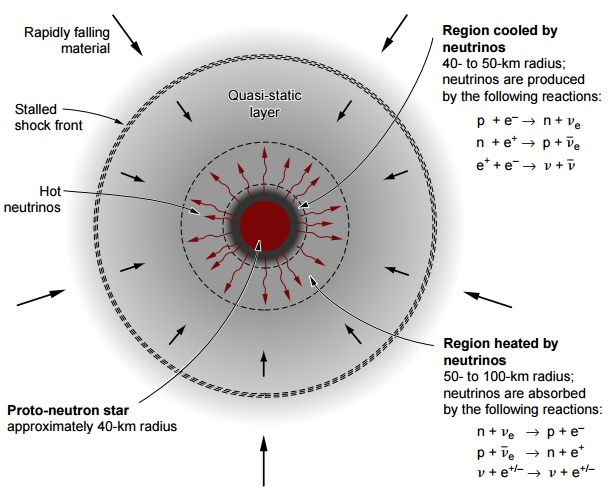
Neutron-star formation is not a quiet compression process. It is tied to neutrino transport, nuclear-density matter, and the explosion mechanism.
Extreme Properties
| Property | Typical neutron star | Physical meaning |
|---|---|---|
| Mass | – | Comparable to the Sun |
| Radius | Comparable to a city | |
| Density | Comparable to nuclear density | |
| Surface gravity | times Earth gravity | |
| Newtonian escape speed | A substantial fraction of light speed | |
| Magnetic field | – | Trillions to quadrillions of gauss |
| Rotation period | – | Milliseconds to seconds |
The Density Calculation
A good compact-object calculation always carries units. With and a teaspoon volume , the mass is . Converting, — about 2.5 billion tonnes in a teaspoon-sized volume. This is a scale analogy, not a laboratory scenario: neutron-star matter exists only because it is compressed by the gravity of an entire star.
Multiple choice
If the density is , a sample has a mass closest to which value?
, which is closest to (the coefficient does not push it up to , and it is well above ). The distractors are the adjacent powers of ten, so you have to actually carry the multiplication, not just eyeball the exponent.
Why So Fast? Conservation of Angular Momentum
Neutron stars often rotate rapidly because collapse shrinks the radius enormously. Angular momentum is approximately conserved during collapse, and for a uniform sphere . With mass roughly fixed, , so , giving . Since , a larger means a shorter period: .
Comparing a Sun-sized object () to a neutron star (), the radius ratio is and the spin-up factor is . Starting from the Sun’s gives
Real neutron stars lose angular momentum during collapse and are not uniform spheres; the point is the scaling — shrinking the radius by can increase the rotation rate by .
Problem
A star collapses from radius to . (1) Should its rotation period become larger or smaller? (2) By what factor does it change if angular momentum is conserved? (3) What assumption did you make about the mass?
Smaller — the star spins faster. With , , so the period is one million times shorter, assuming the mass is approximately unchanged and angular momentum is conserved.