After the Main Sequence
Section 1 of 8
What We See When Stars Leave the Main Sequence
By the end of this reading, you will be able to:
Guiding question: when hydrogen runs out, why does a star swell into a giant before it shrinks into a white dwarf?
The HR diagram tells us what stars do after the main sequence. This reading explains why. When core hydrogen runs out, the core contracts and heats, shell burning turns on, the envelope expands into a red giant, helium ignites, the star sheds its envelope, and a white dwarf remains. Every stage is an inference from observables tied to a physical model. At each stage, the key reasoning task is: what new interior structure or energy source is required to explain the observed position of the star on the HR diagram?
What We See When Stars Leave the Main Sequence
Old clusters show organized post-main-sequence populations
A main-sequence turnoff, a heavily populated red giant branch, a horizontal branch (or red clump), planetary nebulae, and a white-dwarf cooling sequence — structured loci on the HR diagram, not scattered points.
HR position changes only when the interior reorganizes
A star moves on the HR diagram when its luminosity, surface temperature, and radius change — and those change because the interior energy source, pressure support, and transport mechanism change.
Low-mass stars reorganize; they do not simply fade
The populations trace one connected evolutionary path: core-hydrogen exhaustion triggers core contraction, shell burning, helium ignition, envelope ejection, and a degenerate remnant.
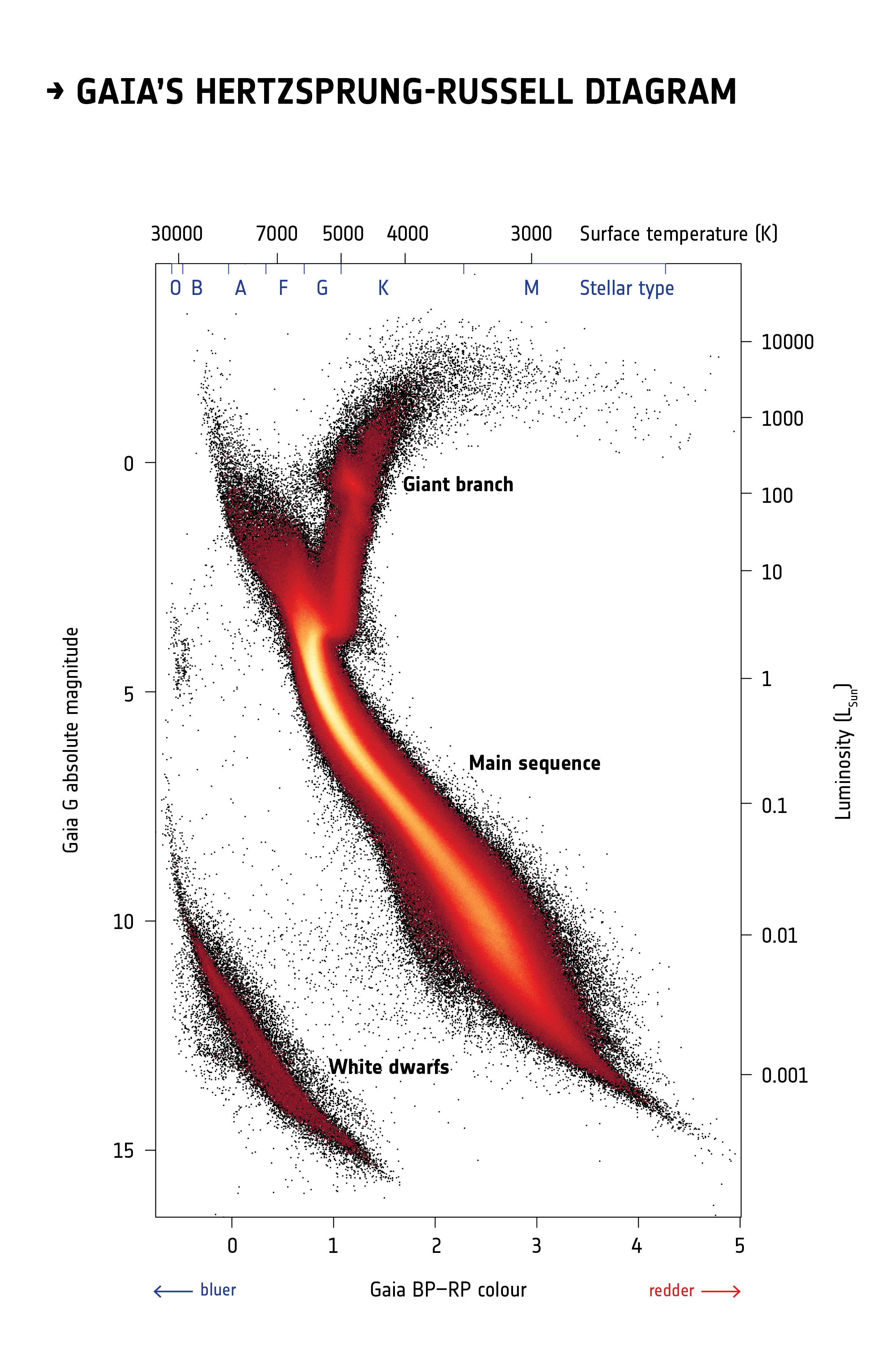
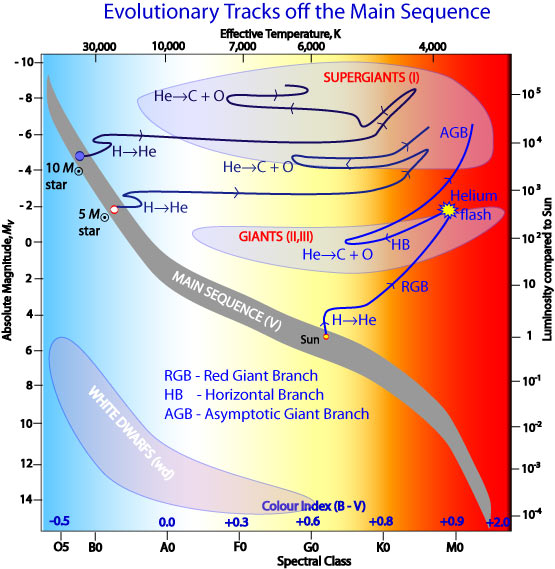
Astronomers do not watch a single Sun-like star for billions of years. Instead, we infer stellar evolution from populations. In old stellar systems we observe:
- a main-sequence turnoff, where the most massive stars that can still burn core hydrogen define an age scale,
- a heavily populated red giant branch (RGB), where stars are cool but luminous,
- a horizontal branch (HB), where stars are less luminous than the RGB tip but hotter,
- planetary nebulae, glowing shells of gas around hot compact central stars,
- and a white dwarf cooling sequence, where hot but faint remnants cool to lower luminosities over time.
These are not random points scattered across the HR diagram. They are organized structures. Because stars in a cluster are observed at nearly the same distance and formed at roughly the same time, differences in their HR-diagram positions can be interpreted primarily as differences in stellar mass and evolutionary stage.
The model idea is simple before it becomes detailed: a star changes position on the HR diagram when its luminosity, surface temperature, and radius change. Those surface properties change because the interior energy source, pressure support, and energy-transport mechanism change.
So the problem is not merely to label post-main-sequence populations. The problem is to explain what interior physics sends a low-mass star from
In older, metal-poor populations the core-helium-burning locus often appears as a horizontal branch; in more metal-rich populations the same locus may appear instead as a red clump. In both cases, the key inference is that a new central energy source has turned on.
The observations imply that low-mass stars do not simply fade when hydrogen runs out in the core. They undergo a sequence of structural reorganizations. The driving question for this reading is:
Why do stars follow this path instead of simply fading?
Why does a low-mass star first swell into a giant, then reorganize around new burning shells and core ignition, and finally end as a compact degenerate remnant rather than simply cooling away from the main sequence?