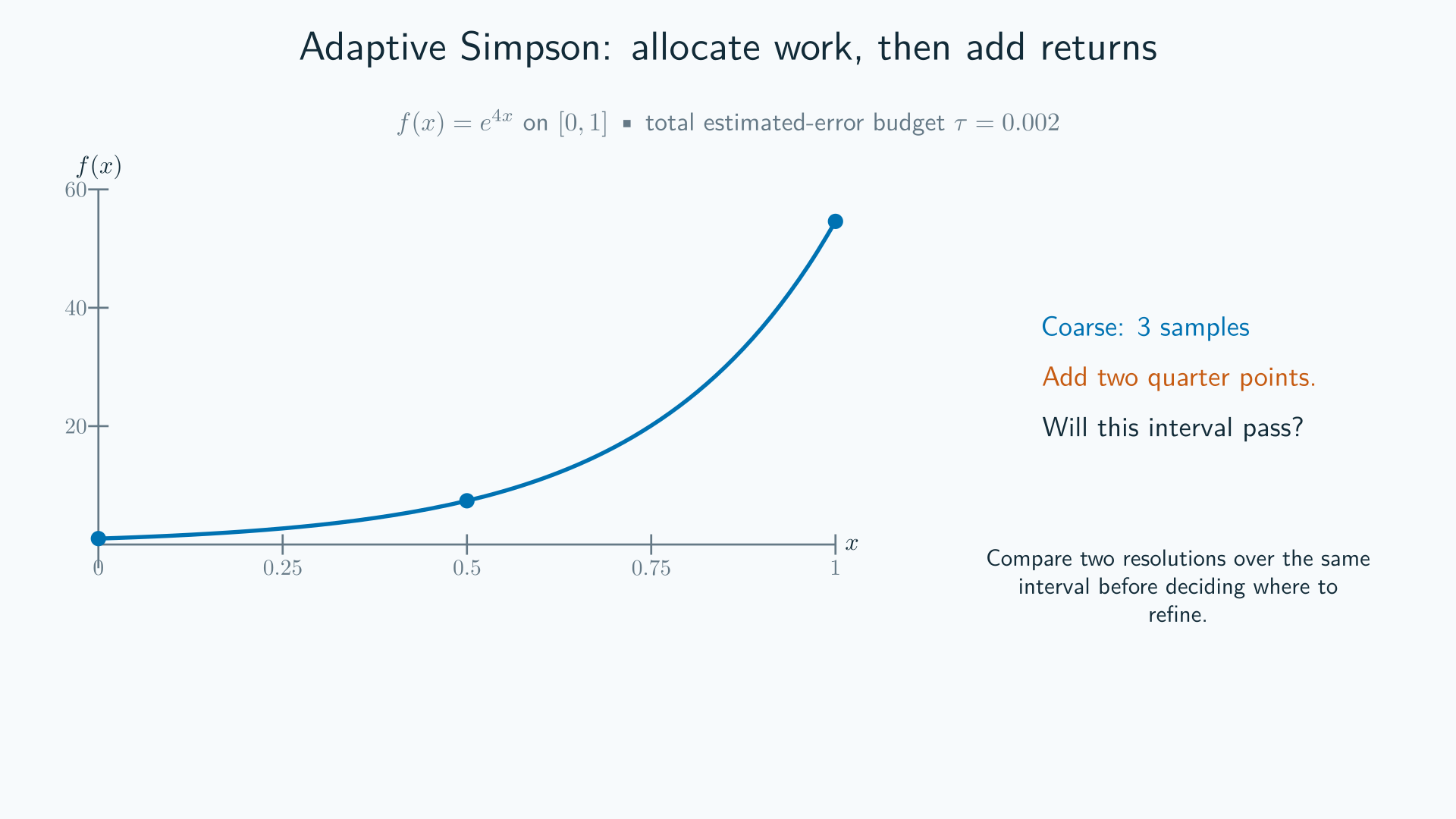
Compare a coarse Simpson estimate with two half-interval estimates. The film follows , splitting intervals and tolerance budgets, then adding accepted integral contributions.
Before watching
Where would you expect refinement to concentrate for ? What information must each interval return so that its parent can assemble an integral?
Mathematical connection
On the same interval, let use one Simpson pair and use two half-width pairs. If the leading smooth-function error term dominates, the fine estimate has about of the coarse estimate’s error. Therefore
The first quantity estimates the error of ; it is not a proven error bound for the corrected result. Compare it with the interval’s tolerance . If refinement is needed, split the interval and give each child budget . Accepted child contributions are added when returning to the parent.
A depth limit must report unfinished refinement as failure. Sample agreement can miss unsampled structure, even with a small estimated error.
Explain what you saw
Follow the quantities in each direction: tolerance budgets go down the tree, integral contributions return upward. The film’s covered-interval actual error uses a known exact integral for this example; a general adaptive integrator does not know that error.
Use the player controls to pause, replay, or view fullscreen. The animation has no narration; its labels and the explanation above carry the content.
Continue: Lecture 7 · Full reading · All animations