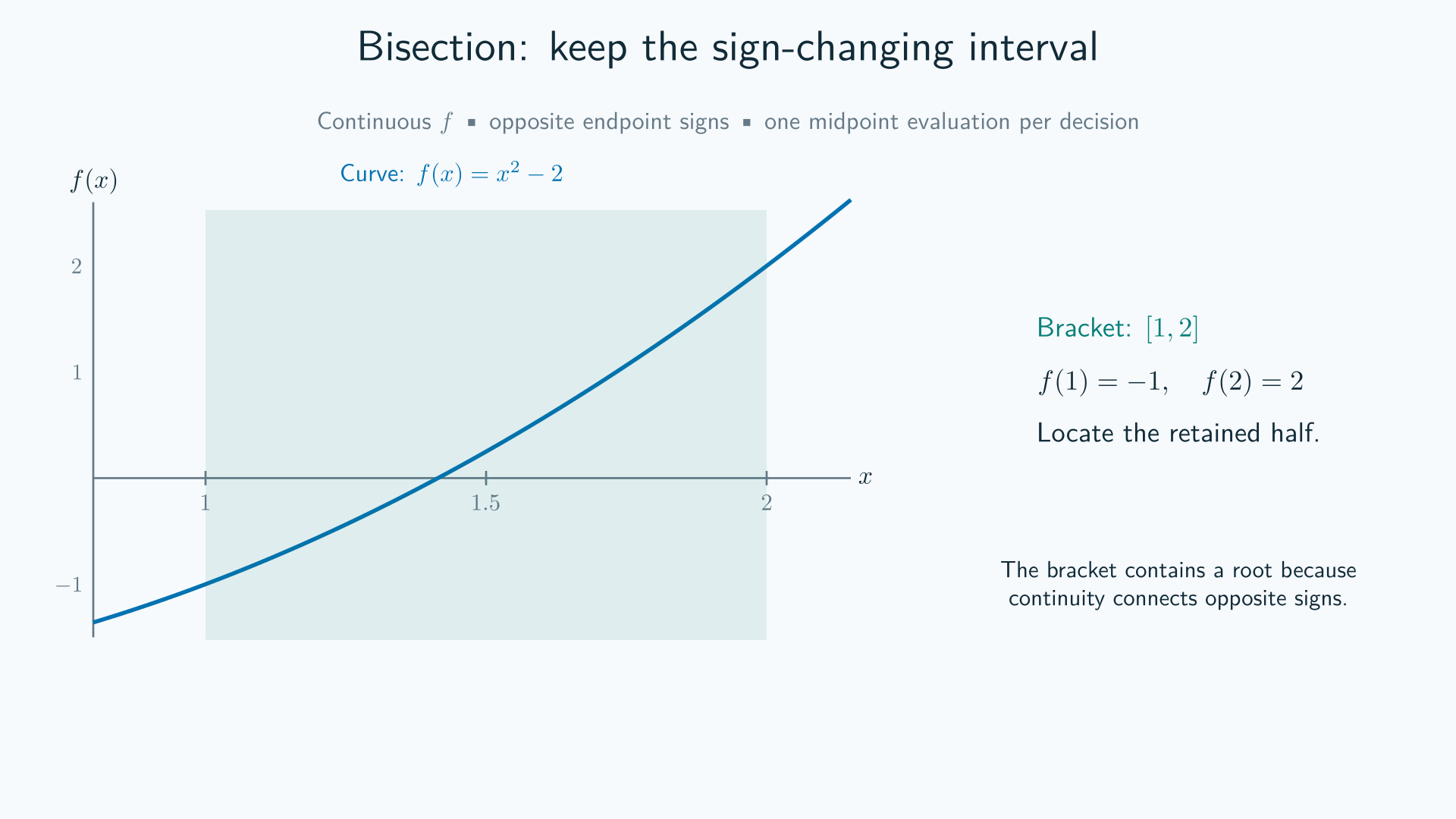
For , start with . Each midpoint evaluation identifies a half-interval that retains opposite endpoint signs. The film follows three decisions.
Before watching
At the first midpoint, . Calculate the sign of and predict which half-interval will remain.
Mathematical connection
If is continuous on and the endpoints have opposite signs, at least one root lies inside. Check endpoint roots before requiring opposite signs.
After halvings of an initial width , the retained width and its midpoint error satisfy
Here is the midpoint of the new retained interval and is a root inside it. This bound does not describe the old midpoint discarded or retained as an endpoint. Opposite signs across a discontinuity do not establish the theorem; a sign change also does not establish uniqueness.
Explain what you saw
Separate the sign test from the width bound. Which justifies retaining a half-interval, and which supports a claim about root location? Explain why a small residual is a different statement.
Use the player controls to pause, replay, or view fullscreen. The animation has no narration; its labels and the explanation above carry the content.
Continue: Lecture 7 · Full reading · All animations