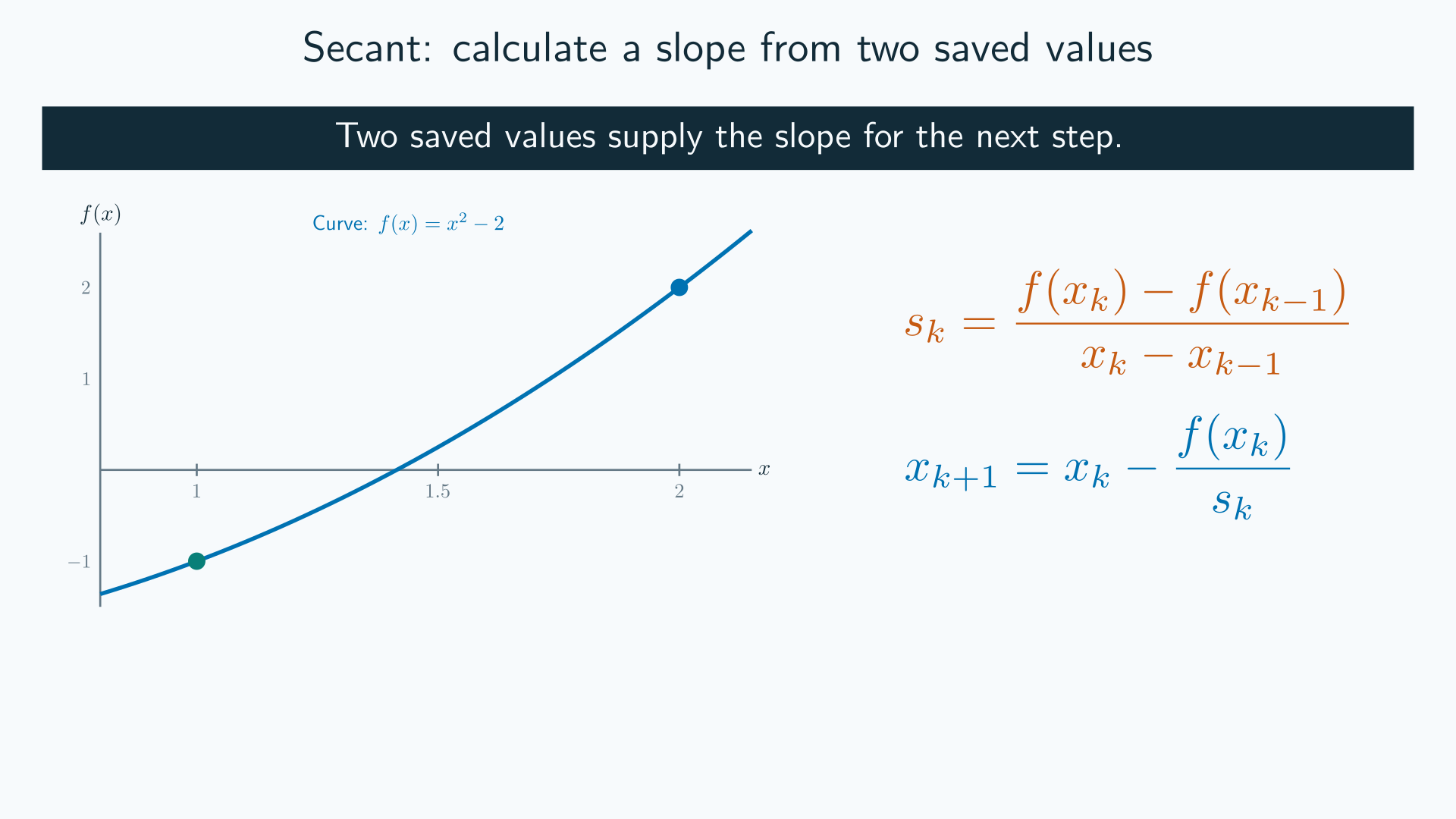
Approximate Newton’s derivative using the two most recent function values. The film follows from the initial inputs 1 and 2, showing which point is retained after each update.
Before watching
Draw the line through the two initial samples. Predict its zero, then decide which two points should define the next secant line.
Mathematical connection
Use the slope
in a Newton-style update:
Keep and for the next step, reusing . After initialization, each successful update needs one new function evaluation. Equal function values make the update undefined; near-equal values can cause a large or unreliable step. Check finite values and the function’s domain. Ordinary secant does not preserve opposite signs or guarantee convergence.
Static walkthrough: one secant update
Predict before opening: start with and . Find the line’s slope and zero. Which input will you discard after evaluating the new point?
Worked explanation: saved values → line zero → new pair
1. Calculate the slope from saved values
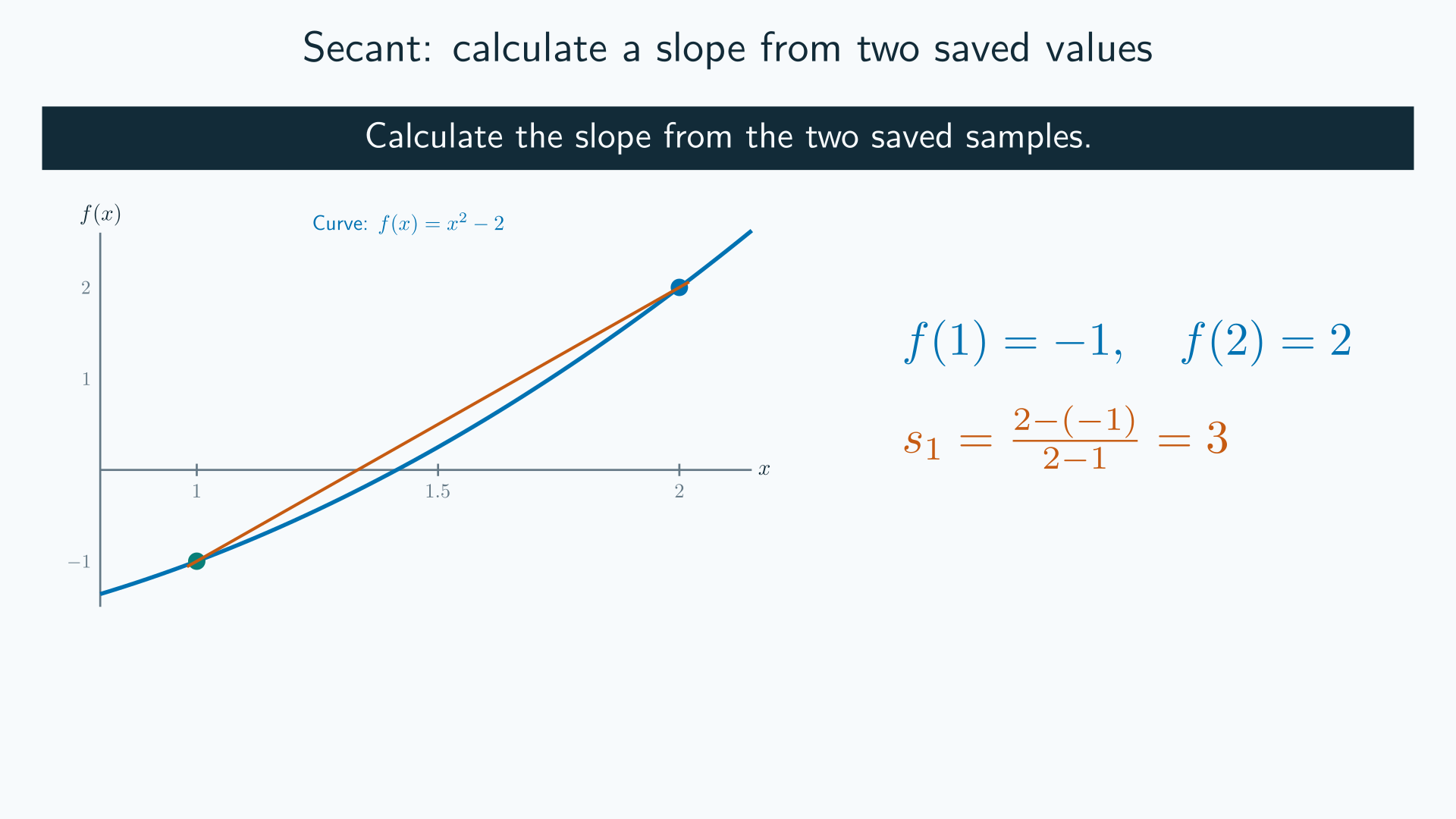
This slope comes from two function values; no derivative is evaluated.
2. Find the line’s zero
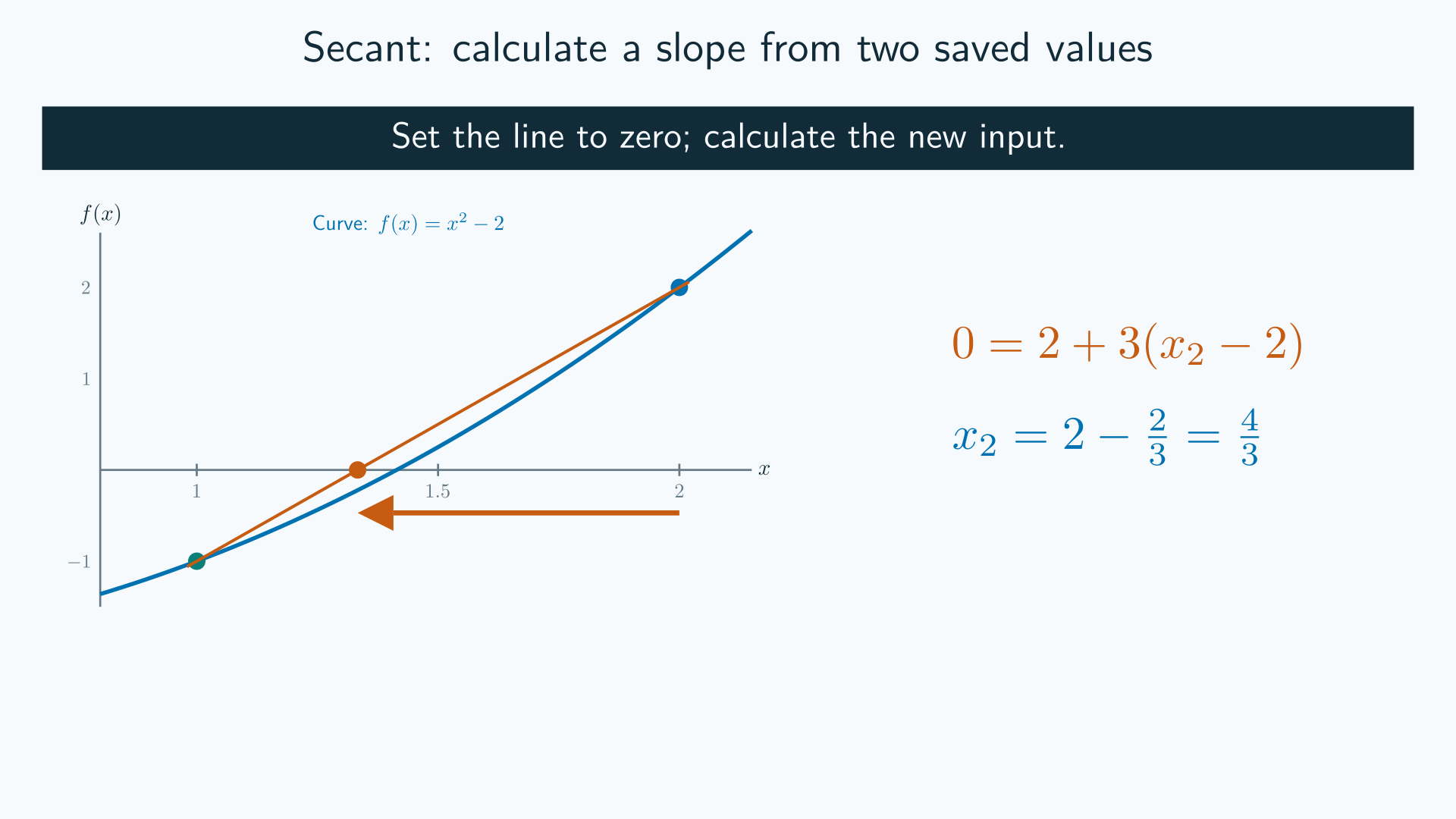
The line proposes the next input. Evaluate the original function there before constructing another line.
3. Evaluate once and keep the latest pair
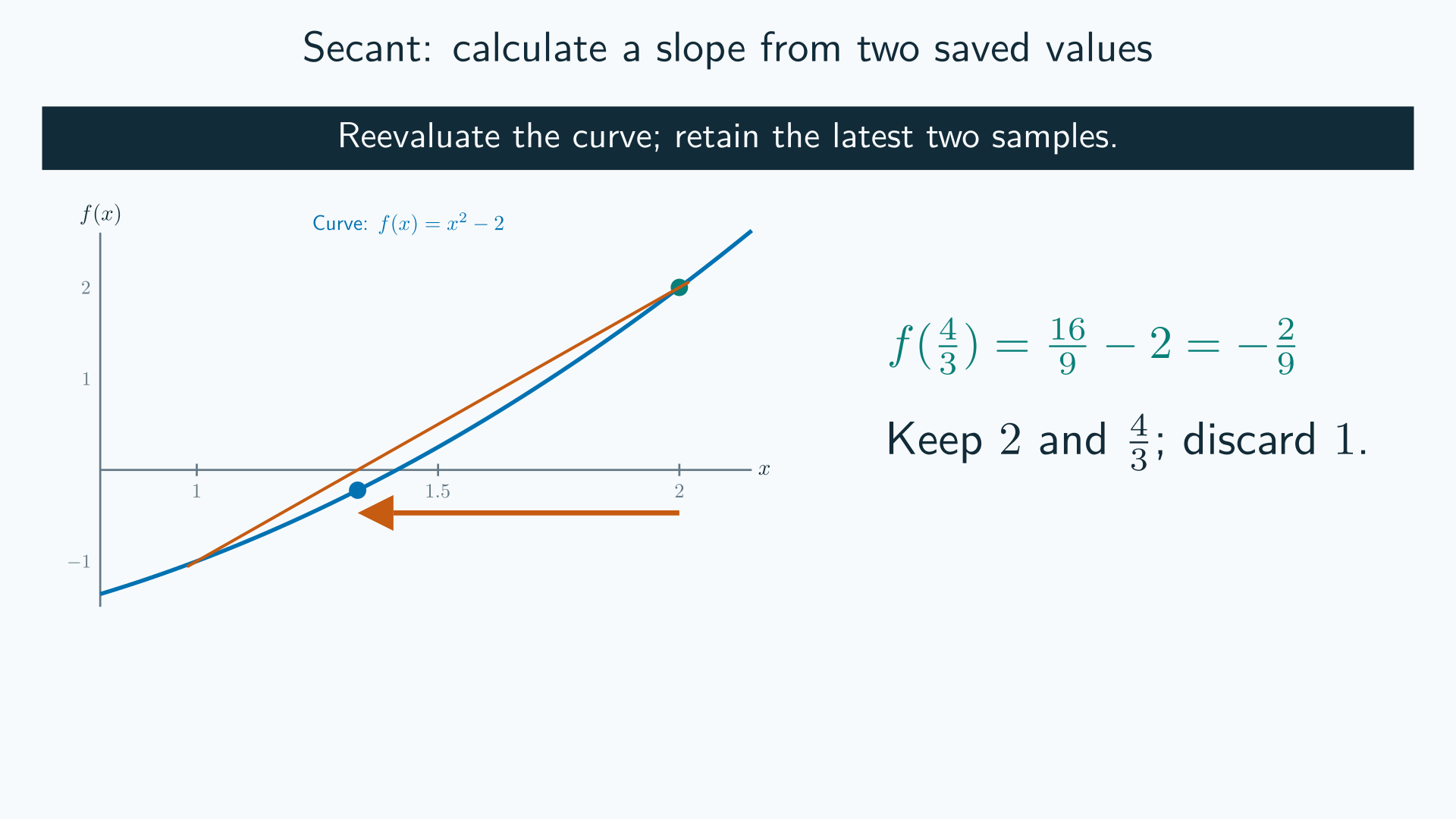
Retain 2 and , reusing . The next update is
Now . Both retained values are negative: keeping the latest pair does not preserve a sign-changing bracket.
Explain what you saw
Track the older point, the current point, and the newly proposed point separately. Explain how the next pair differs from the pair that bisection would retain.
Use the player controls to pause, replay, or view fullscreen. The animation has no narration. Burned-in captions explain each action; the static walkthrough above provides the same calculations without playback.
Continue: Lecture 8 · Full reading · All animations