The First Three Minutes
Complete lesson
Concept Throughline
By the end of this reading, you will be able to:
Concept Throughline
Run the expansion backward. Space contracts, the scale factor shrinks, and everything grows hotter and denser — until, in the first three minutes, the whole universe is a nuclear furnace. The atoms in your body remember it.
The last reading read the Friedmann equation forward, to the universe’s fate. Now we read it backward. If space has been expanding and cooling, then earlier it was smaller, denser, and hotter. Wind the clock back far enough and the universe becomes hot enough to fuse nuclei — a furnace that ran for about three minutes and left a fingerprint we still measure today: the cosmic ratio of hydrogen to helium.
This is the finale, and it closes the oldest thread in the course. The hydrogen in the water you drank this morning is not from any star. It is a relic of the first three minutes — older than the Sun, older than the Galaxy, nearly as old as time.
The cosmic helium fraction and the microwave glow
About a quarter of the ordinary matter in the universe, by mass, is helium — everywhere, even in gas that no star has touched — and the sky glows with relic light.
A hot, dense, expanding early universe
Run the expansion backward: at one second the universe was a plasma of protons, neutrons, electrons, and radiation at ten billion kelvin. Nuclear reactions built light nuclei until expansion cooled and thinned the furnace shut.
The first three minutes, reconstructed
The measured helium fraction matches what those reactions predict, confirming a hot dense origin we can never visit — inference at the farthest possible reach.
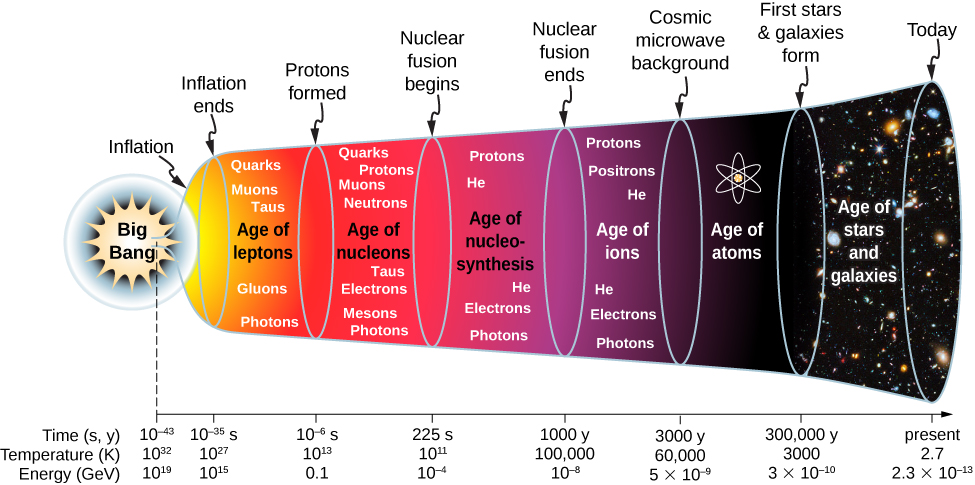
Inflation and the Hot Big Bang
Part 1: Inflation and the Hot Big Bang
The earliest instant we can model is not the reactions but a burst of expansion that preceded them. In the first sliver of a second, the universe underwent
Inflation
A brief episode of extremely rapid, accelerating expansion in the very early universe (around to seconds). It stretched a tiny region smooth and flat, and magnified quantum fluctuations into the density seeds that later grew into galaxies.
Inflation does two jobs worth keeping. It stretches space so smooth and so flat that it explains the flatness we measured last reading (). And — more startling — it takes the unavoidable quantum fluctuations of the microscopic patch and stretches them to macroscopic size. Those frozen-in ripples became slightly denser and slightly emptier regions. They are the seeds gravity later grew into galaxies, clusters, and the cosmic web — and we have already seen their imprint, as the tiny temperature ripples in the cosmic microwave background. The largest structures in the universe are inflated quantum noise.
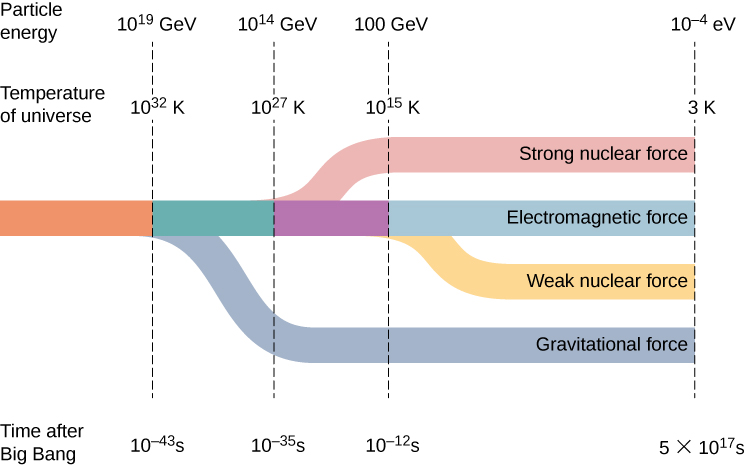
When inflation ended, the energy that drove it dumped into a hot soup of particles and radiation — the hot Big Bang proper. This is the moment to correct a stubborn picture.
Quick check
What is the surprising connection between quantum fluctuations during inflation and the largest structures in the universe today?
Inflation stretched microscopic quantum fluctuations to macroscopic scales, freezing in slightly denser and emptier regions. Gravity later amplified those seeds into galaxies, clusters, and the cosmic web — and the same ripples appear as the tiny temperature variations in the cosmic microwave background. The largest structures grew from inflated quantum noise.
Part 2: The First Three Minutes
By one second after the Big Bang, the universe had cooled to about ten billion kelvin — a plasma of photons, electrons, protons, and neutrons. This is the furnace.
Big Bang nucleosynthesis
The formation of the first light nuclei — deuterium, helium-3, helium-4, and a trace of lithium-7 — in the first few minutes of the hot early universe. It set the primordial composition: about three-quarters hydrogen and one-quarter helium by mass, with everything heavier left for stars.
Why only three minutes? Because the furnace is closing as it burns. The expansion is cooling and thinning the universe the entire time, and that sets a window:
- Reactions need the universe hot and dense enough to drive nuclei together against their electric repulsion.
- But helium is built through deuterium (a proton + a neutron), and deuterium is fragile: at temperatures above about , energetic photons blast it apart as fast as it forms. So helium cannot accumulate until the universe cools below that — roughly three minutes in.
- Once it does, helium builds almost explosively. But within minutes the expansion has thinned and cooled the plasma so far that reactions can no longer proceed. The window slams shut.
This race — reactions versus expansion — is a freeze-out: a reaction runs until the expanding universe dilutes and cools it to a halt, locking in whatever abundances it had reached. The first three minutes are not three minutes of leisurely cooking; they are the brief interval when the furnace is simultaneously hot enough and not yet too thin.
The decisive number is set even earlier. By one second, the neutrons and protons had frozen out at a ratio of about one neutron for every seven protons. Nearly every neutron then ends up bound into helium-4 (two protons, two neutrons), and that ratio fixes the cosmic helium fraction.
Problem
By the time deuterium survives, the neutron-to-proton ratio has frozen at . Essentially every neutron is captured into helium-4 (2 protons + 2 neutrons). Estimate the primordial helium mass fraction — the fraction of ordinary matter’s mass that is helium.
StepCount what each helium-4 takes
Each helium-4 needs 2 neutrons, so the number of helium nuclei is half the number of neutrons. The mass locked in helium is then nucleon masses, while the total baryon mass is nucleon masses.
StepForm the fraction in terms of n/p
Dimensional check
is a mass fraction — helium mass over total baryon mass — so it is a pure number, dimensionless, and must lie between 0 and 1. It does.
Result
About 25% helium by mass — and therefore about 75% hydrogen. This is a genuine prediction of the hot Big Bang, and it matches the helium found in the oldest, most pristine gas in the universe. A single frozen ratio, set in the first second, is why every corner of the cosmos is roughly one-quarter helium before any star burns.
Quick check
Big Bang nucleosynthesis lasted only a few minutes. What opened the window for it, and what closed it?
It opened when the universe cooled below about (~3 minutes), cool enough that deuterium — the stepping stone to helium — could survive instead of being blasted apart by energetic photons. It closed when the ongoing expansion thinned and cooled the plasma so far that nuclear reactions could no longer proceed. The expansion both enabled and ended BBN: a freeze-out.
The Timeline of the Universe
Part 3: The Timeline of the Universe
Step back and put the whole history in order. Each epoch ends when a different component takes over or a key transition occurs — and the sequence is exactly the budget from the last reading, played out in time.
- Inflation (): accelerating expansion stretches quantum fluctuations into structure seeds; it ends by reheating into the hot Big Bang.
- Radiation domination: the hot plasma, with radiation the densest component (). Big Bang nucleosynthesis happens here, at to — inside the radiation era, not before it.
- Matter–radiation equality (, ): matter’s slower dilution lets it overtake radiation; matter domination begins.
- Recombination (, ): the universe cools enough for atoms to form and becomes transparent, releasing the cosmic microwave background. Structure now grows in earnest.
- Dark-energy domination (the last few billion years): the expansion begins to accelerate as dark energy’s repulsion overcomes matter’s pull (around ), and dark energy grows to dominate the density budget by — where the previous reading left off.
Quick check
Big Bang nucleosynthesis (3 minutes) and recombination / the CMB (380,000 years) both belong to the early universe. What did each one make, and which came first?
BBN came first, at about three minutes, and made the first atomic nuclei (hydrogen, helium, a trace of lithium). Recombination came much later, at about 380,000 years, when the universe cooled enough for nuclei and electrons to combine into neutral atoms, releasing the cosmic microwave background. Nuclei first, atoms much later.
The Origin of the Elements
Part 4: The Origin of the Elements
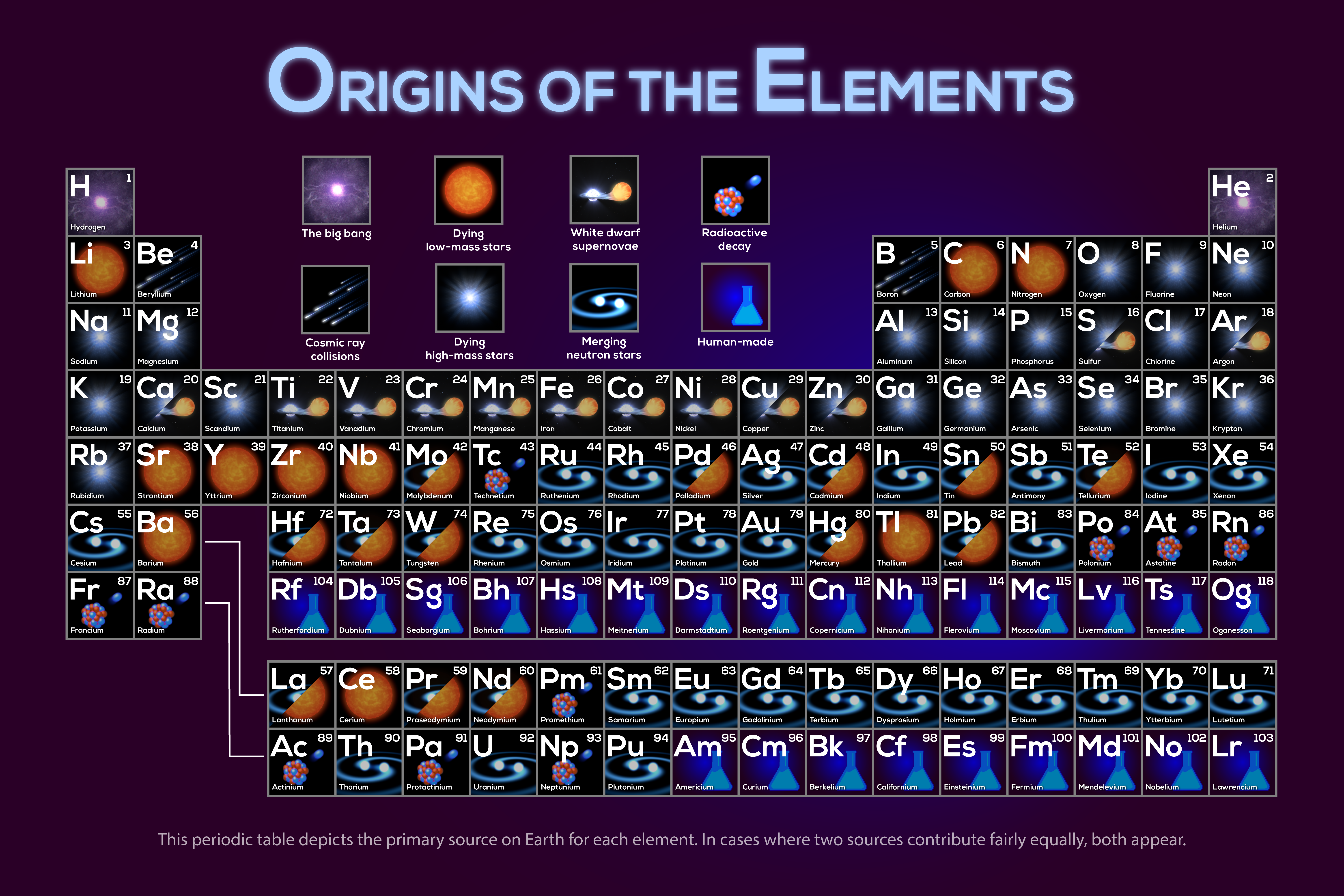
Now the oldest thread in the course closes. We have watched the elements being made in three different cosmic foundries, across three modules:
- The first three minutes made the light nuclei: hydrogen, about a quarter helium, a trace of lithium. The raw material of everything.
- Stars (Module 3) fuse hydrogen and helium into carbon, oxygen, and on up to iron — the elements of rock, water, and life — over their long lives.
- Supernovae and neutron-star mergers (Module 4) forge and scatter the heaviest elements, the ones built by rapid neutron capture in the most violent deaths.
Quick check
A water molecule is . Where and when were its hydrogen and its oxygen made?
The hydrogen is primordial — made in Big Bang nucleosynthesis in the first three minutes, nearly as old as the universe. The oxygen was forged much later, by fusion inside a star and scattered when that star died. The two atoms in the same molecule were made about thirteen billion years apart, in entirely different cosmic environments.
The Grand Synthesis
Part 5: The Grand Synthesis
We end where we began — with a measurement. The whole course has been one disciplined move, repeated at ever-greater reach: observe a proxy, build a model, infer what you cannot directly see.
We started in Module 2 with a parallax angle and asked how far away a star is. From there: a star’s color and spectrum gave its temperature and composition; its motion in a binary gave its mass; the balance of pressure and gravity gave its structure; the limits set by fundamental constants gave its fate. Then we stepped outward — the motion of galaxies revealed a dark mass that emits no light; the redshift of their light revealed an expanding universe and a first age; the Friedmann equation revealed what the cosmos is made of and how it will end. And now, reading that same expansion backward, we have reached the first three minutes — a furnace we can never visit, reconstructed from the cosmic helium fraction and a glow.
We never touched a star, weighed a galaxy on a scale, or visited the early universe. We measured light and motion, built models, and inferred a universe — from a parallax angle to the Big Bang. That is astronomy: not a catalog of objects, but a disciplined imagination, reading the faint signals that reach us and reconstructing thirteen billion years of history from them. The atoms doing the reading were made by the very history they reconstruct.
Quick check
In three or four sentences, close the origin-of-elements arc: name the cosmic foundry for (1) hydrogen and most helium, (2) carbon, oxygen, and iron, and (3) the heaviest elements — and explain why stars alone cannot account for all the elements.
(1) Hydrogen and about a quarter helium were made in Big Bang nucleosynthesis, the first three minutes. (2) Carbon, oxygen, and iron were fused inside stars over their lifetimes (Module 3). (3) The heaviest elements were forged by rapid neutron capture in supernovae and neutron-star mergers (Module 4). Stars cannot account for everything because they begin from hydrogen and helium they did not make — those are primordial, older than any star, supplied by the Big Bang.
Glossary
- Big Bang nucleosynthesis
The formation of the first light nuclei — deuterium, helium-3, helium-4, and a trace of lithium-7 — in the first few minutes of the hot early universe. It set the primordial composition: about three-quarters hydrogen and one-quarter helium by mass, with everything heavier left for stars.
- Inflation
A brief episode of extremely rapid, accelerating expansion in the very early universe (around to seconds). It stretched a tiny region smooth and flat, and magnified quantum fluctuations into the density seeds that later grew into galaxies.