Distance & Parallax
Section 1 of 7
The Distance Problem
By the end of this reading, you will be able to:
Part 1: The Distance Problem — Why It Matters
The Fundamental Challenge
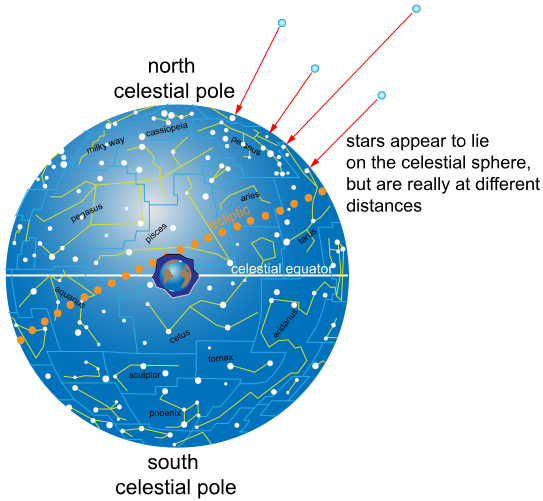
Look up on any clear night. Every star is a point of light — a tiny, seemingly dimensionless dot. This simplicity conceals one of the deepest challenges in astronomy: how far away is it?
Unlike nearby objects on Earth, we cannot pace out a star’s distance or send a probe and measure travel time. We must infer distance from the light alone — and that inference is fraught with ambiguity. A faint, distant star can appear the same brightness as a near, luminous one. Without knowing how far a star is, we cannot determine its true brightness — its intrinsic power output, or luminosity. And without luminosity, we cannot build the
Hertzsprung-Russell diagram
A plot of stellar luminosity (vertical axis, logarithmic) versus effective temperature (horizontal axis) that reveals stellar properties and evolutionary states. Building it requires knowing luminosity — which requires distance.
This is the starting point for stellar astrophysics: everything that follows — radius, composition, age, fate — depends on first solving the distance puzzle. And it is hard, because stars are points with no measurable angular size, and parallax (the apparent shift as Earth orbits) is tiny: even the nearest star shifts by less than one arcsecond across Earth’s orbital diameter.
The Observable → Model → Inference Framework
This lecture is organized around a single framework that threads through all of astronomy:
- Observable: we measure a star’s position at different times of year (it shifts slightly against the distant background) and its brightness (the flux reaching Earth). Both are directly measurable.
- Model: we build a geometric model of Earth’s orbit and apply the small-angle approximation, and we model the star as a point source radiating isotropically. These are assumptions that connect observations to what we want to know.
- Inference: from the position shift we calculate distance; from flux and distance we calculate luminosity. These are derived — not directly measured.
Models can be wrong and assumptions can fail. Good scientists always ask: what am I assuming, and what would break it? In Parts 2–3 we build the angular toolkit; in Part 4 we apply it to parallax; Part 5 develops the inverse-square law two ways; Part 6 combines them to infer luminosity; Part 7 previews standard candles.