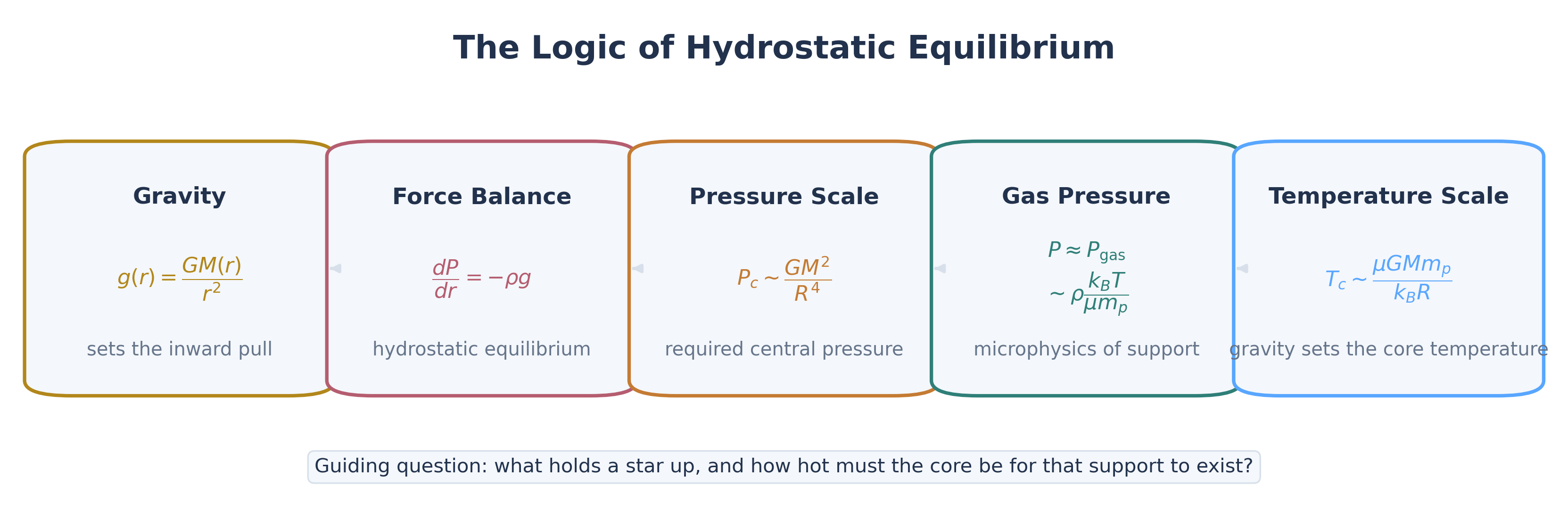
The Balancing Act — Hydrostatic Equilibrium
Section 1 of 7
Concept Throughline
After completing this reading, you should be able to:
Concept Throughline
Gravity never stops pulling inward. For a star to survive, a force must balance gravity at every radius — not uniformly, but with a strength that increases toward the center, where the weight of the overlying material is greatest. That force comes from a
Pressure gradient
The rate at which pressure changes with position, . A uniform pressure exerts no net force; only a pressure gradient produces one. Inside a star the gradient points outward (pressure falls with radius) and supports the weight of the overlying gas.
Hydrostatic equilibrium
The condition in which the outward pressure-gradient force exactly balances the inward pull of gravity at every radius, so the gas has no net radial acceleration. It is the foundational force-balance equation of stellar structure.
This force balance is the foundation of stellar structure theory. Combined with the virial theorem and the ideal-gas picture, it lets us estimate a solar core temperature of order , or about . No nuclear-reaction physics is needed to estimate this temperature scale — only gravity, force balance, energy balance, and the thermal behavior of gas.