Radiation Transport
Section 1 of 7
Why Stars Are Opaque
By the end of this reading, you will be able to:
Guiding question: if photons move at the speed of light, why does energy released in the solar core take roughly years to leak out?
Reading 3 answered the energy-generation question: fusion releases energy in the core. This reading answers a different one: how does that energy get out? The logic chain is the spine of the topic: matter blocks radiation, so stars are opaque; opacity and density set the photon mean free path; a tiny mean free path turns transport into a random walk; random walks are inefficient, so energy diffuses outward slowly; if diffusion becomes too inefficient, convection carries energy by bulk motion; and the same radiation field carries momentum, so radiation pressure can compete with gravity in luminous stars.
The Sun's luminosity is steady, but its energy is made deep in the core
A constant on human timescales, powered by fusion far below the surface.
An optically thick interior — transport as a random walk
Photons interact repeatedly through absorption and scattering, so energy transport becomes a random walk describable macroscopically by radiative diffusion.
Energy diffuses out over ~10^5 years
Energy does not stream outward at across the star; it diffuses through an enormous number of interactions, giving a transport time of order years.
Part 1: Why Stars Are Opaque
The travel-time paradox
Start with the wrong model on purpose. If the Sun were transparent, energy from the core would stream straight to the surface in . That is obviously not how a real star works. The missing physics is opacity.
Opacity: how effectively matter blocks radiation
The
Opacity
A measure of how strongly matter absorbs or scatters radiation per unit mass, (units ). Larger opacity means a shorter photon mean free path and more resistance to radiative energy flow.
| Opacity Source | Physical Process | Dominates When |
|---|---|---|
| Electron scattering (Thomson) | Free electrons deflect photons | Hot, fully ionized gas |
| Bound-free absorption | Photon ionizes an atom | Moderate ; partially ionized gas |
| Free-free absorption (bremsstrahlung) | Photon interacts during an electron-ion encounter | Ionized gas, wide range of conditions |
| Bound-bound absorption | Photon excites an atomic transition | Lower ; partially ionized gas |
For a fully ionized hydrogen-rich plasma, the cleanest baseline is electron scattering: with the hydrogen mass fraction — the standard one-zone baseline for the solar interior.
Optical depth: how many mean free paths thick is the star?
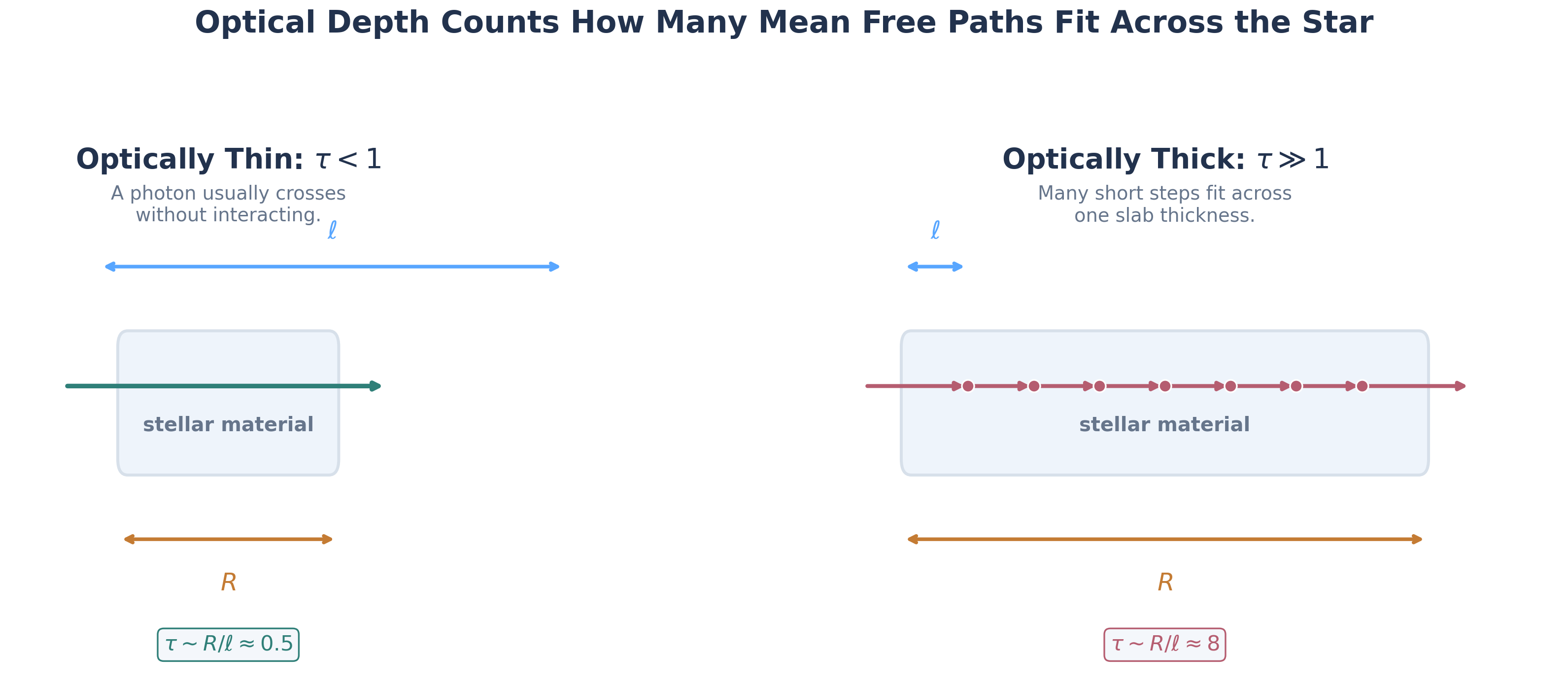
Combine opacity with density. The optical-depth increment is ; integrating across a region of size gives the
Optical depth
The dimensionless thickness of a medium in mean free paths, . is optically thin (photons stream freely); is optically thick (photons interact many times).
Quick check
Suppose a star becomes denser while its opacity stays the same. (1) Does the mean free path get longer or shorter? (2) Does the optical depth get larger or smaller? (3) Should energy escape more easily or less easily?
With , increasing at fixed makes shorter, while gets larger. The medium becomes more optically thick, so radiation escapes less easily.