What the Universe Is Made Of
Section 4 of 7
Part 3: What Is the Universe Made Of?
Now read the budget. Measurements — above all the cosmic microwave background and distant supernovae — pin down each :
- Radiation, : negligible today, though it dominated the early universe.
- Ordinary (baryonic) matter, : everything the periodic table is made of — stars, gas, planets, you.
- Dark matter, : the gravitating mass we weighed two readings ago, now placed in the cosmic budget.
- Dark energy, : the dominant component, driving the acceleration we meet in Part 5.
Two readings ago we showed, galaxy by galaxy, that dark matter outweighs the baryons several-fold and promised a single number for the cosmic budget. Here it is: ordinary matter is only about 5% of the critical density, dark matter about 26%, so dark matter outweighs ordinary matter roughly five to one across the whole universe. Together, .
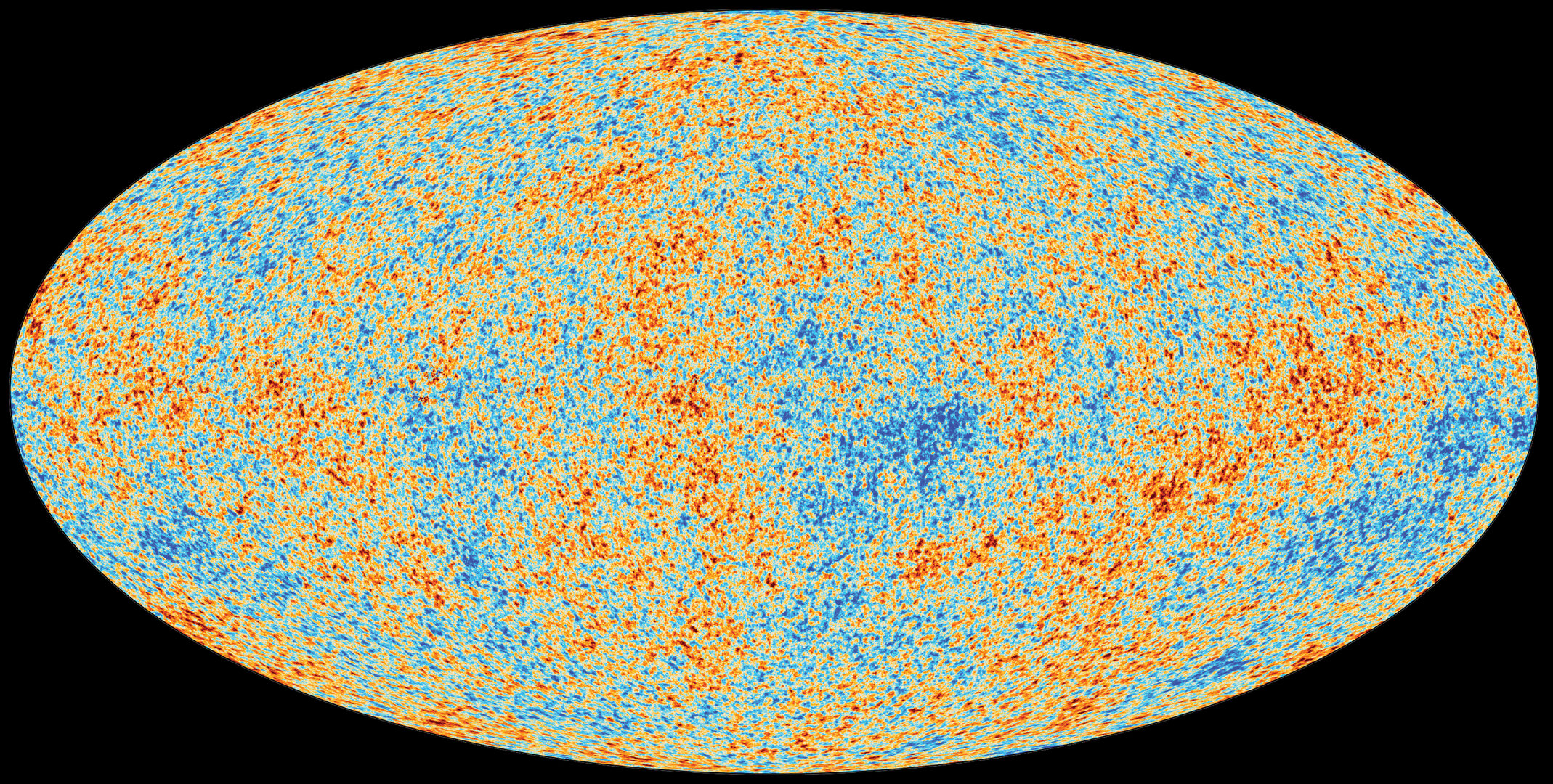
The
Cosmic microwave background
Relic radiation released at recombination, when the expanding universe first became transparent, now stretched into microwaves at . Its near-uniform glow and tiny temperature ripples measure the cosmic budget and the geometry of space.
Recombination
The era, about years after the Big Bang, when electrons combined with nuclei to form neutral atoms and the universe became transparent. The light freed then is the cosmic microwave background.
Quick check
Ordinary matter is about of the critical density and dark matter about . What does that say about the matter we can see versus the matter that gravitates?
Most of the matter in the universe is dark: dark matter outweighs ordinary (luminous) matter by roughly five to one. The atoms of the periodic table — everything we can see — are a small minority of the total mass, and a tiny minority once dark energy is included.