What the Universe Is Made Of
Complete lesson
Concept Throughline
By the end of this reading, you will be able to:
Concept Throughline
One equation governs the whole universe. You do not have to solve it — you have to read it. It tells you what the cosmos is made of, what shape it has, and how it will end.
For three modules you have practiced a single disposition: an equation is not a wall to climb but a story to read. You read hydrostatic equilibrium for the structure of a star; you read the mass–luminosity relation for the main sequence. Now you read the one equation that governs everything — the Friedmann equation — and it answers the three biggest questions at once: what is the universe made of, what is its shape, and what is its fate?
The microwave sky and exploding stars
The cosmic microwave background is uniform and almost perfectly flat-geometry; Type Ia supernovae at large distance are fainter than a coasting universe predicts.
The Friedmann equation and its budget
. Divide by and measure each density against the critical density: .
Composition, shape, and fate
The universe is about ordinary matter, dark matter, dark energy; spatially flat; and switching from deceleration to acceleration.
What Sets the Expansion Rate?
Part 1: What Sets the Expansion Rate?
In the last reading we measured the expansion rate and inverted it for a rough age. But what governs that rate, and how it changes? The answer is the
Read it as a sentence, left to right. is the expansion rate squared — how fast space stretches. The first term on the right, , is the gravity of everything the universe contains: is the total energy density, summing radiation, matter, and dark energy. The second term, , is the shape of space — its curvature. More stuff means faster expansion; the curvature sign decides whether space is open, closed, or flat.
Friedmann equation
The equation governing the cosmic expansion rate, . It ties the expansion rate to the total energy density and the spatial curvature . Read, not solved, in this course.
We will not solve this differential equation — that is a graduate exercise. We will read it, exactly as we read the structure equations for a star. And the most useful read comes from a single move.
Quick check
In the Friedmann equation, which term would you increase to make the universe expand faster at a given moment, and which term carries the shape of space?
Increasing the total energy density (the term) increases , so a denser universe expands faster at a given moment. The curvature term carries the shape of space, with for closed, flat, or open.
The Critical Density
Part 2: The Critical Density
The division above introduced a yardstick: the
Set the curvature term to zero () in the Friedmann equation and solve for the density: . A universe denser than this curves closed; less dense curves open; exactly this is flat. Every cosmic density is then quoted as a fraction of it, .
Critical density
The density that makes the universe spatially flat. About — roughly five hydrogen atoms per cubic meter. Densities are measured against it as .
Problem
Compute the critical density today from , using and . Then express it in hydrogen atoms per cubic meter ().
StepPlug in
.
Dimensional check
— a density, as required.
Result
Dividing by : , or about 5 hydrogen atoms per cubic meter. The average density of the entire universe is five protons in the volume of a small refrigerator — and that number decides its shape and fate.
Part 3: What Is the Universe Made Of?
Now read the budget. Measurements — above all the cosmic microwave background and distant supernovae — pin down each :
- Radiation, : negligible today, though it dominated the early universe.
- Ordinary (baryonic) matter, : everything the periodic table is made of — stars, gas, planets, you.
- Dark matter, : the gravitating mass we weighed two readings ago, now placed in the cosmic budget.
- Dark energy, : the dominant component, driving the acceleration we meet in Part 5.
Two readings ago we showed, galaxy by galaxy, that dark matter outweighs the baryons several-fold and promised a single number for the cosmic budget. Here it is: ordinary matter is only about 5% of the critical density, dark matter about 26%, so dark matter outweighs ordinary matter roughly five to one across the whole universe. Together, .
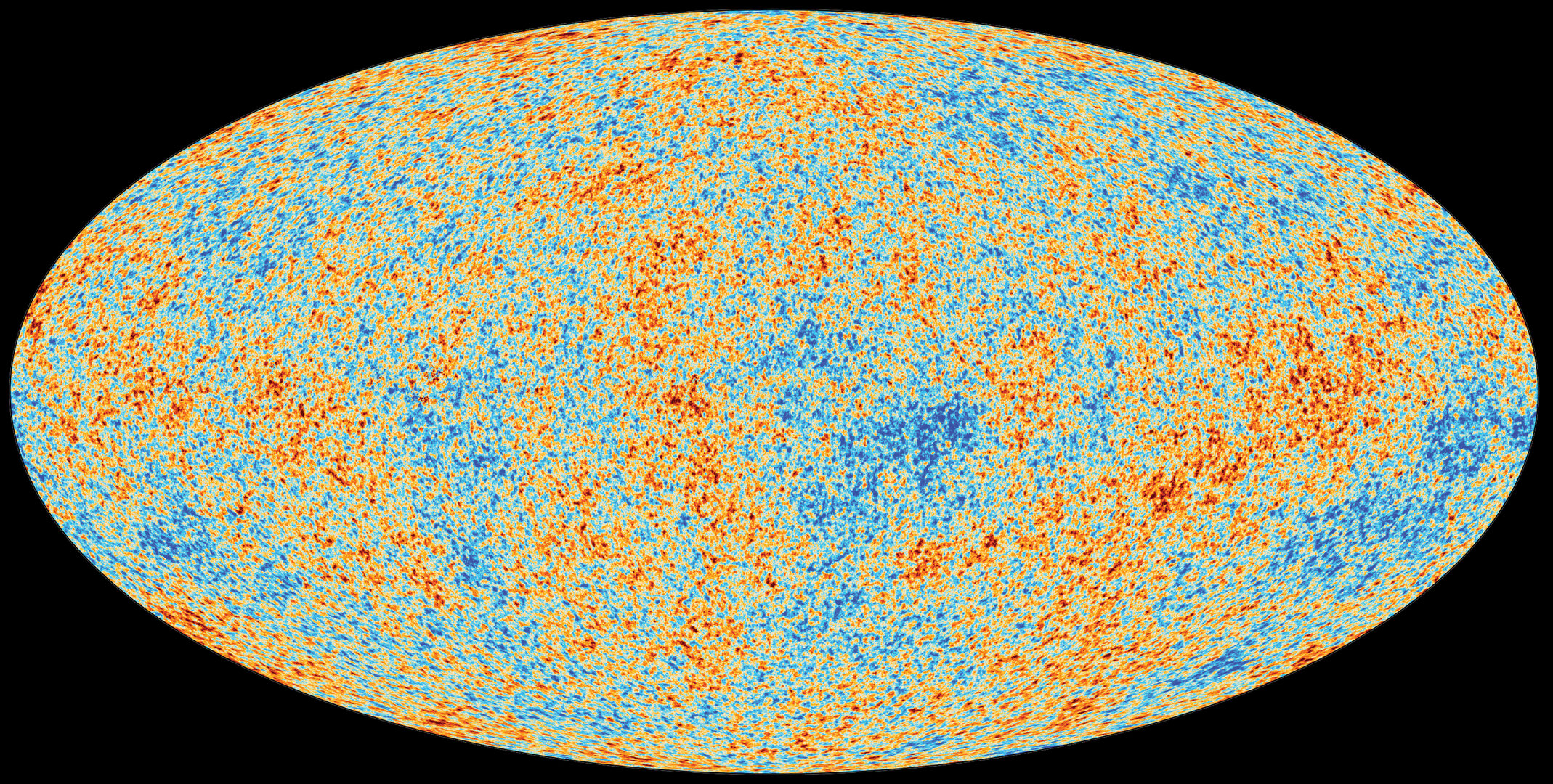
The
Cosmic microwave background
Relic radiation released at recombination, when the expanding universe first became transparent, now stretched into microwaves at . Its near-uniform glow and tiny temperature ripples measure the cosmic budget and the geometry of space.
Recombination
The era, about years after the Big Bang, when electrons combined with nuclei to form neutral atoms and the universe became transparent. The light freed then is the cosmic microwave background.
Quick check
Ordinary matter is about of the critical density and dark matter about . What does that say about the matter we can see versus the matter that gravitates?
Most of the matter in the universe is dark: dark matter outweighs ordinary (luminous) matter by roughly five to one. The atoms of the periodic table — everything we can see — are a small minority of the total mass, and a tiny minority once dark energy is included.
What Shape Is Space?
Part 4: What Shape Is Space?
The curvature term decides the geometry. Add up all the densities: if the total equals the critical density, , the curvature term vanishes and space is flat — ordinary Euclidean geometry, where parallel lines stay parallel and triangles’ angles sum to . If the universe is closed (positively curved, like a sphere’s surface generalized to three dimensions); if it is open (negatively curved, saddle-like).
Spatial geometry
The curvature of space, fixed by the total density relative to critical: flat (), closed (), or open (). The cosmic microwave background measures it to be flat to within about a percent.
Multiple choice
The cosmic microwave background shows . What does this tell us about the geometry of space?
Space is spatially flat. makes the curvature term in the Friedmann equation vanish, so large-scale geometry is Euclidean. “Flat” is a statement about three-dimensional curvature, not a claim that space is a 2-D sheet, and a uniform flat universe has no center or edge.
What Is Its Fate?
Part 5: What Is Its Fate?
The budget is not fixed forever, because the components dilute differently as space expands. Matter thins as volume grows, ; radiation thins faster, (an extra factor from its wavelength stretching); but dark energy holds nearly constant density, , as space expands. Whichever component dominates at a given epoch drives the expansion.
Early on, matter and radiation dominated, and their gravity decelerated the expansion — the pull of all that density slowing the stretch. But as space expanded, matter thinned while dark energy did not. A few billion years ago (around redshift ), dark energy’s repulsion grew strong enough to overcome matter’s pull, and the expansion began to accelerate; dark energy comes to outweigh matter’s density entirely a little later, by . Distant Type Ia supernovae — the same standard candles from the distance ladder — revealed this in 1998: they are fainter, hence farther, than a decelerating universe would place them.
Quick check
Why did the expansion switch from decelerating to accelerating, given that dark energy was always present?
Matter dilutes as the universe expands (), while dark energy’s density stays nearly constant. Early on matter was dense enough that its gravity decelerated the expansion; as matter thinned, dark energy’s negative pressure came to drive acceleration. The expansion began to accelerate around , when dark energy’s repulsion overcame matter’s deceleration; dark energy comes to outweigh matter’s density entirely a little later, by .
Summary
Summary
The Friedmann equation, , governs the whole universe — and you read it rather than solve it. Dividing by gives the cosmic budget, , each density measured against the critical density of about five hydrogen atoms per cubic meter. The universe is roughly ordinary matter, dark matter, and dark energy, and it is spatially flat (), as the cosmic microwave background shows. Because matter dilutes while dark energy does not, the expansion decelerated under matter’s gravity and now accelerates under dark energy.
We have read the universe’s composition, shape, and fate from one equation. The last question runs the expansion backward: wind the scale factor down and the universe grows hotter and denser, until — in the first three minutes — it was a nuclear furnace. That is the finale.
Starting from the Friedmann equation, explain in three steps how you arrive at the statement “the universe is ordinary matter, dark matter, dark energy, and flat.” What does each measure, and what fixes ?
(1) Divide the Friedmann equation by and define , giving with . (2) Each measures a component’s density as a fraction of critical: ordinary matter , dark matter (together ), dark energy , radiation . (3) — fixed by the CMB, which measures the geometry to be flat — makes the curvature term vanish, so the budget sums exactly to one.
Glossary
- Cosmic microwave background
Relic radiation released at recombination, when the expanding universe first became transparent, now stretched into microwaves at . Its near-uniform glow and tiny temperature ripples measure the cosmic budget and the geometry of space.
- Critical density
The density that makes the universe spatially flat. About — roughly five hydrogen atoms per cubic meter. Densities are measured against it as .
- Friedmann equation
The equation governing the cosmic expansion rate, . It ties the expansion rate to the total energy density and the spatial curvature . Read, not solved, in this course.
- Recombination
The era, about years after the Big Bang, when electrons combined with nuclei to form neutral atoms and the universe became transparent. The light freed then is the cosmic microwave background.
- Spatial geometry
The curvature of space, fixed by the total density relative to critical: flat (), closed (), or open (). The cosmic microwave background measures it to be flat to within about a percent.