The Quantum Limit
Section 5 of 6
The White-Dwarf Mass-Radius Relation
Part 5: The Mass-Radius Relation for White Dwarfs
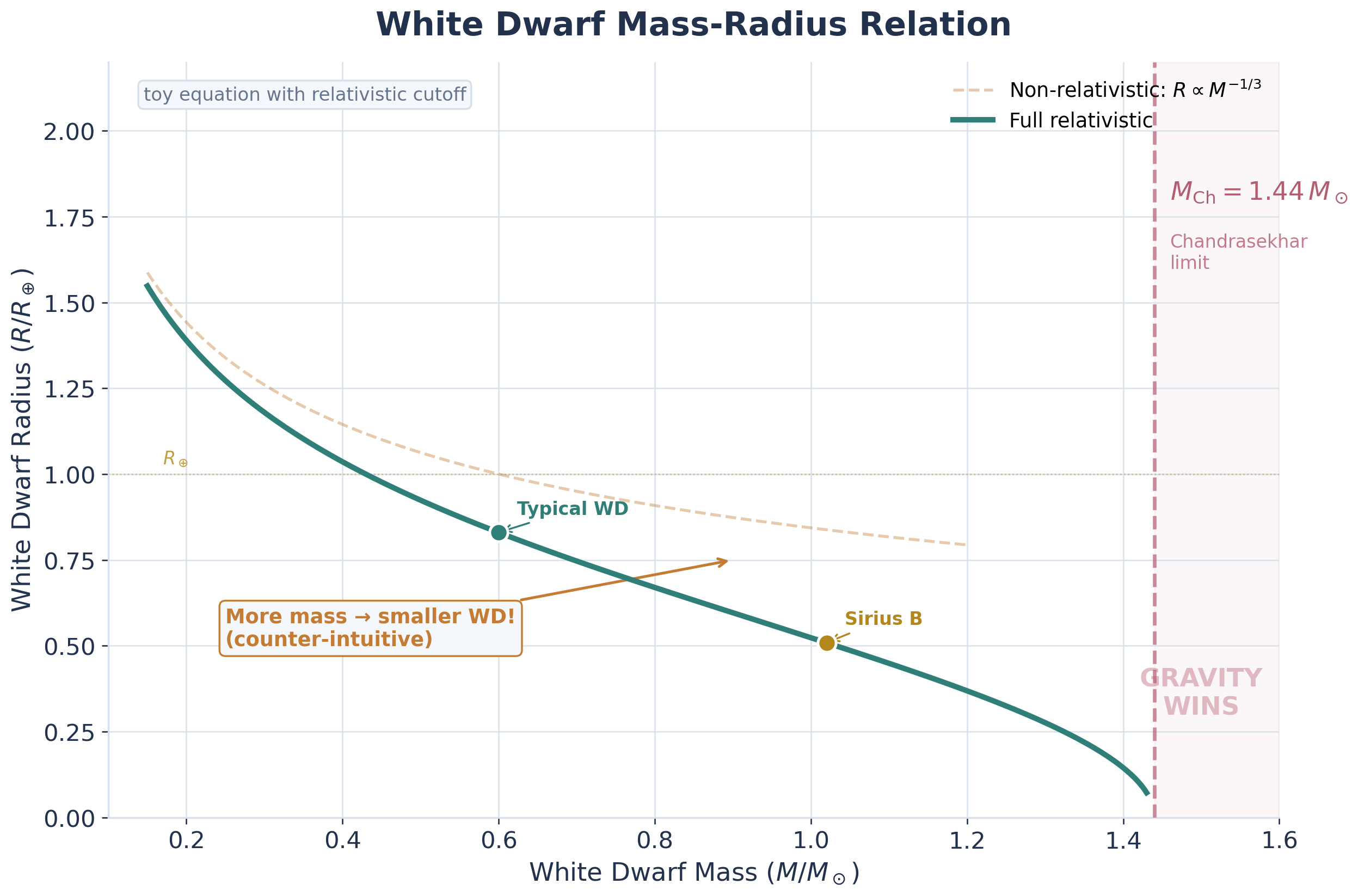
How Size Changes with Mass
For non-relativistic white dwarfs (well below the Chandrasekhar limit), balance non-relativistic degeneracy pressure against gravity:
More massive white dwarfs are smaller — the opposite of main-sequence stars () and ordinary objects. It is a direct consequence of degeneracy: more mass means stronger gravity, tighter electron confinement, higher density, and a smaller star.
The non-relativistic relation predicts a gentle shrinking with mass. Anchoring to a white dwarf at :
| (non-rel., ) | |
|---|---|
| 0.2 | 1.44 |
| 0.6 | 1.00 |
| 1.0 | 0.84 |
| 1.2 | 0.79 |
| 1.4 | 0.75 |
Read the table carefully: the simple formula has no upper limit built in — taken literally it still returns a finite radius () at . The real white dwarf does something more dramatic. As the electrons turn relativistic, the pressure softens from toward , and the true radius drops below these non-relativistic values, plunging toward zero at the Chandrasekhar mass. The gentle decline in the table is the low-mass behavior; the relativistic correction — absent from this simple formula — is exactly what turns the soft trend into the hard wall.
So the simple non-relativistic model stops admitting a stable solution at . If the core mass exceeds , electron degeneracy fails entirely, and something new must take over: neutron degeneracy (or gravity wins completely).
Quick check
If more massive stars make more massive cores, why are more massive white dwarfs smaller instead of larger?
Because a white dwarf is not supported by ordinary thermal pressure. Adding mass strengthens gravity, which squeezes the electron gas more tightly. The electrons are forced into higher-momentum states, so the remnant reaches a smaller equilibrium radius. More mass means more compression, not a puffier star.