The Quantum Limit
Complete lesson
The Pauli Exclusion Principle
By the end of this reading, you will be able to:
Guiding question: what holds up a dead star — and why does quantum mechanics impose a maximum mass on it?
Astronomers measure white dwarf masses and radii in binary systems and find a striking pattern: the remnants are Earth-sized, supported without fusion, and none of the stable ones sit comfortably above about . In Reading 1 we met the Heisenberg uncertainty principle: confining particles to small spaces gives them momentum. In Reading 2 we saw that white dwarfs are supported by this quantum pressure. But how strong is this pressure, and is it invincible? Here we add the third and final piece of the QM toolkit — the Pauli exclusion principle — and then discover something remarkable: when the electrons become relativistic, their pressure weakens relative to gravity, and there is a maximum mass above which no stable white dwarf can exist.
Part 1: The Pauli Exclusion Principle
Before we derive anything, keep the observational puzzle in view: in binaries containing white dwarfs, we can infer both masses and radii from orbital motion, eclipses, spectra, and sometimes gravitational redshifts. Those measurements show compact remnants near Earth-size, and they cluster below a characteristic upper mass. The derivation in this reading is not replacing data — it is explaining why those data look the way they do.
Two Kinds of Particles
All fundamental particles fall into two categories based on their spin — an intrinsic quantum mechanical property with no classical analogue.
| Type | Spin | Examples | Behavior when compressed |
|---|---|---|---|
| Fermions | Electrons, protons, neutrons | Resist compression — exclusion | |
| Bosons | Photons, helium-4 nuclei | Can pile up — no exclusion |
Fermion
A particle with half-integer spin () — electrons, protons, neutrons. Fermions obey the Pauli exclusion principle, so no two identical ones can share a quantum state; this is what makes them resist compression. (Integer-spin particles are bosons, which can pile into the same state.)
The
No two identical fermions can occupy the same quantum state simultaneously.
Pauli exclusion principle
The quantum rule that no two identical fermions can occupy the same quantum state at once. In dense matter it forces electrons to fill momentum states from the bottom up, so compression pushes them into ever-higher momenta — the origin of degeneracy pressure.
A “quantum state” for an electron in a box is defined by the region it is confined to and its momentum. For electrons, the spin quantum number provides two states (spin-up and spin-down) per momentum state. So in a given volume, at most two electrons can have the same momentum — one with each spin orientation.
What This Means for Dense Matter
Imagine packing electrons into a small volume (like a white dwarf core). The first two electrons settle into the lowest-momentum state — one spin-up, one spin-down. The next two must go into the next-highest momentum state, and so on. As you add more electrons (or compress existing ones into a smaller volume), the highest occupied momentum state — the
Fermi momentum
The momentum of the highest-occupied quantum state in a degenerate fermion gas. Set by density through confinement, , it rises as the gas is compressed — and when the electrons turn relativistic, the route to the Chandrasekhar limit.
The critical point: this pressure has nothing to do with temperature. Even at absolute zero (), the electrons are forced into high-momentum states by the exclusion principle. Cooling the gas does not reduce the pressure. This is fundamentally different from thermal pressure (), which vanishes at .
Multiple choice
Helium-4 nuclei are bosons (spin 0); electrons are fermions (spin ½). If you compressed a gas of helium-4 nuclei to high density, would you get degeneracy pressure?
No. Bosons do not obey the Pauli exclusion principle — they can all pile into the same quantum state. Compressing a gas of bosons does not force them into successively higher momentum states; there is no Fermi momentum and no degeneracy pressure.
In fact, at extremely low temperatures bosons do the opposite of fermions: they collapse into the same lowest-energy state, forming a Bose-Einstein condensate. That fermions resist compression while bosons welcome it is one of the most consequential facts in physics — it sets the structure of atoms, the stability of white dwarfs and neutron stars, and the very existence of solid matter.
Degeneracy Pressure
Part 2: Degeneracy Pressure
Deriving the Pressure (Scaling Argument)
We can derive the scaling of
Degeneracy pressure
The pressure of a degenerate fermion gas, arising from the Pauli exclusion principle rather than from heat: compression forces fermions into high-momentum states, and those fast particles push back even at . For non-relativistic electrons (); it is what supports white dwarfs.
Step 1: Find the Fermi momentum. The number density is . Each electron is confined to a volume , so , and by the uncertainty principle the momentum is .
Step 2: Find the kinetic energy. For non-relativistic electrons (), the kinetic energy per electron is .
Step 3: Find the pressure. Pressure is energy per unit volume, :
This is the non-relativistic electron degeneracy pressure — set by density alone, with no temperature anywhere in it.
Key Properties
This result reveals several remarkable properties:
- No temperature dependence. depends on (density), not . The pressure exists at absolute zero. This is why white dwarfs don’t need an energy source — they are held up by quantum mechanics, not heat.
- Scales as . Since (for a fixed composition), . This is steeper than an ideal gas (): degeneracy pressure grows faster with compression — a stiffer equation of state.
- Depends on . Lighter particles produce stronger degeneracy pressure at the same density. This is why electron degeneracy supports white dwarfs — electrons are times lighter than protons, so their degeneracy pressure is times stronger. Proton/neutron degeneracy matters only at much higher densities (neutron stars, Reading 5).
Comparing Thermal and Degeneracy Pressure
Which pressure dominates depends on density and temperature:
At high density and low temperature, dominates — the gas is degenerate. At low density and high temperature, dominates — the gas is classical. The boundary is exactly the condition from Reading 1.
| Object | Dominant pressure | ||
|---|---|---|---|
| Solar core | Thermal (ideal gas) | ||
| White dwarf | Electron degeneracy | ||
| Neutron star | Neutron degeneracy |
Fermi energy
The kinetic energy of the highest-occupied state in a degenerate gas, (non-relativistic). In a typical white dwarf –, so the electrons are non-relativistic; when compression pushes toward the gas turns relativistic.
Quick check
If you could magically double the mass of the electron (keeping everything else the same), what would happen to the degeneracy pressure in a white dwarf? What would be the consequence for the maximum white dwarf mass?
From , doubling would halve the degeneracy pressure: the electrons keep the same momenta (set by confinement), but their kinetic energy is halved.
The consequence: white dwarfs would need to be denser (smaller) to balance gravity. But the Chandrasekhar mass barely changes — does not depend on , because the relativistic limit depends on approaching , and both sides scale with . We see this in the derivation below.
The Chandrasekhar Limit
Part 3: The Chandrasekhar Limit
Why Massive White Dwarfs Fail
As a white dwarf’s mass increases, gravity is stronger, requiring higher density to generate enough degeneracy pressure. Higher density means electrons are confined to smaller volumes, giving them larger momenta (). At some point, the fastest electrons approach the speed of light — they become relativistic. For relativistic particles, the energy-momentum relation changes:
This changes the degeneracy pressure scaling:
| Regime | Pressure | Scaling with |
|---|---|---|
| Non-relativistic () | ||
| Relativistic () |
The relativistic pressure scales more slowly with density ( instead of ). This is the key: gravity’s demand grows as , and now the pressure supply also grows as . The two scalings match — so increasing the density no longer helps. Either there is an equilibrium or there isn’t, and it depends only on the mass.
Deriving the Chandrasekhar Mass — Reading the Limit at Its Cleanest
This is the crest of the move we have been practicing all module. The Chandrasekhar mass is Reading the Limit done as purely as it ever gets — write the balance, cancel the size, read off the constants.
① Write the balance. Set the gravitational pressure required (from hydrostatic equilibrium, Module 3) against the relativistic degeneracy pressure supplied, with :
② Solve — the size cancels. Set . Both sides carry exactly — because in the relativistic regime pressure and gravity grow at the same rate, — so the radius cancels completely (the same disappearing act as the Eddington ceiling in Reading 1, and for the same reason):
③ Read off the constants. The mass is fixed — no radius, no temperature, just , , , . And this combination should look familiar: it is the same natural mass scale that set the minimum stellar mass in Reading 1. The floor and the ceiling of degenerate stardom are built from the same four constants — the floor is times a small thermal factor, the ceiling is times an order-unity number. That is the through-line of the whole module in one equation.
The
The dimensional estimate gives ; the exact relativistic, composition-corrected value (with for C/O) is .
Chandrasekhar mass
The maximum mass of a stable white dwarf, (for ). It is set purely by fundamental constants: above it, relativistic electron degeneracy pressure can no longer balance gravity at any radius, so the core collapses to a neutron star or black hole.
Putting Numbers on the Limit
Problem
Evaluate in CGS and convert to solar masses. Use , , , , .
StepAssemble ℏc/G
StepRaise to the 3/2 power and divide by the proton mass squared
Dimensional check
The constants close to a mass. With , , so . Then , and dividing by leaves ✓.
Result
The bare scaling gives ; the exact relativistic, composition-corrected value ( for carbon-oxygen) is . The dimensional argument lands within — typical for this kind of estimate, and more than enough to understand why the wall sits near a solar mass.
Quick check
In the Chandrasekhar mass derivation, the radius canceled out of the equation. Why is this physically significant?
The cancellation of means the Chandrasekhar mass is a single number — independent of the white dwarf’s size. This has profound implications:
- For : a specific radius balances degeneracy pressure against gravity. The white dwarf is stable, and more massive ones are smaller (, Reading 2).
- For : the idealized solutions run out — the model pushes the radius toward zero, signaling that electron degeneracy is no longer adequate.
- For : no equilibrium exists at any radius. Relativistic degeneracy pressure cannot fight gravity, and the star must collapse further.
This is why the limit is a hard wall, not a soft boundary: the mathematical structure of the equilibrium changes — the radius drops out and equilibrium becomes mass-dependent.
The Physical Meaning
Part 4: The Physical Meaning
Built from Constants
Look at the Chandrasekhar mass again: . It contains exactly four constants:
| Constant | Meaning | Role |
|---|---|---|
| Quantum mechanics | Sets the degeneracy pressure | |
| Relativity | Imposes the speed limit that weakens pressure | |
| Gravity | The attacker that must be balanced | |
| Nuclear physics | Sets the mass per electron |
The Chandrasekhar mass lives at the intersection of quantum mechanics, special relativity, and gravity. It is not an astrophysical accident — the mass scale is built into the fundamental laws of physics. For real white dwarfs, the exact value also depends on composition through the electron fraction .
What It Means for Stellar Evolution
The Chandrasekhar limit divides the fate of stellar remnants:
| Core mass at death | Fate | Support mechanism |
|---|---|---|
| White dwarf | Electron degeneracy | |
| Neutron star | Neutron degeneracy (Reading 5) | |
| Black hole | Nothing — gravity wins (Reading 5) |
Stars below (initial mass) leave cores below and become white dwarfs (Reading 2). More massive stars leave cores that exceed the Chandrasekhar limit — their fate involves core collapse, supernovae, and the most extreme objects in the universe (Readings 4–5).
Stable white-dwarf masses cluster below ~1.4 solar masses
Measured in binaries from orbital dynamics, eclipses, spectra, and sometimes gravitational redshifts; the stable carbon-oxygen white dwarfs we measure cluster below about .
Relativistic electron degeneracy + hydrostatic equilibrium
Together these predict a limiting white-dwarf mass scale, with a carbon-oxygen value near once composition is included.
The Chandrasekhar limit divides remnant fates
The observed mass distribution strongly supports the limit; when stellar cores exceed it, electron degeneracy is no longer enough, so the remnant must collapse further or switch support mechanism.
Multiple choice
If gravity were weaker (smaller ), would the maximum white dwarf mass be larger or smaller?
If were smaller, would be larger. Weaker gravity means each solar mass of material pulls less hard, so electron degeneracy pressure can support more mass before the electrons are forced to relativistic speeds.
Physically: the limit is where gravity’s demand (set by and ) equals the maximum supply of quantum pressure (set by , ). With weaker gravity it takes a larger mass to push electrons relativistic, so white dwarfs could be more massive — and the threshold for neutron stars and black holes would be higher.
The White-Dwarf Mass-Radius Relation
Part 5: The Mass-Radius Relation for White Dwarfs
How Size Changes with Mass
For non-relativistic white dwarfs (well below the Chandrasekhar limit), balance non-relativistic degeneracy pressure against gravity:
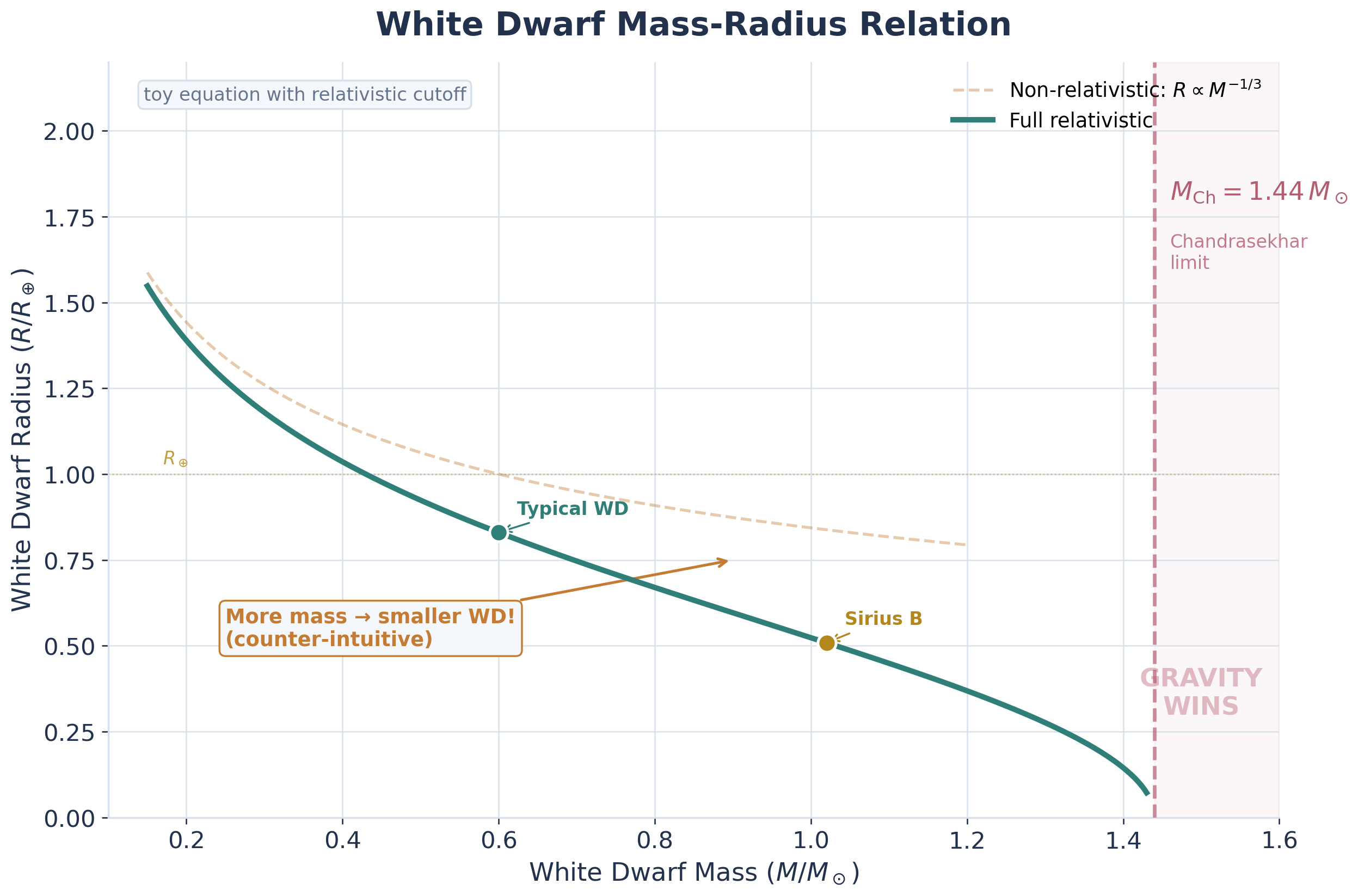
More massive white dwarfs are smaller — the opposite of main-sequence stars () and ordinary objects. It is a direct consequence of degeneracy: more mass means stronger gravity, tighter electron confinement, higher density, and a smaller star.
The non-relativistic relation predicts a gentle shrinking with mass. Anchoring to a white dwarf at :
| (non-rel., ) | |
|---|---|
| 0.2 | 1.44 |
| 0.6 | 1.00 |
| 1.0 | 0.84 |
| 1.2 | 0.79 |
| 1.4 | 0.75 |
Read the table carefully: the simple formula has no upper limit built in — taken literally it still returns a finite radius () at . The real white dwarf does something more dramatic. As the electrons turn relativistic, the pressure softens from toward , and the true radius drops below these non-relativistic values, plunging toward zero at the Chandrasekhar mass. The gentle decline in the table is the low-mass behavior; the relativistic correction — absent from this simple formula — is exactly what turns the soft trend into the hard wall.
So the simple non-relativistic model stops admitting a stable solution at . If the core mass exceeds , electron degeneracy fails entirely, and something new must take over: neutron degeneracy (or gravity wins completely).
Quick check
If more massive stars make more massive cores, why are more massive white dwarfs smaller instead of larger?
Because a white dwarf is not supported by ordinary thermal pressure. Adding mass strengthens gravity, which squeezes the electron gas more tightly. The electrons are forced into higher-momentum states, so the remnant reaches a smaller equilibrium radius. More mass means more compression, not a puffier star.
Reference and Synthesis
Reference Tables
Degeneracy Pressure at a Glance
| Quantity | Formula | Notes |
|---|---|---|
| Non-relativistic degeneracy pressure | Scales as ; -independent | |
| Relativistic degeneracy pressure | Scales as ; weaker than non-rel | |
| Chandrasekhar mass | From , , , only | |
| WD mass-radius relation | Reversed: more mass = smaller | |
| Electron Fermi energy at | Transition to relativistic |
Three Kinds of Pressure
| Pressure type | Source | dependence | Scaling with |
|---|---|---|---|
| Thermal (ideal gas) | Random thermal motions | ||
| Radiation | Photon momentum | Via | |
| Electron degeneracy | Pauli exclusion (QM) | None ( OK) | or |
Symbol Legend
| Symbol | Meaning | CGS Units |
|---|---|---|
| Fermi momentum | ||
| Fermi energy | erg | |
| Electron number density | ||
| Degeneracy pressure | ||
| Chandrasekhar mass | ||
| Electron fraction (electrons per baryon) | for C/O |
Summary: Quantum Mechanics vs. Gravity — The Final Score
The most important ideas from this reading:
- The Pauli exclusion principle — fermions cannot share quantum states, so compressing them forces them into higher-momentum states, generating degeneracy pressure that operates at zero temperature.
- Degeneracy pressure does not depend on temperature — fundamentally different from thermal pressure. This is why white dwarfs can exist without an energy source.
- Relativistic effects impose the Chandrasekhar limit — when electrons approach , the pressure scaling softens from to . Above , no equilibrium exists.
- The Chandrasekhar mass is built from fundamental constants — . It divides gentle stellar death (white dwarfs) from catastrophic collapse (neutron stars, black holes).
Degeneracy pressure holds up a white dwarf at any temperature — yet there is still a maximum white-dwarf mass. In two or three sentences, explain what changes at high mass to impose that limit, and why the radius “drops out” of the balance.
At higher mass, gravity demands higher density, which (via ) pushes the electrons to relativistic speeds. Relativistic degeneracy pressure scales as — the same power as gravity’s demand — so the factors cancel when you set equal to . Equilibrium then depends only on mass: , above which no static white dwarf exists.
Glossary
- Chandrasekhar mass
The maximum mass of a stable white dwarf, (for ). It is set purely by fundamental constants: above it, relativistic electron degeneracy pressure can no longer balance gravity at any radius, so the core collapses to a neutron star or black hole.
- Degeneracy pressure
The pressure of a degenerate fermion gas, arising from the Pauli exclusion principle rather than from heat: compression forces fermions into high-momentum states, and those fast particles push back even at . For non-relativistic electrons (); it is what supports white dwarfs.
- Fermi energy
The kinetic energy of the highest-occupied state in a degenerate gas, (non-relativistic). In a typical white dwarf –, so the electrons are non-relativistic; when compression pushes toward the gas turns relativistic.
- Fermi momentum
The momentum of the highest-occupied quantum state in a degenerate fermion gas. Set by density through confinement, , it rises as the gas is compressed — and when the electrons turn relativistic, the route to the Chandrasekhar limit.
- Fermion
A particle with half-integer spin () — electrons, protons, neutrons. Fermions obey the Pauli exclusion principle, so no two identical ones can share a quantum state; this is what makes them resist compression. (Integer-spin particles are bosons, which can pile into the same state.)
- Pauli exclusion principle
The quantum rule that no two identical fermions can occupy the same quantum state at once. In dense matter it forces electrons to fill momentum states from the bottom up, so compression pushes them into ever-higher momenta — the origin of degeneracy pressure.