The Stellar Blueprint
Section 3 of 8
Why Stellar Structure Requires Differential Equations
Part 2: Why Stellar Structure Requires Differential Equations
A star is not described by a single temperature or a single pressure. Those quantities vary continuously from center to surface:
That means stellar structure is a profile problem. We are not asking for one number. We are asking how each quantity changes with radius. That is why ordinary algebra is not enough. We need a dynamical profile model: a set of differential equations that describes how stellar properties vary with radius.
Why ODEs?
If you want to know the structure of a star, you are really asking: how does each quantity change as you move outward? That is a question about rates of change — and rates of change are what derivatives describe. If a quantity changes continuously with radius, then the natural question is not “what is its value?” but “how fast is it changing?” That is what a derivative tells us.
The stellar structure equations therefore relate how enclosed mass grows with radius, how pressure changes with radius, how temperature changes with radius, and how luminosity changes with radius. Each equation gives one radial rate of change.
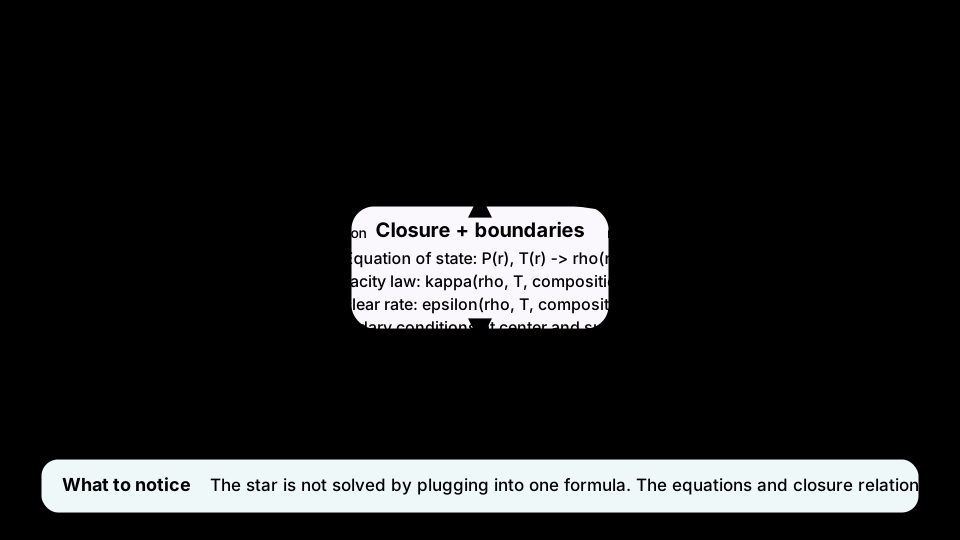
The important point is that the structure equations are not independent recipes. Each equation needs quantities that are determined by the others, so the solution must be self-consistent. A star is not defined by numbers — it is defined by a solution.