The Stellar Blueprint
Section 6 of 8
When Radiation Fails
Part 5: When Radiation Fails — Convection
The radiative-transport equation does more than tell us how energy flows. It also tells us when radiation is no longer able to carry the required luminosity stably by itself. When that happens, convection can begin.
The physical idea
Imagine a small blob of gas displaced upward inside a star. As it rises, the pressure around it drops. The blob expands and cools. Now compare two temperature gradients:
- the
adiabatic gradient - the
radiative gradient
Adiabatic gradient
The temperature gradient a gas parcel follows as it rises and expands without exchanging heat with its surroundings. It sets the cooling rate of a displaced parcel and is the stability reference in the Schwarzschild criterion.
Radiative gradient
The temperature gradient the background star would need if radiative diffusion alone carried the local luminosity. It steepens with high opacity, high density, high luminosity, low temperature, or small radius — and when it exceeds the adiabatic gradient, convection sets in.
If the surroundings cool more rapidly than the blob does, then the blob remains warmer and less dense than its environment. It stays buoyant and continues to rise. That is
Convective instability
The condition under which a displaced gas parcel keeps rising instead of returning: when the radiative gradient is steeper than the adiabatic gradient, the surroundings cool faster than the parcel, so it stays buoyant. It is the onset criterion for convection, captured formally by the Schwarzschild criterion.
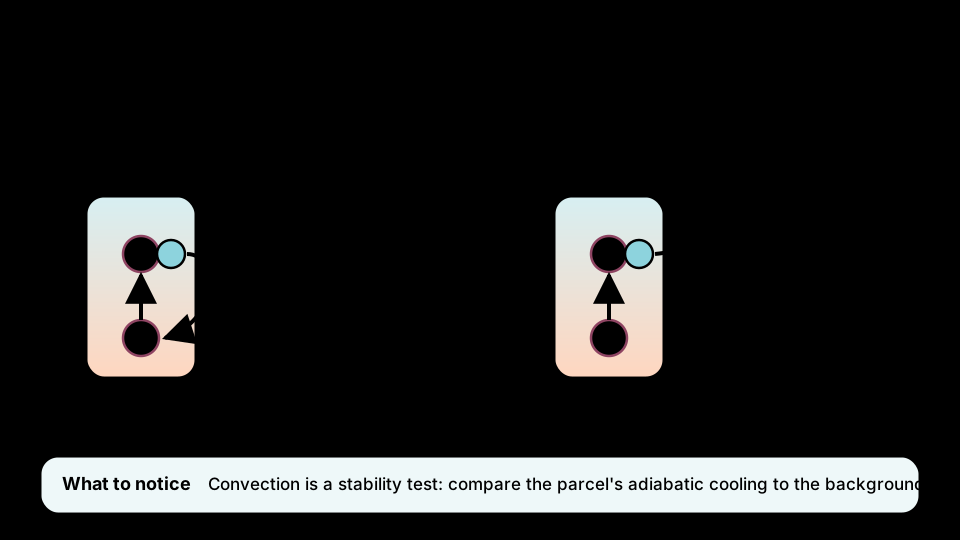
This is why convection is a stability problem, not just the slogan “hot gas rises.” What matters is the comparison between the parcel’s adiabatic cooling and the background radiative gradient. The question is not “is the gas hot?” The question is “does the environment cool faster than the parcel?”
The Schwarzschild criterion
The standard criterion is written in logarithmic form using the
Schwarzschild criterion
The condition for convective instability in a chemically homogeneous layer: convection occurs where the radiative gradient exceeds the adiabatic gradient, , with . Below threshold the layer stays radiative; above it, a displaced parcel remains buoyant and convection carries the energy.
At the level of physical intuition, this means the radiative temperature drop is too steep for stability, so a displaced parcel remains buoyant instead of returning to its original position. In words:
- if radiation can carry the luminosity with a gentle enough gradient, the region stays radiative,
- if radiation would require too steep a gradient, convection begins.
Why compare gradients per unit pressure instead of per unit radius? A displaced parcel matches the pressure of its new surroundings almost instantly — pressure equilibrates at the sound-crossing time, long before heat can leak across the parcel. At a fixed depth the parcel and the background therefore sit at the same , so recasting the gradient in the dimensionless form divides out the hydrostatic structure they share and isolates the one thing that decides stability: how the parcel’s temperature responds to pressure compared with the background’s.
What makes the radiative gradient steep?
From the radiative-transport equation, that same radiative gradient — written here in its un-normalized form — scales as
So the radiative gradient becomes steeper when opacity is high, density is high, luminosity is high, temperature is low, or radius is small. That already suggests two places where convection might appear:
- cool, opaque outer layers, where radiation struggles to get through,
- very luminous cores, where too much energy must pass through a small area.
Three main-sequence interior regimes
1. Very low-mass stars: often fully convective
At the lowest main-sequence masses, the combination of cool temperatures, high opacity, and structural properties can make convection efficient throughout most or all of the star. Result: many stars below roughly are close to fully convective.
2. Solar-like stars: radiative cores and convective envelopes
For stars like the Sun, the core is hot and fully ionized, so the opacity is relatively low and radiation can carry the energy without requiring an unstable gradient. But the outer envelope is cooler and more opaque. There, radiative transport becomes inefficient and convection takes over. Result: stars of roughly solar mass typically have radiative cores and convective envelopes.
3. Higher-mass stars: convective cores and radiative envelopes
In more massive stars, the core temperature becomes high enough that the CNO cycle dominates hydrogen burning. The CNO cycle is much more temperature-sensitive than the pp chain, so energy generation becomes strongly concentrated toward the center. That concentrates a large luminosity into a small inner region, making the required radiative gradient very steep. The core becomes convective. Meanwhile, the envelope is hot and relatively transparent, so radiation can often carry the energy there. Result: stars above roughly to typically have convective cores and radiative envelopes.
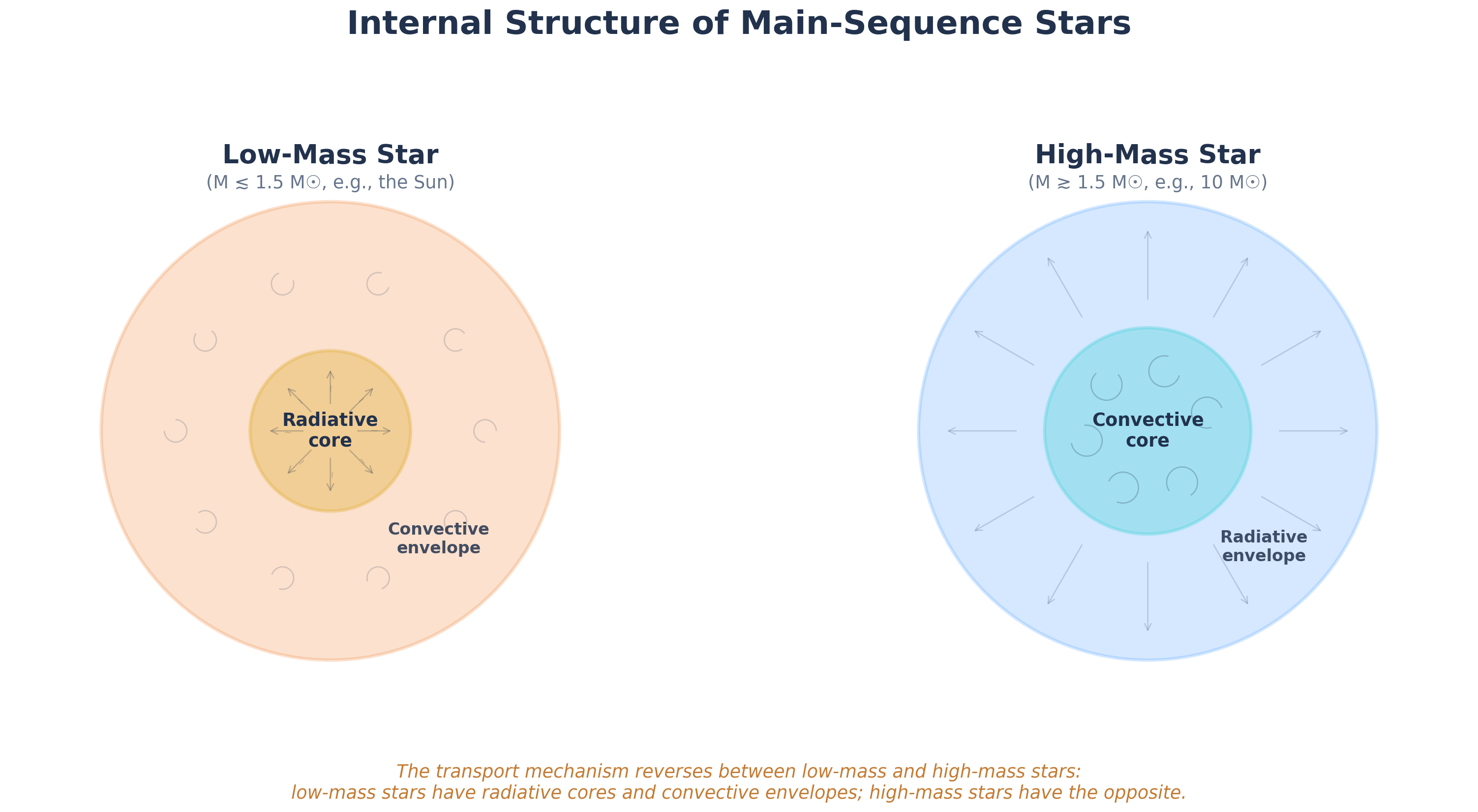
This schematic compares the solar-like and high-mass archetypes. The very lowest-mass main-sequence stars are a third regime: many are nearly fully convective and are therefore not represented by the Sun-like panel.
Multiple choice
Using , which change in an outer envelope is more likely to trigger convection?
Increasing the opacity makes radiative transport less efficient, so the required radiative temperature gradient becomes steeper. That pushes the star closer to convective instability. Decreasing the opacity makes radiative transport easier, so the required gradient becomes shallower and convection becomes less likely.