Distance & Parallax
Section 4 of 7
Parallax
Part 4: Parallax — Distance from Baseline Geometry
Now we apply the small-angle formula to the most direct distance technique: parallax — use a long baseline and measure the angular shift of a nearby object against fixed background objects.
The Parallax Angle
Hold your finger at arm’s length and blink between eyes: it shifts against the background, and the farther away it is, the smaller the shift. That’s parallax. The geometry is the small-angle formula with the baseline playing the role of “size,” the parallax angle playing “angle,” and the distance what we want. Substituting and solving:
Here is the baseline, the parallax angle (radians), and the distance in the same units as . This works for any baseline and any observer.
The distance you can probe is set by the baseline: your eyes ( cm) give depth perception to a few meters; Earth’s orbit ( AU) makes stellar parallax possible; a larger baseline reaches proportionally farther at the same angular precision. The physics is always — only the baseline changes.
Stellar Parallax: Earth’s Orbit as Baseline
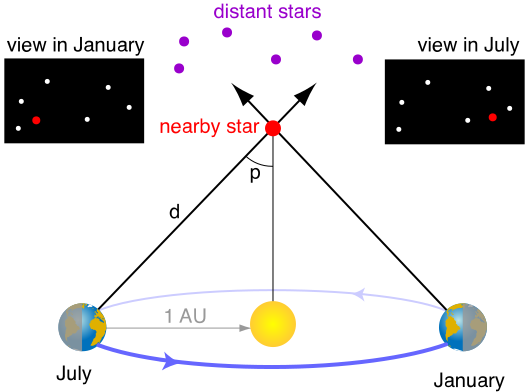
As Earth moves from one side of the Sun to the other, a nearby star shifts against the distant background. We define the
Parallax angle
The apparent angular shift of a nearby star as Earth orbits, defined as half the total six-month shift — the angle Earth’s 1 AU orbital radius subtends as seen from the star. Measured in arcseconds.
From General Parallax to the Parsec
Substituting Earth’s baseline AU and converting to arcseconds gives . Astronomers then define a unit to make this clean: one
A star with is at 2 pc; is at 10 pc. The name “parsec” is parallax-arcsecond — it works only because Earth’s 1 AU baseline and the arcsecond are baked into the definition.
Parsec
The distance at which a star shows a parallax of (with Earth’s 1 AU baseline): light-years. The natural unit for stellar distances.
For reference: cm light-years, and kpc pc.
Problem
Proxima Centauri, the nearest known star, has parallax . Find its distance in parsecs and centimeters.
StepApply the parsec form
StepConvert to CGS
Dimensional check
gives pc by the definition of the parsec; pc (cm/pc) leaves cm ✓.
Result
pc cm. Sanity check: nearby stars fall in the 1–5 pc range ✓. Its parallax was barely measurable from the ground — which is why parallax was historically so hard.
A nearby star's position shifts as Earth orbits
Over a year a nearby star traces a tiny ellipse against the fixed background; its semi-major axis is the parallax angle , measured in arcseconds.
Parallax geometry (small-angle, 1 AU baseline)
Earth’s 1 AU orbital radius subtends at the star, so — specialized to arcseconds and parsecs, .
The star's distance — purely geometric
Inverting gives the distance with no assumption about the star itself: the foundation rung of the cosmic distance ladder.
Numeric answer
Estimate the parallax angle for a star at 1000 pc.
milliarcsecond — right at the Hipparcos limit, well within Gaia’s reach.