Distance & Parallax
Section 3 of 7
Small-Angle Geometry
Part 3: Geometric Foundations — The Small-Angle Approximation
We need a relationship connecting angular size, true size, and distance.
The Geometric Picture
Consider an observer at distance from a small object of true size , which subtends an angle . Drawing the triangle, for small angles the arc subtended by the object’s edge is approximately its true size, and the arc’s radius is the distance.
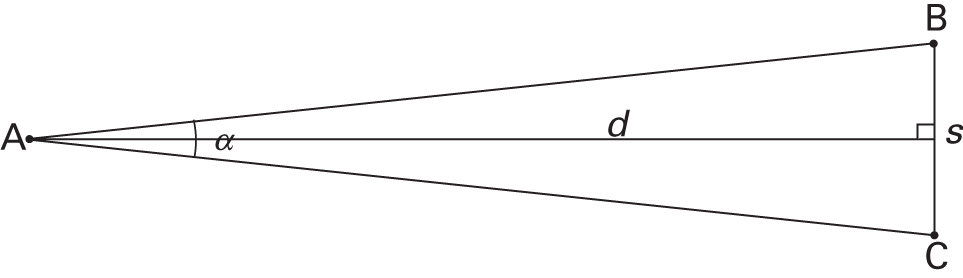
By the definition of angle in radians, . This is the
Angular size is inversely proportional to distance: a distant object appears small, a nearby one large. The angle must be in radians for the formula to work without a conversion factor.
Small-angle approximation
For small angles ( rad), , giving the clean geometric relation between physical size, angular size, and distance.
Numeric answer
The Moon subtends about ; its distance is cm. Estimate its true diameter.
rad. Then km — within ~4% of the true 3,474 km. ✓
The approximation holds while rad (roughly 5–6 degrees); beyond that, use the exact trigonometry. In astronomy we rarely exceed a degree, so it’s superb for parallax, galaxy sizes, and telescope resolution.