Distance & Parallax
Section 7 of 7
Standard Candles and Synthesis
Part 7: Standard Candles — A Preview
Parallax reaches ~100 pc from the ground, ~10 kpc with Gaia — too close for most of the Milky Way, let alone other galaxies. Beyond that, we invert the inverse-square law: if we know a source’s intrinsic luminosity, we measure its flux and infer distance, . Such objects of known luminosity are
Problem
A Cepheid has known (from its pulsation period) and measured . Find its distance.
StepInvert the inverse-square law
Dimensional check
✓.
Result
cm Mpc — well beyond the Milky Way, in a nearby galaxy, far past parallax reach.
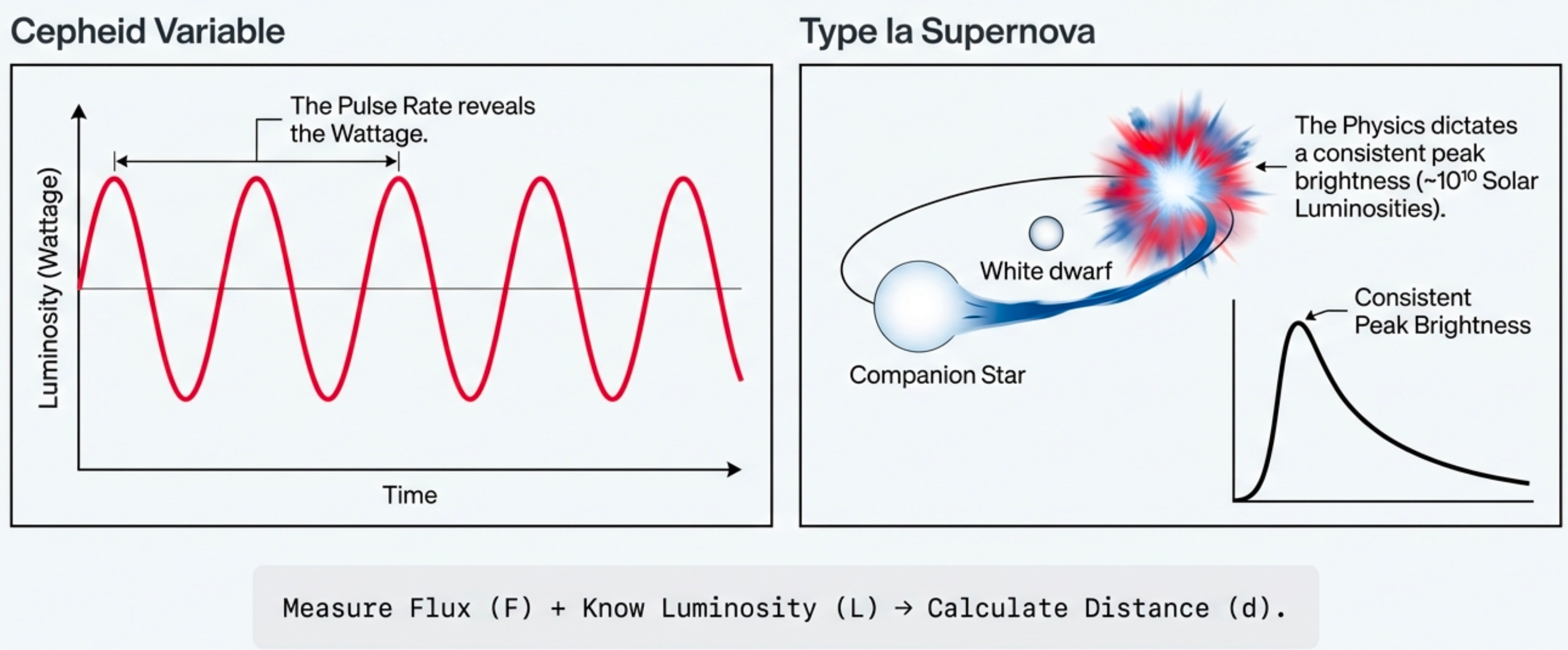
Cepheid variables pulsate over days to months; Henrietta Leavitt (1912) found that pulsation period tracks luminosity, so measuring the period gives . Hubble used Cepheids in Andromeda in the 1920s to prove it is a separate galaxy. Type Ia supernovae — thermonuclear explosions of white dwarfs — reach a consistent peak ( a few ), making them standard candles to cosmological distances; in 1998 they revealed the accelerating expansion (dark energy, 2011 Nobel Prize).
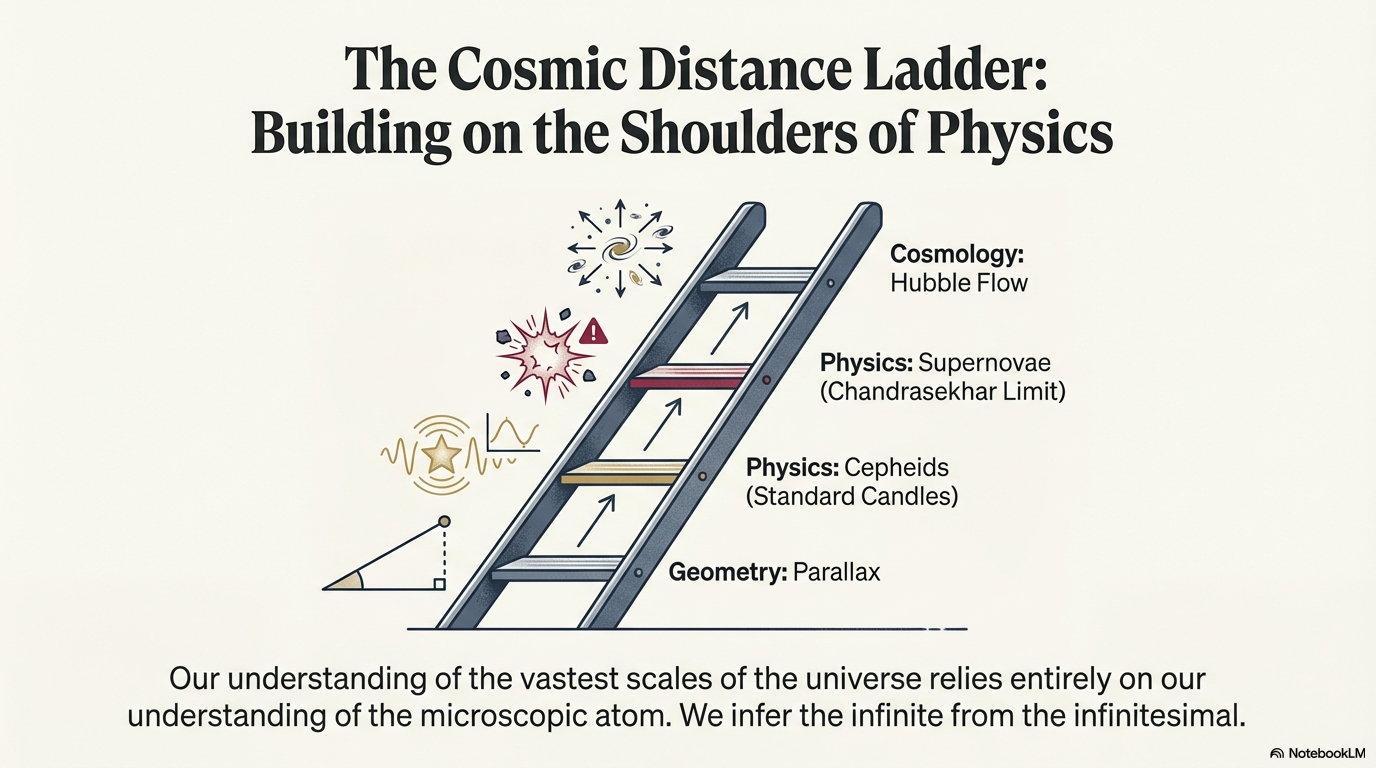
The cosmic distance ladder chains the methods: parallax (geometry) calibrates nearby Cepheids; Cepheids calibrate Type Ia supernovae; each rung rests on the one below. The entire cosmic distance scale ultimately rests on getting nearby parallaxes right — which is why Gaia’s improvement rippled through all of cosmology.
Summary: Observable → Model → Inference
| Goal | Observable | Model | Inference |
|---|---|---|---|
| Distance | Position shift across the sky (arcsec) | Parallax: | Distance in pc and cm |
| Luminosity | Measured flux (photometry) | Inverse-square law | |
| Distance (reversed) | Flux + known luminosity (Cepheid period) | Standard-candle relation |
Each step has assumptions: parallax assumes Earth’s orbit is known; the inverse-square law assumes isotropic emission and no absorption; standard candles assume correct calibration. Good science always asks: what could go wrong?
Two stars have exactly the same apparent brightness in your telescope. Must they have the same luminosity?
No. Equal flux only means equal . A nearby faint star and a distant luminous one can share the same apparent brightness — you need the distance (e.g., from parallax) to break the degeneracy and recover luminosity.
Looking Ahead
This lecture gave you distance and luminosity — one axis of the HR diagram. Next (Surface Flux & Colors) we apply thermal physics (Stefan-Boltzmann, Wien) to get effective temperature and radius; later lectures add composition (spectra), mass (binary orbits), and the magnitude system, before we assemble the full HR diagram.
Glossary
- Arcsecond
An angular unit equal to of a degree (or of an arcminute) — the standard unit for stellar parallax. It measures angle, never distance.
- Hertzsprung-Russell diagram
A plot of stellar luminosity (vertical axis, logarithmic) versus effective temperature (horizontal axis) that reveals stellar properties and evolutionary states. Building it requires knowing luminosity — which requires distance.
- Parallax angle
The apparent angular shift of a nearby star as Earth orbits, defined as half the total six-month shift — the angle Earth’s 1 AU orbital radius subtends as seen from the star. Measured in arcseconds.
- Parsec
The distance at which a star shows a parallax of (with Earth’s 1 AU baseline): light-years. The natural unit for stellar distances.
- Radian
The natural (dimensionless) angle unit: the angle subtended by an arc whose length equals the radius, so angle = arc length / radius. A full circle is rad, and .
- Small-angle approximation
For small angles ( rad), , giving the clean geometric relation between physical size, angular size, and distance.