Tools of the Trade
Section 4 of 5
Order-of-Magnitude Estimation
2.4 Tool 4: Order-of-Magnitude Estimation
You Already Do This
“Can I drive there before dinner?” You estimate: distance about 50 miles, speed about 50 mph, time about 1 hour. No calculator, and good enough. That is order-of-magnitude reasoning — and it is essential in astronomy.
Why It’s Essential
Astronomical numbers span more than 40 orders of magnitude:
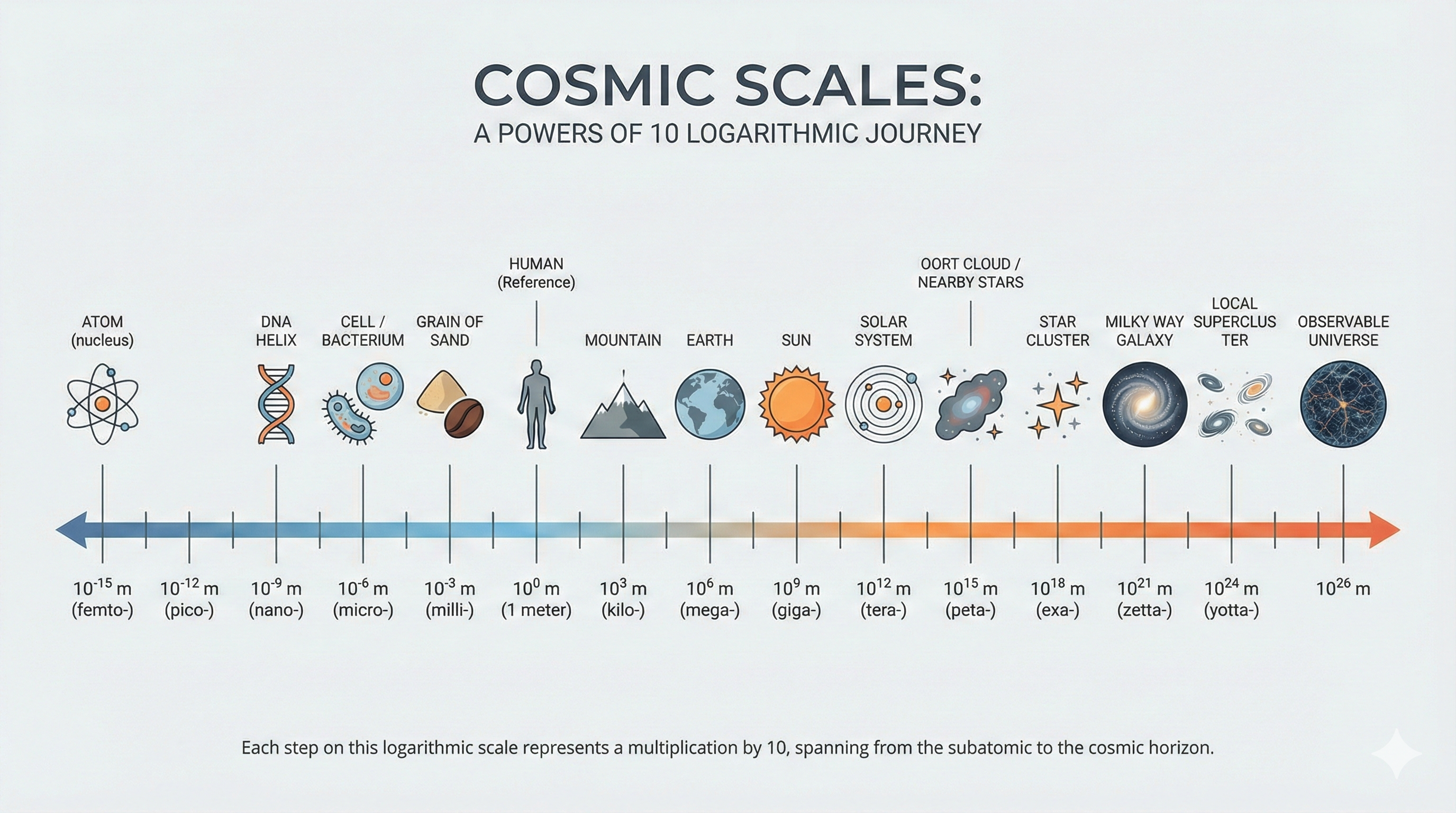
| Scale | Size (cm) | What |
|---|---|---|
| Atomic nucleus | Where fusion happens | |
| Visible wavelength | What we detect | |
| Solar radius | A typical star | |
| 1 parsec | Distance scale | |
| Observable universe | Cosmic horizon |
Exact precision can hide the physics. Off by a factor of 2? A triumph. Off by ? Something is fundamentally broken.
Order of magnitude
A power of 10. Two quantities are “within an order of magnitude” of each other when their ratio falls between 0.1 and 10.
The “Rule of 3”
When estimating, collapse each coefficient to the nearer power of ten: a coefficient below 3 rounds down to 1; above 3, up to 10. So and . Working to an
The Universe’s “Phone Number”
Here is a mnemonic for cosmic scales — the number 555-711-2555, where each digit is a number of factors of ten:
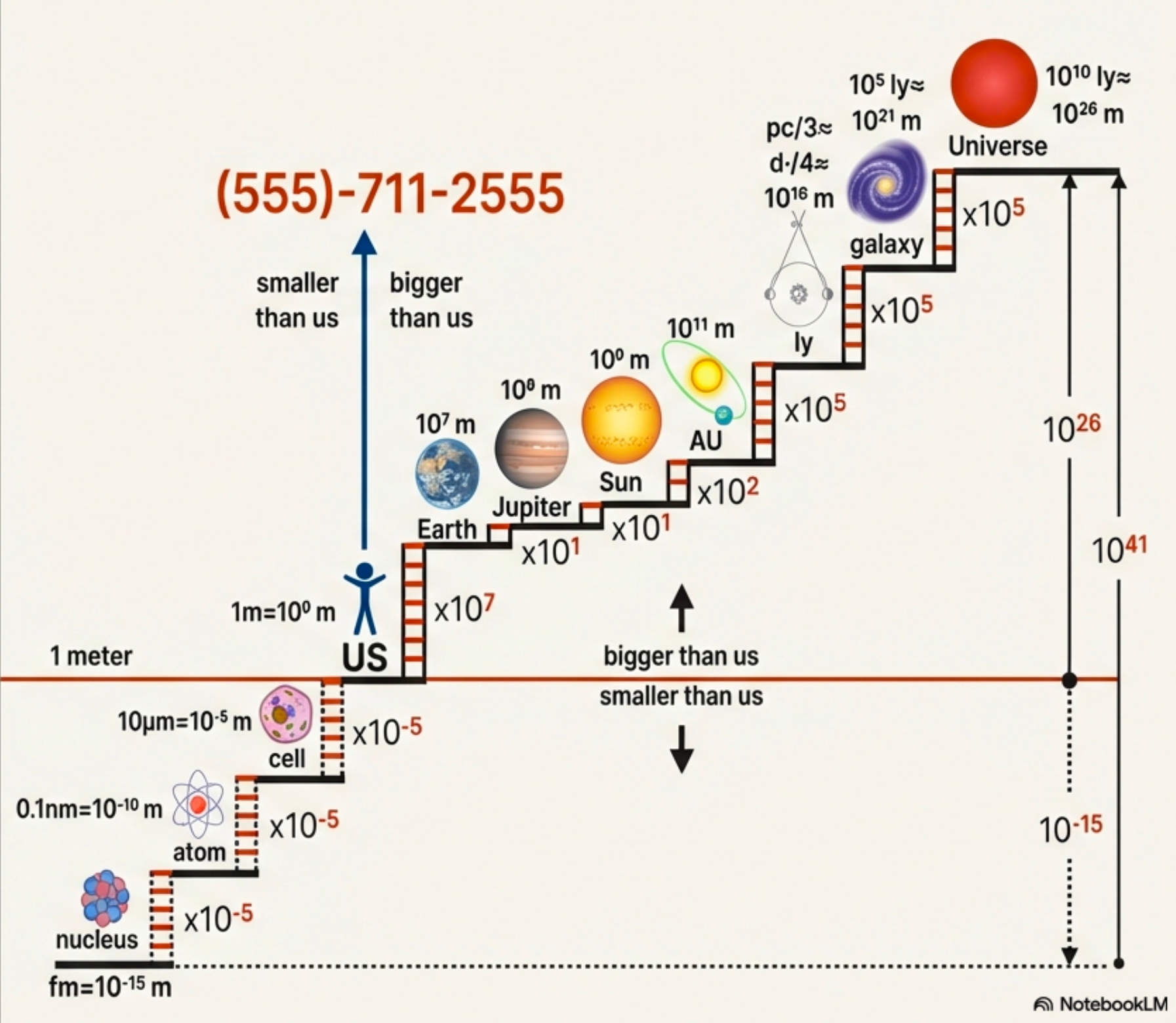
- 555 (area code) — three steps down from human scale: human → cells (), cells → atoms (), atoms → nucleus ().
- 711 (exchange) — solar-system scales: human → Earth (), Earth → Jupiter (), Jupiter → Sun ().
- 2555 (subscriber) — the cosmos: Sun → 1 AU (), AU → nearest stars (), nearest stars → Milky Way (), Milky Way → observable universe ().
A Classic Fermi Problem: Piano Tuners in Chicago
How many piano tuners work in Chicago? Estimate the pieces and chain them: population , roughly one piano per ten households gives pianos, each tuned about once a year, and one tuner handles tunings a year. Then
A reasonable ballpark, with no exact data anywhere.
Fermi estimation
Order-of-magnitude estimation that chains together rough guesses for unknown quantities to reach a defensible ballpark for something you could never look up directly.
This is
Problem
We claimed a black hole has km. Verify the order of magnitude with , rounding every input.
StepRound the ingredients (CGS)
, g, cm/s.
StepCombine
.
Dimensional check
The combination is , whose dimensions we already showed are — so the result is a length ✓.
Result
km against an exact 3 km — off by a factor of 3, i.e. within an order of magnitude. That is OOM success.
Estimate the Schwarzschild radius of Sgr A*, the Milky Way’s central black hole, with mass .
Since , scale from the value: km — about 17 solar radii, or roughly 0.08 AU, well inside Mercury’s orbit.