Tools of the Trade
Section 5 of 5
Connecting the Toolkit
2.5 Connecting the Toolkit
The Problem-Solving Flow
The four tools are not rivals — they work in sequence:
- Dimensional analysis: is this equation even physically valid?
- Ratio method: how does this compare to something I already know?
- Unit conversion: what is the numeric value in CGS?
- Order-of-magnitude check: does the answer make sense?
Dimensional analysis
The technique of checking or deriving relationships by requiring the dimensions on both sides of an equation to match. It verifies validity and recovers scaling laws — but never the pure numerical prefactor.
Run them together and your reasoning becomes hard to fool:
A Complete Workflow
Problem
Estimate the light-crossing time of the Milky Way, using all four tools in one pass.
StepSet up — and dimension-check
Time is distance over speed, .
Dimensional check
✓ — the setup yields a time before we touch a single number.
StepIdentify values
Milky Way diameter light-years; speed of light ly/yr (true by the definition of the light-year).
StepCompute by ratio
— the light-year units cancel cleanly.
StepOOM sanity check
Light crosses 1 ly in 1 yr; the galaxy is ly across; so yr is exactly the right ballpark.
Result
About 100,000 years. Converting to CGS seconds, s.
Summary: Your New Superpowers
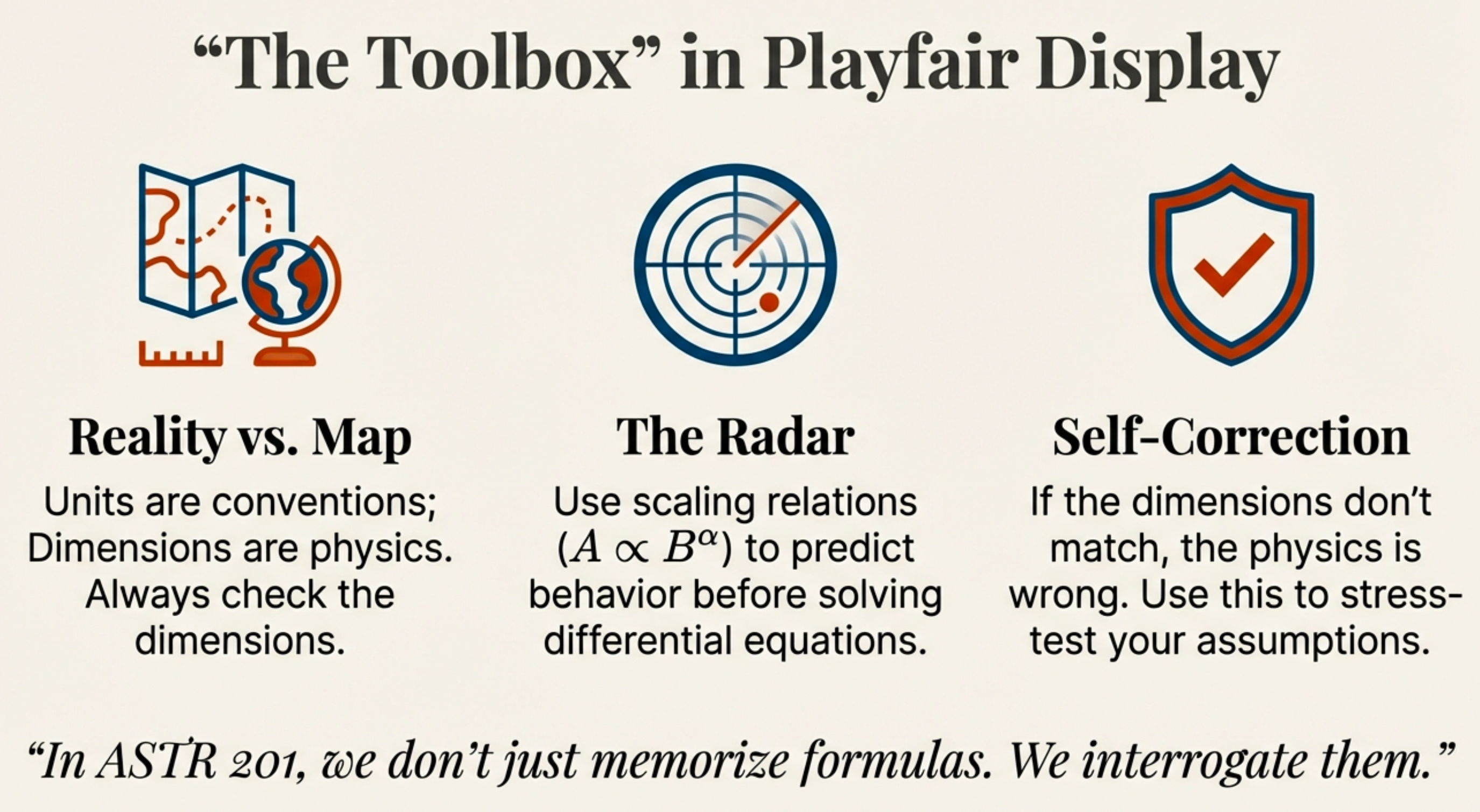
| Tool | Question It Answers | Key Insight |
|---|---|---|
| Dimensional Analysis | Is this equation physically valid? | Dimensions must match on both sides |
| Ratio Method | How does this compare to something known? | Constants cancel; the scaling tells the story |
| Unit Conversions | What is the value in CGS? | Multiply by 1; cancel units like variables |
| OOM Estimation | Does this answer make sense? | Exponents matter; coefficients are refinement |
The Workflow
- Before calculating: check dimensions.
- When comparing: use ratios.
- When computing: convert to CGS.
- After getting an answer: run an order-of-magnitude sanity check.
What You Can Now Do
With nothing but these four tools, you can derive how orbital period scales with distance (Kepler’s third law), estimate a black hole’s size from first principles via the
Schwarzschild radius
The radius of a non-rotating black hole’s event horizon, . Dimensional analysis recovers the scaling; general relativity supplies the factor of 2.
Light from the Sun takes 8.3 minutes to reach Earth. Roughly how far away is the Sun, in cm? (This is essentially the definition of 1 AU — use it as a sanity check.)
Distance speed time cm — which is 1 AU, exactly as expected.
Glossary
- CGS
The centimeter–gram–second system of units, standard throughout astrophysics. Derived units include the erg (energy) and dyne (force).
- Dimension
The physical nature of a quantity — what kind of thing it is (length, mass, time, …). Dimensions are invariant; units are conventions.
- Dimensional analysis
The technique of checking or deriving relationships by requiring the dimensions on both sides of an equation to match. It verifies validity and recovers scaling laws — but never the pure numerical prefactor.
- Event horizon
The boundary beyond which nothing — not even light — can escape a black hole’s gravitational pull. Its radius is the Schwarzschild radius.
- Fermi estimation
Order-of-magnitude estimation that chains together rough guesses for unknown quantities to reach a defensible ballpark for something you could never look up directly.
- Order of magnitude
A power of 10. Two quantities are “within an order of magnitude” of each other when their ratio falls between 0.1 and 10.
- Ratio method
Comparing quantities by division rather than subtraction, so that shared constants cancel and only the physically meaningful scaling survives.
- Scaling relationship
A proportionality showing how one quantity depends on another, . The exponent carries the physics: when , small changes in the input drive large changes in the output.
- Schwarzschild radius
The radius of a non-rotating black hole’s event horizon, . Dimensional analysis recovers the scaling; general relativity supplies the factor of 2.
- Scientific notation
Expressing a number as with . Arithmetic reduces to adding, subtracting, or multiplying the exponents.