The Balancing Act — Hydrostatic Equilibrium
Section 6 of 7
Estimating the Core Temperature
Part 5: Estimating the Core Temperature
Pressure is the macroscopic requirement. To finish answering our guiding question, we connect that required pressure to microscopic particle motion — and therefore to temperature. We run Reading the Math a second time, with one honest difference: there is no new derivative to approximate here. The derivative work was already spent in Part 3 getting ; now we only need two pressure estimates to agree.
① No new derivative — equate the two pressure scales. Part 3 gave the hydrostatic requirement . The ideal-gas law gives the thermal pressure the core actually supplies, . A star in balance must satisfy both, so set them equal — using the same mean density :
② Extract the scaling. Cancel one factor of and multiply by , leaving . Rearranging for gives the core-temperature scaling.
The left-hand side is the thermal-energy scale per particle; the right-hand side is the gravitational-energy scale per particle. Hydrostatic support requires these to be comparable — so gravity alone predicts a stellar core temperature of order , no nuclear physics needed.
③ Name the assumption. This pass inherits every row of the Part 3 audit — it is built on top of — and adds one of its own:
| We assumed | by replacing | What it costs |
|---|---|---|
| gas pressure dominates | , dropping | fine for the Sun; in massive stars grows and lowers the required |
The audit only ever grows: each Reading-the-Math pass stacks its assumptions on the ones before. Reading 5 collects the full stack and tests where it finally breaks.
Worked example: the Sun’s core temperature
Problem
Estimate the Sun’s core temperature from , using , , , , , and .
StepEvaluate the numerator
.
StepEvaluate the denominator
.
Dimensional check
, because . ✓
Result
. Detailed solar models give , so this stripped-down estimate is already in the correct solar ballpark — a scaling success, not an exact stellar-structure solution.
The Sun's measured mass and radius
The Sun’s mass () and radius () — both measured from binary orbits and angular size plus distance.
Hydrostatic equilibrium plus the ideal-gas picture
Combine hydrostatic equilibrium, gas-pressure dominance, the ideal-gas law, and the mean-density scaling .
A core temperature of order 10⁷ K
— about 15 million kelvin, hot enough for nuclear fusion. The temperature needed for fusion is set by gravity.
What this temperature means
A core temperature of corresponds to an average thermal energy per particle of , or about (using ). At these temperatures atoms are fully ionized, so the solar core is a plasma of free electrons, protons, and helium nuclei.
But this is still not enough thermal energy to overcome the proton–proton Coulomb barrier classically. That barrier is of order , hundreds of times larger than the typical thermal energy. So classical thermal motion alone should not allow fusion — the missing ingredient is quantum tunneling, the subject of Reading 3.
Problem
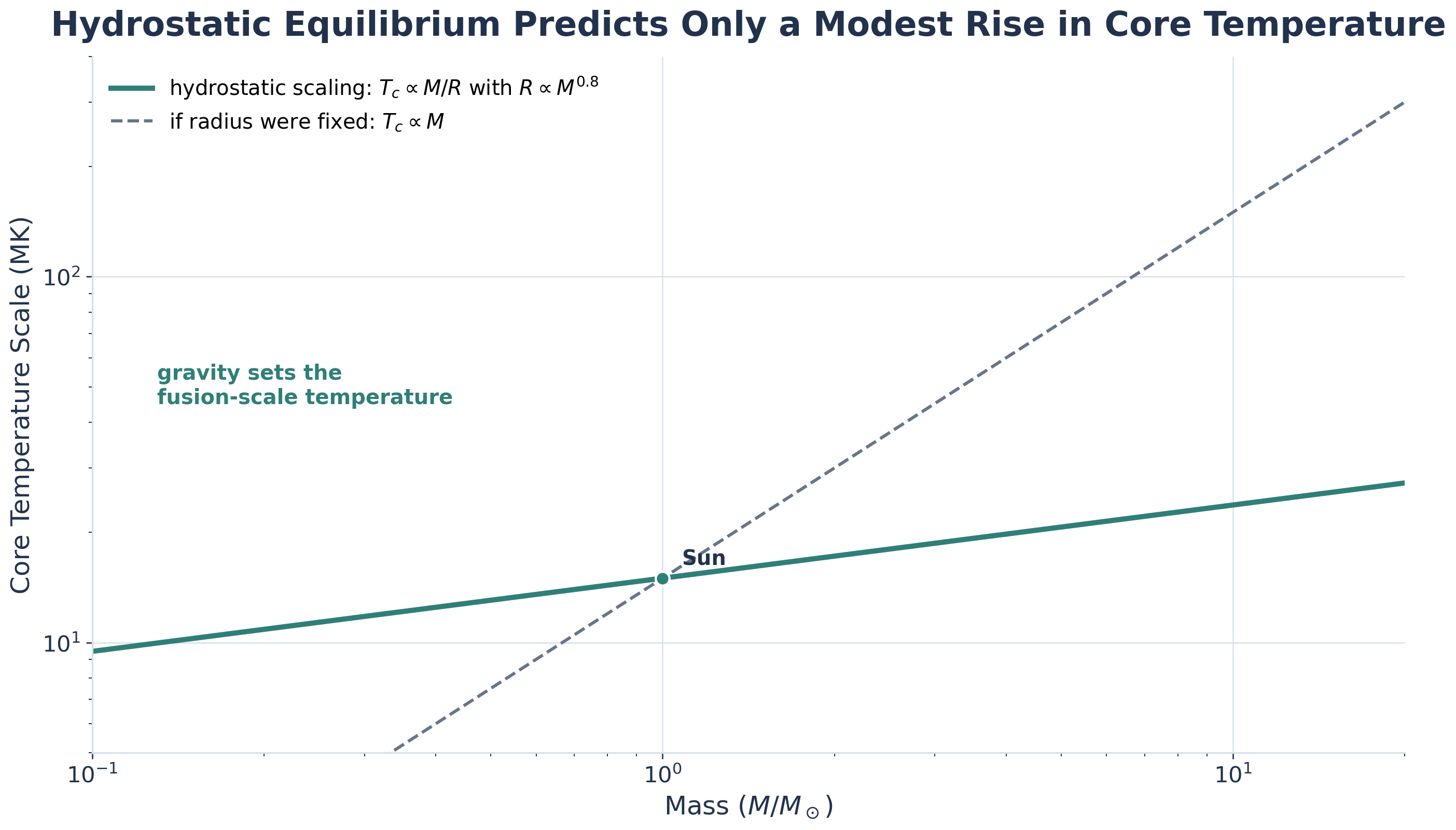
Using and the main-sequence mass–radius relation , how does core temperature scale with mass? Is a star’s core hotter or cooler than the Sun’s?
Combining with gives — core temperature increases only weakly with mass. For a star, , so its core is only about 60% hotter, . Core temperature varies surprisingly little across the main sequence because more massive stars are also larger; the enormous luminosity differences come from structure and the steep temperature sensitivity of nuclear reaction rates, not from order-of-magnitude differences in core temperature.
| Step | Physics | What it determines |
|---|---|---|
| Gravity | inward pull | |
| Hydrostatic equilibrium | pressure gradient | |
| Pressure scaling | central pressure | |
| Ideal gas | temperature | |
| Virial theorem | energy balance |