The Balancing Act — Hydrostatic Equilibrium
Section 2 of 7
Why the Sun Does Not Collapse
Part 1: Why Doesn’t the Sun Collapse?
A deceptively simple question
In Reading 1 you calculated the Sun’s
Dynamical timescale
The characteristic time for a star to respond mechanically to a force imbalance — roughly the free-fall time, . For the Sun it is about 50 minutes; departures from hydrostatic equilibrium are corrected on this timescale.
What force opposes gravity? The answer is pressure — specifically, the pressure of the hot gas inside the star. But saying “pressure holds the star up” is not quite right, and understanding why requires some care. If the balance fails, even briefly, the gas cannot remain static: some layer must accelerate inward or outward on roughly the dynamical timescale.
Pressure vs. pressure gradient
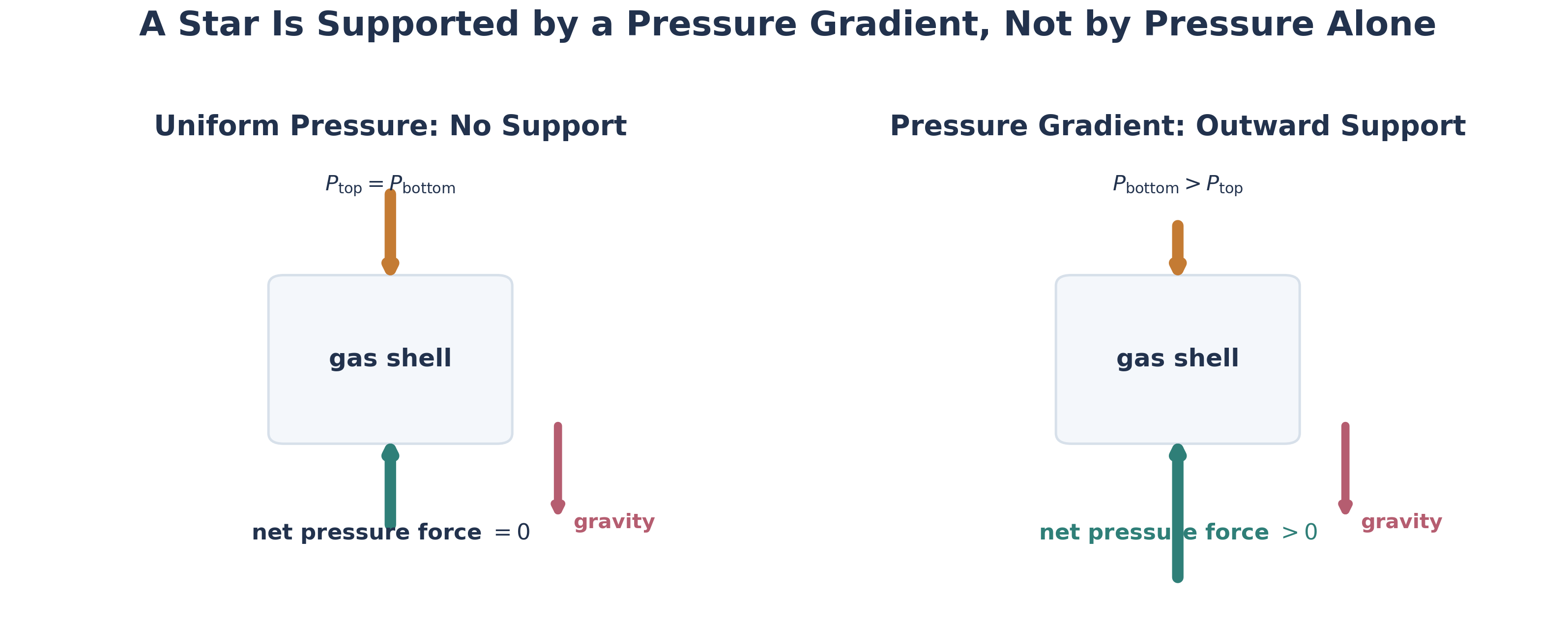
Imagine a thin shell of gas at some radius inside a star. This shell feels gravity pulling it inward and pressure pushing it from both sides — inward from the gas above and outward from the gas below.
If the pressure were the same everywhere inside the star, the inward and outward pressure forces on the shell would exactly cancel, and gravity would win unopposed. For pressure to resist gravity, the pressure below the shell must exceed the pressure above it. What matters physically is the difference in pressure across the shell:
If , then no matter how large the common pressure is. A star is supported only when the lower side pushes harder than the upper side. The physical point is that it is the pressure gradient, , not the pressure by itself, that provides the outward force.
Think first
At the bottom of a swimming pool, the water pressure is higher than at the surface. Why? Commit to a guess before reading on, then state the analogy to a star.
Hold this prediction — the answer is just below.
Quick check
Check your prediction: what makes the pressure rise with depth in the pool, and what plays the role of “depth” inside a star?
The water pressure increases with depth because each layer must support the weight of all the water above it. A star works the same way: the gas pressure increases toward the center because each layer must support the weight of all the stellar material above it. The deeper you go, the more weight there is to support, so the higher the pressure must be.
Quick check
Predict the motion of a gas shell if the pressure were extremely large but exactly uniform everywhere inside the star. Be explicit about the pressure forces and gravity.
The shell would move inward. Uniform pressure produces equal forces in opposite directions, so the net pressure force on the shell is zero. Gravity would be unopposed, and only a pressure gradient could provide outward support.
Types of pressure in stars
To say that “pressure supports a star” raises a deeper question: what physical process creates that pressure? In ordinary stars like the Sun, the answer begins with the random thermal motions of particles. In hotter, more massive stars, trapped radiation also contributes. Much later in the course, when we discuss white dwarfs and stellar remnants, we will meet a third kind of support that comes from quantum mechanics rather than temperature.
Thermal gas pressure: momentum from particle collisions
A gas is made of particles moving in many directions. When those particles strike a surface, they bounce and transfer momentum. Pressure is the rate of momentum transfer per unit area. Faster particles hit harder; more particles per cubic centimeter hit more often. That is why heating a gas or compressing it both raise its pressure. For a thermal gas, this is summarized by the ideal-gas pressure law.
In ordinary stars like the Sun, this thermal gas pressure is the main source of support against gravity: at fixed density a hotter gas pushes harder, and at fixed temperature a denser gas pushes harder.
| Symbol | Meaning |
|---|---|
| thermal gas pressure, in | |
| number density, in particles per | |
| Boltzmann’s constant | |
| temperature, in | |
| mass density, in | |
| proton mass | |
| mean molecular weight | |
| mean mass per particle |
Mean molecular weight
The average mass per particle in a gas, in units of the proton mass ( is the mean mass per particle). For fully ionized solar-composition gas ; a smaller means more particles per gram and therefore more pressure at fixed density and temperature.
For a fully ionized mixture with hydrogen, helium, and metal mass fractions , , (which satisfy ), the mean molecular weight is given below.
Hydrogen contributes one proton and one electron when fully ionized, so it gives many particles per gram; helium contributes one nucleus and two electrons packed into four nucleons, so fewer; heavier elements give fewer still. For ionized solar-composition gas (, , ) this gives , so — the value we use throughout this reading.
Multiple choice
If decreases while and stay fixed, does the gas pressure increase or decrease?
The gas pressure increases. From , a smaller gives a larger pressure at fixed and . The physical reason matters more than the algebra: if decreases, the average mass per particle decreases, so the same mass density contains more particles. More particles per unit volume means more collisions, so the momentum-transfer rate — and therefore the pressure — increases.
Temperature describes a distribution, not a single speed
Temperature does not assign one “correct speed” to every particle. It describes a distribution of particle speeds and kinetic energies. Some particles move slower than the average, some faster, and the whole distribution shifts as the gas heats up.
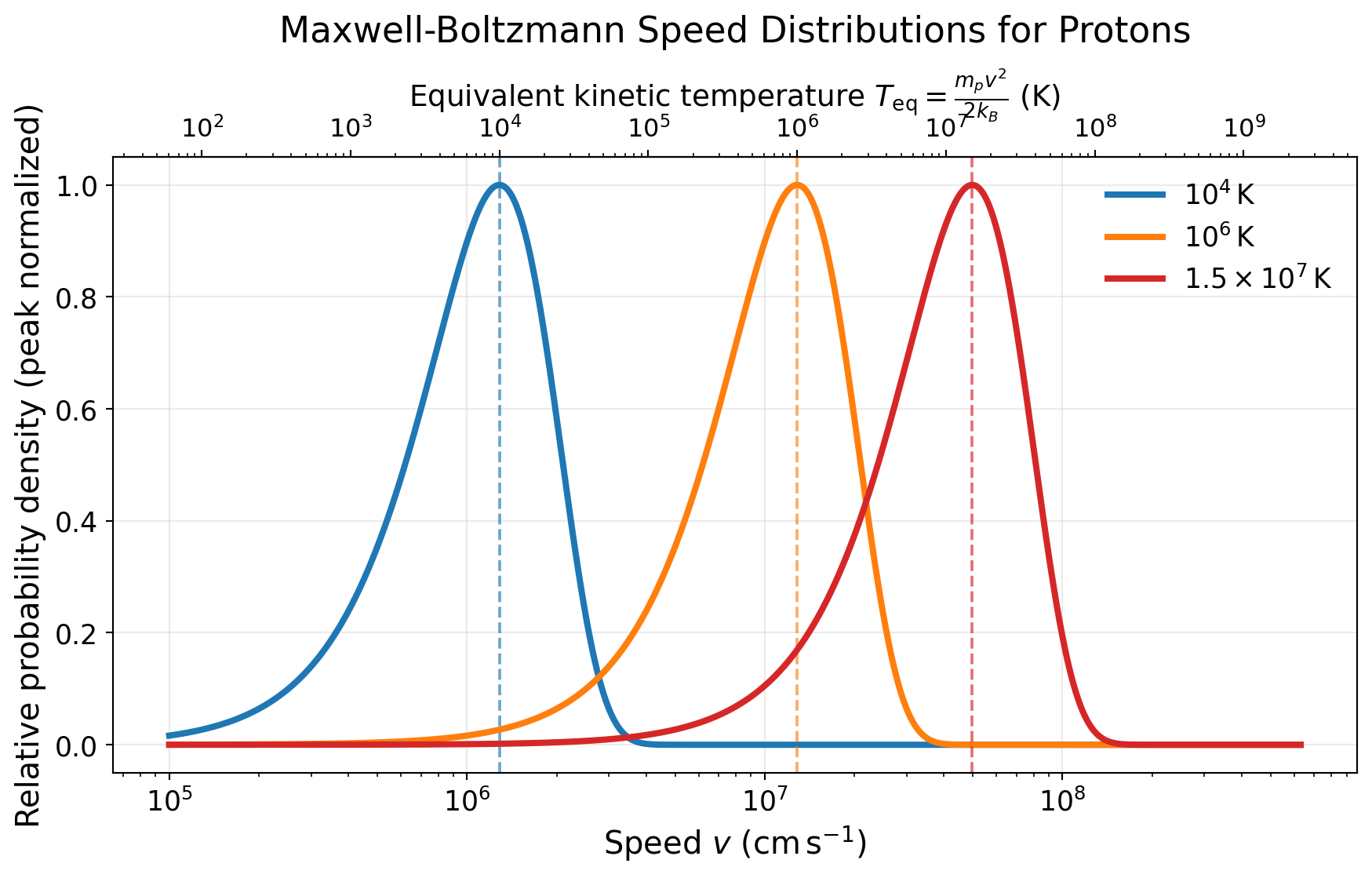
The upper axis of that plot translates speed into the single-particle kinetic-temperature scale . It is a way to compare speeds and thermal-energy scales, not a claim that all protons at temperature move at one speed.
Radiation pressure: momentum from light
Photons carry momentum even though they have no rest mass. If photons are trapped inside a star and scatter repeatedly from matter, they exert a pressure on the gas — called
Radiation pressure
The pressure exerted by a trapped, isotropic photon field, . Because it scales as while gas pressure scales as , radiation pressure grows far more rapidly with temperature and dominates only in hot, massive stars.
The important physics is the temperature dependence: while at fixed density. Radiation pressure therefore grows much more rapidly with temperature than thermal gas pressure does. For a star like the Sun, thermal gas pressure dominates; in very hot, very massive stars, radiation pressure becomes much more important.
We can make that trend explicit with a scaling argument. The ratio of the two pressures scales as
Later in this reading we estimate and . Substituting those hydrostatic scaling estimates gives
This scaling uses simplified hydrostatic estimates and ignores detailed structure and composition. It shows a trend, not exact stellar interiors.
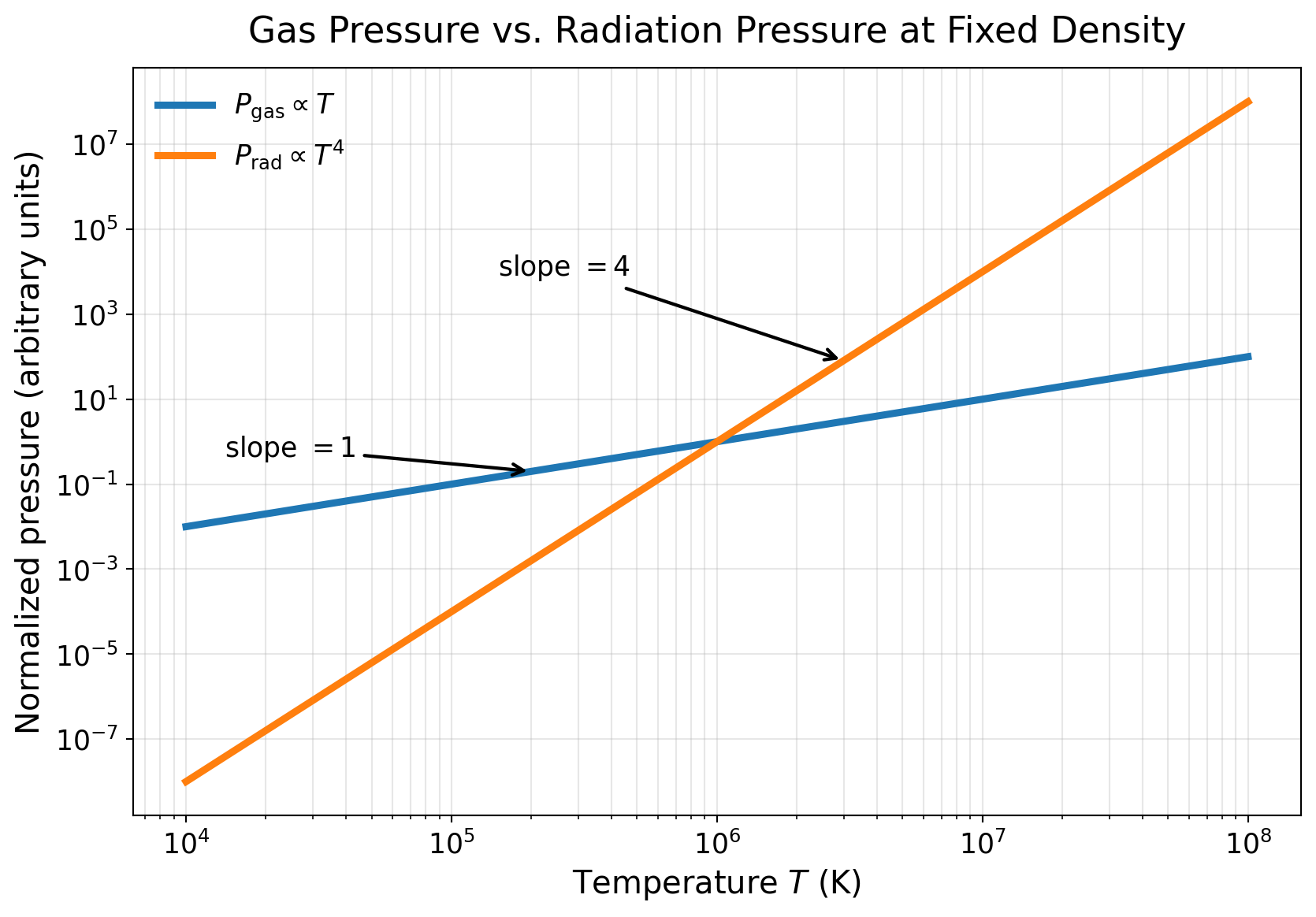
Radiative diffusion
The slow, random-walk transport of radiation through a stellar interior, where the photon mean free path is tiny compared with the stellar radius. Repeated absorption, re-emission, and scattering make the radiation field nearly isotropic and drive it toward a local blackbody spectrum.
Degeneracy pressure
A quantum-mechanical pressure arising from the Pauli exclusion principle, independent of temperature. It supports white dwarfs (electron degeneracy) and neutron stars (neutron degeneracy), and dominates at high density and low temperature.
Problem
Suppose the density stays the same but the temperature doubles. How does the thermal gas pressure change? How does the radiation pressure change? Which source becomes relatively more important in a hotter star?
For thermal gas pressure, at fixed density, so doubling gives . For radiation pressure, , so doubling gives . Radiation pressure increases much more rapidly with temperature, which is why it becomes relatively more important in hotter stars even though thermal gas pressure dominates in the Sun.