The Balancing Act — Hydrostatic Equilibrium
Section 3 of 7
Hydrostatic Equilibrium
Part 2: The Equation of Hydrostatic Equilibrium
Setting up the force balance
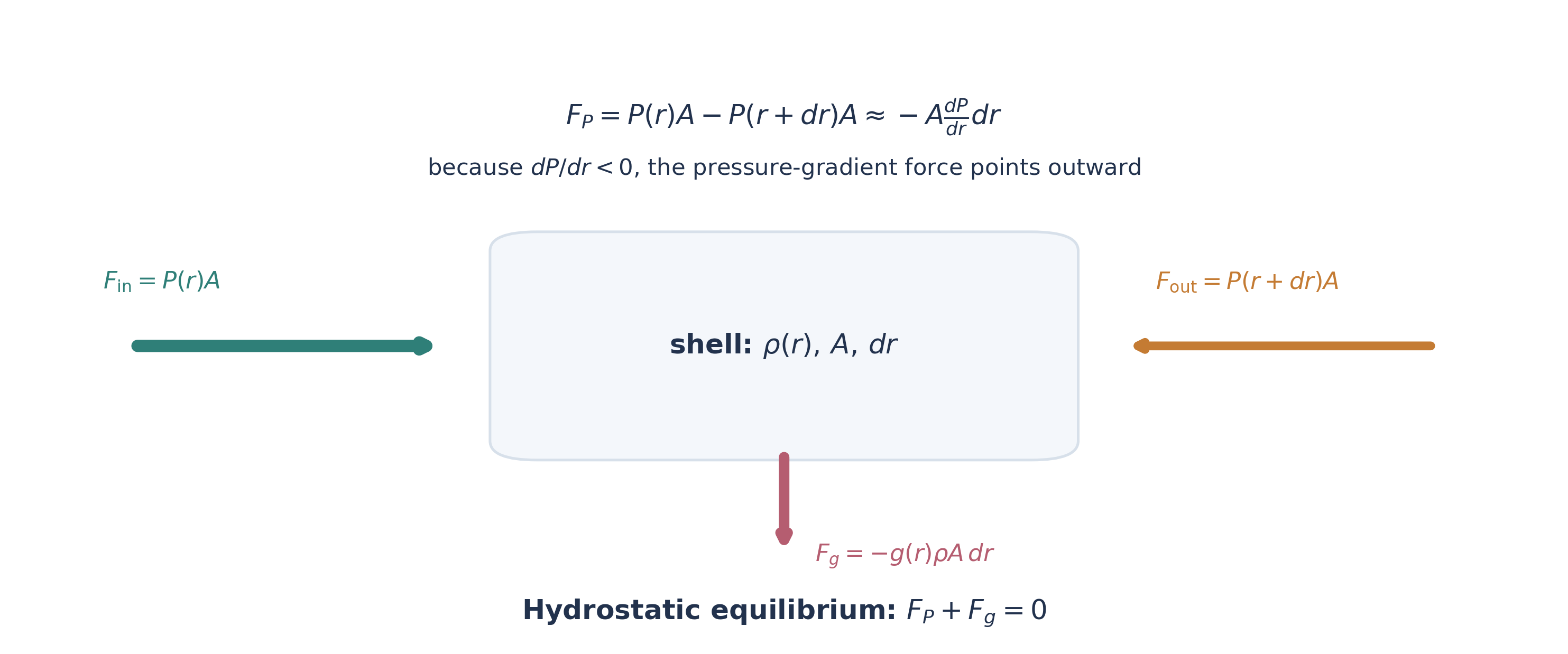
Consider a thin shell of gas at radius inside a star, with thickness , cross-sectional area , and density . Its mass is . If the inward and outward forces do not cancel, the shell accelerates — which is exactly why this equation matters: hydrostatic equilibrium is the condition for a star to remain nearly static instead of beginning a rapid global readjustment.
Two forces act on the shell in the radial direction. The pressure on the inner face pushes outward, ; the pressure on the outer face pushes inward, . The net pressure force is
Using the first-order Taylor expansion , this becomes
Because pressure decreases outward, , so the pressure-gradient force points outward. Gravity pulls the shell inward with , using . For hydrostatic equilibrium the net force vanishes, :
Dividing through by and substituting gives the equation of hydrostatic equilibrium.
Read as a sentence: at every radius inside the star, the pressure must decrease outward at exactly the rate needed to support the weight of the overlying gas. Since and , the right-hand side is negative, so must also be negative — pressure is highest at the center and falls to nearly zero at the surface. This is a local force-balance law; solving for the full structure , , needs additional equations (the subject of Reading 5).
Quick check
Classify each statement as a local law or a global scaling estimate, then say what physical question each one answers:
is a local law: it tells us how pressure must change with radius at a specific location to balance the local weight of the gas. is a global scaling estimate: it tells us the approximate pressure scale a whole star must build to support itself, using only its overall mass and radius. The first describes the detailed force balance inside the star; the second gives an order-of-magnitude inference about central conditions.
The Sun holds its size for billions of years
The Sun keeps nearly the same size for many billions of years, far longer than its -minute dynamical timescale.
Force balance on a thin shell
Treat the interior as a stack of thin shells and require the pressure-gradient force to balance gravity on each one.
Each shell satisfies dP/dr = -ρg
Each shell must satisfy . If that balance is violated, the shell accelerates inward or outward instead of staying in place.
Quick check
Hydrostatic equilibrium says everywhere inside a star. What would happen if at some radius (pressure increasing outward)? What if (uniform pressure)?
If , pressure increases outward, so the pressure-gradient force points inward, in the same direction as gravity — the gas is driven inward even more strongly. If , the pressure is uniform, so the pressure forces on a shell cancel exactly; gravity is unopposed and the star collapses on the dynamical timescale. For hydrostatic equilibrium we require everywhere: pressure must decrease outward so the net pressure force points outward and balances gravity.