The Expanding Universe
Section 2 of 6
Distance First, Then Expansion
Part 1: Distance First, Then Expansion
Imagine observing a galaxy spectrum and seeing that its lines are redshifted. That tells you the light has been stretched. But by itself, it does not yet tell you the expansion history of the universe. To discover a pattern, you need distances.
This is why the
Distance ladder
A chain of distance-measurement methods in which nearby calibrated methods support more distant methods — parallax calibrates Cepheids, Cepheids calibrate supernovae, and so on out to cosmological distances.
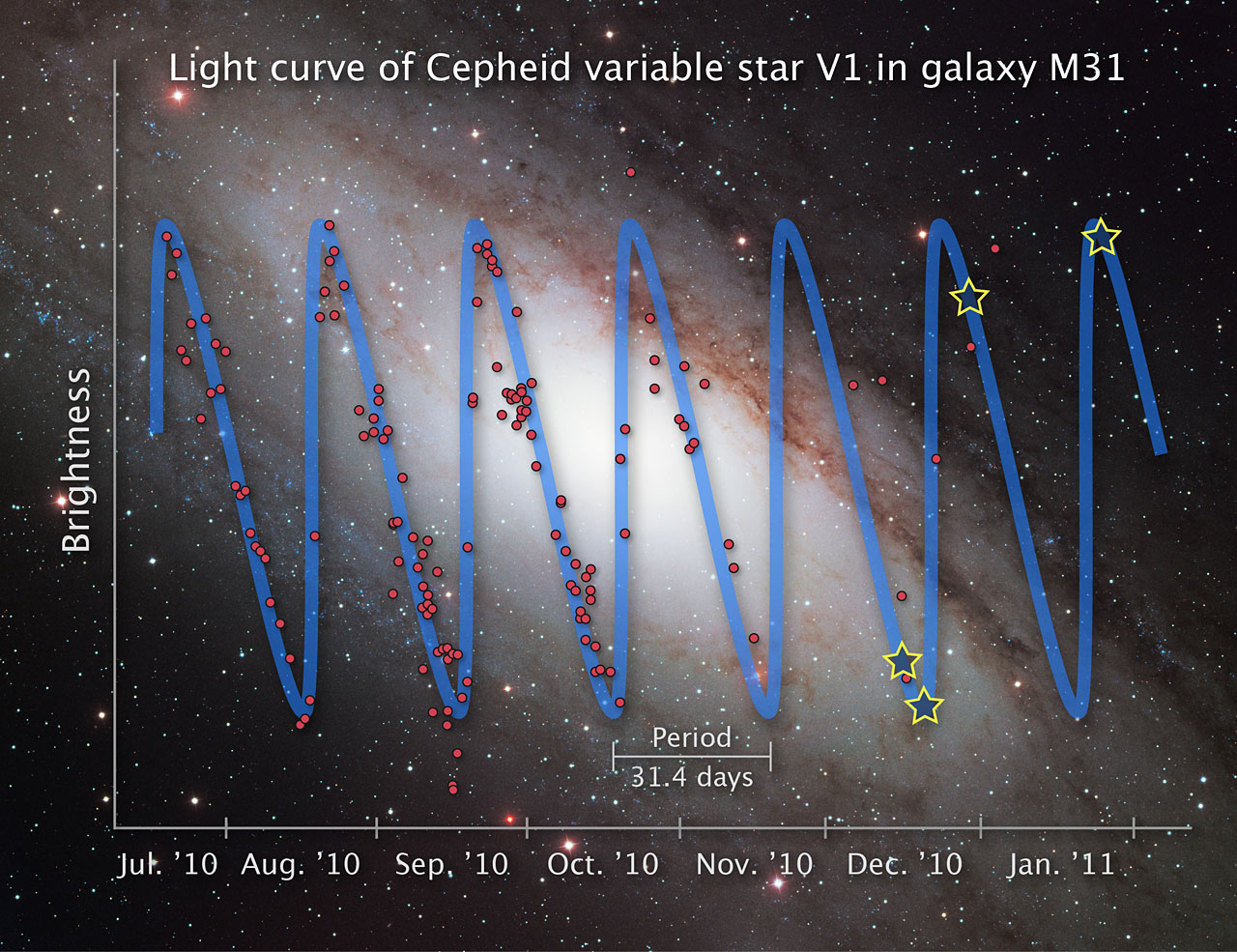
A Cepheid’s brightness rises and falls in a regular pattern. The directly measured observable is time: the pulsation period. The model is the period-luminosity relation: longer-period Cepheids are more luminous. Once we know luminosity and measure flux, the inverse-square law gives distance.
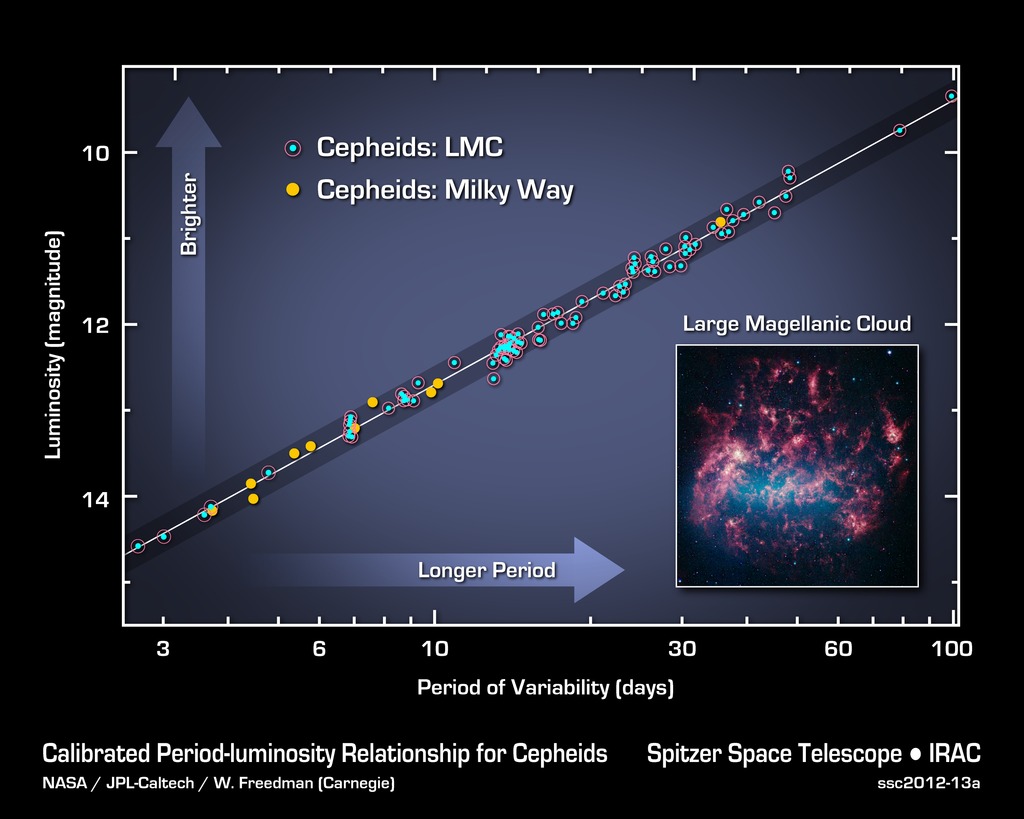
This is a beautiful example of astronomical inference. A clock-like variation becomes a luminosity. A luminosity plus a flux becomes a distance. A distance plus a redshift becomes a point on the expansion diagram.
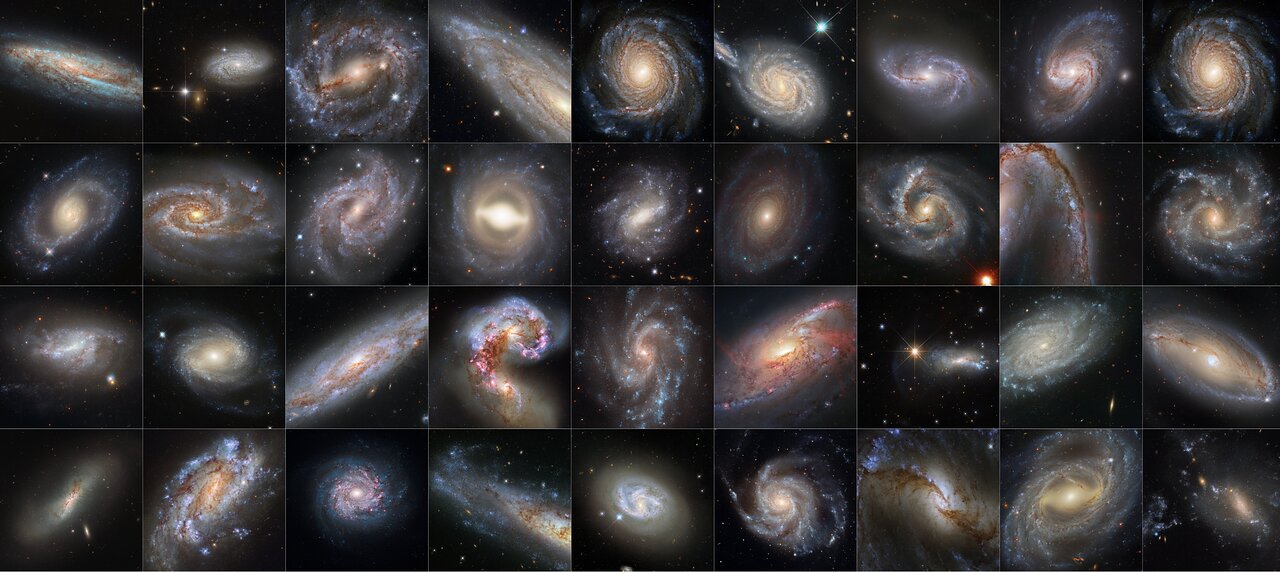
Supernova host galaxies help extend the same logic to larger distances. The important idea is not that every
Standard candle
An object whose luminosity can be inferred — a Cepheid from its period, a Type Ia supernova from its light curve — allowing distance to be estimated from the observed flux via the inverse-square law.
Quick check
Why would redshifts alone not have been enough to discover Hubble’s law?
Hubble’s law is a relation between recession speed and distance. Redshift gives the recession-speed side of the pattern, but without distances there is no way to see that more distant galaxies recede faster.