The Expanding Universe
Section 3 of 6
Hubble's Law as an Expansion Pattern
Part 2: Hubble’s Law Is an Expansion Pattern
At low redshift, the observed pattern is summarized by
Unpack it: is the recession speed inferred from redshift (usually km/s), is distance (often megaparsecs for galaxies), and is the
Hubble's law
The large-scale relation , connecting galaxy recession speed and distance at low redshift. It is the empirical signature of cosmic expansion.
Hubble constant
The present-day expansion rate in Hubble’s law, usually written in . Independent measurement chains currently disagree — early-universe methods give roughly , local distance-ladder methods roughly — a gap called the Hubble tension, an active research frontier.
This is not a rule for every object near us. The Moon is not expanding away from Earth by Hubble’s law. The Solar System is bound. The Milky Way is bound. The Local Group is bound. Hubble’s law describes the large-scale expansion pattern after local gravitational motions average out.
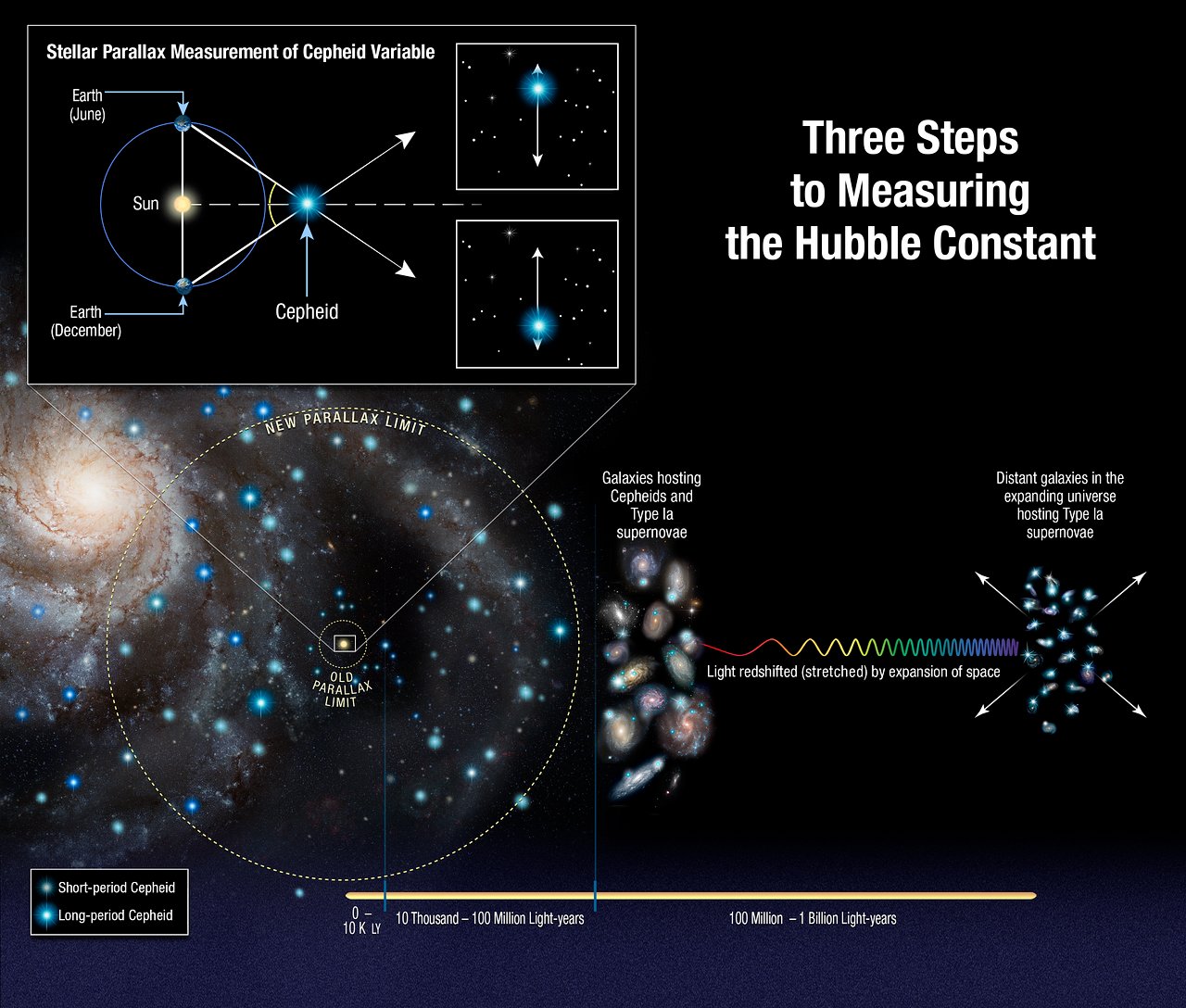
The Hubble constant can be measured in more than one way. That is powerful because independent methods test the model. It is also where modern cosmology becomes alive: when different measurement chains disagree, astronomers have to decide whether the issue is unrecognized systematic error, incomplete modeling, or new physics. The expansion rate is not just a number; it is a constraint on cosmic history — including its age.
Problem
Take . (a) A galaxy lies at ; find its recession speed. (b) Invert to estimate the age of the universe. Use and .
StepRecession speed from v = H₀ d
— about of the speed of light.
StepThe Hubble time, 1/H₀
Convert to inverse seconds: . Then .
Dimensional check
, a speed; and , a time. Both units land where they should.
Result
The Hubble time is a first estimate of the age — what you would get if the universe had always expanded at the same speed (neither slowing nor speeding up). The true age (about ) is close, but getting it exactly requires the full expansion history — how the rate sped up and slowed down — which is the next reading’s job. Keep the number; we will earn it properly in L4.
Now push the law where it surprises us.
Quick check
A student computes for a very distant galaxy and gets , then concludes the calculation must be wrong because nothing travels faster than light. What is the student missing?
The recession is the expansion of space itself, not motion through space, so it can exceed without violating relativity — relativity’s limit applies to motion through space. (Separately, at such distances the simple linear is only an extrapolation; redshift at high is read as the scale-factor stretch, not as a velocity.)
Quick check
Why does Hubble’s law work better for large-scale galaxy samples than for nearby bound systems such as the Local Group?
Nearby bound systems can have motions dominated by local gravity. Hubble’s law describes the large-scale average expansion pattern after local gravitational motions are averaged over.