Why ASTR 201 is Different
ASTR 201: Astronomy for Science Majors | Spring 2026
What This Course Actually Teaches
Most astronomy courses focus on what we know: facts about planets, stars, galaxies. This course focuses on how we know it.
You’ll learn to:
- Infer physical properties from limited data — A star’s spectrum tells you its temperature, composition, motion, even its age. But only if you know how to read it.
- Build and test physical models — Not memorize formulas, but understand why those formulas work and when they break down.
- Quantify uncertainty — Real science isn’t about right answers. It’s about knowing how confident you can be in your conclusions.
This is how professional scientists think. Observers collect data. Theorists build models. Both use math as the common language. The goal: explain why the universe behaves the way it does—not just describe what we see.
Why It Feels Different
If this course feels harder than “memorize and regurgitate,” that’s intentional.
You’ll wrestle with math. Not because math is the point, but because it’s the language that makes precise thinking possible. You can’t understand why stars shine without understanding the physics—and you can’t understand the physics without the math.
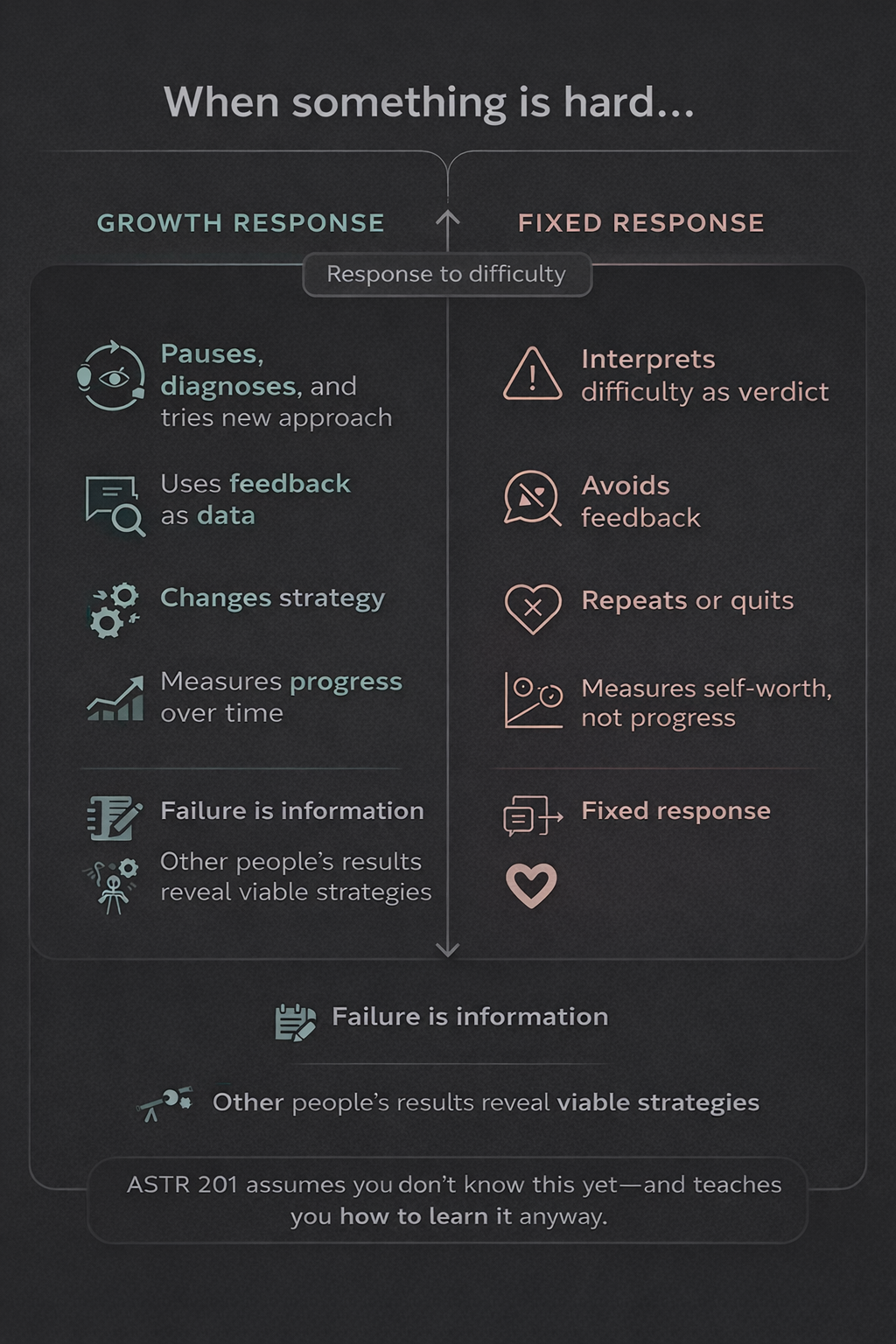
You’ll sit with confusion. Real learning happens at the edge of your understanding. If everything feels easy, you’re not growing.
You’ll reflect on your own thinking. After each homework, you’ll write a brief grade memo analyzing your work against the solutions. This isn’t busywork—it’s how you develop the metacognitive skills that separate students who get through a course from those who actually learn.
The discomfort is the point. It means your brain is building new pathways.
The Growth Mindset Payoff
This isn’t just motivational fluff — there’s evidence from cognitive science and neuroscience that effortful learning changes the brain.
Your brain physically changes when you learn hard things. When you struggle with challenging material, your brain releases proteins that strengthen neural connections. London taxi drivers who memorized the city’s 25,000+ streets showed measurable growth in their hippocampus—the brain region for spatial memory (Woollett & Maguire, 2011). Adults. Measurable brain change. From effortful learning.
Mistakes drive learning more than successes. Your brain generates stronger signals when you make errors than when you get things right. Students who view mistakes as learning opportunities show enhanced brain activity that directly predicts improved performance (Moser et al., 2011).
“Not a math person” is a myth. Research shows mathematical ability is shaped by experience and effort, not fixed at birth (Uwerhiavwe, 2022). If you’ve ever believed you’re “bad at math,” that belief was learned—and it can be unlearned.
That uncomfortable feeling when grappling with new concepts? That’s your neurons forming new connections. You’re not failing—you’re literally getting smarter.
What This Means for You
You have agency here. I’ve designed this course to maximize your growth, but I can’t do the learning for you.
Use the resources. Office hours aren’t just for crisis mode—come with questions, come to think out loud, come even if you’re not sure what to ask. The Astronomy Help Room offers free tutoring. Study with classmates.
Expect a trajectory. Early confusion → connecting concepts → building confidence → genuine understanding. Trust the process.
The effort compounds. Every problem you work through builds capacity for the next one. By semester’s end, you’ll look back and realize you’ve become a different kind of thinker.
References
Moser, J. S., et al. (2011). Mind your errors: Evidence for a neural mechanism linking growth mindset to adaptive posterror adjustments. Psychological Science.
Woollett, K., & Maguire, E. A. (2011). Acquiring “the Knowledge” of London’s layout drives structural brain changes. Current Biology.
Uwerhiavwe, O. (2022). The influence of learners’ mathematical social identities on their mathematics learning. Open Journal of Social Sciences.