Ages & Lifetimes
Section 2 of 6
Three Timescales That Govern a Star
Part 2: Three Timescales That Govern a Star
Stars are governed by three fundamental timescales, each tied to a different physical process. Their hierarchy — which is shortest, which longest — tells you what a star is doing.
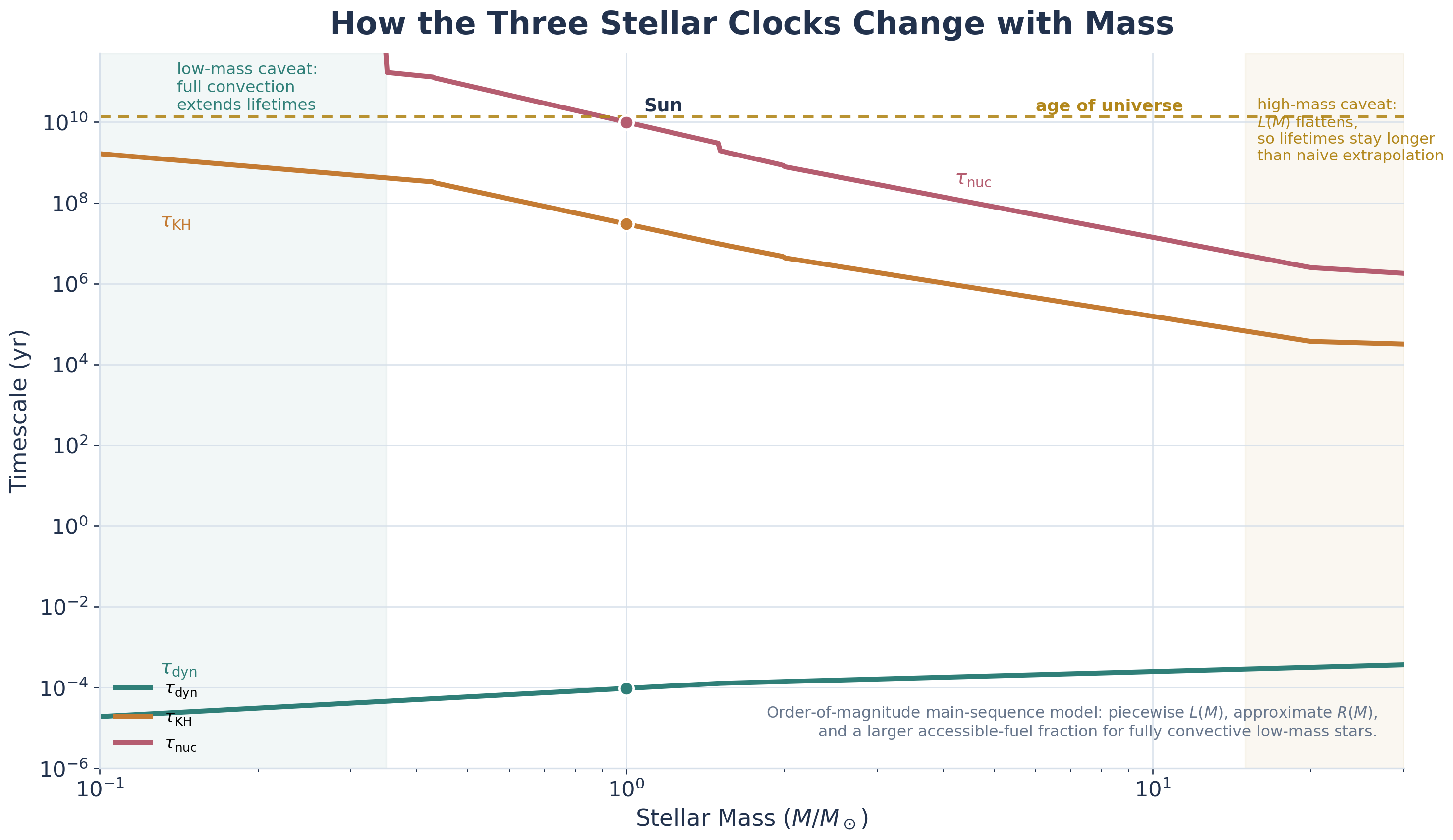
| Timescale | Question it answers |
|---|---|
| How fast would gravity rearrange the star if pressure support failed? | |
| How long could the star shine if gravity were its only long-term energy source? | |
| How long can nuclear fusion sustain the star’s luminosity? |
The Dynamical Timescale: How Fast Could a Star Collapse?
Imagine you could suddenly “turn off” all the internal pressure holding a star up. How long would it take to collapse under its own gravity? This is the
The equation is not predicting what a healthy star is doing now — it predicts how fast gravity would win if pressure support suddenly failed. (Exact free-fall calculations add numerical factors of order unity; here we keep the scaling and meaning.)
Dynamical timescale
The characteristic time for gravity to rearrange a star if pressure support failed: — about 50 minutes for the Sun. The shortest of the three stellar clocks; it sets how fast a star restores hydrostatic equilibrium after a perturbation.
Problem
The Sun’s mean density is (about 1.4× water). Estimate its dynamical timescale.
StepEvaluate inside the square root
StepInvert
Dimensional check
; the inverse square root gives seconds ✓.
Result
If pressure support were removed, the Sun would collapse in about an hour. Since it clearly is not collapsing, something holds it up — pressure. Understanding that balance is the next reading.
Problem
A white dwarf has roughly the Sun’s mass but the Earth’s radius (). Estimate its mean density and dynamical timescale. How do they compare to the Sun’s?
Density scales as , so , giving (two million times denser than water). Since , . If its pressure support failed it would collapse almost instantly — a preview of compact-object physics later in Module 3.
The Thermal (Kelvin-Helmholtz) Timescale: How Long Could Gravity Alone Power a Star?
Before anyone knew about nuclear reactions, the best guess for the Sun’s energy source was gravitational contraction — the Sun shines by slowly shrinking, converting gravitational potential energy into heat and light. Using the same grammar, , the reservoir is the star’s gravitational binding energy: (a scaling statement; a virial treatment changes only the prefactor). If there is no nuclear source, the luminosity must leak away that bound energy, (the minus sign matters: a star losing energy has negative while the outward is positive). Together these give the
Here is the mass, the radius, the luminosity. The hidden assumption: this is the lifetime if gravitational contraction is the only long-term energy source.
Kelvin-Helmholtz timescale
The time a star could shine on gravitational contraction alone: — about 30 Myr for the Sun. It is a quasi-static contraction time, not a free fall; nuclear fusion makes the real lifetime hundreds of times longer.
You can also see it from a contraction-rate argument: with and roughly constant mass, ; for a contracting star is negative, so , giving a contraction time . The Kelvin-Helmholtz timescale is not a free-fall time — it is the time for a star to contract quasi-statically as it radiates energy away.
Problem
Estimate for the Sun (, , ).
StepPlug into GM²/RL
Dimensional check
✓.
Result
. This was Lord Kelvin’s answer in the 1860s — he concluded the Sun could not be much older than 20–30 million years. Then the geologists objected.
Multiple choice
If a star has the same mass and radius as the Sun but twice the luminosity, is its Kelvin–Helmholtz timescale longer or shorter?
Shorter by a factor of 2, since at fixed and . Same logic as the nuclear timescale: lifetime is set not just by how much energy a star has, but by how fast it spends it.