Ages & Lifetimes
Section 5 of 6
The Hierarchy of Timescales
Part 5: The Hierarchy of Timescales
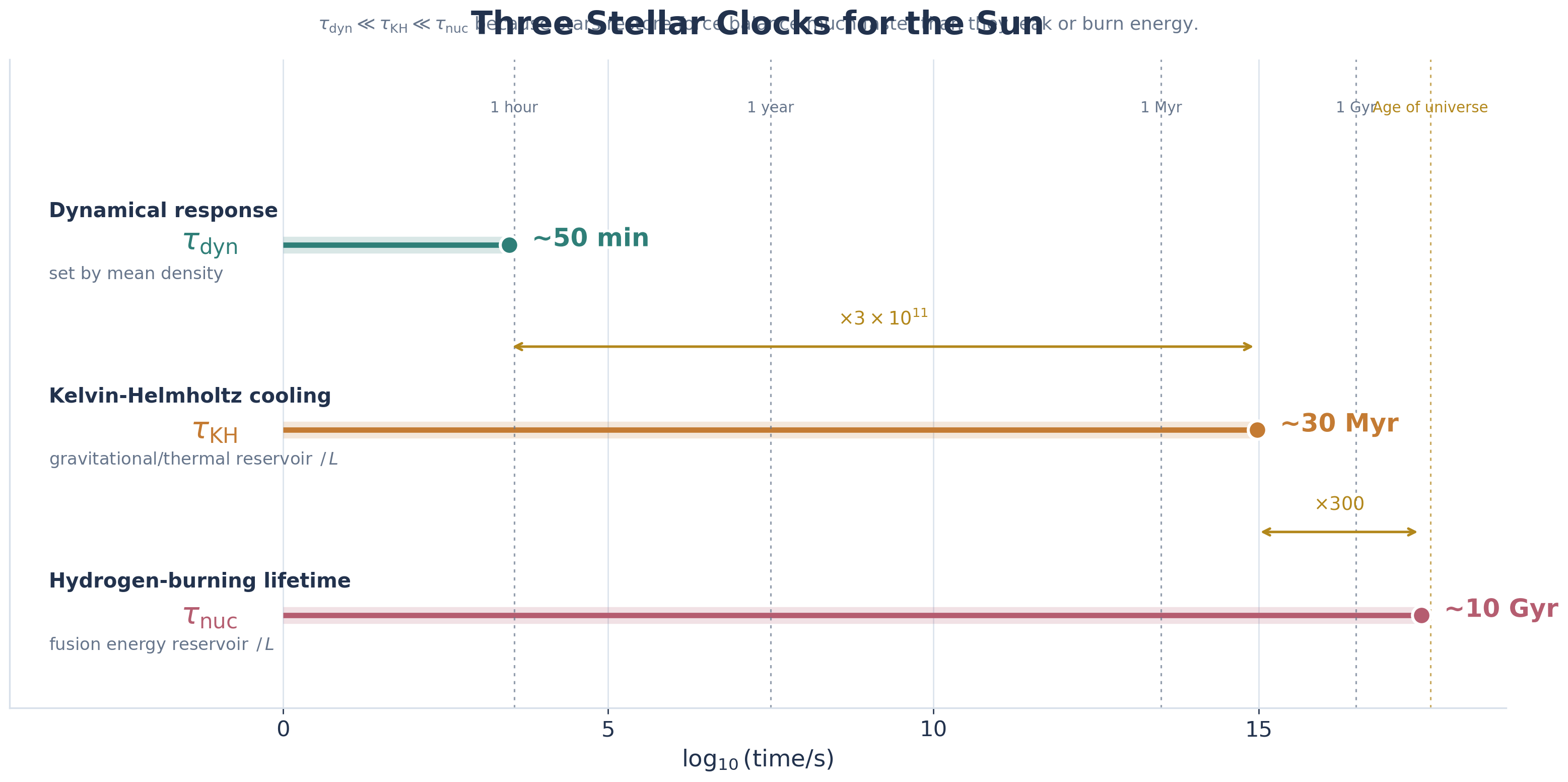
For the Sun, the three timescales span an enormous range — each answering a different physical question: mechanical response, thermal depletion, fuel exhaustion.
| Timescale | Symbol | Value (Sun) | Physical Process |
|---|---|---|---|
| Dynamical | Free-fall / pressure response | ||
| Thermal (KH) | Quasi-static contraction on the binding-energy reservoir | ||
| Nuclear | Hydrogen fusion |
The hierarchy has profound consequences:
- The star is in dynamical equilibrium. Because is so short (minutes), any departure from pressure-gravity balance is corrected almost instantly — which is why stars are (nearly) in hydrostatic equilibrium at all times (formalized in the next reading).
- Thermal adjustments are slow but finite. If the nuclear source were suddenly switched off, the star wouldn’t collapse instantly — it would slowly contract and radiate its stored thermal energy over .
- Nuclear burning sets the true lifetime. Because , the star has ample time to establish thermal equilibrium while burning fuel, shining steadily for billions of years.
Why This Hierarchy Matters
The separation of timescales is why stars exist as stable, luminous objects. If were comparable to , stars would pulsate wildly; if were comparable to , stars couldn’t establish thermal equilibrium before their fuel ran out. The enormous separation lets us treat stars as quasi-static objects evolving slowly through equilibrium states — the simplification that makes stellar physics tractable.
The main-sequence turnoff of a star cluster
In a coeval cluster, the most luminous (most massive) star still on the main sequence — the turnoff point — is directly read off the cluster’s HR diagram.
Nuclear lifetime from the mass-luminosity relation
: the turnoff mass maps to a main-sequence lifetime.
The cluster's age
Cluster age of the turnoff star. Blue (massive) turnoffs mean young clusters; red (low-mass) turnoffs mean old ones.
Quick check
From Module 2 you read a young cluster’s HR diagram and find its main-sequence turnoff at . Which of the three timescales turns that single observation into the cluster’s age — and why are the other two the wrong tool here?
Use the nuclear timescale: the turnoff star is the most massive one still fusing hydrogen, so the cluster’s age is roughly its . The dynamical timescale ( minutes) only tells you how fast that star springs back from a pressure jolt — nothing about age. The Kelvin-Helmholtz timescale would be the answer only in a universe with no fusion; lean on it here and you undercount the age by a factor of a few hundred — exactly Kelvin’s mistake. Choosing the right clock is the inference.
Multiple choice
Rank fastest to slowest: (a) the Sun responding to a sudden pressure disturbance, (b) the Sun exhausting its hydrogen fuel, (c) a hypothetical Sun (no nuclear source) radiating away its stored gravitational energy.
(a) Fastest — pressure response, dynamical timescale . (c) Middle — radiating gravitational energy, . (b) Slowest — exhausting nuclear fuel, . The hierarchy spans from fastest to slowest — the separation that lets stars exist as stable objects.