After the Main Sequence
Section 6 of 8
White Dwarfs
Part 5: White Dwarfs Are Degenerate Stellar Remnants
In HR diagrams,
White dwarf
The exposed, degenerate carbon-oxygen (or helium) core left after a low-mass star sheds its envelope. It is roughly Earth-sized, holds , and is supported against gravity by temperature-independent electron degeneracy pressure rather than fusion — so it simply cools over billions of years.
A white dwarf is supported by electron degeneracy pressure, not by ordinary thermal gas pressure: the pressure comes from quantum state packing, not from thermal agitation. The key scaling for a non-relativistic degenerate electron gas is , assuming the electrons are degenerate, still non-relativistic, and the dominant pressure source. Because this pressure comes from quantum state filling, it is largely independent of temperature. That is why a white dwarf can cool without losing its pressure support. Electron degeneracy pressure supports the white dwarf mechanically against gravity, but it is not a continuing energy source — the white dwarf shines only because it is still hot and slowly cooling. So a white dwarf remains standing not because it is still generating fusion energy, but because quantum mechanics supplies a pressure that does not disappear as the star cools.
Why more massive white dwarfs are smaller
Combine the degeneracy-pressure scaling with a characteristic gravitational pressure scaling. For a star of mass and radius , , so
A characteristic self-gravitational pressure scale is (a scaling, not an exact local formula). Equilibrium requires these to scale together:
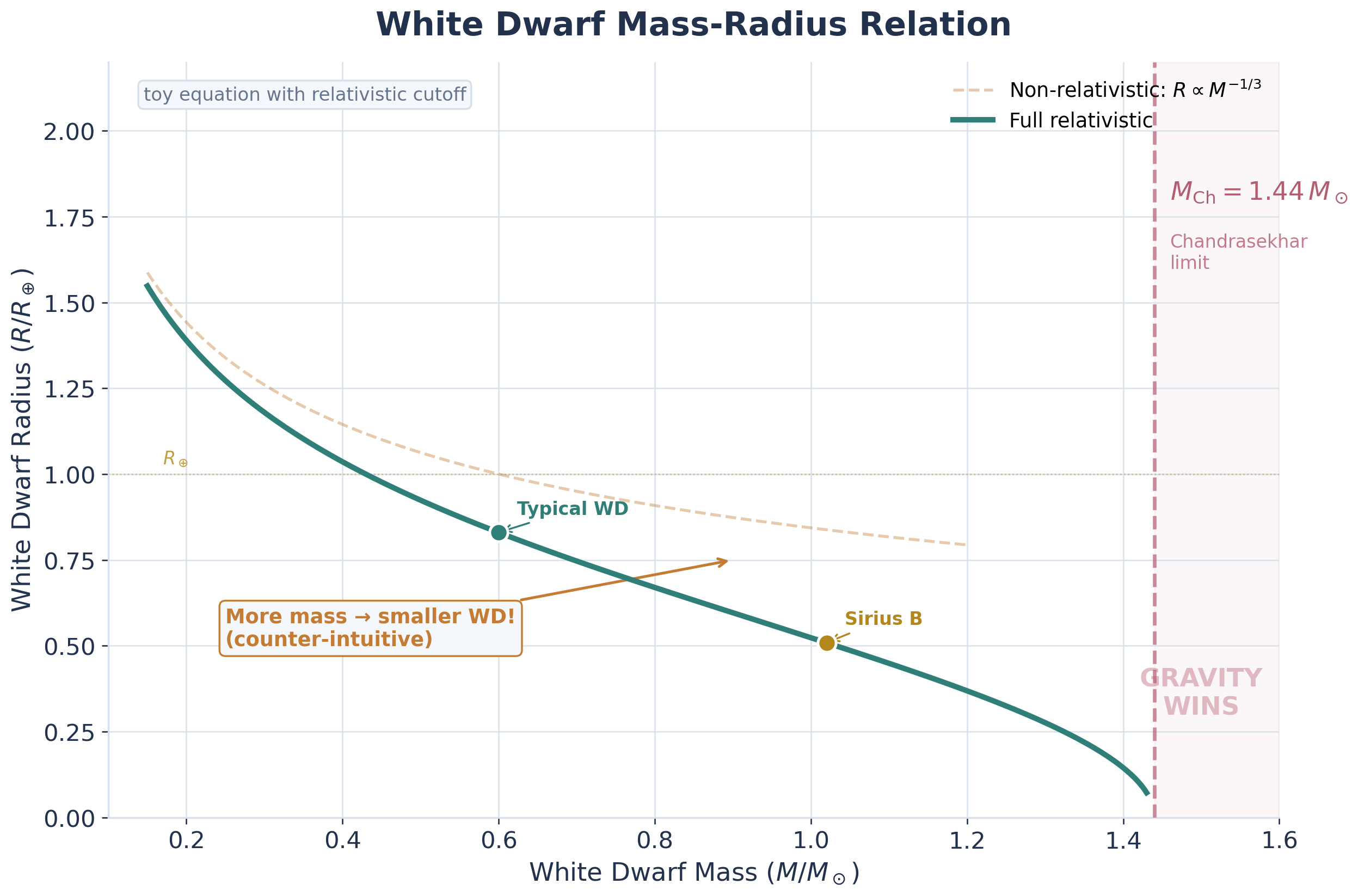
So the white-dwarf mass-radius relation is:
Adding mass strengthens gravity, so equilibrium requires higher density; in a degenerate object higher pressure means packing electrons into a smaller volume, so the radius decreases.
More massive white dwarfs are smaller because stronger gravity demands higher density, and higher density means larger degeneracy pressure.
Density example with units
Problem
Estimate the mean density of a white dwarf with and .
StepConvert the mass
StepCompute the volume
StepDivide mass by volume
Dimensional check
, a density ✓.
Result
A million times denser than water — a teaspoon would weigh several tonnes. This extreme density is what makes the degenerate electron gas the dominant pressure source.
An object that is hot but faint on the HR diagram must have a very small radius. That rules out an ordinary gas-supported star of comparable temperature. An Earth-sized, hot, faint stellar remnant with no fusion source therefore points to a white dwarf supported by electron degeneracy pressure. The inverse mass-radius relation is a signature of quantum pressure, not ordinary gas support.
Quick check
A white dwarf has far more mass than Earth but a radius of order Earth’s. Use to explain why increasing the mass makes the remnant smaller rather than larger. Your answer must mention both gravity and degeneracy pressure.
Increasing the white dwarf mass strengthens gravity, so equilibrium requires a larger inward pressure scale. In a degenerate electron gas, the way to get more pressure is to increase the density. Higher density means electrons are confined to a smaller volume, which increases their momentum spread and therefore the pressure. That is why the star becomes smaller and denser rather than larger, and captures that balance.
Inference: an inverse mass-radius relation is evidence for quantum support, not ordinary thermal support.