After the Main Sequence
Complete lesson
What We See When Stars Leave the Main Sequence
By the end of this reading, you will be able to:
Guiding question: when hydrogen runs out, why does a star swell into a giant before it shrinks into a white dwarf?
The HR diagram tells us what stars do after the main sequence. This reading explains why. When core hydrogen runs out, the core contracts and heats, shell burning turns on, the envelope expands into a red giant, helium ignites, the star sheds its envelope, and a white dwarf remains. Every stage is an inference from observables tied to a physical model. At each stage, the key reasoning task is: what new interior structure or energy source is required to explain the observed position of the star on the HR diagram?
What We See When Stars Leave the Main Sequence
Old clusters show organized post-main-sequence populations
A main-sequence turnoff, a heavily populated red giant branch, a horizontal branch (or red clump), planetary nebulae, and a white-dwarf cooling sequence — structured loci on the HR diagram, not scattered points.
HR position changes only when the interior reorganizes
A star moves on the HR diagram when its luminosity, surface temperature, and radius change — and those change because the interior energy source, pressure support, and transport mechanism change.
Low-mass stars reorganize; they do not simply fade
The populations trace one connected evolutionary path: core-hydrogen exhaustion triggers core contraction, shell burning, helium ignition, envelope ejection, and a degenerate remnant.
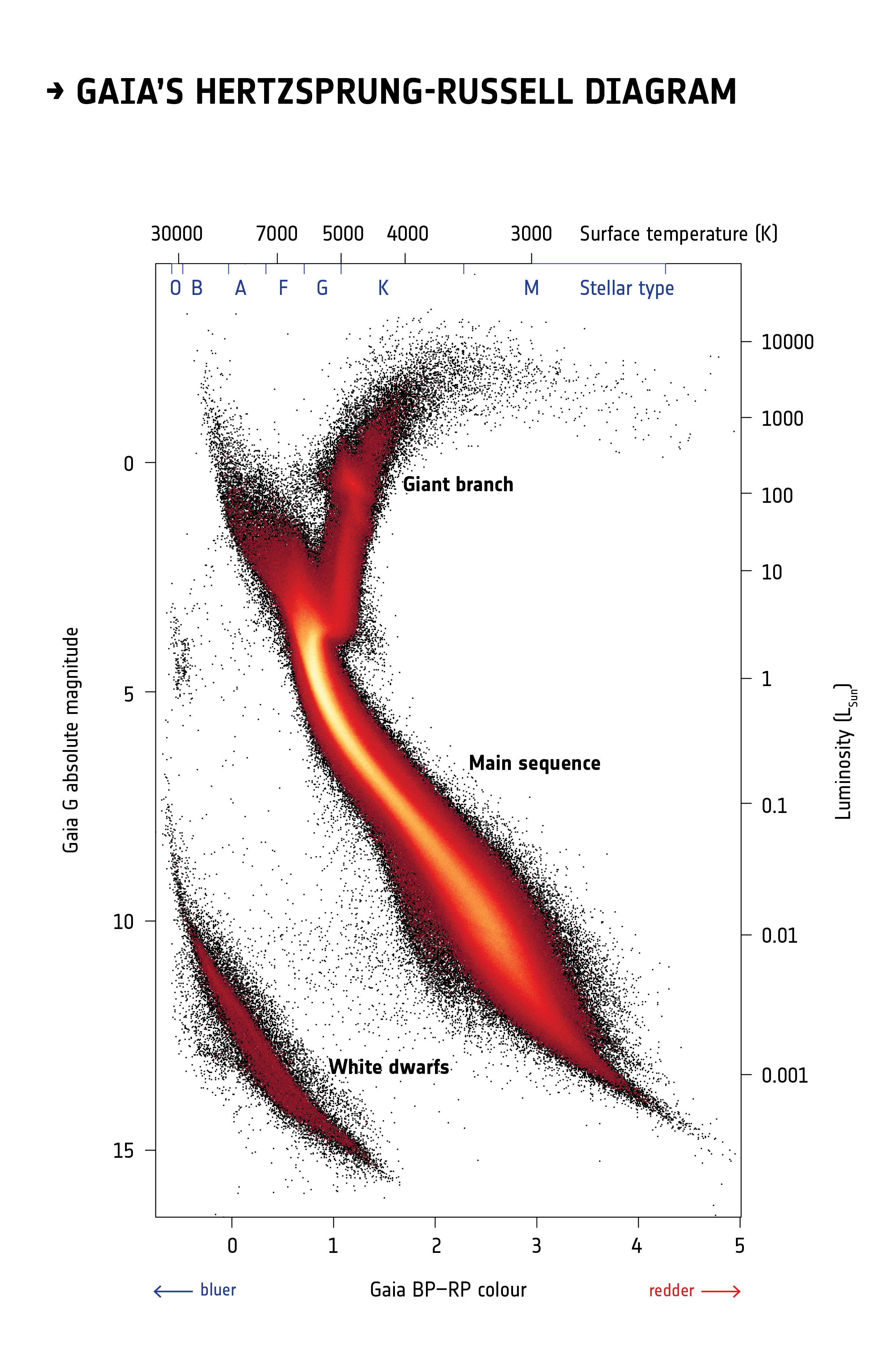
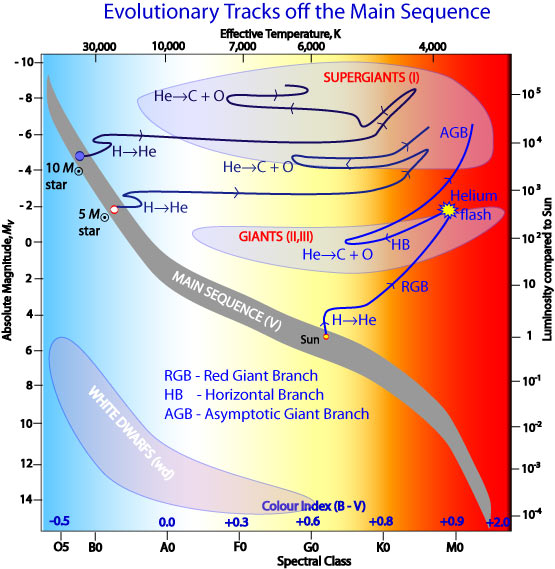
Astronomers do not watch a single Sun-like star for billions of years. Instead, we infer stellar evolution from populations. In old stellar systems we observe:
- a main-sequence turnoff, where the most massive stars that can still burn core hydrogen define an age scale,
- a heavily populated red giant branch (RGB), where stars are cool but luminous,
- a horizontal branch (HB), where stars are less luminous than the RGB tip but hotter,
- planetary nebulae, glowing shells of gas around hot compact central stars,
- and a white dwarf cooling sequence, where hot but faint remnants cool to lower luminosities over time.
These are not random points scattered across the HR diagram. They are organized structures. Because stars in a cluster are observed at nearly the same distance and formed at roughly the same time, differences in their HR-diagram positions can be interpreted primarily as differences in stellar mass and evolutionary stage.
The model idea is simple before it becomes detailed: a star changes position on the HR diagram when its luminosity, surface temperature, and radius change. Those surface properties change because the interior energy source, pressure support, and energy-transport mechanism change.
So the problem is not merely to label post-main-sequence populations. The problem is to explain what interior physics sends a low-mass star from
In older, metal-poor populations the core-helium-burning locus often appears as a horizontal branch; in more metal-rich populations the same locus may appear instead as a red clump. In both cases, the key inference is that a new central energy source has turned on.
The observations imply that low-mass stars do not simply fade when hydrogen runs out in the core. They undergo a sequence of structural reorganizations. The driving question for this reading is:
Why do stars follow this path instead of simply fading?
Why does a low-mass star first swell into a giant, then reorganize around new burning shells and core ignition, and finally end as a compact degenerate remnant rather than simply cooling away from the main sequence?
Core Hydrogen Exhaustion
Part 1: Core Hydrogen Exhaustion Starts the Evolutionary Track
In old star clusters, we do not see stars vanish from the main sequence and disappear. We see them peel away onto the subgiant branch and then ascend the red giant branch. That means the end of core hydrogen burning does not shut the star off immediately. It launches a new phase.
On the main sequence, a low-mass star is in hydrostatic equilibrium (pressure gradients balance gravity) and thermal equilibrium (luminosity leaving the surface is replenished by nuclear burning in the core). Once core hydrogen is exhausted, the core can no longer replenish the energy it loses. The correct starting point is the stellar virial theorem:
Use the virial theorem as a quasi-static, ideal-gas argument for the contracting core. We are not claiming that every detail of the post-main-sequence interior can be read off from this one equation alone.
Let be the thermal kinetic energy of the gas (in erg) and the gravitational potential energy (in erg, and negative). The total energy of the core is . Now use the virial theorem step by step:
Substitute into the total-energy expression:
so we also have
This line is the key to the whole section. For a self-gravitating system, losing total energy makes the bound state deeper. If the core radiates energy away, then . Because , making more negative means : the potential well deepens, so the core must contract. Because , making more negative means : contraction raises the thermal kinetic energy. For an ideal gas,
so with fixed, higher means higher . This is the negative-heat-capacity behavior of self-gravitating objects: the core loses energy, contracts, and gets hotter.
After central hydrogen is exhausted, the core is mostly helium ash left behind by earlier fusion. Because the temperature is still too low for helium fusion, this helium core is inert: it contributes mass and gravity, but not new nuclear power. At the outer edge of that contracting core, a hydrogen-rich layer that was previously too cool for fusion gets compressed and heated. The shell that ignites is the layer just outside the inert helium core, because it is the first hydrogen-rich region compressed strongly by the contracting core. The center itself cannot resume hydrogen burning because its hydrogen fuel has already been exhausted.
The turnoff and subgiant observations imply that core hydrogen exhaustion does not make the star simply switch off and fade at roughly fixed structure. Instead, gravity regains control of the center, forcing contraction of the inert helium core and heating of the surrounding shell. That is why the star leaves the main sequence and enters subgiant evolution rather than disappearing from the HR diagram.
Problem
A stellar core loses energy, so . Using , decide whether the core temperature rises or falls. Write your answer as a chain of algebraic statements and a one-sentence physical interpretation.
Start with . Because , we have , so the gravitational potential energy becomes more negative and the core contracts. Because , we also have . Finally, since with fixed, larger means larger .
Inference: a self-gravitating core that loses energy contracts and heats up. That is negative heat capacity in action.
Shell Burning and the Red Giant Branch
Part 2: Shell Burning Drives the Red Giant Branch
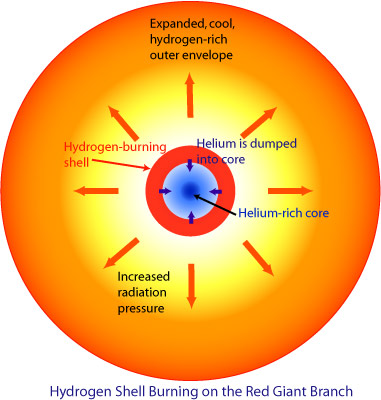
On the HR diagram, the star does not move down and to the right as a fading ember. It climbs the
Red giant branch
The evolutionary phase (and HR-diagram locus) of a post-main-sequence low-mass star burning hydrogen in a shell around an inert, contracting helium core. The star is cool () but very luminous, so by the Stefan-Boltzmann law it must be enormous — tens to a hundred times the solar radius.
From we can write the schematic radius scaling . So if a star becomes much more luminous while its surface temperature drops, its radius must increase dramatically. That is the defining signature of a red giant.
The model has two linked pieces: why shell burning is powerful, and why that power inflates the envelope.
Why can shell hydrogen burning exceed the old core luminosity?
The luminosity from any burning region is , where is the energy generation rate per unit mass (erg g^{-1} s^{-1}) and is the mass element (g). For pedagogical purposes, we use the rough local scaling , where is density, is the hydrogen mass fraction, and is temperature. The exact dependence varies with conditions, but the main point is that compression and heating of the shell make the burning rate rise sharply.
When the helium core contracts, the hydrogen-rich layer just outside it is compressed. Both and in that shell rise. Because the reaction rate depends strongly on temperature, even a modest rise in increases substantially. The shell is geometrically thin, but it is located exactly where the temperature and density have become large enough for intense burning. The result is a large luminosity emerging from a small region.
Why does the envelope expand instead of just glowing harder at the same size?
Here is the causal chain, step by step:
- Core contraction raises the pressure at the core-envelope boundary.
- That compresses and heats the hydrogen shell.
- The shell luminosity rises.
- That enhanced outward energy flux must be transported through the base of the envelope.
- The envelope opacity is high, so purely radiative transport struggles to carry the new luminosity.
- The radiative temperature gradient steepens.
- Convection turns on when the gradient exceeds the stability threshold.
- The envelope expands until the star finds a new equilibrium with a larger radius, lower surface temperature, and high luminosity.
So the correct physical story is not “convection makes giants big” in isolation. It is:
Convection is part of the envelope response, but the deeper point is global structural readjustment: the outer star must find a new equilibrium that can carry the enhanced shell luminosity. That is why red giant structure is an envelope response to an interior burning-shell problem. As the envelope expands, the radiating surface becomes much larger, allowing the star to remain very luminous while cooling at the photosphere, moving it up and to the right onto the red giant branch.
Radius example from the Stefan-Boltzmann law
We can now quantify what “giant” means using the Stefan-Boltzmann law:
Taking the ratio of a giant to the Sun cancels the constants and leaves a dimensionless relation between luminosity, radius, and temperature ratios.
Problem
A red giant has and . With , find its radius in solar radii.
StepTake the Stefan-Boltzmann ratio to the Sun
StepInsert the temperature ratio
StepSolve for the radius ratio
Dimensional check
The luminosity ratio is dimensionless and the kelvin units cancel in , so the right-hand side is dimensionless — consistent with ✓.
Result
An RGB star that is luminous but cool must be enormous — about 87 times the solar radius. That rules out simple fading at fixed radius after core hydrogen exhaustion.
An RGB star that is luminous but cool must have a very large radius. That rules out simple fading at roughly fixed radius after core hydrogen exhaustion. Instead, the red giant branch requires large-scale envelope expansion driven by shell burning and transport physics. So the red giant branch is not a star fading after core hydrogen exhaustion; it is the observable signature of shell burning around a contracting inert core driving a much larger envelope structure.
Numeric answer
Use the Stefan-Boltzmann law to find the radius ratio of a star with and (take ). Enter the dimensionless ratio .
The temperature ratio is , so . Then
Inference: a star this luminous and cool is far too large to be an ordinary main-sequence star. It is a giant.
Helium Ignition and the Helium Flash
Part 3: Helium Ignition, the Triple-Alpha Process, and the Helium Flash
In old clusters, the red giant branch does not continue forever. Stars reach the RGB tip, then populate the
Horizontal branch
The HR-diagram locus of low-mass stars that are quietly burning helium in their cores (plus hydrogen in a shell) after the helium flash. It is less luminous than the RGB tip but hotter; in metal-rich populations the same core-helium-burning stars instead form a compact “red clump.”
Why helium ignition requires higher temperatures
Helium nuclei have charge , so the Coulomb barrier is much larger than it was for proton-proton burning. The helium core therefore has to contract to before helium burning can proceed efficiently. This explains why helium ignition happens later: the core must contract much farther than it did during hydrogen burning. But temperature alone is not enough — helium also faces a nuclear-pathway problem.
Why helium must burn through the triple-alpha process
There are no stable nuclei at mass number or , so nature cannot climb smoothly upward from helium by single-particle additions. That forces the
It proceeds in two steps, bridged by an unstable intermediate.
Triple-alpha process
The reaction sequence that fuses three helium-4 nuclei into carbon-12: , then . It needs and high density, and is fast enough only because of the Hoyle resonance in carbon-12.
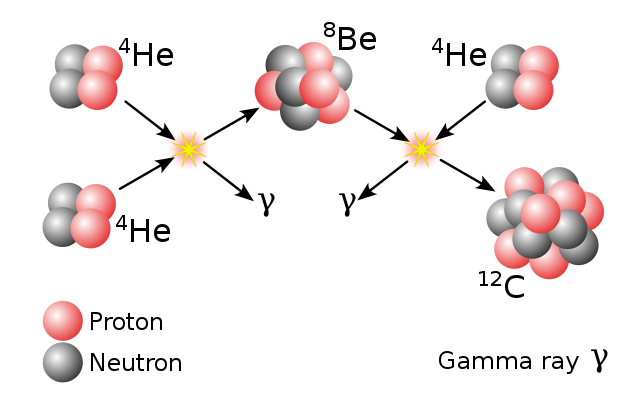
The two steps are
The Hoyle state in makes this chain fast enough to matter astrophysically. Now that we know how helium burns, we can ask why this stage is comparatively brief.
Why helium-burning phases are shorter
Compare the energy released per unit mass of fuel. For hydrogen burning, four protons become one helium nucleus and release about from about of fuel, so
For helium burning, three helium nuclei produce one carbon nucleus and release about from of fuel, so
Taking the ratio,
so helium burning releases only about 9% as much energy per unit mass as hydrogen burning. That is one important reason helium-burning phases are shorter. The total lifetime also depends on the available fuel and the luminosity, following the rough estimate — so a very luminous phase is short even with fuel available.
Numeric answer
Helium burning yields only of the energy per unit mass that hydrogen burning does ( vs ). Imagine a star whose core-helium-burning phase had the same luminosity and the same fuel mass as its main-sequence hydrogen-burning phase. Using , about how many times shorter would the helium-burning phase be? Enter the factor.
With the same luminosity and fuel mass, lifetime scales with the energy released: . Since helium burning releases a fraction as much energy per gram,
So the helium phase would be about shorter from the energy budget alone. In real stars the helium phase is shorter still, because the post-main-sequence luminosity is also much higher — both effects push the same way.
Why helium ignition runs away in a degenerate core
The triple-alpha rate has an extremely steep temperature dependence. For pedagogical purposes, use the schematic scaling — vastly steeper than the of hydrogen shell burning above, which is exactly why a small temperature rise that hydrogen burning would shrug off becomes explosive for helium. Perturb the temperature slightly, . Then for small . A rise () gives (exact: ) — already an extremely sensitive response in an ordinary gas.
Now add degeneracy. In a non-relativistic degenerate electron gas:
The important physical point is that with no explicit temperature dependence. This is a schematic non-relativistic scaling, not a full equation of state with all constants restored.
That means:
- in an ordinary thermal gas, heating raises pressure and the core expands,
- in a degenerate core, the pressure depends mainly on density, so heating does not trigger the usual rapid pressure increase,
- so the core does not expand enough to cool itself,
- so the temperature keeps rising,
- and because , the burning runs away.
That is the
Helium flash
The runaway onset of core helium burning in a low-mass star whose helium core is electron-degenerate. Because degeneracy pressure barely responds to temperature, the steep burning is not throttled by expansion, so it spikes violently — but the energy is absorbed deep in the interior (lifting degeneracy), not released as a surface explosion.
Why the helium flash is not seen as a surface explosion
The helium flash is violent in the core but not at the surface. The released energy is absorbed by the surrounding stellar interior and goes mainly into lifting the electron degeneracy, expanding the core slightly, and restoring an ordinary thermal thermostat — rather than emerging promptly from the surface as a bright optical outburst. So the flash is a deep interior restructuring event, not a giant optical outburst at the photosphere.
The horizontal branch or red clump rules out continued evolution powered only by shell hydrogen burning. It requires a new central energy source, which the model identifies as core helium burning. The helium flash further implies that ignition occurred under degenerate conditions, where the normal thermal thermostat was broken. So the horizontal branch or red clump marks the moment a new central energy source has turned on.
Problem
If the core temperature in a helium-burning region rises by , estimate the change in using . Then explain why the same perturbation is much more dangerous in a degenerate core than in an ordinary thermal gas.
With , . The small-perturbation estimate gives (exact ), so a rise roughly doubles the burning rate.
In an ordinary gas, that stronger burning raises pressure, the core expands, and the temperature drops back. In a degenerate core, depends mainly on density, not temperature, so expansion does not happen quickly enough. The extra burning therefore drives still more heating: runaway.
The AGB and Planetary Nebula Phase
Part 4: The AGB and Planetary Nebula Phase
After the horizontal branch, low-mass stars return to a cool, luminous giant phase: the
Asymptotic giant branch
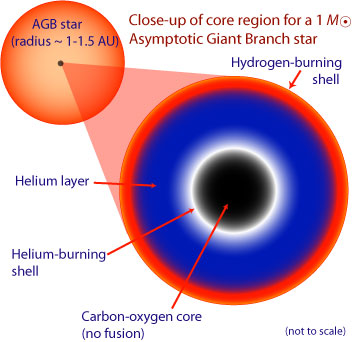
The late luminous-giant phase of a low-mass star with an inert carbon-oxygen core and two burning shells (helium inside, hydrogen outside). The thin helium shell burns unstably in pulses, driving dredge-up and heavy mass loss that ultimately strips the envelope.
The AGB resembles the RGB in that the star again has a compact inert core, surrounding shell burning, and an enormous convective envelope. The difference is that two burning shells are now present instead of one. Once core helium is exhausted, the star has an inert carbon-oxygen core, and evolution is again driven by core contraction:
Now there are two burning shells: an inner helium-burning shell and an outer hydrogen-burning shell. This structure is thermally unstable. Because helium burning occurs in a thin shell with strong temperature sensitivity, the helium shell can ignite in pulses, causing episodic luminosity spikes, convective dredge-up that mixes carbon-rich material upward, and strong mass loss from the outer envelope.
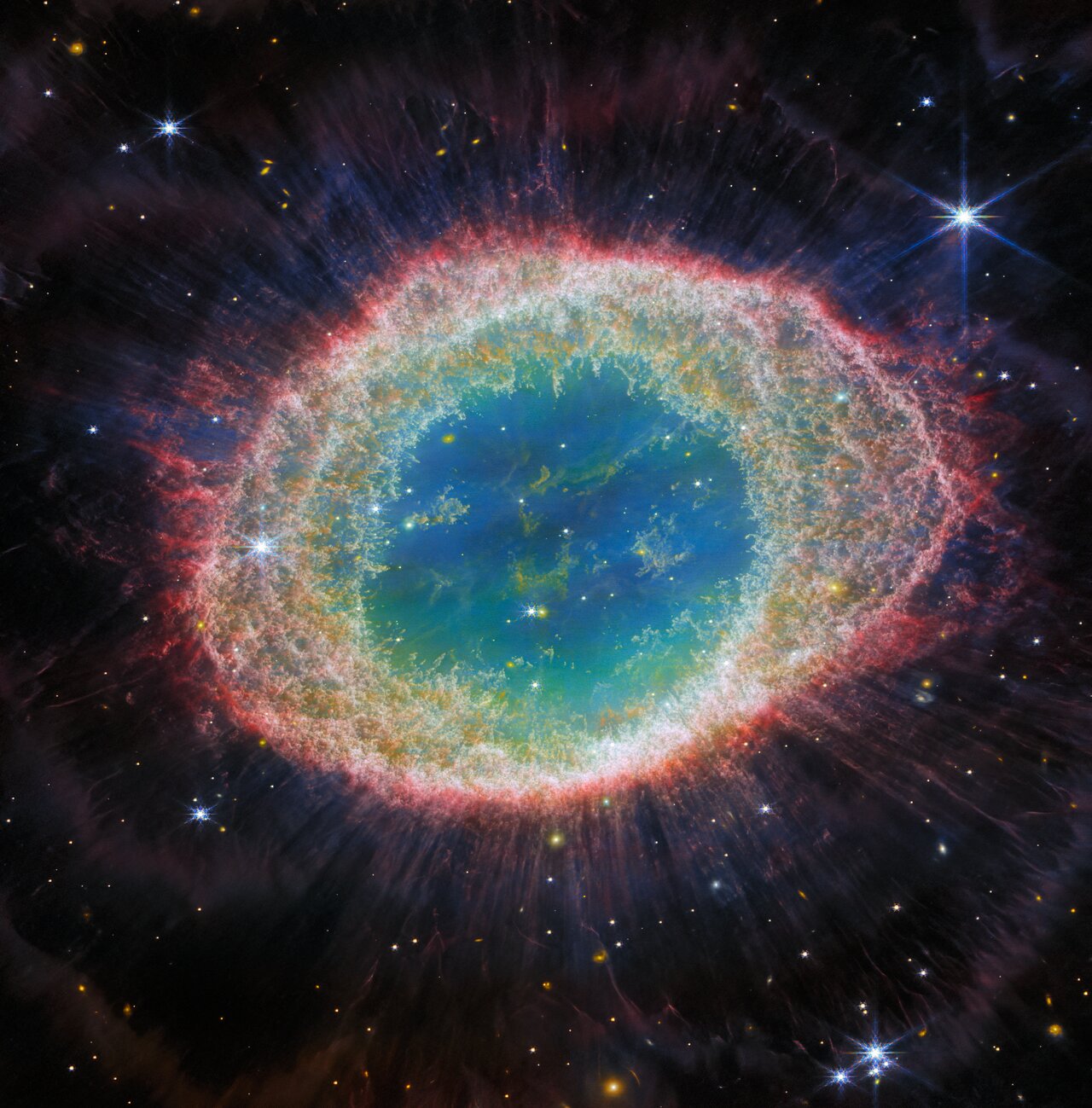
As mass loss strips away the envelope, the hot compact core is exposed. That bare core emits ultraviolet photons that ionize the expelled gas. The
Planetary nebula
A glowing shell of gas ejected by a low-mass star at the end of the AGB, photoionized by the exposed hot post-AGB core at its center. It is a brief () transient — the gas thins and fades — not the long-lived remnant itself, and has nothing to do with planets.
Planetary nebulae imply that low-mass stars do not end by direct core collapse or by quietly fading as intact giants. They end by envelope ejection. The observed nebula plus hot central star together point to an AGB star that lost its envelope and exposed a compact remnant core, linking the late AGB population to the white-dwarf track that follows.
Quick check
Explain why a planetary nebula is short-lived even though the white dwarf remnant persists for billions of years. Identify the observable, the mechanism making the gas glow, and the reason the nebula disappears long before the white dwarf does.
The observable is a glowing shell of ejected gas around a hot compact central star. The gas glows because ultraviolet photons from the exposed post-AGB core ionize the ejected material; recombination and line emission then produce the visible nebula.
The nebula is short-lived because the ejected gas expands and thins out — its density drops and the surface brightness falls rapidly. After roughly it has dispersed enough to no longer be bright. The white dwarf persists much longer because it is a compact degenerate object with a large thermal reservoir and a very long cooling time.
Inference: the nebula is a transient envelope phenomenon, not the long-term remnant.
White Dwarfs
Part 5: White Dwarfs Are Degenerate Stellar Remnants
In HR diagrams,
White dwarf
The exposed, degenerate carbon-oxygen (or helium) core left after a low-mass star sheds its envelope. It is roughly Earth-sized, holds , and is supported against gravity by temperature-independent electron degeneracy pressure rather than fusion — so it simply cools over billions of years.
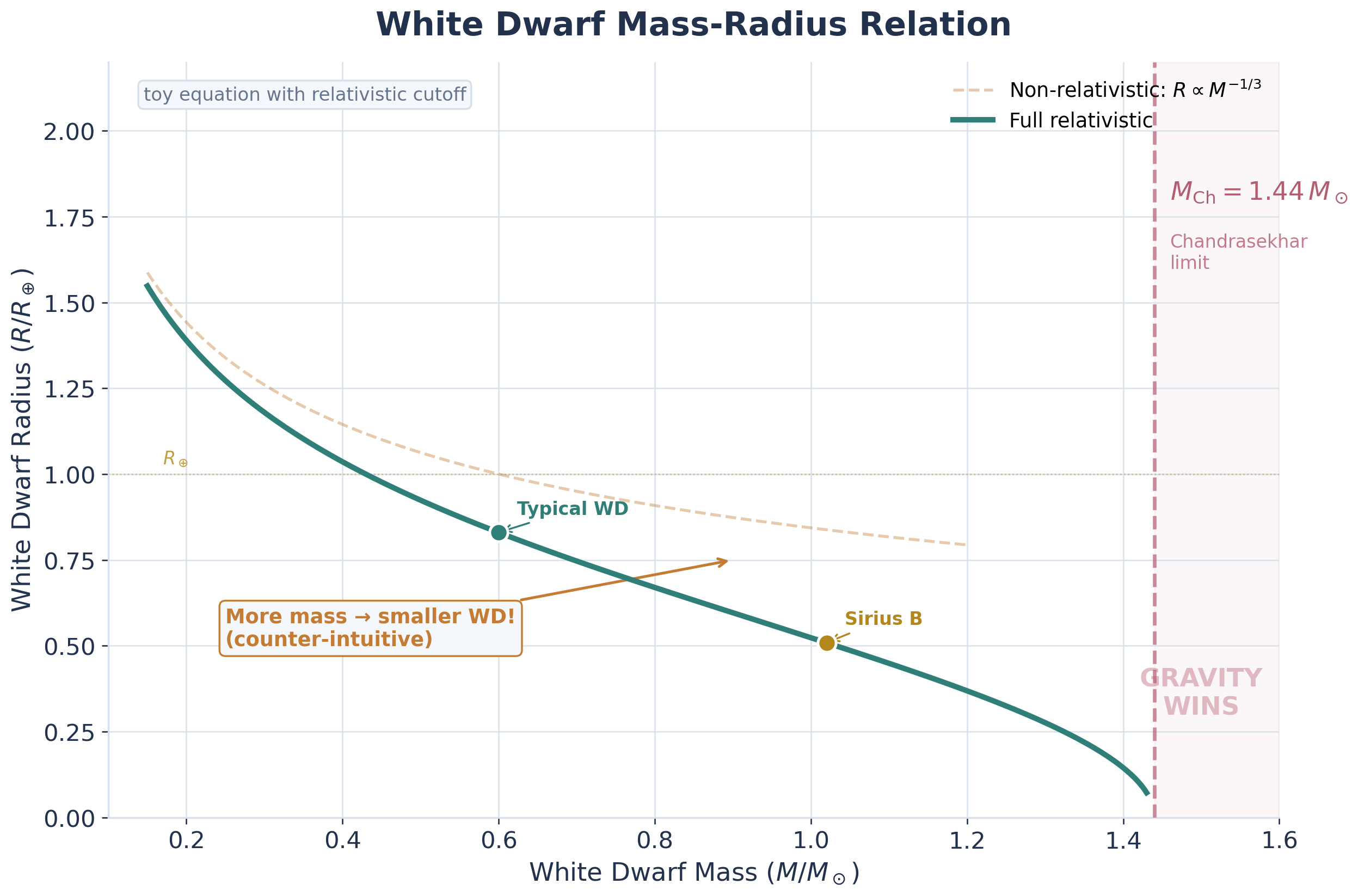
A white dwarf is supported by electron degeneracy pressure, not by ordinary thermal gas pressure: the pressure comes from quantum state packing, not from thermal agitation. The key scaling for a non-relativistic degenerate electron gas is , assuming the electrons are degenerate, still non-relativistic, and the dominant pressure source. Because this pressure comes from quantum state filling, it is largely independent of temperature. That is why a white dwarf can cool without losing its pressure support. Electron degeneracy pressure supports the white dwarf mechanically against gravity, but it is not a continuing energy source — the white dwarf shines only because it is still hot and slowly cooling. So a white dwarf remains standing not because it is still generating fusion energy, but because quantum mechanics supplies a pressure that does not disappear as the star cools.
Why more massive white dwarfs are smaller
Combine the degeneracy-pressure scaling with a characteristic gravitational pressure scaling. For a star of mass and radius , , so
A characteristic self-gravitational pressure scale is (a scaling, not an exact local formula). Equilibrium requires these to scale together:
So the white-dwarf mass-radius relation is:
Adding mass strengthens gravity, so equilibrium requires higher density; in a degenerate object higher pressure means packing electrons into a smaller volume, so the radius decreases.
More massive white dwarfs are smaller because stronger gravity demands higher density, and higher density means larger degeneracy pressure.
Density example with units
Problem
Estimate the mean density of a white dwarf with and .
StepConvert the mass
StepCompute the volume
StepDivide mass by volume
Dimensional check
, a density ✓.
Result
A million times denser than water — a teaspoon would weigh several tonnes. This extreme density is what makes the degenerate electron gas the dominant pressure source.
An object that is hot but faint on the HR diagram must have a very small radius. That rules out an ordinary gas-supported star of comparable temperature. An Earth-sized, hot, faint stellar remnant with no fusion source therefore points to a white dwarf supported by electron degeneracy pressure. The inverse mass-radius relation is a signature of quantum pressure, not ordinary gas support.
Quick check
A white dwarf has far more mass than Earth but a radius of order Earth’s. Use to explain why increasing the mass makes the remnant smaller rather than larger. Your answer must mention both gravity and degeneracy pressure.
Increasing the white dwarf mass strengthens gravity, so equilibrium requires a larger inward pressure scale. In a degenerate electron gas, the way to get more pressure is to increase the density. Higher density means electrons are confined to a smaller volume, which increases their momentum spread and therefore the pressure. That is why the star becomes smaller and denser rather than larger, and captures that balance.
Inference: an inverse mass-radius relation is evidence for quantum support, not ordinary thermal support.
The Full Low-Mass Path
Part 6: Putting the Full Low-Mass Path Together
The combined HR-diagram evidence from clusters and field stars shows a path: main-sequence turnoff, subgiant branch, red giant branch, horizontal branch or red clump, AGB stars, planetary nebulae, white dwarf cooling sequence. These are the observable signposts of low-mass stellar evolution.
The physical chain is now complete:
- Core hydrogen is exhausted.
- The helium core contracts and heats by the virial theorem.
- Hydrogen shell burning ignites around the inert core.
- The envelope expands because shell luminosity and transport bottlenecks reorganize the outer star.
- Helium ignites when the core reaches .
- A helium flash occurs if the core is degenerate.
- Core helium burning creates carbon, and some carbon captures helium to form oxygen.
- The carbon-oxygen core contracts after helium is exhausted.
- Double-shell burning on the AGB drives instability and mass loss.
- The envelope is ejected as a planetary nebula.
- A white dwarf remains, supported by electron degeneracy pressure.
The overall timing is also part of the model:
| Phase | Typical duration for a Sun-like star | Dominant energy source |
|---|---|---|
| Main sequence | Core H burning | |
| RGB ascent | H shell burning | |
| Core He burning | Core He burning + H shell | |
| AGB | He shell + H shell | |
| Planetary nebula | Ionized ejecta around hot core | |
| White dwarf cooling | No fusion; cooling only |
These timescales reflect the basic rule , so long phases have large fuel reservoirs and modest luminosities, while short phases are either high-luminosity burning stages or brief transient transitions.
Low-mass stars do not end by catastrophic collapse, and the HR diagram does not show unrelated classes of stars scattered by chance. It shows a physically connected sequence of structural states that low-mass stars pass through after core hydrogen exhaustion.
Reference and Synthesis
Reference Tables
Key Equations and What They Mean Here
| Equation | Role in this reading | Core idea |
|---|---|---|
| Core response after H exhaustion | Energy loss leads to contraction and heating | |
| Giant radius inference | Luminous + cool implies large radius | |
| Net triple-alpha reaction | Carbon is built from helium | |
| Helium flash stability | Small temperature changes strongly amplify burning | |
| White dwarf support | Degeneracy pressure is density-controlled, not temperature-controlled | |
| White dwarf structure | More massive white dwarfs are smaller |
Symbol Legend
| Symbol | Meaning | Units |
|---|---|---|
| Thermal kinetic energy | erg | |
| Gravitational potential energy | erg | |
| Total energy | erg | |
| Energy generation rate per unit mass | erg g^{-1} s^{-1} | |
| Effective surface temperature | K | |
| Density | g cm^{-3} | |
| Degeneracy pressure | dyn cm^{-2} | |
| RGB | Red giant branch | — |
| HB | Horizontal branch | — |
| AGB | Asymptotic giant branch | — |
A self-gravitating core loses energy yet gets hotter, and a more massive white dwarf is smaller. In one or two sentences each, name the physics behind these two counter-intuitive facts.
Negative heat capacity: the virial theorem gives , so losing total energy deepens the potential well (contraction) and raises the thermal energy (heating) — gravity converts released binding energy into heat. Inverse mass-radius: white dwarfs are held up by density-dependent degeneracy pressure (), so more mass needs more pressure, hence higher density and a smaller radius — .
Glossary
- Asymptotic giant branch
The late luminous-giant phase of a low-mass star with an inert carbon-oxygen core and two burning shells (helium inside, hydrogen outside). The thin helium shell burns unstably in pulses, driving dredge-up and heavy mass loss that ultimately strips the envelope.
- Helium flash
The runaway onset of core helium burning in a low-mass star whose helium core is electron-degenerate. Because degeneracy pressure barely responds to temperature, the steep burning is not throttled by expansion, so it spikes violently — but the energy is absorbed deep in the interior (lifting degeneracy), not released as a surface explosion.
- Horizontal branch
The HR-diagram locus of low-mass stars that are quietly burning helium in their cores (plus hydrogen in a shell) after the helium flash. It is less luminous than the RGB tip but hotter; in metal-rich populations the same core-helium-burning stars instead form a compact “red clump.”
- Planetary nebula
A glowing shell of gas ejected by a low-mass star at the end of the AGB, photoionized by the exposed hot post-AGB core at its center. It is a brief () transient — the gas thins and fades — not the long-lived remnant itself, and has nothing to do with planets.
- Red giant branch
The evolutionary phase (and HR-diagram locus) of a post-main-sequence low-mass star burning hydrogen in a shell around an inert, contracting helium core. The star is cool () but very luminous, so by the Stefan-Boltzmann law it must be enormous — tens to a hundred times the solar radius.
- Triple-alpha process
The reaction sequence that fuses three helium-4 nuclei into carbon-12: , then . It needs and high density, and is fast enough only because of the Hoyle resonance in carbon-12.
- White dwarf
The exposed, degenerate carbon-oxygen (or helium) core left after a low-mass star sheds its envelope. It is roughly Earth-sized, holds , and is supported against gravity by temperature-independent electron degeneracy pressure rather than fusion — so it simply cools over billions of years.