After the Main Sequence
Section 4 of 8
Helium Ignition and the Helium Flash
Part 3: Helium Ignition, the Triple-Alpha Process, and the Helium Flash
In old clusters, the red giant branch does not continue forever. Stars reach the RGB tip, then populate the
Horizontal branch
The HR-diagram locus of low-mass stars that are quietly burning helium in their cores (plus hydrogen in a shell) after the helium flash. It is less luminous than the RGB tip but hotter; in metal-rich populations the same core-helium-burning stars instead form a compact “red clump.”
Why helium ignition requires higher temperatures
Helium nuclei have charge , so the Coulomb barrier is much larger than it was for proton-proton burning. The helium core therefore has to contract to before helium burning can proceed efficiently. This explains why helium ignition happens later: the core must contract much farther than it did during hydrogen burning. But temperature alone is not enough — helium also faces a nuclear-pathway problem.
Why helium must burn through the triple-alpha process
There are no stable nuclei at mass number or , so nature cannot climb smoothly upward from helium by single-particle additions. That forces the
It proceeds in two steps, bridged by an unstable intermediate.
Triple-alpha process
The reaction sequence that fuses three helium-4 nuclei into carbon-12: , then . It needs and high density, and is fast enough only because of the Hoyle resonance in carbon-12.
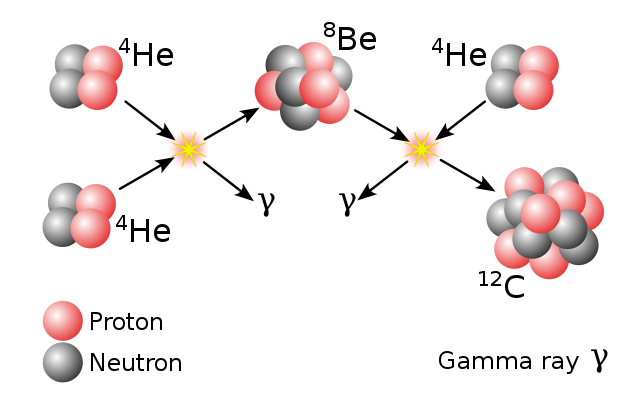
The two steps are
The Hoyle state in makes this chain fast enough to matter astrophysically. Now that we know how helium burns, we can ask why this stage is comparatively brief.
Why helium-burning phases are shorter
Compare the energy released per unit mass of fuel. For hydrogen burning, four protons become one helium nucleus and release about from about of fuel, so
For helium burning, three helium nuclei produce one carbon nucleus and release about from of fuel, so
Taking the ratio,
so helium burning releases only about 9% as much energy per unit mass as hydrogen burning. That is one important reason helium-burning phases are shorter. The total lifetime also depends on the available fuel and the luminosity, following the rough estimate — so a very luminous phase is short even with fuel available.
Numeric answer
Helium burning yields only of the energy per unit mass that hydrogen burning does ( vs ). Imagine a star whose core-helium-burning phase had the same luminosity and the same fuel mass as its main-sequence hydrogen-burning phase. Using , about how many times shorter would the helium-burning phase be? Enter the factor.
With the same luminosity and fuel mass, lifetime scales with the energy released: . Since helium burning releases a fraction as much energy per gram,
So the helium phase would be about shorter from the energy budget alone. In real stars the helium phase is shorter still, because the post-main-sequence luminosity is also much higher — both effects push the same way.
Why helium ignition runs away in a degenerate core
The triple-alpha rate has an extremely steep temperature dependence. For pedagogical purposes, use the schematic scaling — vastly steeper than the of hydrogen shell burning above, which is exactly why a small temperature rise that hydrogen burning would shrug off becomes explosive for helium. Perturb the temperature slightly, . Then for small . A rise () gives (exact: ) — already an extremely sensitive response in an ordinary gas.
Now add degeneracy. In a non-relativistic degenerate electron gas:
The important physical point is that with no explicit temperature dependence. This is a schematic non-relativistic scaling, not a full equation of state with all constants restored.
That means:
- in an ordinary thermal gas, heating raises pressure and the core expands,
- in a degenerate core, the pressure depends mainly on density, so heating does not trigger the usual rapid pressure increase,
- so the core does not expand enough to cool itself,
- so the temperature keeps rising,
- and because , the burning runs away.
That is the
Helium flash
The runaway onset of core helium burning in a low-mass star whose helium core is electron-degenerate. Because degeneracy pressure barely responds to temperature, the steep burning is not throttled by expansion, so it spikes violently — but the energy is absorbed deep in the interior (lifting degeneracy), not released as a surface explosion.
Why the helium flash is not seen as a surface explosion
The helium flash is violent in the core but not at the surface. The released energy is absorbed by the surrounding stellar interior and goes mainly into lifting the electron degeneracy, expanding the core slightly, and restoring an ordinary thermal thermostat — rather than emerging promptly from the surface as a bright optical outburst. So the flash is a deep interior restructuring event, not a giant optical outburst at the photosphere.
The horizontal branch or red clump rules out continued evolution powered only by shell hydrogen burning. It requires a new central energy source, which the model identifies as core helium burning. The helium flash further implies that ignition occurred under degenerate conditions, where the normal thermal thermostat was broken. So the horizontal branch or red clump marks the moment a new central energy source has turned on.
Problem
If the core temperature in a helium-burning region rises by , estimate the change in using . Then explain why the same perturbation is much more dangerous in a degenerate core than in an ordinary thermal gas.
With , . The small-perturbation estimate gives (exact ), so a rise roughly doubles the burning rate.
In an ordinary gas, that stronger burning raises pressure, the core expands, and the temperature drops back. In a degenerate core, depends mainly on density, not temperature, so expansion does not happen quickly enough. The extra burning therefore drives still more heating: runaway.