After the Main Sequence
Section 5 of 8
The AGB and Planetary Nebula Phase
Part 4: The AGB and Planetary Nebula Phase
After the horizontal branch, low-mass stars return to a cool, luminous giant phase: the
Asymptotic giant branch
The late luminous-giant phase of a low-mass star with an inert carbon-oxygen core and two burning shells (helium inside, hydrogen outside). The thin helium shell burns unstably in pulses, driving dredge-up and heavy mass loss that ultimately strips the envelope.
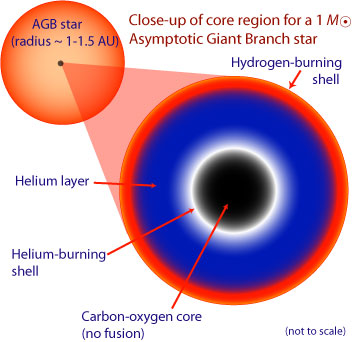
The AGB resembles the RGB in that the star again has a compact inert core, surrounding shell burning, and an enormous convective envelope. The difference is that two burning shells are now present instead of one. Once core helium is exhausted, the star has an inert carbon-oxygen core, and evolution is again driven by core contraction:
Now there are two burning shells: an inner helium-burning shell and an outer hydrogen-burning shell. This structure is thermally unstable. Because helium burning occurs in a thin shell with strong temperature sensitivity, the helium shell can ignite in pulses, causing episodic luminosity spikes, convective dredge-up that mixes carbon-rich material upward, and strong mass loss from the outer envelope.
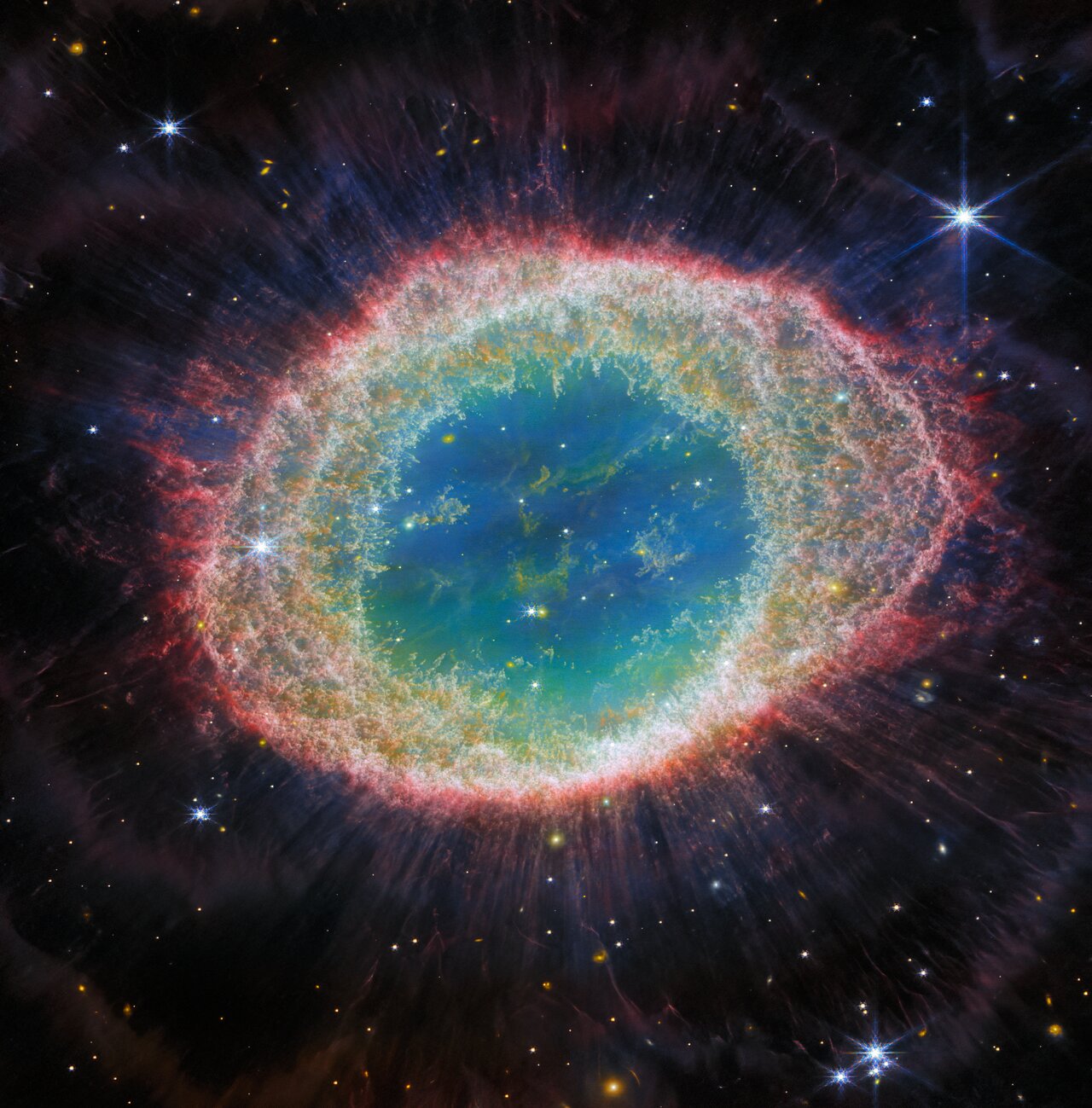
As mass loss strips away the envelope, the hot compact core is exposed. That bare core emits ultraviolet photons that ionize the expelled gas. The
Planetary nebula
A glowing shell of gas ejected by a low-mass star at the end of the AGB, photoionized by the exposed hot post-AGB core at its center. It is a brief () transient — the gas thins and fades — not the long-lived remnant itself, and has nothing to do with planets.
Planetary nebulae imply that low-mass stars do not end by direct core collapse or by quietly fading as intact giants. They end by envelope ejection. The observed nebula plus hot central star together point to an AGB star that lost its envelope and exposed a compact remnant core, linking the late AGB population to the white-dwarf track that follows.
Quick check
Explain why a planetary nebula is short-lived even though the white dwarf remnant persists for billions of years. Identify the observable, the mechanism making the gas glow, and the reason the nebula disappears long before the white dwarf does.
The observable is a glowing shell of ejected gas around a hot compact central star. The gas glows because ultraviolet photons from the exposed post-AGB core ionize the ejected material; recombination and line emission then produce the visible nebula.
The nebula is short-lived because the ejected gas expands and thins out — its density drops and the surface brightness falls rapidly. After roughly it has dispersed enough to no longer be bright. The white dwarf persists much longer because it is a compact degenerate object with a large thermal reservoir and a very long cooling time.
Inference: the nebula is a transient envelope phenomenon, not the long-term remnant.