After the Main Sequence
Section 3 of 8
Shell Burning and the Red Giant Branch
Part 2: Shell Burning Drives the Red Giant Branch
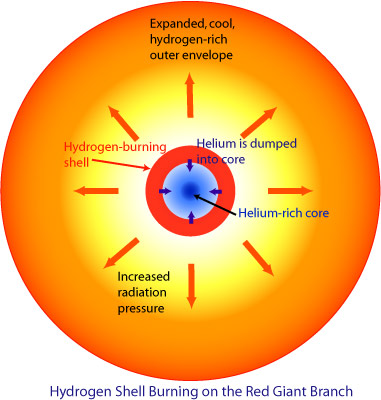
On the HR diagram, the star does not move down and to the right as a fading ember. It climbs the
Red giant branch
The evolutionary phase (and HR-diagram locus) of a post-main-sequence low-mass star burning hydrogen in a shell around an inert, contracting helium core. The star is cool () but very luminous, so by the Stefan-Boltzmann law it must be enormous — tens to a hundred times the solar radius.
From we can write the schematic radius scaling . So if a star becomes much more luminous while its surface temperature drops, its radius must increase dramatically. That is the defining signature of a red giant.
The model has two linked pieces: why shell burning is powerful, and why that power inflates the envelope.
Why can shell hydrogen burning exceed the old core luminosity?
The luminosity from any burning region is , where is the energy generation rate per unit mass (erg g^{-1} s^{-1}) and is the mass element (g). For pedagogical purposes, we use the rough local scaling , where is density, is the hydrogen mass fraction, and is temperature. The exact dependence varies with conditions, but the main point is that compression and heating of the shell make the burning rate rise sharply.
When the helium core contracts, the hydrogen-rich layer just outside it is compressed. Both and in that shell rise. Because the reaction rate depends strongly on temperature, even a modest rise in increases substantially. The shell is geometrically thin, but it is located exactly where the temperature and density have become large enough for intense burning. The result is a large luminosity emerging from a small region.
Why does the envelope expand instead of just glowing harder at the same size?
Here is the causal chain, step by step:
- Core contraction raises the pressure at the core-envelope boundary.
- That compresses and heats the hydrogen shell.
- The shell luminosity rises.
- That enhanced outward energy flux must be transported through the base of the envelope.
- The envelope opacity is high, so purely radiative transport struggles to carry the new luminosity.
- The radiative temperature gradient steepens.
- Convection turns on when the gradient exceeds the stability threshold.
- The envelope expands until the star finds a new equilibrium with a larger radius, lower surface temperature, and high luminosity.
So the correct physical story is not “convection makes giants big” in isolation. It is:
Convection is part of the envelope response, but the deeper point is global structural readjustment: the outer star must find a new equilibrium that can carry the enhanced shell luminosity. That is why red giant structure is an envelope response to an interior burning-shell problem. As the envelope expands, the radiating surface becomes much larger, allowing the star to remain very luminous while cooling at the photosphere, moving it up and to the right onto the red giant branch.
Radius example from the Stefan-Boltzmann law
We can now quantify what “giant” means using the Stefan-Boltzmann law:
Taking the ratio of a giant to the Sun cancels the constants and leaves a dimensionless relation between luminosity, radius, and temperature ratios.
Problem
A red giant has and . With , find its radius in solar radii.
StepTake the Stefan-Boltzmann ratio to the Sun
StepInsert the temperature ratio
StepSolve for the radius ratio
Dimensional check
The luminosity ratio is dimensionless and the kelvin units cancel in , so the right-hand side is dimensionless — consistent with ✓.
Result
An RGB star that is luminous but cool must be enormous — about 87 times the solar radius. That rules out simple fading at fixed radius after core hydrogen exhaustion.
An RGB star that is luminous but cool must have a very large radius. That rules out simple fading at roughly fixed radius after core hydrogen exhaustion. Instead, the red giant branch requires large-scale envelope expansion driven by shell burning and transport physics. So the red giant branch is not a star fading after core hydrogen exhaustion; it is the observable signature of shell burning around a contracting inert core driving a much larger envelope structure.
Numeric answer
Use the Stefan-Boltzmann law to find the radius ratio of a star with and (take ). Enter the dimensionless ratio .
The temperature ratio is , so . Then
Inference: a star this luminous and cool is far too large to be an ordinary main-sequence star. It is a giant.