UNDER REVIEW
Optional sections
Reading width
Color theme

Radiation Transport

Section 3 of 7

The Random Walk

Part 3: The Random Walk — Why It Takes Hundreds of Thousands of Years

A photon does not travel radially outward in one path. After each interaction, the next step goes in a new direction — a random walk. For step size and steps, the net displacement is:

The total path length is , but the net outward displacement is only . So to cross a distance requires steps.

Random walk

A path of many steps each taken in an independent random direction. The net displacement grows only as (not ), which is why crossing a distance needs steps and makes radiative transport slow.
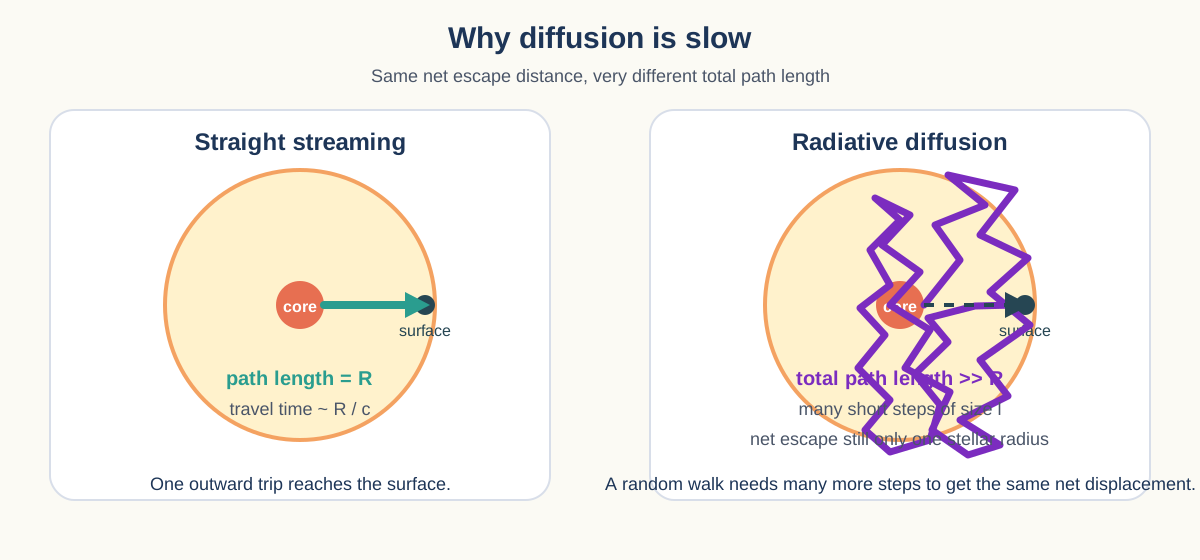
Two-panel comparison between straight streaming and radiative diffusion. The left panel shows a direct path from the stellar core to the surface. The right panel shows a tangled random-walk path with many short steps reaching the same surface only after a much longer total path.
Figure 2A straight-line beam crosses the star in one stellar radius, but radiative diffusion follows a tangled path whose total length is vastly larger. The step size stays tiny, so the transport time explodes even though each step is taken at the speed of light.Course illustration (A. Rosen)
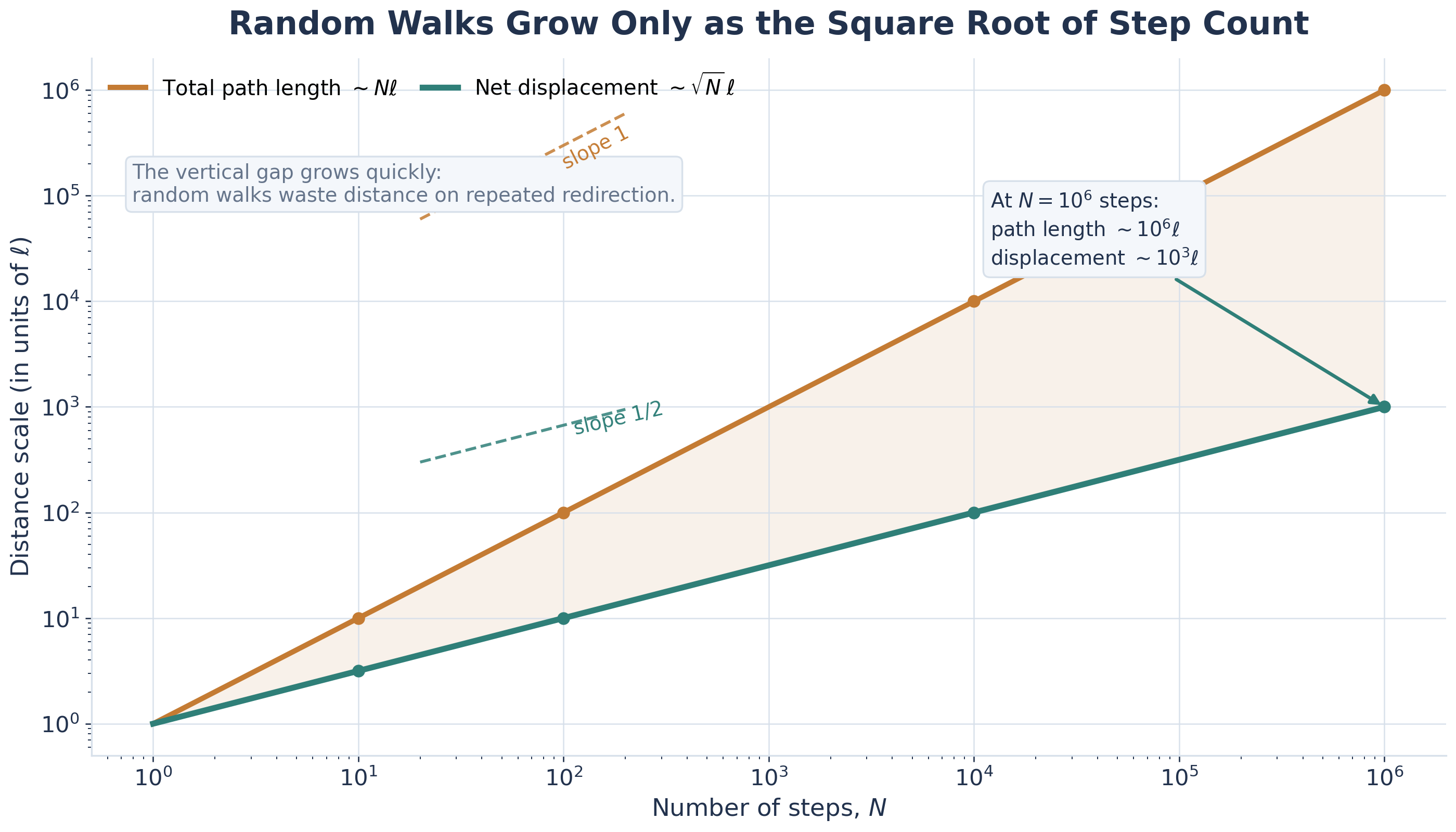
Log-log plot of distance scale versus number of steps N. One line shows total path length proportional to N times ell, and a lower line shows net displacement proportional to square root of N times ell. Callouts mark the slope 1 and slope one-half behavior and note that at one million steps the path length is about a million ell while the displacement is only about a thousand ell.
Figure 3The total path length grows as N times ell, but the net displacement grows only as sqrt(N) times ell. The widening gap is why random walks are so inefficient: after many steps, most travel has been spent getting redirected rather than making net outward progress.ASTR 201 (generated)
Worked Example 2Photon Diffusion Time in the Sun

Problem

Use and to estimate the number of scatterings and the diffusion time.

StepNumber of steps to cross the Sun

StepDiffusion time (each step takes ell/c)

Dimensional check

✓.

Result

About scatterings and — the right order of magnitude. More realistic stratified models stay in the same -year range.

A useful alternate form: since , the diffusion time is . Here is the straight-line crossing time and is how many mean-free-path layers thick the star is — an optically thick star multiplies the crossing time by an enormous factor.
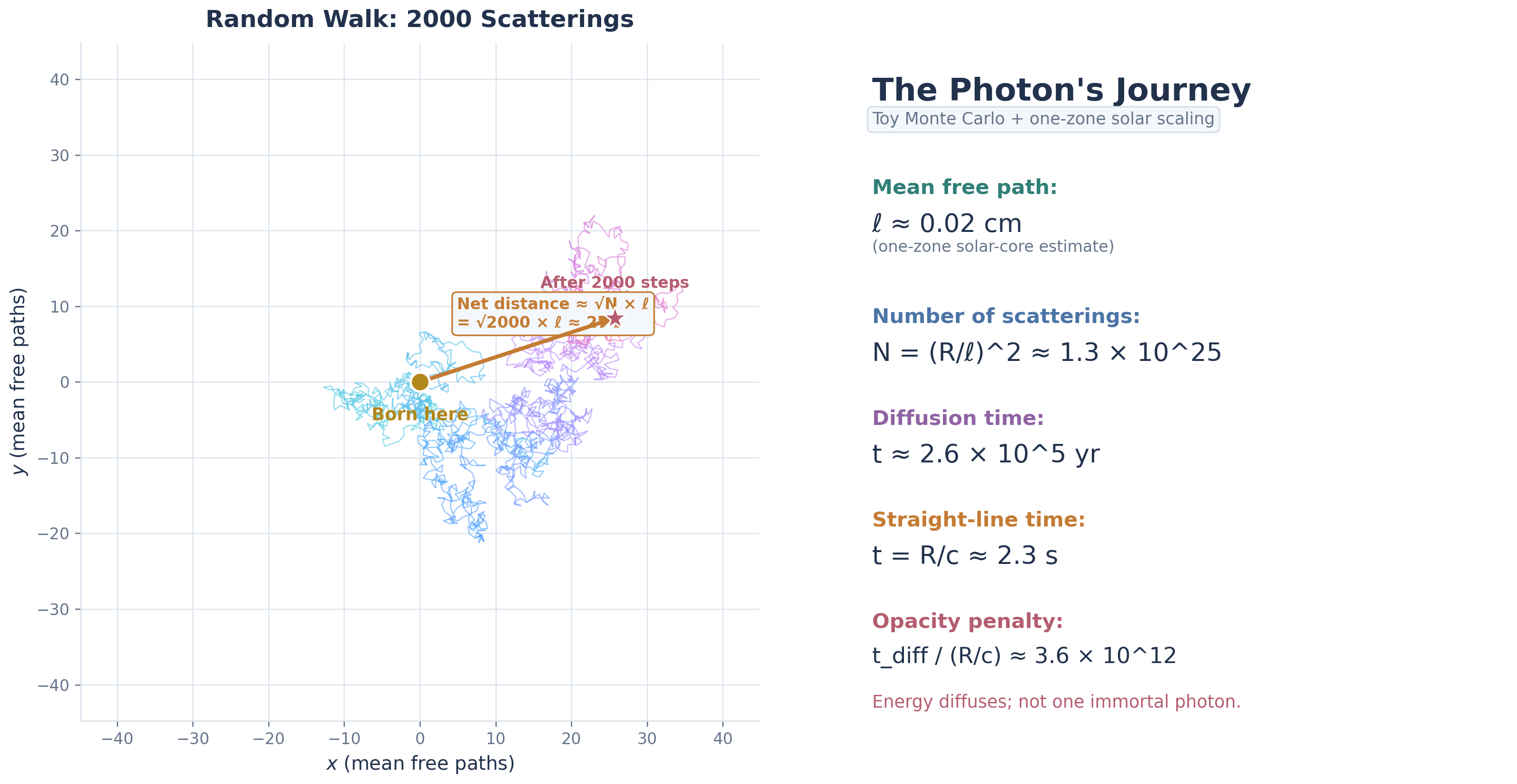
Two-panel figure. Left panel shows a colorful 2000-step toy random walk with a start point, end point, and net-displacement arrow. Right panel summarizes a separate one-zone solar estimate with mean free path about 0.02 centimeters, about 10 to the 25 scatterings, diffusion time of a few times 10 to the 5 years, and straight-line time of 2.3 seconds.
Figure 4Toy walk plus one-zone solar scaling. Left: a simulated 2,000-step random walk that makes the sqrt(N) scaling visible. Right: a separate one-zone solar estimate with a mean free path of about 0.02 cm, about 10^25 interactions, and a diffusion time of about 260,000 years. Do not read the left-panel geometry as a literal solar trajectory.ASTR 201 (generated)

Problem

Use . (1) If decreases by a factor of 10, what happens to ? (2) If doubles while stays fixed?