Radiation Transport
Section 5 of 7
When Radiation Is Not Enough
Part 5: When Radiation Isn’t Enough — Convection
Radiative diffusion has a built-in limit: photons move energy by many tiny random steps, high opacity makes those steps smaller, and energy flow becomes inefficient. To carry a fixed luminosity through a very opaque region, the star must steepen the temperature gradient. What if it becomes too steep?
Unlike photons, the stellar plasma is a fluid. A blob slightly hotter than its surroundings is less dense, so buoyancy pushes it upward, carrying energy; cooler, denser gas sinks. This circulating flow is
Convection
Energy transport by the bulk motion of fluid, driven by buoyancy: hot material rises, cool material sinks, and energy is carried by moving matter rather than diffusing radiation. It takes over where the radiative temperature gradient would be too steep to be stable.
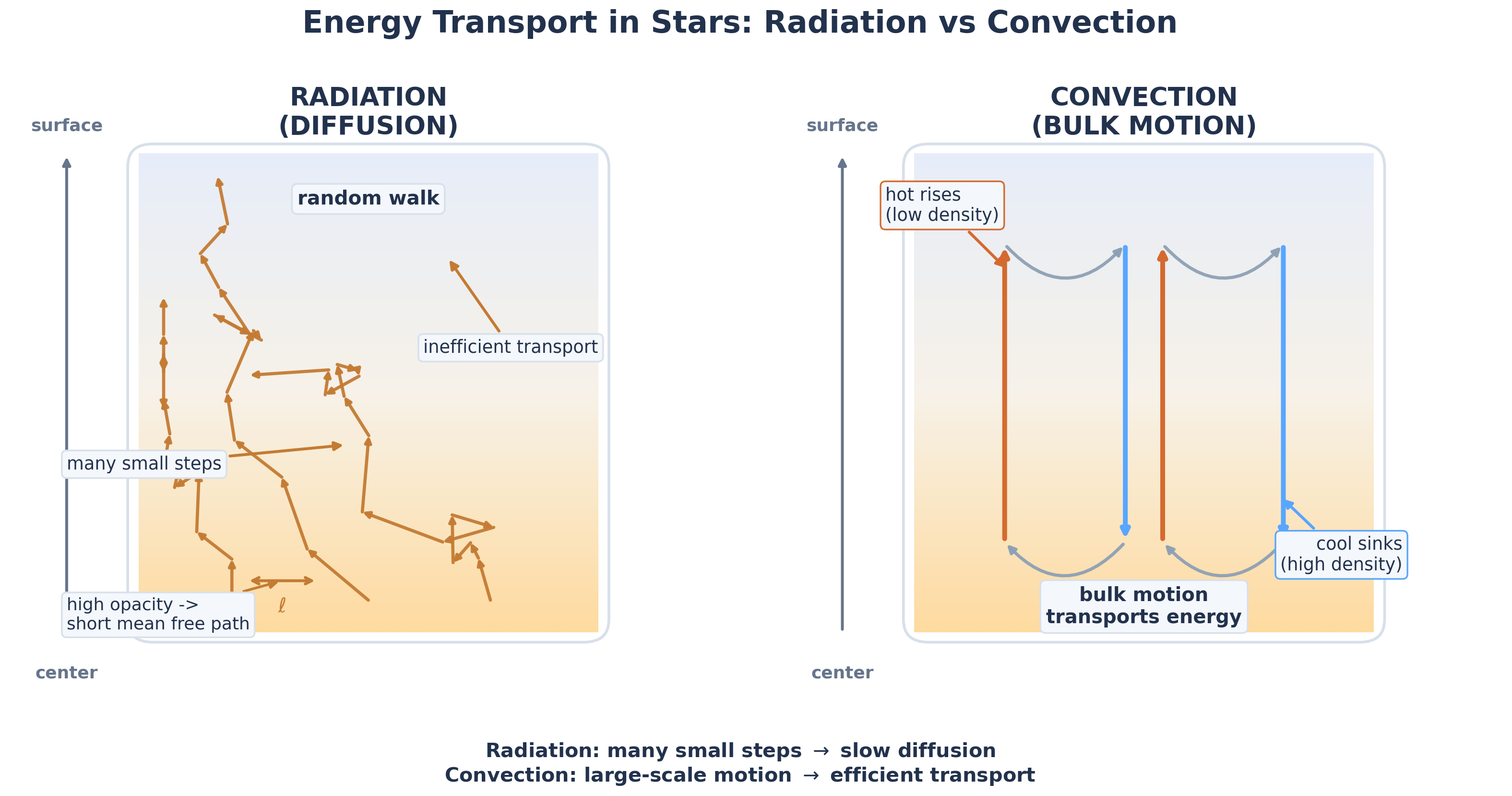
Compared mechanism to mechanism — radiation makes many tiny random-walk steps, convection moves energy by large-scale motion — convection transports energy much more efficiently where diffusion struggles. Conceptually: if radiation can carry the luminosity the star stays radiative; if it struggles, the gradient steepens; if the gradient becomes too steep, the fluid becomes unstable and convection turns on.
The Schwarzschild criterion
Make the buoyancy argument quantitative. Displace a blob of gas upward by and let it stay in pressure balance with its new surroundings while expanding adiabatically — it rises too fast to exchange heat. The blob keeps going — the layer is unstable to convection — only if it remains less dense than the gas around it after the nudge. At fixed pressure, lower density means higher temperature, so the instability condition is that the surroundings cool faster with height than the adiabatic blob does:
written compactly with the logarithmic gradient . For an ideal monatomic gas is essentially fixed, while the radiative gradient is whatever slope diffusion must adopt to carry the luminosity. From the diffusion law, grows with and with the local luminosity-to-mass ratio . So convection switches on exactly where the required radiative gradient is forced past the adiabatic value — in high-opacity zones (cool stellar envelopes) and where energy generation is fiercely concentrated (the CNO-burning cores of massive stars, Reading 3).
Name the assumption. This criterion assumes the displaced blob exchanges no heat (perfectly adiabatic), stays in instantaneous pressure equilibrium, and meets no composition gradient — refinements that real stellar-structure codes restore one at a time.
Quick check
If opacity increases in some region of a star, does radiative transport become easier or harder? What must happen to the temperature gradient? Would this make convection more or less likely? Explain in words.
Higher opacity makes radiative transport harder, so the temperature gradient must steepen to carry the same luminosity. A steeper gradient is more likely to exceed the stability threshold, making convection more likely.
| Mechanism | How Energy Moves | When It Dominates |
|---|---|---|
| Radiation | Diffusion of photons | Low opacity / gentle gradients |
| Convection | Bulk fluid motion | High opacity / steep gradients |