Radiation Transport
Complete lesson
Why Stars Are Opaque
By the end of this reading, you will be able to:
Guiding question: if photons move at the speed of light, why does energy released in the solar core take roughly years to leak out?
Reading 3 answered the energy-generation question: fusion releases energy in the core. This reading answers a different one: how does that energy get out? The logic chain is the spine of the topic: matter blocks radiation, so stars are opaque; opacity and density set the photon mean free path; a tiny mean free path turns transport into a random walk; random walks are inefficient, so energy diffuses outward slowly; if diffusion becomes too inefficient, convection carries energy by bulk motion; and the same radiation field carries momentum, so radiation pressure can compete with gravity in luminous stars.
The Sun's luminosity is steady, but its energy is made deep in the core
A constant on human timescales, powered by fusion far below the surface.
An optically thick interior — transport as a random walk
Photons interact repeatedly through absorption and scattering, so energy transport becomes a random walk describable macroscopically by radiative diffusion.
Energy diffuses out over ~10^5 years
Energy does not stream outward at across the star; it diffuses through an enormous number of interactions, giving a transport time of order years.
Part 1: Why Stars Are Opaque
The travel-time paradox
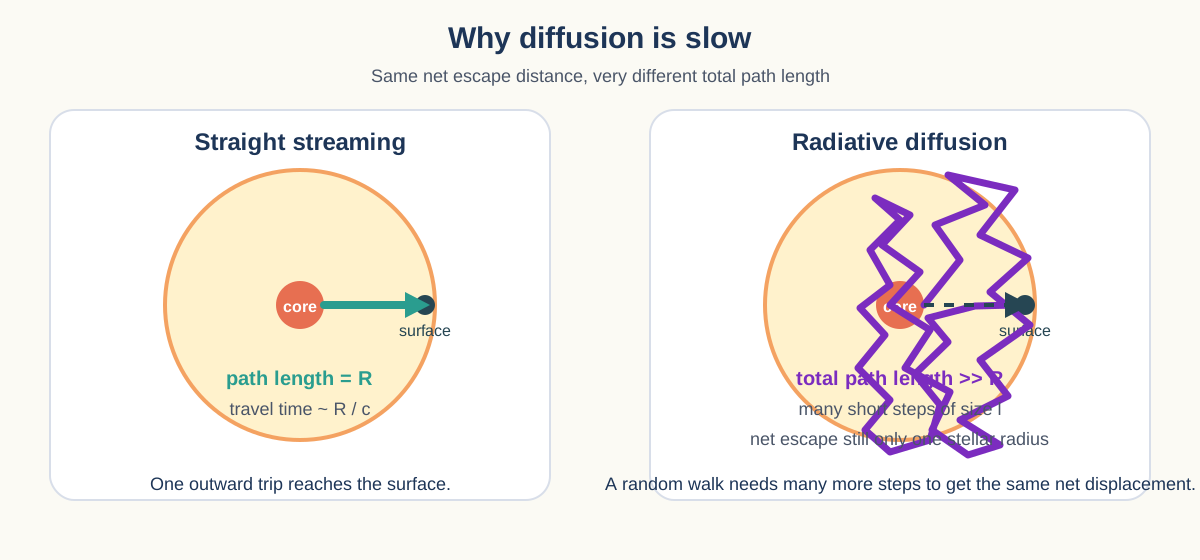
Start with the wrong model on purpose. If the Sun were transparent, energy from the core would stream straight to the surface in . That is obviously not how a real star works. The missing physics is opacity.
Opacity: how effectively matter blocks radiation
The
Opacity
A measure of how strongly matter absorbs or scatters radiation per unit mass, (units ). Larger opacity means a shorter photon mean free path and more resistance to radiative energy flow.
| Opacity Source | Physical Process | Dominates When |
|---|---|---|
| Electron scattering (Thomson) | Free electrons deflect photons | Hot, fully ionized gas |
| Bound-free absorption | Photon ionizes an atom | Moderate ; partially ionized gas |
| Free-free absorption (bremsstrahlung) | Photon interacts during an electron-ion encounter | Ionized gas, wide range of conditions |
| Bound-bound absorption | Photon excites an atomic transition | Lower ; partially ionized gas |
For a fully ionized hydrogen-rich plasma, the cleanest baseline is electron scattering: with the hydrogen mass fraction — the standard one-zone baseline for the solar interior.
Optical depth: how many mean free paths thick is the star?
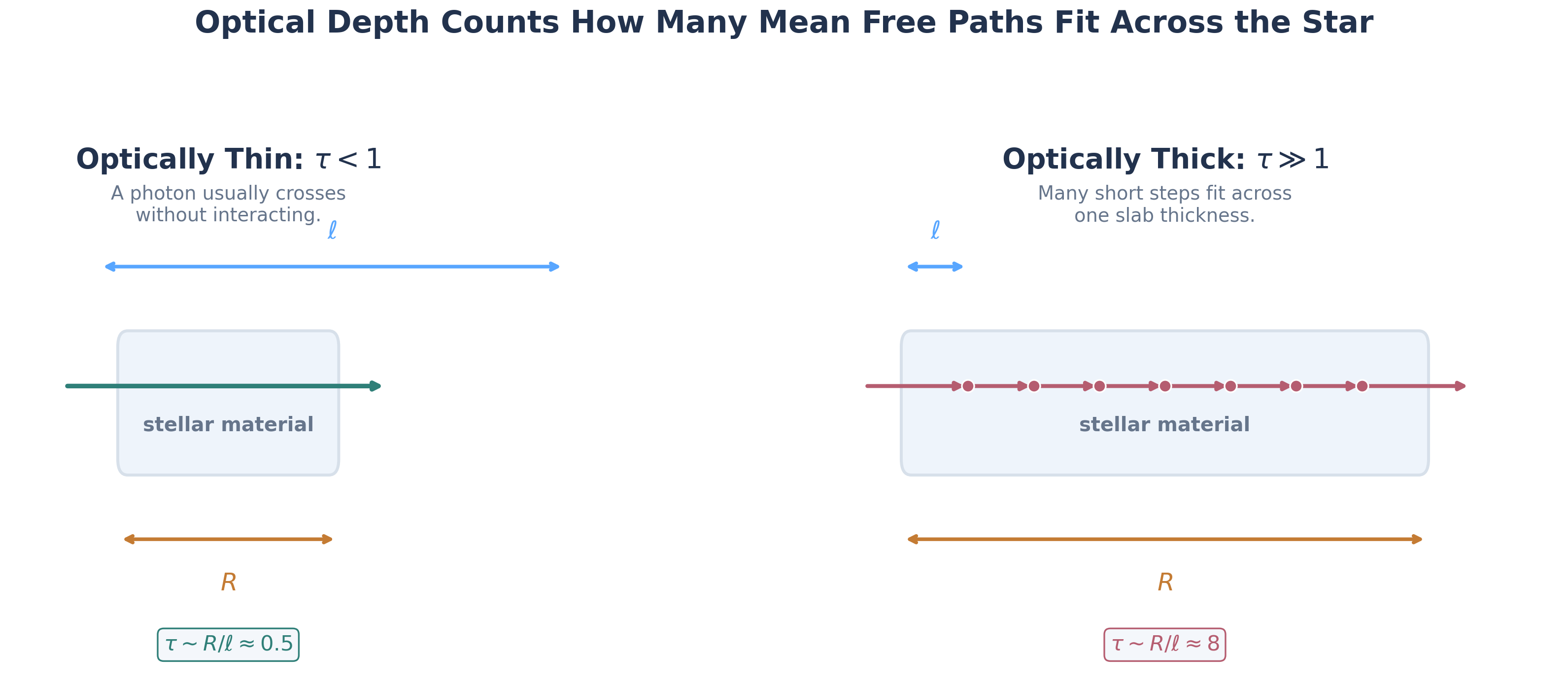
Combine opacity with density. The optical-depth increment is ; integrating across a region of size gives the
Optical depth
The dimensionless thickness of a medium in mean free paths, . is optically thin (photons stream freely); is optically thick (photons interact many times).
Quick check
Suppose a star becomes denser while its opacity stays the same. (1) Does the mean free path get longer or shorter? (2) Does the optical depth get larger or smaller? (3) Should energy escape more easily or less easily?
With , increasing at fixed makes shorter, while gets larger. The medium becomes more optically thick, so radiation escapes less easily.
The Mean Free Path
Part 2: The Mean Free Path — How Far a Photon Travels
Start microscopically. If a photon moves through targets of number density , each with cross section , the
Higher density means more targets per volume; higher opacity means more effective targets per gram. Both shorten the distance a photon travels before interacting.
Mean free path
The average distance a photon travels between interactions, — about in the solar core. When , radiation cannot stream out; it diffuses.
Problem
Use one-zone solar-core values and to find the mean free path, and compare it to the solar radius.
StepCompute the mean free path
StepCount mean free paths across the Sun
Dimensional check
, so ✓.
Result
A photon travels only ~0.2 mm between interactions, and the Sun is mean free paths thick — not just opaque, but enormously optically thick. The crucial result is : the diffusion regime.
Quick check
Suppose doubles while stays fixed. (1) What happens to ? (2) To across the same star? (3) Does diffusion become faster or slower?
(the step size halves); doubles. Transport becomes slower — smaller steps through a more optically thick medium.
The Random Walk
Part 3: The Random Walk — Why It Takes Hundreds of Thousands of Years
A photon does not travel radially outward in one path. After each interaction, the next step goes in a new direction — a
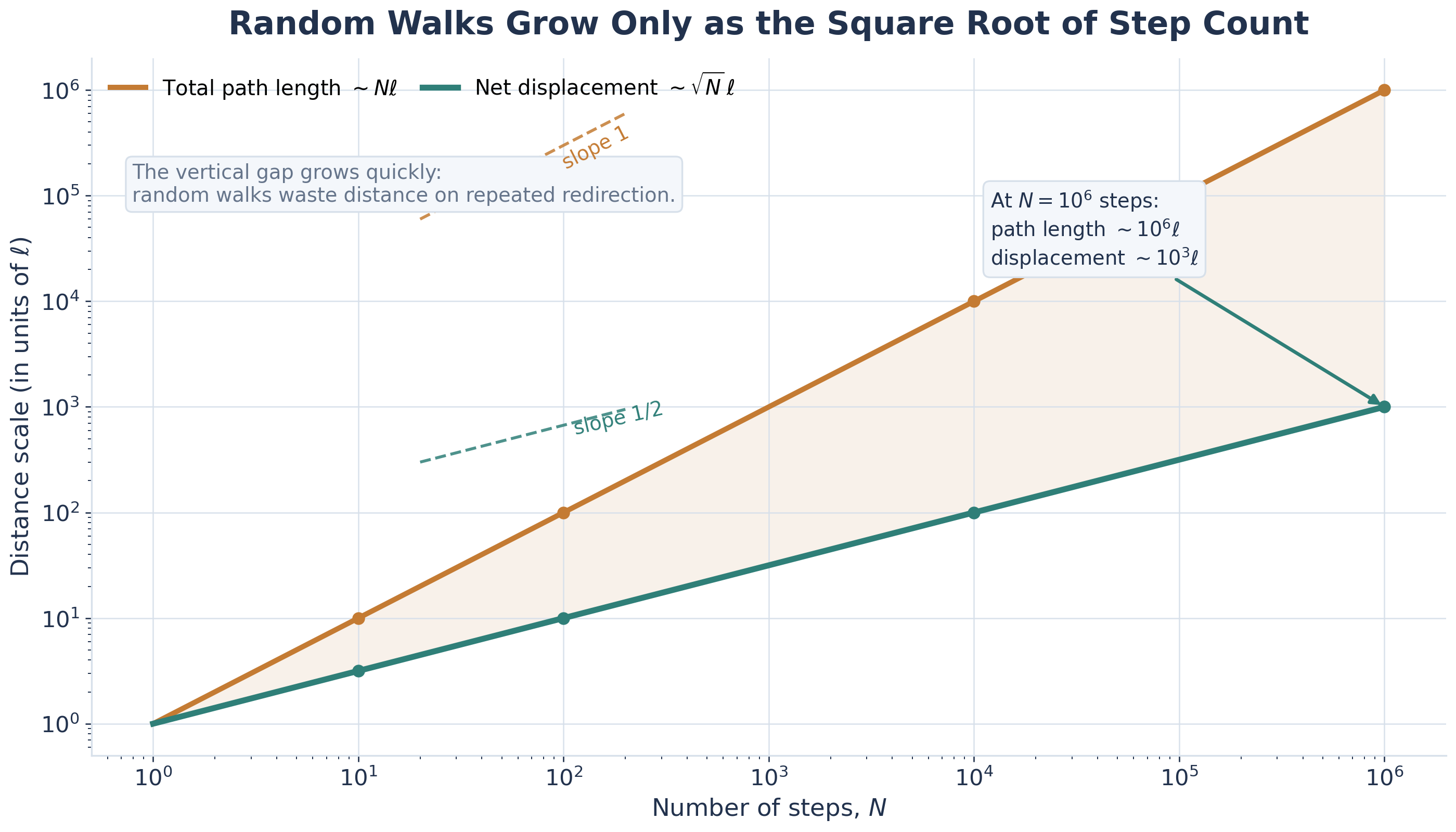
The total path length is , but the net outward displacement is only . So to cross a distance requires steps.
Random walk
A path of many steps each taken in an independent random direction. The net displacement grows only as (not ), which is why crossing a distance needs steps and makes radiative transport slow.
Problem
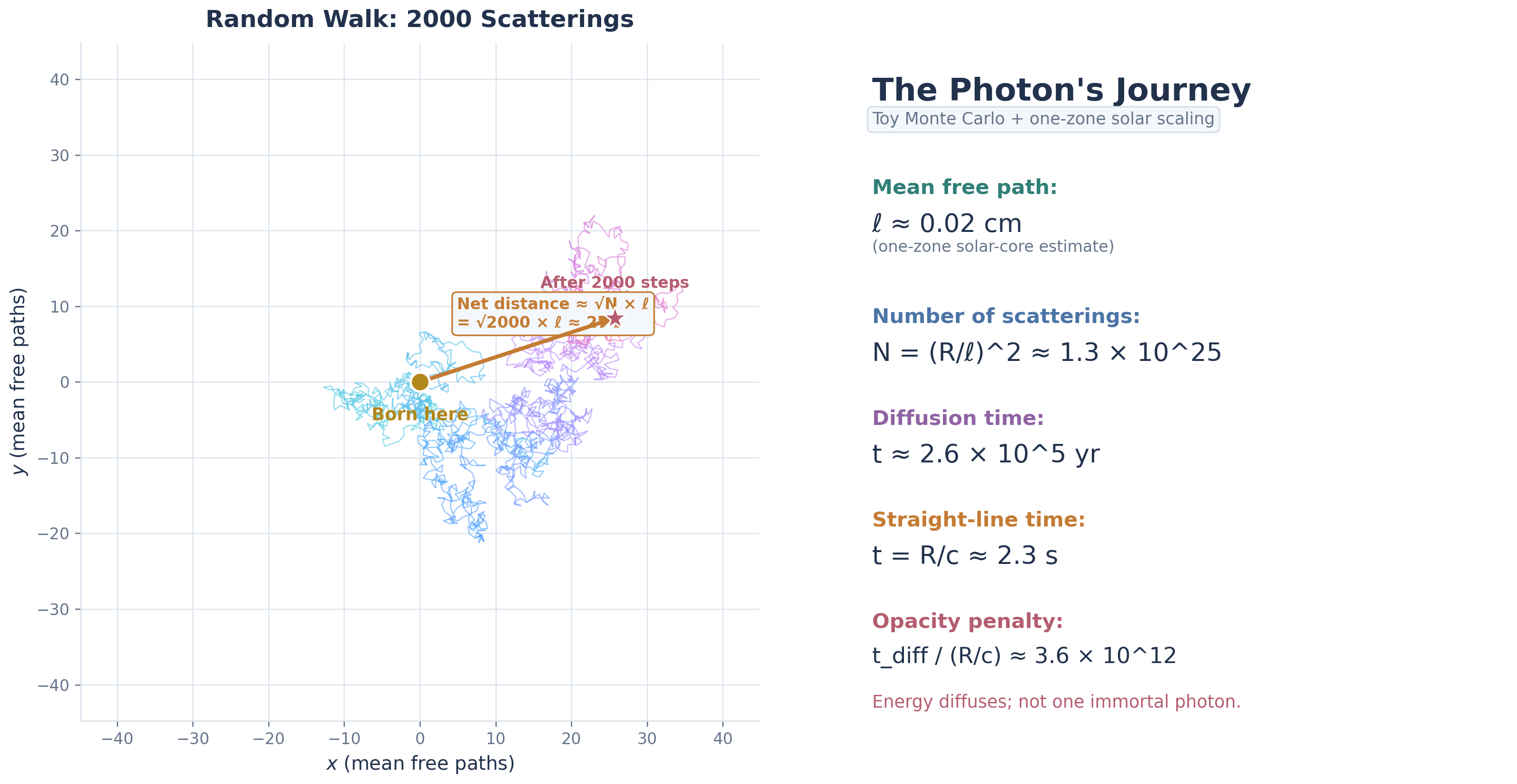
Use and to estimate the number of scatterings and the diffusion time.
StepNumber of steps to cross the Sun
StepDiffusion time (each step takes ell/c)
Dimensional check
✓.
Result
About scatterings and — the right order of magnitude. More realistic stratified models stay in the same -year range.
A useful alternate form: since , the diffusion time is . Here is the straight-line crossing time and is how many mean-free-path layers thick the star is — an optically thick star multiplies the crossing time by an enormous factor.
Problem
Use . (1) If decreases by a factor of 10, what happens to ? (2) If doubles while stays fixed?
Since , a 10× smaller makes it ten times longer. Since , doubling makes it four times longer.
Radiative Diffusion
Part 4: Radiative Diffusion — Energy Flow as a Leaking Fog
The random walk tells us why transport is slow; stellar structure needs a law for how much luminosity a temperature gradient can carry. A thermal radiation field has energy density (with ). If the interior is hotter than the exterior, decreases outward, and that gradient drives a net outward flux:
A steeper temperature gradient drives a larger flux; higher opacity or density suppress it; the minus sign means energy flows from hot to cool. Opacity acts like a resistance to energy flow — this is
Radiative diffusion
Energy transport by photons random-walking down a temperature gradient through an optically thick medium. The diffusive flux is — throttled by opacity, driven by the gradient.
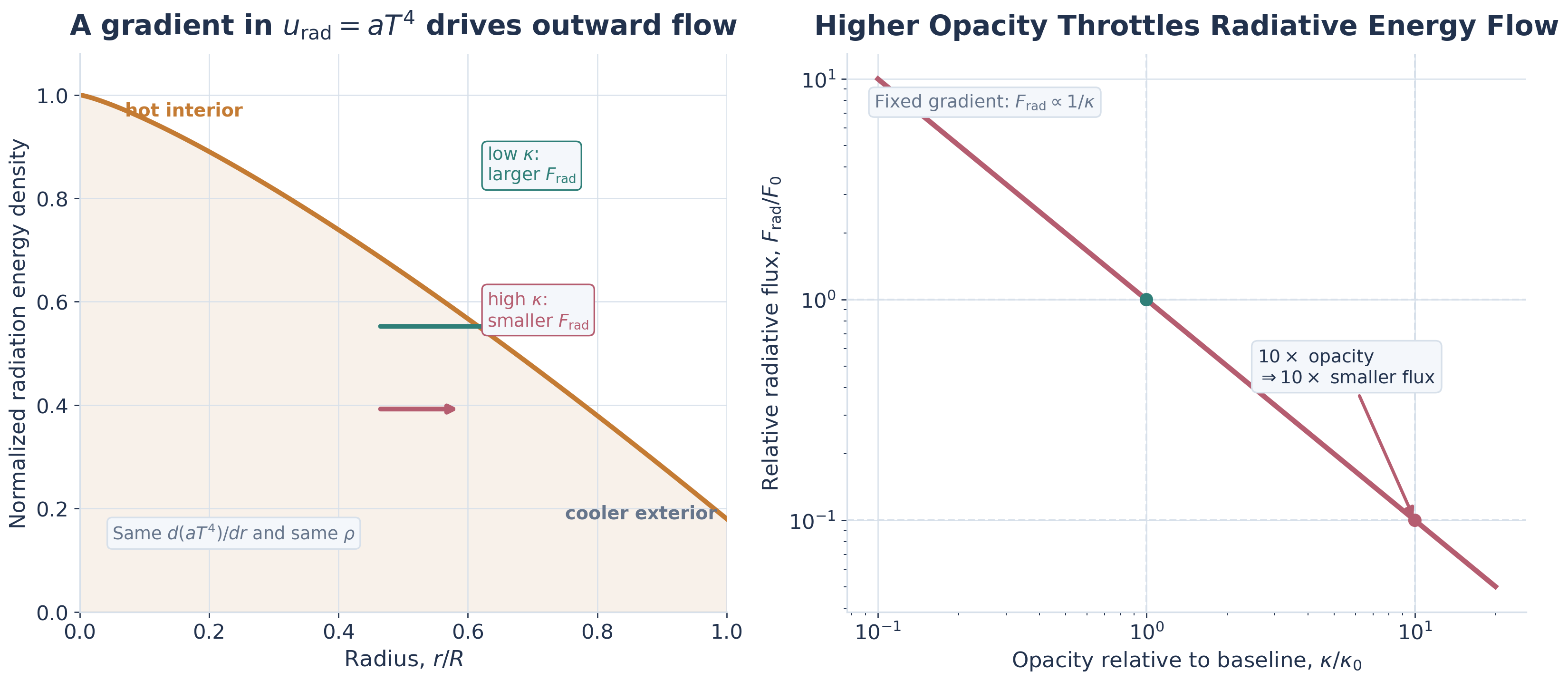
Luminosity is flux times area, :
This treatment assumes the medium is optically thick, in local thermodynamic equilibrium, radiation-dominated, and close to isotropic.
Reading the Math: the diffusion luminosity
The flux law carries a derivative, , so we run the signature move again — now on the temperature profile — and read off how a star’s luminosity scales with its mass and radius.
① Approximate the derivative. Temperature falls from at the center to essentially nothing at the surface over a distance :
The coefficient out front, , is the radiative diffusion coefficient — Part 2’s tiny mean free path in one symbol. A small makes small, which is the random walk of Part 3.
② Extract the scaling. Substitute into , form the luminosity , and replace :
Read the exponents — but note is not free. Reading 5 substitutes the hydrostatic core temperature ; the four factors of cancel and one power of survives, leaving the headline mass–luminosity law . Hydrostatic equilibrium (Reading 2) built the first half of that result; this diffusion law is the second.
③ Name the assumption. The audit gains a transport row:
| We assumed | by replacing | What it costs |
|---|---|---|
| one temperature scale | , with | a scale, not the profile — fine for the exponents |
| constant opacity | real bends the slope of | |
| mean density | the same central-concentration error as Reading 2 | |
| optically thick + LTE | the diffusion approximation itself | fails in the thin outer layers, where transport is not diffusive |
Same deal as Reading 2: right exponents, approximate coefficient. The scaling is robust; the prefactor needs the true opacity and structure.
At fixed luminosity, high opacity makes radiative transport less efficient, so the star needs a steeper temperature gradient to carry the same energy. If the required gradient becomes too steep, radiation is no longer the preferred mechanism and convection can take over.
Multiple choice
At some radius, is fixed but increases by a factor of 10. To carry the same luminosity, what must the temperature gradient do?
Larger suppresses the flux, so transport becomes harder. To carry the same , the temperature gradient must become steeper.
The Sun's luminosity and surface temperature
and , both steady.
Radiative diffusion through an optically thick interior
The flux is set by the temperature gradient and opacity; opacity controls how hard energy is to move.
Luminosity and fusion rate are self-regulated
Opacity controls how hard it is for energy to escape; the fusion rate adjusts through the stellar thermostat until energy production matches energy loss.
When Radiation Is Not Enough
Part 5: When Radiation Isn’t Enough — Convection
Radiative diffusion has a built-in limit: photons move energy by many tiny random steps, high opacity makes those steps smaller, and energy flow becomes inefficient. To carry a fixed luminosity through a very opaque region, the star must steepen the temperature gradient. What if it becomes too steep?
Unlike photons, the stellar plasma is a fluid. A blob slightly hotter than its surroundings is less dense, so buoyancy pushes it upward, carrying energy; cooler, denser gas sinks. This circulating flow is
Convection
Energy transport by the bulk motion of fluid, driven by buoyancy: hot material rises, cool material sinks, and energy is carried by moving matter rather than diffusing radiation. It takes over where the radiative temperature gradient would be too steep to be stable.
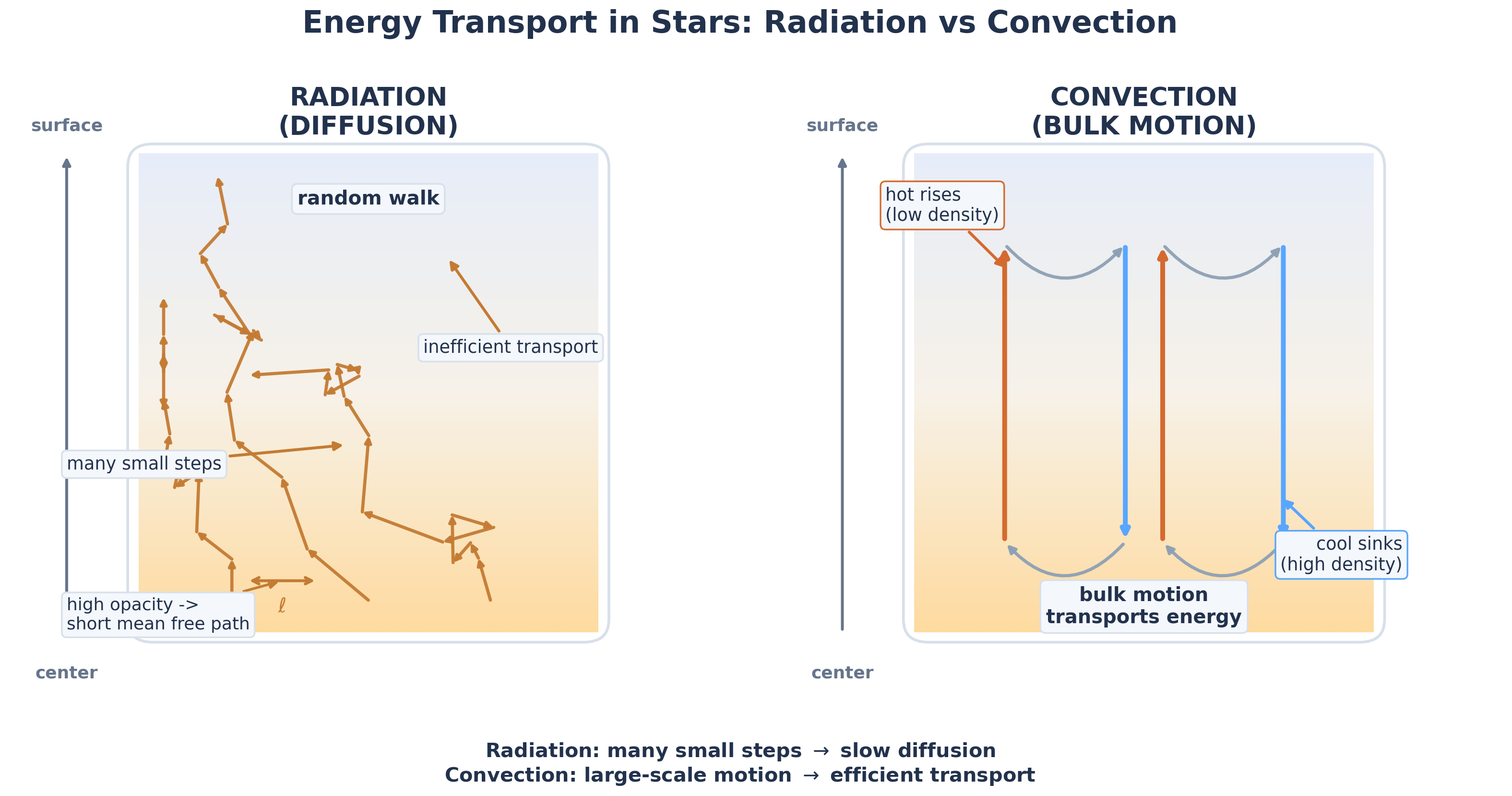
Compared mechanism to mechanism — radiation makes many tiny random-walk steps, convection moves energy by large-scale motion — convection transports energy much more efficiently where diffusion struggles. Conceptually: if radiation can carry the luminosity the star stays radiative; if it struggles, the gradient steepens; if the gradient becomes too steep, the fluid becomes unstable and convection turns on.
The Schwarzschild criterion
Make the buoyancy argument quantitative. Displace a blob of gas upward by and let it stay in pressure balance with its new surroundings while expanding adiabatically — it rises too fast to exchange heat. The blob keeps going — the layer is unstable to convection — only if it remains less dense than the gas around it after the nudge. At fixed pressure, lower density means higher temperature, so the instability condition is that the surroundings cool faster with height than the adiabatic blob does:
written compactly with the logarithmic gradient . For an ideal monatomic gas is essentially fixed, while the radiative gradient is whatever slope diffusion must adopt to carry the luminosity. From the diffusion law, grows with and with the local luminosity-to-mass ratio . So convection switches on exactly where the required radiative gradient is forced past the adiabatic value — in high-opacity zones (cool stellar envelopes) and where energy generation is fiercely concentrated (the CNO-burning cores of massive stars, Reading 3).
Name the assumption. This criterion assumes the displaced blob exchanges no heat (perfectly adiabatic), stays in instantaneous pressure equilibrium, and meets no composition gradient — refinements that real stellar-structure codes restore one at a time.
Quick check
If opacity increases in some region of a star, does radiative transport become easier or harder? What must happen to the temperature gradient? Would this make convection more or less likely? Explain in words.
Higher opacity makes radiative transport harder, so the temperature gradient must steepen to carry the same luminosity. A steeper gradient is more likely to exceed the stability threshold, making convection more likely.
| Mechanism | How Energy Moves | When It Dominates |
|---|---|---|
| Radiation | Diffusion of photons | Low opacity / gentle gradients |
| Convection | Bulk fluid motion | High opacity / steep gradients |
Radiation Pressure
Part 6: Radiation Pressure
Photons carry not only energy but momentum: . So when radiation is absorbed or scattered, it exerts a force on matter. In an isotropic thermal radiation field, the
This is why radiation transport is also a force problem.
Radiation pressure
The pressure exerted by a photon field through its momentum, for an isotropic thermal field. It grows as — negligible in the Sun, but dominant in very massive, hot stars.
Problem
Compare with the ideal-gas pressure at the solar core (, , mean molecular weight ).
StepRadiation pressure
StepGas pressure
Dimensional check
Both reduce to (a pressure) ✓.
Result
— radiation pressure is tiny in the Sun. But while (at fixed ), so radiation pressure grows far faster with temperature — which is why it dominates in very massive stars.
Deriving the Eddington luminosity
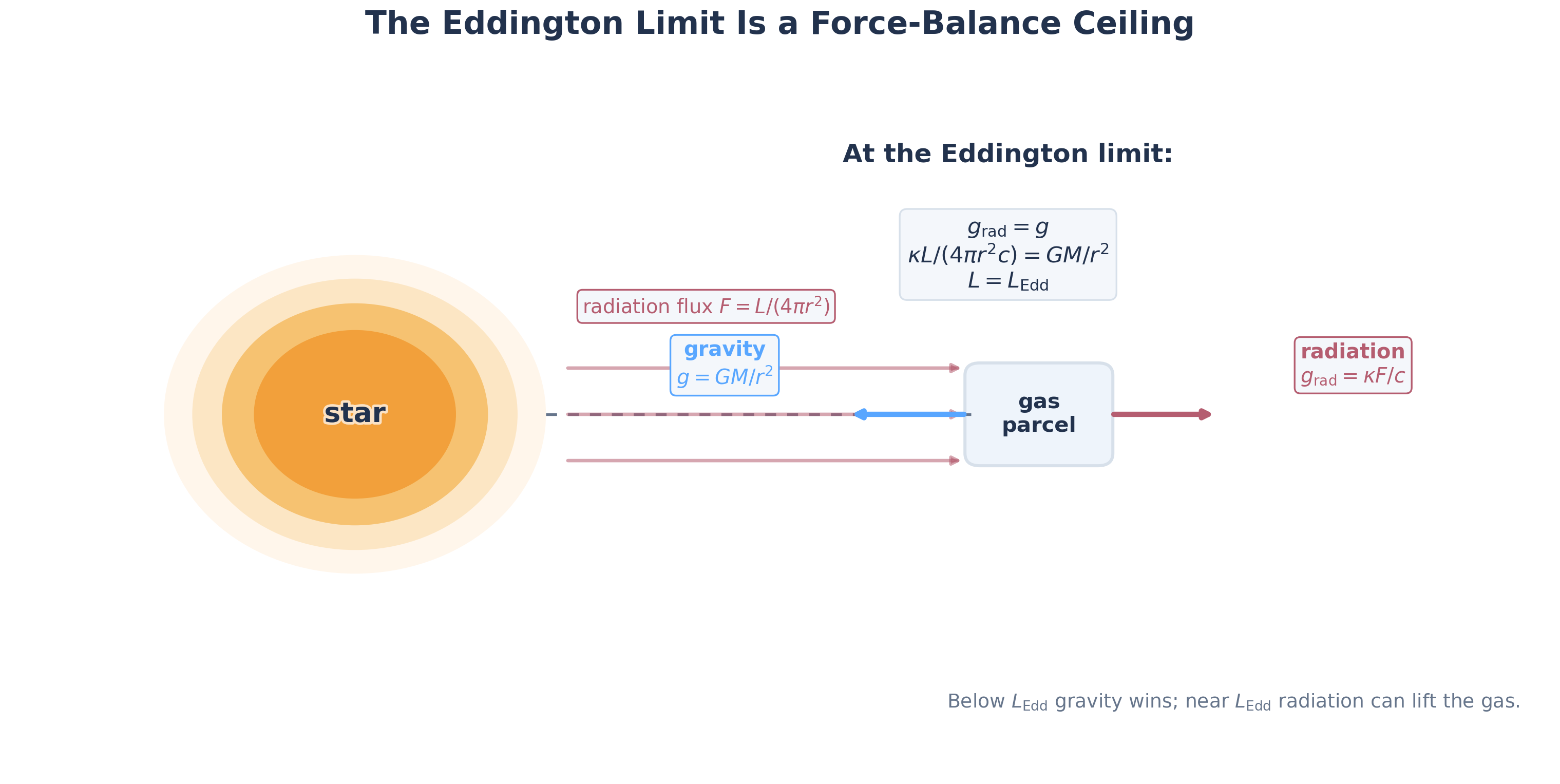
How luminous can a star become before radiation pushes outward as strongly as gravity pulls inward? Assume spherical symmetry, steady state, and electron-scattering opacity. The outward radiative acceleration on a shell is ; the inward gravitational acceleration is . Setting them equal (the cancels) gives the
A force-balance ceiling: below gravity wins; near it, radiation reshapes the envelope and drives strong winds; above it, hydrostatic balance becomes very hard to maintain.
Eddington luminosity
The luminosity at which radiation’s outward force balances gravity, (about for the Sun). A structural ceiling, not a hard cutoff — stars near it drive winds and instabilities.
Problem
Compute for the Sun with , .
StepPlug into 4πGMc/κ
Dimensional check
✓.
Result
. The Sun is far below this, so radiation pressure is dynamically negligible for solar structure — but massive stars come much closer because their luminosities rise faster than linearly with mass.
Problem
. (1) At fixed opacity, if stellar mass doubles, what happens to ? (2) Why do the most massive stars come closest to this limit even though rises with mass?
At fixed , , so doubling the mass doubles it. But the most massive stars still come closest because their actual luminosities rise much faster than linearly with mass, so catches up to as mass increases.
Reference and Synthesis
Reference Tables
Radiation Transport at a Glance
| Quantity | Formula | Sun Value |
|---|---|---|
| Opacity (electron scattering) | ||
| Mean free path (core) | ||
| Number of scatterings | ||
| Optical depth | ||
| Photon diffusion time | ||
| Radiation pressure (core) | ||
| Pressure ratio | ||
| Eddington luminosity |
Symbol Legend
| Symbol | Meaning | CGS Units |
|---|---|---|
| Opacity (cross-section per unit mass) | ||
| Mass density | ||
| Mean free path | cm | |
| Optical depth | dimensionless | |
| Number of scatterings | dimensionless | |
| Radiative flux | ||
| Radiation constant | ||
| Radiation pressure | ||
| Mean molecular weight | dimensionless |
Summary: Energy’s Tortuous Journey
- Stars are opaque — the photon mean free path in the solar core is , about a hundred billion times smaller than the solar radius.
- The random walk explains the diffusion time: a one-zone estimate gives , and realistic models stay in the same -year range.
- Radiative diffusion transports energy down the temperature gradient; the random walk explains why it is slow, the diffusion equation how much luminosity a gradient can carry.
- Convection takes over when radiative diffusion becomes too inefficient — energy is then carried by rising and sinking fluid.
- Radiation pressure () is negligible in the Sun but grows as ; in very luminous stars it competes with gravity and sets the Eddington luminosity.
Photons move at , yet energy takes years to cross the Sun. In one sentence, where does the delay come from — and what would shorten it?
The delay comes from the random walk: a tiny mean free path () means crossing the Sun takes steps, so . Lowering the opacity or density would lengthen , cut the number of steps, and shorten the diffusion time.
Glossary
- Convection
Energy transport by the bulk motion of fluid, driven by buoyancy: hot material rises, cool material sinks, and energy is carried by moving matter rather than diffusing radiation. It takes over where the radiative temperature gradient would be too steep to be stable.
- Eddington luminosity
The luminosity at which radiation’s outward force balances gravity, (about for the Sun). A structural ceiling, not a hard cutoff — stars near it drive winds and instabilities.
- Mean free path
The average distance a photon travels between interactions, — about in the solar core. When , radiation cannot stream out; it diffuses.
- Opacity
A measure of how strongly matter absorbs or scatters radiation per unit mass, (units ). Larger opacity means a shorter photon mean free path and more resistance to radiative energy flow.
- Optical depth
The dimensionless thickness of a medium in mean free paths, . is optically thin (photons stream freely); is optically thick (photons interact many times).
- Radiation pressure
The pressure exerted by a photon field through its momentum, for an isotropic thermal field. It grows as — negligible in the Sun, but dominant in very massive, hot stars.
- Radiative diffusion
Energy transport by photons random-walking down a temperature gradient through an optically thick medium. The diffusive flux is — throttled by opacity, driven by the gradient.
- Random walk
A path of many steps each taken in an independent random direction. The net displacement grows only as (not ), which is why crossing a distance needs steps and makes radiative transport slow.